Chaetomys subspinosusbristle-spined rat
Geographic Range
Chaetomys subspinosus live in northern and central Brazil.
- Biogeographic Regions
- neotropical
Habitat
Thin-spined Porcupines mostly live in the trees of dense vegetated forests and bush regions around savannas and cultivated areas.(Stahnke and Hendrichs, 1990)
- Habitat Regions
- tropical
- Terrestrial Biomes
- forest
Physical Description
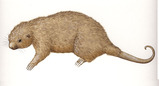
Chaetomys subspinosus weigh about 1300 grams and have a head to body length of 380-457mm with a tail length of 255-280mm. Color is mostly brownish, but sometimes grey. Unlike most other porcupines, Thin-spined Porcupines have hairs that resemble bristles more than spines. However, neck, head, and forelimb regions contain spinelike hairs that are less flexible compared to those on the rest of the body. The feet and tail are dark brown to black. The tail itself is long and scaly, but arguably not prehensile. The hands and feet all have 4 digits containing long, curved claws (Nowak, 1999).
- Other Physical Features
- endothermic
- bilateral symmetry
-
- Average mass
- 1.300 kg
- 2.86 lb
-
- Range length
- 380 to 457 mm
- 14.96 to 17.99 in
Reproduction
Female Thin-spined Porcupines are sexually active for one month of the year. Sexual selection of a mate is suggested to be based on the male's size and density of his quills. A female who doesn't want to mate with a certain male leaves her heavily quilled tail down so the male can not have access (Dworetzky, 1998).
- Key Reproductive Features
- gonochoric/gonochoristic/dioecious (sexes separate)
- sexual
- Parental Investment
- precocial
Behavior
Thin-spined Porcupines are slow movers, but are able to jump and climb quickly in the tress if needed. During the day they sleep in hollow tree trunks, nests, or ground holes under rocks (Wolkomir and Wolkomir, 1993-4).
Communication and Perception
Food Habits
Chaetomys subspinosus are mostly fruit and nut eaters. They generally like to live in the area of cocoa trees, where there is an ample supply of nuts (Nowak, 1999).
Conservation Status
Chaetomys subspinosus reside only in a small area of Brazil, where its habitat is slowly being taken away by deforestation, industry, and agriculture. Numbers may be declining, but since Thin-spined Porcupines have the ability to live on forest edges, they might not be as vulnerable (Nowak, 1999).
-
- IUCN Red List
-
Vulnerable
More information
-
- IUCN Red List
-
Vulnerable
More information
-
- CITES
- No special status
Contributors
James Kyle (author), University of Michigan-Ann Arbor, Ondrej Podlaha (editor), University of Michigan-Ann Arbor.
Glossary
- Neotropical
-
living in the southern part of the New World. In other words, Central and South America.

- bilateral symmetry
-
having body symmetry such that the animal can be divided in one plane into two mirror-image halves. Animals with bilateral symmetry have dorsal and ventral sides, as well as anterior and posterior ends. Synapomorphy of the Bilateria.
- chemical
-
uses smells or other chemicals to communicate
- endothermic
-
animals that use metabolically generated heat to regulate body temperature independently of ambient temperature. Endothermy is a synapomorphy of the Mammalia, although it may have arisen in a (now extinct) synapsid ancestor; the fossil record does not distinguish these possibilities. Convergent in birds.
- forest
-
forest biomes are dominated by trees, otherwise forest biomes can vary widely in amount of precipitation and seasonality.
- frugivore
-
an animal that mainly eats fruit
- granivore
-
an animal that mainly eats seeds
- herbivore
-
An animal that eats mainly plants or parts of plants.
- motile
-
having the capacity to move from one place to another.
- native range
-
the area in which the animal is naturally found, the region in which it is endemic.
- nocturnal
-
active during the night
- sexual
-
reproduction that includes combining the genetic contribution of two individuals, a male and a female
- tactile
-
uses touch to communicate
- tropical
-
the region of the earth that surrounds the equator, from 23.5 degrees north to 23.5 degrees south.
- young precocial
-
young are relatively well-developed when born
References
Dworetzky, T. 1998. How does a Female Porcupine Select a Mate?. National Wildlife, 36: 12.
Nowak, R. 1999. Thin-spined "Porcupine". Pp. 1700-1702 in Walker's Mammals of the World. Baltimore and London: The John Hopkins University Press.
Stahnke, A., H. Hendrichs. 1990. Tree Porcupines. Pp. 315 & 352-353 in Grzimek's Encyclopedia of Mammals. New York: McGraw-Hill Publishing Company.
Wolkomir, R., J. Wolkomir. Dec 93/Jan94. Prying into the Life of a Prickly Beast. National Wildlife, 32: 34-39.