Cetorhinus maximusbasking shark(Also: Bone shark)
Geographic Range
Basking sharks (Cetorhinus maximus) have a wide geographic range and are most commonly found in temperate and boreal waters. In the Northern Hemisphere, basking sharks have been observed in the North Pacific Ocean, off the coast of Japan, as well as off the coast of China. This species has also been found inhabiting the North Atlantic Ocean and the Arctic Ocean. They have been found off the North Cape of Norway and off the coast of Russia. In the Southern Hemisphere, basking sharks have been reported off the coast of Brazil as well as near South Africa in the southern Atlantic Ocean. Basking sharks mostly inhabit neuritic zones (shallow areas on the continental shelf) during the summer, however they migrate to the offshore continental shelf during the winter. (Fowler, 2005; Hoelzel, et al., 2006; Siders, et al., 2013)
- Biogeographic Regions
- ethiopian
- neotropical
- oceanic islands
- atlantic ocean
- pacific ocean
Habitat
Basking sharks are a pelagic fish that inhabit a wide range of depths - from 200 to 2,000 m. They are usually found in subpolar and temperate waters moving south during the winter months (December to February). As the name states, basking sharks are commonly found at depths where sunlight reaches, usually dwelling in surface waters. They migrate inland to mate and feed during the summer. Throughout the year, basking sharks inhabits waters between 8 to 14°C. (Castro, 2011; Cotton, et al., 2005; Sims, et al., 2005)
- Habitat Regions
- temperate
- polar
- saltwater or marine
-
- Range depth
- 200 to 2000 m
- 656.17 to 6561.68 ft
Physical Description
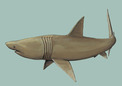
Basking sharks are the second largest shark in the world, with an average adult size of 7 to 8 m in length, but occasionally adults reach 9 to 11 m. They have an average mass of 3,900 kg, and males are larger than females. Basking sharks have conical snouts and large gill slits behind their mouths that almost encircle their heads. On the front area of each gill arch, basking sharks have gill rankers ranging from 10 to 12 cm long. They have strong caudal keels located on their caudal peduncles, followed by crescent-shaped caudal fins.
Basking sharks have small teeth, just 3 to 4 mm long. Adult basking sharks have as many as 1,200 teeth, each with a single conical cusp in six rows in the upper and lower jaw. These sharks are grayish brown to black with pale white on their undersides, although mutations can cause blotchy areas. Two albino specimens have been reported in North Atlantic waters. (Castro, 2011; Parker and Stott, 1965)
- Other Physical Features
- ectothermic
- bilateral symmetry
- Sexual Dimorphism
- male larger
-
- Average mass
- 3900 kg
- 8590.31 lb
-
- Average mass
- 2.2e+06 g
- 77533.04 oz
- AnAge
-
- Range length
- 11 (high) m
- 36.09 (high) ft
-
- Average length
- 7 m
- 22.97 ft
Development
Basking sharks have a somewhat different ovary compared to other elasmobranchs. As female basking sharks reach sexual maturity, their ovaries begin to produce large amounts of small eggs, which contain a small amount of yolk. Their eggs closely resemble that of bony fish eggs. Females lay approximately 6 million small eggs averaging 2 mm in diameter. As these eggs begin to mature, they move through a system of narrow, complex canals leading towards the uterus. Baskings sharks have large uteri lined with thousands of threadlike projections called trophonemata. These help nourish embryos after fertilization, as in every other viviparous elasmobranch. These newly-fertilized embryos develop into juvenile basking sharks, then feed on unfertilized eggs in utero until it is time for female basking sharks to deliver their pups. (Matthews, 1962)
Reproduction
Basking sharks move into coastal areas during the breeding season (May to July). Once inshore, basking sharks begin courtship behaviors. This species is polygynandrous, meaning both females and males have multiple mates. Very little is known about courtship behavior in sharks, especially pelagic species. As of today, 380 shark species have been discovered, but only nine species have been studied for their courtship, pairing, copulation, and post-copulatory behaviors. Females basking shark shave been observed breaching, giving a small insight on the behaviors involved in selecting mates. Breaching occurs when females leap meters out of the water then land, elaborately creating an outward surge of water. Scientists have determined this behavior is one way females attract males. this breaching behavior demonstrates that female basking sharks are ready to mate. (Matthews, 1950; Sims, et al., 2000)
- Mating System
- polygynandrous (promiscuous)
Males have a breeding season from May to July. It is demonstrated that basking sharks are ovoviviparous which means pups hatch from eggs while still inside their mother’s womb, then proceed to develop before being born. Embryos are completely nourished by the yolk in their eggs. As embryos develop into juvenile basking sharks and hatch, these infant basking sharks feed upon unfertilized eggs in utero.
At birth, basking shark pups have an average size of 2 m and immediately swim away from their mother. As development continues, sexual maturity is obtained when males reach 4.6 to 6.1 m – around 8 years old. Females reach maturity at 8.1 to 9.8 m, or after about 11.5 years.
Female gestation times last about three years, based on vertebral ring count. It is believed female basking sharks live somewhat hidden lifestyles for three consecutive years. (Castro, 2011; Harvey-Clark, et al., 1999; Matthews, 1950; "The Marine Conservation Society Basking Shark Watch 20-year report (1987-2006)", 2006)
- Key Reproductive Features
- seasonal breeding
- sexual
- fertilization
- ovoviviparous
-
- Breeding interval
- Basking sharks breed once every year during the warmer months (May-July).
-
- Breeding season
- May-July
-
- Average number of offspring
- 4
-
- Average gestation period
- 36 months
-
- Average time to independence
- 1 minutes
-
- Average age at sexual or reproductive maturity (female)
- 11.5 years
-
- Average age at sexual or reproductive maturity (female)
Sex: female - 4197 days
- AnAge
- Average age at sexual or reproductive maturity (female)
-
- Average age at sexual or reproductive maturity (male)
- 8 years
-
- Average age at sexual or reproductive maturity (male)
Sex: male - 2920 days
- AnAge
- Average age at sexual or reproductive maturity (male)
As basking shark embryos develop in the wombs of females, nutrients are given through threadlike projections called trophonemata, which are used to nourish embryos after fertilization, as in every other viviparous elasmobranch (Elasmobranchii). After basking shark pups are delivered, they immediately swim away from their mothers. (Matthews, 1950; Sims, et al., 2000)
- Parental Investment
- no parental involvement
-
pre-hatching/birth
-
provisioning
- female
-
protecting
- female
-
provisioning
Lifespan/Longevity
Maximum lifespan of basking sharks in the wild is roughly 32 years. This number was obtained using vertebral ring counts. Parker and Stott (1965) found that basking sharks can reach the 32 vertebral ring count by an average age of 17.5 years. Researchers believe basking sharks gains two vertebral rings annually. There is no information available on basking shark longevity in captivity. (Carey and Judge, 2000; Parker and Stott, 1965)
-
- Range lifespan
Status: wild - 32 (high) years
- Range lifespan
-
- Average lifespan
Status: captivity - 32 years
- AnAge
- Average lifespan
Behavior
Basking sharks migrate mostly based on the abundance of plankton. In the North Atlantic Ocean, basking sharks migrate north while food resources remain high. As the amount of plankton begins decreases around the beginning of winter, basking sharks then move southward in search of new areas to feed. Basking sharks may migrate as far as the northern coast of South America as well as South Africa. Cotton et al. (2005) report that basking sharks have forging patterns based on thermal fronts. These thermal fronts are known to have high populations of zooplankton due to higher water temperatures.
Basking sharks have demonstrated a behavior known as breaching. Breaching happens when they leap out of the water, with reports of 182 cm distance between their tails and the ocean surface. This behavior is most commonly displayed during mating season, from May to July. It is thought that females do this to announce receptivity of mating. (Bres, 1993; Cotton, et al., 2005; Siders, et al., 2013; Sims, et al., 2006)
- Key Behaviors
- natatorial
- motile
- nomadic
- migratory
- social
Home Range
Home ranges have not been reported for this shark. They are not known to defend a territory. (Fowler, 2005; Hoelzel, et al., 2006; Siders, et al., 2013)
Communication and Perception
Not much is known about the perception and communication of basking sharks. Like other sharks, it is believed that they have keen chemoreceptors and electroreceptors around their snout, which they use to detect plankton. Their chemosensory detectors are believed to detect dimethyl sulfide released by phytoplantkon as they are eaten by larger predatory zooplankton. Basking sharks then feed on these larger zooplankton. Basking sharks demonstrate visual communication behaviors and breaching, which is used during the mating season to communicate to males that females are ready to mate. (Gore, et al., 2008; Kalmijn, 1971; Sims, et al., 2006)
Food Habits
Basking sharks are selective foragers, concentrating their feeing activity along thermal fronts with high densities of zooplankton. To feed, thes megaplanktivores swim with their mouths open, closing their jaws every 30 to 60 seconds. After collecting water, gill rakers filter the water through five large gills, capturing plankton. Basking sharks filter an average of 6,000 L of water per hour. Their stomach matter includes other small copepods such as Psuedocalanus and Oithona, but it is certain the basking shark is an indiscriminate plankton feeder. (Castro, 2011; Matthews and Parker, 1950; Sims, 1999; Sims, et al., 2005)
- Primary Diet
-
carnivore
- eats non-insect arthropods
- planktivore
- Animal Foods
- aquatic crustaceans
- zooplankton
- Foraging Behavior
- filter-feeding
Predation
Basking sharks have been noted to have one major predator: Homo sapiens (humans). Thousands of basking sharks are caught per year by fisheries around the world. There is also documentation of great white sharks (Carcharodon carcharias) feeding on carcasses of basking sharks, but it is unknown whether or not the basking sharks were killed by those great white sharks. (Stevens, et al., 2000)
- Anti-predator Adaptations
- cryptic
-
- Known Predators
Ecosystem Roles
Basking sharks have been known to leap out of the water in efforts to dislodge lampreys and copepods that attach themselves to these large sharks. These are the only parasitic relationships that have been noted among basking sharks. Basking sharks also have a mutualistic relationship with pilot fish (Carangidae). These fish swim alongside basking sharks and clean harmful parasites, such as the large copepods (Dinematura producta) from their bodies. (Cotton, et al., 2005; Matthews and Parker, 1950)
- Carangidae (pilot fish)
- copepods Dinematura producta
- lampreys, isopods
Economic Importance for Humans: Positive
Basking sharks have extremely large livers that makes up most of its mass. The livers of basking sharks hold useful oils that humans use. These oils are most commonly found in cosmetic supplies, such as lotions and hair products. Because this oil is economically important for the cosmetic industry, it has inevitably put the basking shark into a vulnerable state due to their increased capture rate by fisheries. (Castro, 2011)
- Positive Impacts
- food
- body parts are source of valuable material
Economic Importance for Humans: Negative
Basking sharks have hindered some fishery industries by becoming entangled in their nets, causing them to rip. This negatively impacts fisheries economically when each net is replaced. (Castro, 2011)
Conservation Status
As a large, slow moving, surface-feeding species, basking sharks normally come into contact with humans. This contact has increased the mortality of basking sharks due to the commercial fishery harvesting their livers. The recognition of the negative impact of shark finning on the aquatic environment has led to laws being established by the federal government to keep this species protected. The Convention on International Trade in Endangered Species (CITES) has listed the basking shark in Appendix II, which means that the monitoring of basking shark trading is carefully watched and, if need be, facilitation will occur in order to get fisheries involved. Basking sharks are heavily protected within 22.2 km of the Isle of Man and Guernsey as well as in British waters by wildlife legislation. Furthermore, the National Marine Fisheries Service has enacted a rule prohibiting direct commercial capturing and sale of this species in the waters of the United States. The Shark Trust has established a code of conduct for boaters that encounter basking sharks, ensuring that the sharks will have minimal disturbance. Boaters must slow their vessels and carefully pass until any basking sharks have cleared the area. (Fowler, 2005; Fowler, 2005; "The Marine Conservation Society Basking Shark Watch 20-year report (1987-2006)", 2006)
-
- IUCN Red List
-
Endangered
More information
-
- IUCN Red List
-
Endangered
More information
-
- US Federal List
- No special status
-
- CITES
- Appendix II
-
- State of Michigan List
- No special status
Contributors
Logan Powell (author), Radford University - Fall 2015, Cari Mcgregor (editor), Radford University, Zeb Pike (editor), Radford University, Karen Powers (editor), Radford University, April Tingle (editor), Radford University, Jacob Vaught (editor), Radford University, Galen Burrell (editor), Special Projects.
Glossary
- Atlantic Ocean
-
the body of water between Africa, Europe, the southern ocean (above 60 degrees south latitude), and the western hemisphere. It is the second largest ocean in the world after the Pacific Ocean.

- Ethiopian
-
living in sub-Saharan Africa (south of 30 degrees north) and Madagascar.
- Neotropical
-
living in the southern part of the New World. In other words, Central and South America.
- Pacific Ocean
-
body of water between the southern ocean (above 60 degrees south latitude), Australia, Asia, and the western hemisphere. This is the world's largest ocean, covering about 28% of the world's surface.
- bilateral symmetry
-
having body symmetry such that the animal can be divided in one plane into two mirror-image halves. Animals with bilateral symmetry have dorsal and ventral sides, as well as anterior and posterior ends. Synapomorphy of the Bilateria.
- carnivore
-
an animal that mainly eats meat
- chemical
-
uses smells or other chemicals to communicate
- coastal
-
the nearshore aquatic habitats near a coast, or shoreline.
- cryptic
-
having markings, coloration, shapes, or other features that cause an animal to be camouflaged in its natural environment; being difficult to see or otherwise detect.
- ectothermic
-
animals which must use heat acquired from the environment and behavioral adaptations to regulate body temperature
- electric
-
uses electric signals to communicate
- fertilization
-
union of egg and spermatozoan
- filter-feeding
-
a method of feeding where small food particles are filtered from the surrounding water by various mechanisms. Used mainly by aquatic invertebrates, especially plankton, but also by baleen whales.
- food
-
A substance that provides both nutrients and energy to a living thing.
- internal fertilization
-
fertilization takes place within the female's body
- migratory
-
makes seasonal movements between breeding and wintering grounds
- motile
-
having the capacity to move from one place to another.
- natatorial
-
specialized for swimming
- native range
-
the area in which the animal is naturally found, the region in which it is endemic.
- nomadic
-
generally wanders from place to place, usually within a well-defined range.
- oceanic islands
-
islands that are not part of continental shelf areas, they are not, and have never been, connected to a continental land mass, most typically these are volcanic islands.
- ovoviviparous
-
reproduction in which eggs develop within the maternal body without additional nourishment from the parent and hatch within the parent or immediately after laying.
- pelagic
-
An aquatic biome consisting of the open ocean, far from land, does not include sea bottom (benthic zone).
- planktivore
-
an animal that mainly eats plankton
- polar
-
the regions of the earth that surround the north and south poles, from the north pole to 60 degrees north and from the south pole to 60 degrees south.
- polygynandrous
-
the kind of polygamy in which a female pairs with several males, each of which also pairs with several different females.
- saltwater or marine
-
mainly lives in oceans, seas, or other bodies of salt water.
- seasonal breeding
-
breeding is confined to a particular season
- sexual
-
reproduction that includes combining the genetic contribution of two individuals, a male and a female
- social
-
associates with others of its species; forms social groups.
- tactile
-
uses touch to communicate
- temperate
-
that region of the Earth between 23.5 degrees North and 60 degrees North (between the Tropic of Cancer and the Arctic Circle) and between 23.5 degrees South and 60 degrees South (between the Tropic of Capricorn and the Antarctic Circle).
- visual
-
uses sight to communicate
- zooplankton
-
animal constituent of plankton; mainly small crustaceans and fish larvae. (Compare to phytoplankton.)
References
The Marine Conservation Society. The Marine Conservation Society Basking Shark Watch 20-year report (1987-2006). 1004005. Wolf Business Park: The Marine Conservation Society. 2006.
Bres, M. 1993. The behaviour of sharks. Reviews in Fish Biology and Fisheries, 3/2: 133-159.
Carey, J., D. Judge. 2000. Longevity Records: Life Spans of Mammals, Birds, Amphibians, Reptiles, and Fish. Denmark: Odense University Press.
Castro, J. 2011. The Sharks of North America. Oxford University Press: Oxford, NY.
Cotton, P., D. Sims, S. Fanshawe, M. Chadwick. 2005. The effects of climate variability on zooplankton and basking shark (Cetorhinus maximus) relative abundance off southwest Britain. Fisheries Oceanography, 14/2: 151-155.
Fowler, S. 2005. "Cetorhinus maximus" (On-line). The IUCN Red List of Threatened Species. Accessed September 07, 2015 at http://www.iucnredlist.org/details/4292/0.
Gore, M., D. Rowat, J. Hall, F. Gell, R. Ormond. 2008. Transatlantic migration and deep mid-ocean diving by basking shark. Biology Letters, 4/4: 395-398.
Harvey-Clark, C., T. Stobo, M. Mattson, E. Helle. 1999. Putative mating behavior in basking sharks off the Nova Scotia coast. Copeia, 1999/3: 780-782.
Hoelzel, A., J. Magnussen, M. Shivji, M. Francis. 2006. Low worldwide genetic diversity in the basking shark (Cetorhinus maximus). Biology Letters, 2/4: 639-642.
Kalmijn, A. 1971. The electrical sense of sharks and rays. The Journal of Experimental Biology, 253/55: 371-383.
Matthews, L. 1950. Reproduction in the basking shark, Cetorhinus maximus (Gunner). Philosophical Transactions of the Royal Society of London. Series B, Biological Sciences, 234/612: 247-316.
Matthews, L. 1962. The shark that hibernates. New Scientist, 13/280: 756-759.
Matthews, L., H. Parker. 1950. Notes on the anatomy and biology of the Basking Shark (Cetorhinus maximus (Gunner)). Proceedings of the Zoological Society of London, 120/3: 535-576.
Parker, H., F. Stott. 1965. Age, size and vertebral calcification in the basking shark, Cetorhinus maximus (Gunnerus). Zoologische Mededelingen, 40/34: 305-319.
Siders, Z., A. Westgate, D. Johnston, L. Murison, H. Koopman. 2013. Seasonal variation in the spatial distribution of basking sharks (Cetorhinus maximus) in the Lower Bay of Fundy, Canada. PLoS ONE, 8/12: 1-11.
Sims, D. 1999. Threshold foraging behaviour of basking sharks on zooplankton: life on an energetic knife-edge?. Proceedings of the Royal Society of London B, 266/1427: 1437-1443.
Sims, D., M. Witt, A. Richardson, E. Southall, J. Metcalfe. 2006. Encounter success of free-ranging marine predator movements across a dynamic prey landscape. Proceedings of the Royal Society of London B, 273/1591: 1195-1201.
Sims, D., E. Southall, V. Quayle, A. Fox. 2000. Annual social behaviour of basking sharks associated with coastal front areas. Proceedings of the Royal Society of London B, 267/1455: 1897-1904.
Sims, D., E. Southall, T. Geraint, J. Metcalfe. 2005. Habitat-specific normal and reverse diel vertical migration in the plankton-feeding basking shark. Journal of Animal Ecology, 74/4: 755-761.
Sims, D., E. Southall, A. Richardson, P. Reid, J. Metcalfe. 2003. Seasonal movements and behaviour of basking sharks from archival tagging: No evidence of winter hibernation. Marine Ecology Progress Series, 248/3: 187-196.
Skomal, G., S. Zeeman, J. Chisholm, E. Summers, H. Walsh, K. McMahon, S. Thorrold. 2009. Transequatorial migrations by basking sharks in the western Atlantic Ocean. Current Biology, 19/12: 1019-1022.
Stevens, J., R. Bonfil, P. Walker, N. Dulvy. 2000. The effects of fishing on sharks, rays, and chimaeras (chondrichthyans), and the implications for marine ecosystems. ICES Journal of Marine Science, 57/3: 476-494.