Cercopithecus wolfiWolf's monkey


Geographic Range
Cercopithecus wolfi is most commonly found in the Democratic Republic of Congo and areas in Uganda. There are three subspecies of Wolf’s monkey: Cercopithecus wolfi wolfi occurs between the Congo and Sankuru Rivers, Cercopithecus wolfi pyrogaster is found between the Kwango and Kasai-Lulua Rivers, and Cercopithecus wolfi elegans is found between the Lomami and Lualaba Rivers. (Groves, 2001)
Habitat
Cercopithecus wolfi occupies primary and secondary lowland rainforest habitats. Wolf's monkeys are commonly found in swamp forests and secondary forests along riverbanks. They spend a majority of their time between 15 and 25 meters high in the canopy where they forage and sleep. (Groves, 2001; Napier and Napier, 1967; Rowe, 1996)
- Habitat Regions
- tropical
- terrestrial
- Terrestrial Biomes
- rainforest
- Other Habitat Features
- riparian
Physical Description
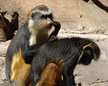
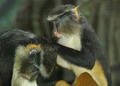
Wolf's monkeys have dark grey fur dorsally with a reddish patch in the center of the back. The ventral fur is usually white or pale yellow. The forelimbs are dark grey to black while the hindlimbs are a light reddish-brown color. The distal half of the tail is black while the proximal half is a grayish coloration. The face is characterized by a black patch extending from ear to ear, from below the eyes to the top of the head. Within this black area is a patch of white fur that grows from the brow. The cheeks and chin are the same whitish-yellow as the ventral fur and the ear tufts are often white or slightly reddish. The scrotum is blue, which may be important in mate selection. Blue scrotal color is common in many Cercopithecus species and related genera. Wolf's monkeys have ischial callosities (callus-like areas of skin on the buttocks). This provides a degree of comfort while sitting on branches and night resting. These callosities are typical of the family Cercopithecidae. ("Wildlife Conservation Society", 2007; Fleagle, 1999; Napier and Napier, 1967; Rowe, 1996)
Being an arboreal quadruped, Wolf's monkeys have forelimbs and hindlimbs that are fairly equal in length giving it an intermembral index number close to 100. The head and body length of males varies from 445 to 511 mm with an average of 485 mm. The length of the tail in males ranges from 695 to 822 mm with an average of 779 mm. There has not been enough data collected from females to adaquetely determine these measurements. Cercopithecus wolfi is a sexually dimorphic species. The weight of males ranges from 3.8 to 4.2 kg, females are considerably smaller, ranging from 2.4 to 3.1 kg. Males also have larger canine teeth than females.
- Other Physical Features
- endothermic
- homoiothermic
- bilateral symmetry
- Sexual Dimorphism
- male larger
-
- Range mass
- 2.4 to 4.2 kg
- 5.29 to 9.25 lb
-
- Range length
- 445 to 511 mm
- 17.52 to 20.12 in
-
- Average length
- 485 mm
- 19.09 in
Reproduction
The mating system is a single-male, multi-female polygynous system. There is usually one dominant male and sometimes several less dominant males that mate with a larger number of females. In groups with many females and a single male, males from nearby bachelor groups will often come into the group to mate with females and then retreat to their bachelor group. Copulation is usually initiated by females. They will often present their genitals to a male as a way of enticing him. Though it seems to serve no reproductive function, females will often engage in “pouting” during copulation. This means that the female will look back over her shoulder and pout out her bottom lip at the male. (Fleagle, 1999)
- Mating System
- polygynous
Wolf's monkeys give birth to one offspring at a time, though twins occur rarely. Most births occur from June to December when there is the greatest abundance of food. Gestation length is from 160 to 170 days and the young are nursed for 3 months after birth. Females produce their first young at 4 to 5 years old. ("Wildlife Conservation Society", 2007; Estes, 1991; Fleagle, 1999; "Wildlife Conservation Society", 2007; Estes, 1991; Fleagle, 1999; "Wildlife Conservation Society", 2007; Estes, 1991; Fleagle, 1999; "Wildlife Conservation Society", 2007; Estes, 1991; Fleagle, 1999; Nowak, 1999)
- Key Reproductive Features
- iteroparous
- year-round breeding
- gonochoric/gonochoristic/dioecious (sexes separate)
- sexual
- viviparous
-
- Breeding interval
- Interbirth interval in Wolf's monkeys is not documented. Other Cercopithecus species generally give birth every year, although interbirth intervals can be as high as 5 years in some populations.
-
- Breeding season
- There is no fixed breeding season, although most births occur from June to December.
-
- Range number of offspring
- 1 to 2
-
- Average number of offspring
- 1
-
- Range gestation period
- 160 to 170 days
-
- Average weaning age
- 180 days
-
- Average time to independence
- 180 days
-
- Average age at sexual or reproductive maturity (female)
- 4.5 years
-
- Average age at sexual or reproductive maturity (male)
- 4.5 years
Not much information is known about the parental investment of Wolf's monkeys, though it has been observed that infants will ride on the backs of their mothers for the first few months after birth. Female young stay in their natal group, male young disperse from their natal group when they become independent. (Napier and Napier, 1967; Nowak, 1999)
- Parental Investment
- altricial
-
pre-fertilization
- provisioning
-
protecting
- female
-
pre-hatching/birth
-
provisioning
- female
-
protecting
- female
-
provisioning
-
pre-weaning/fledging
-
provisioning
- female
-
protecting
- female
-
provisioning
- post-independence association with parents
Lifespan/Longevity
The average lifespan is reported to be 20 to 26 years. ("Wildlife Conservation Society", 2007)
-
- Typical lifespan
Status: wild - 20 to 26 years
- Typical lifespan
Behavior
Cercopithecus wolfi is a diurnal species with an arboreal quadrupedal style of locomotion. They tend to reside and forage at an average height of 15 meters above the ground. Wolf's monkeys are most active in the morning and evening.
Wolf’s monkeys live in single-male, multi-female groups. Post adolescent males leave their natal group and form bachelor groups. These bachelors will occasionally try to overtake the dominant male of another group and gain reproductive rights to the females. Females stay in their natal group.
Group size varies from 1 to 12 individuals. Larger groups will often split into smaller foraging groups while searching for patchy foods such as fruits and insects. These monkeys are also found in mixed-species groups. They are most often seen associating with black mangabeys (Lophocebus aterrimus), about 80% of the time. Less often they are seen with red-tailed guenons (Cercopithecus ascanius) and Angolan black-and-white colobus monkeys (Colobus angolensis). (Fleagle, 1999; Nowak, 1999; Rowe, 1996)
- Key Behaviors
- arboreal
- scansorial
- diurnal
- motile
- sedentary
- territorial
- social
- dominance hierarchies
Home Range
There is currently not enough data about the size of day ranges and home ranges of C. wolfi. Both females and males have been observed actively defending territories, but it is unclear what the boundaries and size of these territories are. Home ranges in other Cercopithecus species vary widely, from 3 to 130 hectares. (Fleagle, 1999)
Communication and Perception
Vocalizations of Wolf’s monkeys includes 2 contact calls, 2 travel calls, and 3 alarm calls. The most common contact call is used while foraging. These monkeys let out an occasional grunting sound to maintain vocal contact and know the positions of other members of the group. These calls are made more often when foraging in large groups or in areas of low visibility, such as the upper areas of the canopy. Vocal communication is also more common while hunting for insects than foraging for fruits and leaves. To communicate territoriality, males let out a boom call, which is a low, short tone that can be carried long distances due to resonating air sacs. A common alarm call is the sneeze call. It is a short call resembling a the sound of a sneeze.
This species also uses visual communication to convey threats and aggression. Males fix their eyes on the target, move back their ears to stretch out the facial skin, and retract their scalp. This is called staring. Along with staring, they will sometimes open their mouths, but keep the teeth hidden. To present an even greater threat, they will stare with their mouth open, but begin bobbing their head. A fear grimace is used as an appeasement signal to reduce aggression in aggressive encounters. This is accomplished by retracting the lips to show the teeth, but keeping the teeth closed together. Males also perform a visual cue that resembles yawning. The mouth is opened and the canines are revealed to convey tension or aggression.
Like other primates, Wolf's monkeys also extensively use grooming for tactile social communication. The use of chemical cues, such as pheromones, is likely, but undocumented. (Estes, 1991; Mulavwa, 1991; Rowe, 1996)
Food Habits
Wolf's monkeys are frugivorous, but they supplement their diet heavily with leaves, seeds, and flowers. At Salonga National Park in the Democratic Republic of Congo, Wolf's monkeys have been recorded consuming 32% fruit (4% fleshy and 27% arils), 27% seeds, 29% leaves, and 11% flowers. Though not a primary means of sustenance, Wolf’s monkeys will occasionally feed on nectars and insects if they are readily available. The principal feeding time for this species is during the early morning and early afternoon. (Chapman, et al., 2002; Napier and Napier, 1967)
- Animal Foods
- insects
- Plant Foods
- leaves
- seeds, grains, and nuts
- fruit
- nectar
- flowers
Predation
Since this species is arboreal, its main predators are avian, primarily crowned hawk eagles (Stephanoaetus coronatus). When these birds are spotted by Wolf's monkeys, they will sound an alarm call and retreat to the ground. Though less common, leopards also pose a threat to this species. More recently, humans have become a major predator of this species for the bush meat market. In addition, their primary habitat is being destroyed at an extremely rapid pace for lumber. ("Wildlife Conservation Society", 2007; Rowe, 1996)
-
- Known Predators
-
- crowned hawk eagles (Stephanoaetus coronatus)
- leopards (Panthera pardus)
Ecosystem Roles
Wolf's monkeys are probably important in seed dispersal of food trees and they may contribute to pollination when they drink nectar.
- Ecosystem Impact
- disperses seeds
Economic Importance for Humans: Positive
Wolf's monkeys are one of the species hunted in the bushmeat market. Their meat provides food to local inhabitants and a product to trade for other goods. They are also likely to play a role in the regeneration of healthy forests through seed dispersal.
- Positive Impacts
- food
Economic Importance for Humans: Negative
Wolf's monkeys occasionally raid local agricultural crops and have a potential for carrying diseases that can be contagious to humans.
- Negative Impacts
-
injures humans
- carries human disease
- crop pest
Conservation Status
Cercopithecus wolfi has not been evaluated by the IUCN. As a primate, C. wolfi is on appendix II in CITES.
-
- IUCN Red List
-
Least Concern
More information
-
- IUCN Red List
-
Least Concern
More information
-
- US Federal List
- No special status
-
- CITES
- Appendix II
Contributors
Tanya Dewey (editor), Animal Diversity Web.
Branden Platter (author), University of Oregon, Stephen Frost (editor, instructor), University of Oregon.
Glossary
- Ethiopian
-
living in sub-Saharan Africa (south of 30 degrees north) and Madagascar.

- acoustic
-
uses sound to communicate
- altricial
-
young are born in a relatively underdeveloped state; they are unable to feed or care for themselves or locomote independently for a period of time after birth/hatching. In birds, naked and helpless after hatching.
- arboreal
-
Referring to an animal that lives in trees; tree-climbing.
- bilateral symmetry
-
having body symmetry such that the animal can be divided in one plane into two mirror-image halves. Animals with bilateral symmetry have dorsal and ventral sides, as well as anterior and posterior ends. Synapomorphy of the Bilateria.
- chemical
-
uses smells or other chemicals to communicate
- diurnal
-
- active during the day, 2. lasting for one day.
- dominance hierarchies
-
ranking system or pecking order among members of a long-term social group, where dominance status affects access to resources or mates
- endothermic
-
animals that use metabolically generated heat to regulate body temperature independently of ambient temperature. Endothermy is a synapomorphy of the Mammalia, although it may have arisen in a (now extinct) synapsid ancestor; the fossil record does not distinguish these possibilities. Convergent in birds.
- food
-
A substance that provides both nutrients and energy to a living thing.
- frugivore
-
an animal that mainly eats fruit
- herbivore
-
An animal that eats mainly plants or parts of plants.
- iteroparous
-
offspring are produced in more than one group (litters, clutches, etc.) and across multiple seasons (or other periods hospitable to reproduction). Iteroparous animals must, by definition, survive over multiple seasons (or periodic condition changes).
- motile
-
having the capacity to move from one place to another.
- native range
-
the area in which the animal is naturally found, the region in which it is endemic.
- polygynous
-
having more than one female as a mate at one time
- rainforest
-
rainforests, both temperate and tropical, are dominated by trees often forming a closed canopy with little light reaching the ground. Epiphytes and climbing plants are also abundant. Precipitation is typically not limiting, but may be somewhat seasonal.
- riparian
-
Referring to something living or located adjacent to a waterbody (usually, but not always, a river or stream).
- sedentary
-
remains in the same area
- sexual
-
reproduction that includes combining the genetic contribution of two individuals, a male and a female
- social
-
associates with others of its species; forms social groups.
- tactile
-
uses touch to communicate
- terrestrial
-
Living on the ground.
- territorial
-
defends an area within the home range, occupied by a single animals or group of animals of the same species and held through overt defense, display, or advertisement
- tropical
-
the region of the earth that surrounds the equator, from 23.5 degrees north to 23.5 degrees south.
- visual
-
uses sight to communicate
- viviparous
-
reproduction in which fertilization and development take place within the female body and the developing embryo derives nourishment from the female.
- year-round breeding
-
breeding takes place throughout the year
References
2007. "Wildlife Conservation Society" (On-line). Accessed October 15, 2007 at http://www.congogorillaforest.com/congo-meet-wolfsmonkey.
Chapman, C., L. Chapman, M. Cords, J. Gathua, A. Gautier-Hion, J. Lambert, K. Rode, C. Tutin, L. White. 2002. The Guenons: Diversity and Adaptation in African Monkeys. New York: Kluwer Academic/Plenum Publishers. Accessed October 09, 2007 at http://www.anthropology.wisc.edu/lambert/pdf/Chapmanetal2002.pdf.
Estes, R. 1991. The Behavior Guide to African Mammals. Berkeley, CA: University of California Press.
Fleagle, J. 1999. Primate Adaptation and Evolution. San Diego, CA: Academic Press.
Groves, C. 2001. Primate Taxonomy. Washington, DC: Smithsonian Institution Press.
Ihobe, H. 1997. Non-antagonistic Relations Between Wild Bonobos and Two Species of Guenons. Primates, Volume 38, Issue 4: 351-357. Accessed October 11, 2007 at http://0-www.metapress.com.janus.uoregon.edu/content/r7mu77606r682116/fulltext.pdf.
Mulavwa, M. 1991. Notes On the Call of Mona Monkeys (Cercopithecus wolfi) in the Mabali Forest: Frequency of Emission and Daily Activities. Pp. 1 in A Ehara, T Kimura, O Takenaka, M Iwamoto, eds. Primatology Today Proceedings of the XIII Congress of the International Primatological Society. Amsterdam: Elsevier Science Publishers.
Napier, J., P. Napier. 1967. A Handbook of Living Primates. London: Academic Press.
Nowak, R. 1999. Walker's Primates of the World. Baltimore, Maryland: The Johns Hopkins University Press.
Rowe, N. 1996. The Pictorial Guide to the Living Primates. East Hampton, New York: Pogonias Press.