Carettochelys insculptaPig-nosed Turtle, Pitted-Shelled Turtle, Warrajan
Geographic Range
Pig-nosed turtles have a very restricted range, being found in the northernmost river systems of the Northern Territory of Australia and in southern lowlands of New Guinea. These turtles inhabit several rivers within the Northern Territory, including the Victoria and Daly River systems. The southernmost extent of their range is 14˚04’40”S latitude and the easternmost extent is 131˚15’00"E longitude, during the dry season. (Doody, et al., 2002; Georges, et al., 2000)
- Biogeographic Regions
- australian
Habitat
Pig-nosed turtles inhabit freshwater and estuarine bodies of water. They are normally found on beaches or in ribbonweed beds of ponds, rivers, creeks, lakes, brackish water, and thermal springs. Females prefer sandy flat rock microhabitats whereas males prefer isolated log microhabitats. Both sexes show equal preference for ribbonweed bed microhabitats. (Doody, et al., 2002; Georges, et al., 2000)
- Habitat Regions
- tropical
- freshwater
- Aquatic Biomes
- lakes and ponds
- rivers and streams
- temporary pools
- coastal
- brackish water
- Wetlands
- swamp
- Other Habitat Features
- estuarine
Physical Description
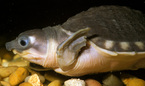
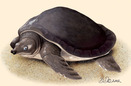
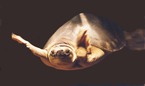
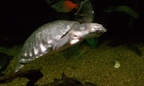
Pig-nosed turtles have large bodies and a nose similar to that of a pig, giving them their common name. These turtles lack bony scutes overlaying their shell, which has a leathery texture akin to that found in softshell turtles. The plastron is cream-colored, while the carapace can vary between different shades of brown to dark gray. They have flat, broad limbs that have two claws each, with their enlarged pectoral flippers having a similar appearance to those of sea turtles. These flippers lead to a rather clumsy gait on land, thus leading pig-nosed turtles to spend most of their time in the water. Pig-nosed turtles have strong jaws and short tails. An adult's size depends on its habitat, with individuals near the coast being much larger than those near rivers. Female pig-nosed turtles tend to be larger than males in size but males tend to have a longer and thicker tail. Adults can be as large as half a meter long, with an average weight of 22.5 kg and an average shell length of 46 cm. (Doody, et al., 2002; Eisemberg, et al., 2011; Georges, et al., 2000; Groombridge and Wright, 1982; Rooij and Archive E. J., 2010)
- Other Physical Features
- ectothermic
- bilateral symmetry
- Sexual Dimorphism
- female larger
-
- Average mass
- 22.5 kg
- 49.56 lb
-
- Average length
- 46 cm
- 18.11 in
Development
Maternal choice of nest site can have a great impact on embryonic development, determining offspring sex and survival rate. Pig-nosed turtles exhibit temperature-dependent sex determination. Both males and females are produced when eggs are incubated at 32°C. Males are produced when the temperature is decreased by half a degree and females are produced when the temperature increases by half a degree. Like other turtles, pig-nosed turtles exhibit indeterminate growth and do not go through any type of metamorphosis. (Doody, et al., 2003a; Eisemberg, et al., 2011; Georges, et al., 2005; Webb, et al., 1986)
- Development - Life Cycle
- temperature sex determination
- indeterminate growth
Reproduction
Little is known about the mating habits of pig-nosed turtles, but given the evidence for multiple paternity and observed polygyny in several turtle species, it seems likely that this species is similarly promiscuous. Studies have indicated that mating occurs in the water. Males never come out of the water and females only come out when they are about to lay eggs. They don’t return to land until the next nesting season. (Crim, et al., 2002; Doody, et al., 2003b)
- Mating System
- polygynandrous (promiscuous)
Pig-nosed turtles are oviparous and breed during the dry season. In the Daly River, turtles nest and lay two clutches of eggs during the dry season (July-October), every other year. (Doody, et al., 2003a; Doody, et al., 2003b)
- Key Reproductive Features
- iteroparous
- seasonal breeding
- gonochoric/gonochoristic/dioecious (sexes separate)
- sexual
- fertilization
- oviparous
-
- Breeding interval
- Pig-nosed turtles lay two clutches of eggs, every two years
-
- Breeding season
- Pig-nosed turtles nest during the dry season, which falls between July and October.
Females invest energy in the pre-hatching stage, whereas males provide no investment. Females look for the best place with the lowest predator density to lay their eggs, which they do by communicating with other females of the group with whom they travel. The best laying sites have soil with an ideal moisture content to easily make a nest chamber. They tend to avoid nesting at low elevations because of the chances of egg loss due to flooding. Females also avoid beaches that are dominated by submerged vegetation. (Doody, et al., 2003a; Doody, et al., 2003c; Eisemberg, et al., 2011)
- Parental Investment
- female parental care
-
pre-hatching/birth
-
protecting
- female
-
protecting
Lifespan/Longevity
Pig-nosed turtles have been reported to live 38.4 years in captivity. No information is available regarding the lifespan of this species in the wild. (de Magalhaes and Costa, 2009)
-
- Range lifespan
Status: captivity - 38.4 (high) years
- Range lifespan
-
- Average lifespan
Sex: female
Status: captivity - 17.3 years
- Max Planck Institute for Demographic Research
- Average lifespan
Behavior
In the wild, pig-nosed turtles appear to be a social species, although they are widely considered to be highly aggressive towards conspecifics and other turtles in captivity. These turtles move around according to the wet and dry seasons. In Australia, they have been found to gather in dense aggregations in the Alligator River during the dry season, when water levels drop so that the river is an intermittent series of pools. During the wet season, they are found in deep, turbid water. Females travel together when they are ready to lay eggs. This allows them to communicate with others to find out which beaches are the safest for their eggs. (Doody, et al., 2003a; Georges and Kennett, 1989; Georges, et al., 2000)
- Key Behaviors
- natatorial
- motile
- sedentary
- social
Home Range
During the wet season, pig-nosed turtles usually migrate into the lower estuarine floodplains. They do not defend a nesting territory, because the mothers lay their eggs then leave. (Doody, et al., 2002)
Communication and Perception
Little is known about how pig-nosed turtles communicate or perceive their surroundings. The nose is used for snorkeling in murky water, and contains sensory receptors that are used to detect and locate their prey. Like other turtles, they have eyes for visual perception of their environment, although the turbid waters in which they are often found likely relegates vision to a secondary sensory role. They also have well-developed inner ears, which are capable of detecting a wide range of sound frequencies. (Groombridge and Wright, 1982; Zug, et al., 2001)
- Communication Channels
- tactile
- Other Communication Modes
- scent marks
Food Habits
The diet of pig-nosed turtles varies by life stage. At hatching, nutrition comes from the left-over yolk of the egg. As they grow, they turn to small forms of aquatic life such as insect larvae, small shrimp, and snails. These three types of food are easily accessible and are found where they hatch, preventing them from having to leave their hole. Adult pig-nosed turtles are omnivorous, but prefer to eat more plant matter such as flowers, fruits, and leaves found at the riverbank. They also eat mollusks and insects. (Georges, et al., 2000)
- Animal Foods
- insects
- mollusks
- aquatic crustaceans
- Plant Foods
- leaves
- fruit
- flowers
Predation
Adult pig-nosed turtles are relatively well protected from predators by their tough shells, with the only real threat of predation coming from humans. Their eggs, however, are highly vulnerable to predation by other organisms. A study at the beaches near the Daly River found that eggs were being consumed by two lizard species (Varanus panoptes and Varanus mertensi). This study suggested that predation was lowest when pig-nosed turtles laid eggs in clusters rather than in single nests. (Doody, et al., 2003a; Georges, et al., 2000)
-
- Known Predators
-
- Argus monitors (Varanus panoptes )
- Mertens' water monitors (Varanus mertensi)
- humans (Homo sapiens)
Ecosystem Roles
These turtles act as predators of several species of aquatic invertebrates and riparian plants. Their eggs serve as as prey to several lizard species. Pig-nosed turtles also provide an ecosystem service by aerating soil while digging holes during the nesting season. Known parasites of pig-nosed turtles include three species of flatworms, two of which (Doodytrema carettochelydis and Paradeuterobaris novaguieae) were first described from this species. (Blair and Rose, 1986; Tkach and Snyder, 2006)
- Ecosystem Impact
- soil aeration
- Doodytrema carettochelydis (Subclass Digenea, Phylum Platyhelminthes)
- Paradeuterobaris novaguieae (Subclass Digenea, Phylum Platyhelminthes)
- Neosychnocotyle maggiae (Subclass Aspidogastrea, Phylum Platyhelminthes)
Economic Importance for Humans: Positive
In New Guinea, pig-nosed turtles are hunted for meat. Their eggs are highly prized and are sold in markets. If adults are caught, they are usually traded off for something more profitable at the market. Local people eat pig-nosed turtles often, both for their taste and high protein content. (Georges, et al., 2000)
- Positive Impacts
- food
Economic Importance for Humans: Negative
There are no known adverse effects of pig-nosed turtles on humans.
Conservation Status
Pig-nosed turtles are considered vulnerable by the IUCN Red List and are a CITES Appendix II species. This species has experienced a dramatic population due to overharvest as a food source. In Kakadu National Park, pig-nosed turtles can gain protection from feral buffalos, which crush pig-nosed turtle eggs buried in river banks, if they live in the Alligator region of the park. Austraila has attempted and failed to preserve their habitat through their Australian EPBC Act. (Asian Turtle Trade Working Group 2000, 2011; Eisemberg, et al., 2011; Georges, et al., 2000)
-
- IUCN Red List
-
Vulnerable
More information
-
- IUCN Red List
-
Vulnerable
More information
-
- US Federal List
- No special status
-
- CITES
- Appendix II
-
- State of Michigan List
- No special status
Other Comments
This species has multiple alternative common names, including the Fly River turtle, warradja, pitted shell turtle and Yirrin. (Georges, et al., 2000)
Contributors
Ekta Patel (author), Radford University, Karen Powers (editor), Radford University, Kiersten Newtoff (editor), Radford University, Melissa Whistleman (editor), Radford University.
Glossary
- Australian
-
Living in Australia, New Zealand, Tasmania, New Guinea and associated islands.

- acoustic
-
uses sound to communicate
- bilateral symmetry
-
having body symmetry such that the animal can be divided in one plane into two mirror-image halves. Animals with bilateral symmetry have dorsal and ventral sides, as well as anterior and posterior ends. Synapomorphy of the Bilateria.
- brackish water
-
areas with salty water, usually in coastal marshes and estuaries.
- carnivore
-
an animal that mainly eats meat
- chemical
-
uses smells or other chemicals to communicate
- coastal
-
the nearshore aquatic habitats near a coast, or shoreline.
- ectothermic
-
animals which must use heat acquired from the environment and behavioral adaptations to regulate body temperature
- estuarine
-
an area where a freshwater river meets the ocean and tidal influences result in fluctuations in salinity.
- female parental care
-
parental care is carried out by females
- fertilization
-
union of egg and spermatozoan
- folivore
-
an animal that mainly eats leaves.
- food
-
A substance that provides both nutrients and energy to a living thing.
- freshwater
-
mainly lives in water that is not salty.
- frugivore
-
an animal that mainly eats fruit
- herbivore
-
An animal that eats mainly plants or parts of plants.
- indeterminate growth
-
Animals with indeterminate growth continue to grow throughout their lives.
- insectivore
-
An animal that eats mainly insects or spiders.
- iteroparous
-
offspring are produced in more than one group (litters, clutches, etc.) and across multiple seasons (or other periods hospitable to reproduction). Iteroparous animals must, by definition, survive over multiple seasons (or periodic condition changes).
- molluscivore
-
eats mollusks, members of Phylum Mollusca
- motile
-
having the capacity to move from one place to another.
- natatorial
-
specialized for swimming
- native range
-
the area in which the animal is naturally found, the region in which it is endemic.
- omnivore
-
an animal that mainly eats all kinds of things, including plants and animals
- oviparous
-
reproduction in which eggs are released by the female; development of offspring occurs outside the mother's body.
- polygynandrous
-
the kind of polygamy in which a female pairs with several males, each of which also pairs with several different females.
- scent marks
-
communicates by producing scents from special gland(s) and placing them on a surface whether others can smell or taste them
- seasonal breeding
-
breeding is confined to a particular season
- sedentary
-
remains in the same area
- sexual
-
reproduction that includes combining the genetic contribution of two individuals, a male and a female
- social
-
associates with others of its species; forms social groups.
- soil aeration
-
digs and breaks up soil so air and water can get in
- swamp
-
a wetland area that may be permanently or intermittently covered in water, often dominated by woody vegetation.
- tactile
-
uses touch to communicate
- tropical
-
the region of the earth that surrounds the equator, from 23.5 degrees north to 23.5 degrees south.
- visual
-
uses sight to communicate
References
Asian Turtle Trade Working Group 2000, 2011. "The IUCN Red List of Threatened Species" (On-line). Accessed April 08, 2012 at http://www.iucnredlist.org/apps/redlist/details/3898/0.
Blair, D., M. Rose. 1986. Paradeuterobaris novaguineae n. gen. and n. sp. (Digenea: Microscaphidiidae) from the intestine of Carettochelys insculpta (Reptilia: Chelonia) from Papua New Guinea. The Journal of Parasitology, 72/2: 232-235.
Crim, J., L. Spotila, J. Spotila, M. O'Connor, R. Reina, C. Williams, F. Paladinos. 2002. The leatherback turtle, Dermochelys coriacea, exhibits both polyandry and polygyny. Molecular Ecology, 11: 2097-2106.
Doody, J., S., M. Pauza, B. Stewart, C. Camacho. 2009. Nesting behavior of the pig-nosed turtle, Carettochelys insculpta, in Australia. Chelonian Conservation & Biology, 8/2: 185-191.
Doody, J., A. Georges, J. Jeanne E. Young. 2003. Twice every second year: Reproduction in the pig-nosed turtle, Carettochelys insculpta, in the wet–dry tropics of Australia. Journal of Zoology, 259/2: 179-188.
Doody, J., R. Sims, A. Georges. 2003. Gregarious behavior of nesting turtles (Carettochelys insculpta) does not reduce nest predation risk. Copeia, 2003/4: 894-898.
Doody, J., R. Sims, A. Georges, M. Lannoo. 2003. Gregarious behavior of nesting turtles (Carettochelys insculpta) does not reduce nest predation risk. Copeia, 2003/4: 894-898.
Doody, J., P. West, A. Georges. 2003. Beach selection in nesting pig-nosed turtles, Carettochelus insculpta. Journal of Herpetology, 37/1: 178-182.
Doody, J., J. Young, A. Georges. 2002. Sex differences in activity and movements in the pig-nosed turtle, Carettochelys insculpta, in the wet-dry tropics of Australia. Copeia, 2002/1: 93-103.
Eisemberg, C., M. Rose, B. Yaru, A. Georges. 2011. Demonstrating decline of an iconic species under sustained indigenous harvest – The pig-nosed turtle (Carettochelys insculpta) in Papua New Guinea. Biological Conservation, 144/9: 2282-2288.
Georges, A., K. Beggs, J. Young, J. Doody. 2005. Modelling development of reptile embryos under fluctuating temperature regimes. Modelling Reptilian Development, 78/1: 18-29.
Georges, A., R. Kennett. 1989. Dry-season distribution and ecology of Carettochelys-Insculpta (Chelonia, Carettochelydidae) in Kakadu-National-Park, Northern Australia. Wildlife Research, 16/3: 323-335.
Georges, A., S. Doody, J. Young, J. Cann. 2000. The Australian Pig-Nosed Turtle. Canberra, Australia: Robey.
Groombridge, B., L. Wright. 1982. The IUCN Amphibia-Reptilia Red Data Book. Gland, Switzerland: IUCN.
Rooij, N., B. Archive E. J.. 2010. The Reptiles of the Indo-Australian Archipelago. BiblioBazaar: Brill Archive.
Snyder, S., V. Tkach. 2007. Neosychnocotyle maggiae, n. gen., n. sp. (Platyhelminthes: aspidogastrea) from freshwater turtles in Northern Australia. The Journal of Parasitology, 93/2: 399-403.
Tkach, V., S. Snyder. 2006. Doodytrema carettochelydis n. gen., n. sp., (Digenea: Microscaphidiidae) from the Pig-Nosed Turtle, Carettochelys insculpta, (Cryptodira: Carettochelydidae) in Australia. Comparative Parasitology, 73/2: 165-171.
Webb, G., D. Choquenot, P. Whitehead. 1986. Nests, eggs, and embryonic development of Carettochelys insculpta (chelonia: Carettochelidae) from Northern Australia. Journal of Zoology, 1/3: 521-550.
Zug, G., L. Vitt, J. Caldwell. 2001. Herpetology, Second Edition: An Introductory Biology of Amphibians and Reptiles. San Diego, CA: Academic Press.
de Magalhaes, J., J. Costa. 2009. A database of vertebrate longevity records and their relation to other life-history traits. A Journal of Evolutionary Biology, 22/8: 1770-1774.