Carcharhinus limbatusShark
Geographic Range
The blacktip shark is widespread in all tropical and subtropical continental waters. These waters include: the Western Atlantic Ocean (including the Caribbean Sea), the Eastern Atlantic, the Indo-West Pacific (Southeast Asia and Australian waters), Central Pacific (Hawaiian Islands), Eastern Pacific (Californian coast) as well as in the Red Sea (Compagno, 1984).
- Biogeographic Regions
- oceanic islands
- indian ocean
- atlantic ocean
- pacific ocean
Habitat
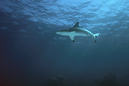
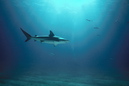
Blacktip sharks are common tropical, warm-temperate, inshore and offshore sharks (Stafford-Deitsch, 1987). They are often found on or near the continental and insular shelves. Blacktips are also commonly found close to the shore, in estuaries as well as river mouths (Stafford-Deitsch, 1987). They are also found in shallow muddy bays, mangrove swamps of high salinity, lagoons, coral reef dropoffs and in areas found far offshore (Compagno, 1984). Blacktip sharks usually stay in waters shallower than thirty meters and can handle freshwater environments but are rarely found in them (Compagno, 1984).
Physical Description
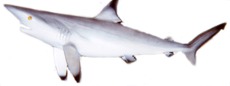
Blacktip sharks are relatively large sharks, grey in color with a long pointed snout. They have small eyes. The teeth are narrow, erect and narrow-cusped serrated upper anterolatheral teeth (Compagno, 1984). Blacktips lack an interdorsal ridge and have relatively large pectoral fins (Compagno, 1984). The first dorsal fin is large with a black tip on the rear. The second dorsal fin is much smaller yet contains a black tip as well. Usually, most fins on the black tip sharks contain black tips (with the exception of the tail-fin) (Stafford-Deitsch, 1987).
- Other Physical Features
- ectothermic
- heterothermic
- bilateral symmetry
-
- Range mass
- 30 to 100 kg
- 66.08 to 220.26 lb
Reproduction
Female blacktips are viviparous and contain a yolk-sac placenta. The number of offspring per litter ranges from 1-10 (usually 4-7)(Compagno, 1984).
Gestation of the young lasts anywhere from 10-12 months (Compagno, 1984). The young are born in late spring or early summer. Pregnant females move inshore to drop their young in nursery and pupping grounds. Young are believed to be produced in alternate years by each female blacktip (Compagno, 1984).
-
- Average age at sexual or reproductive maturity (female)
Sex: female - 2555 days
- AnAge
- Average age at sexual or reproductive maturity (female)
Lifespan/Longevity
-
- Average lifespan
Status: captivity - 12 years
- AnAge
- Average lifespan
Behavior
Blacktip sharks fast-swimming sharks that often travel in schools. They are active and usually found in near surface waters of shallower marine areas (Taylor, 1993). Blacktips are often confused with related spinner sharks because of their feeding method. A blacktip often shoots itself through the surface water and can rotate up to three times around its axis snapping in all directions in hope of attaining food (Compagno, 1984).
Blacktips, at times, can be an aggressive species which approaches swimmers and divers. Aside from this behavior, very few blacktip attacks on humans have been documented. Moreover, blacktips are regarded as relatively harmless sharks.
- Key Behaviors
- natatorial
- motile
Food Habits
Blacktip sharks are primarily fish eaters (Taylor, 1993). The prey species include a number of bony fishes including sardines, menhaden, herring, anchovies, ten-pounders, sea catfish, coronetfish, tongue-soles, threadfins, mullet, spanish mackeral, jacks, groupers, snook, porgies, mojarras, emperors, grunts, slipjaws, butterfish, croakers, soles, tilapia, triggerfish, boxfish and porcupine fish (Compagno, 1984). Occasionally blacktips even consume small sharks. They also consume other aquatic organisms such as guitarfish, skates, butterfly rays, stingrays, eagle rays, squid, cuttlefish, octopi, crabs and lobsters (Compagno, 1984). Blacktips are quite prone to feeding frenzies when there is competition between sharks for a common abundant food source (Stafford-Deitsch, 1987).
Economic Importance for Humans: Positive
Blacktips are used as a food source for human consumption. Their hide can be used to make leather goods. Due to the high vitamin content of the liver oil, it is used for vitamins. The dead carcasses can also be used as fish meal (Compagno, 1984).
Economic Importance for Humans: Negative
There have been instances of blacktip attacks on humans, though these instances are very rare. It is also common for blacktips to get caught in shrimp trawl nets (Compagno, 1984; Taylor, 1993).
Conservation Status
As is true with many species of shark, blacktips have experienced reductions in their numbers. This is due to overfishing and killing of the shark. The blacktip however is still a relatively abundant species of shark and is currently not protected by federal law.
-
- IUCN Red List
-
Vulnerable
More information
-
- IUCN Red List
-
Vulnerable
More information
-
- US Federal List
- No special status
-
- CITES
- No special status
Contributors
William Fink (editor), University of Michigan-Ann Arbor.
Nicholas Thomas (author), University of Michigan-Ann Arbor.
Glossary
- Atlantic Ocean
-
the body of water between Africa, Europe, the southern ocean (above 60 degrees south latitude), and the western hemisphere. It is the second largest ocean in the world after the Pacific Ocean.

- Pacific Ocean
-
body of water between the southern ocean (above 60 degrees south latitude), Australia, Asia, and the western hemisphere. This is the world's largest ocean, covering about 28% of the world's surface.
- bilateral symmetry
-
having body symmetry such that the animal can be divided in one plane into two mirror-image halves. Animals with bilateral symmetry have dorsal and ventral sides, as well as anterior and posterior ends. Synapomorphy of the Bilateria.
- coastal
-
the nearshore aquatic habitats near a coast, or shoreline.
- ectothermic
-
animals which must use heat acquired from the environment and behavioral adaptations to regulate body temperature
- heterothermic
-
having a body temperature that fluctuates with that of the immediate environment; having no mechanism or a poorly developed mechanism for regulating internal body temperature.
- motile
-
having the capacity to move from one place to another.
- natatorial
-
specialized for swimming
- native range
-
the area in which the animal is naturally found, the region in which it is endemic.
- oceanic islands
-
islands that are not part of continental shelf areas, they are not, and have never been, connected to a continental land mass, most typically these are volcanic islands.
- reef
-
structure produced by the calcium carbonate skeletons of coral polyps (Class Anthozoa). Coral reefs are found in warm, shallow oceans with low nutrient availability. They form the basis for rich communities of other invertebrates, plants, fish, and protists. The polyps live only on the reef surface. Because they depend on symbiotic photosynthetic algae, zooxanthellae, they cannot live where light does not penetrate.
References
Copagno, L. 1984. Sharks of the World. Rome, Italy: United Nations Development Programme Food and Agriculture Organization of the United Nations.
Stafford-Deitsch, J. 1987. Shark. 730 Polk Street, San Francisco, CA 94109.: Sierra Club Books.
Taylor, L. 1993. Sharks of Hawaii: Their Biology and Cultural Significance. 2840 Kolowalu Street Honolulu, Hawaii 96822: University of Hawaii Press.