Caracara cheriwaycrested caracara


Geographic Range
Caracaras are present along the Mexican - American Border, from Baja California to Eastern Texas, then south to Panama. There are also isolated populations in Cuba, the Isle of Pines, Louisiana, and in Central Florida
Habitat
The crested caracaras are birds of open countryside. Their typical habitats are either comprised of dry prairie with some wetter areas or agricultural environments. Caracaras spread themselves thinly over a wide area, with each pair maintaining a large territory.
- Terrestrial Biomes
- savanna or grassland
Physical Description
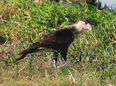
The crested caracara is about the same size as an osprey, but it has shorter wings. It has a length of approximately 53 to 58 centimeters, with a wingspan of approximately 1.2 meters. Caracaras can be identified by thier long yellow legs, and their large, hooked, bluish bill. Caracaras have black crowns and crests, with red facial skin. Thier tails are banded, alternating black and white, with a wide black terminal band. The ends of the primaries and at the base of the neck are also banded. Immature birds appear similar, but their coloring is duller overall. Both sexes of the birds are similarily plumaged.
- Other Physical Features
- endothermic
- bilateral symmetry
Reproduction
Bonds between adult caracaras are strong, persisting until one of the mates dies. Together, the pair of caracaras will maintain a large territory. The nesting site is usually in a cabbage palm tree, and the nest is a bulky structure made with slender vines and sticks. The breeding season for caracaras is from January to March, and the usual clutch being two or three eggs. Incubation is about 32 days, and the young do not leave the nest until they are at least eight weekes old. The family of caracaras can be observed together for at least three months after the young fledge. There is usually only one brood, but two are not unusual.
- Key Reproductive Features
- iteroparous
- gonochoric/gonochoristic/dioecious (sexes separate)
- sexual
- oviparous
Lifespan/Longevity
-
- Range lifespan
Status: wild - 25.8 (high) years
- Range lifespan
-
- Average lifespan
Status: wild - 211 months
- Bird Banding Laboratory
- Average lifespan
Behavior
- Key Behaviors
- flies
- motile
Communication and Perception
Food Habits
The caracara is an opportunistic feeder, its diet consists of both carrion and living prey. The living prey is usually small turtles, turtle eggs, fish, insects, frogs, lizard, snakes, small birds, and some small mammals. Sometimes, when trying to capture a larger animal, pairs will unite their forces. Caracaras have also been observed eating with vultures.
Economic Importance for Humans: Positive
There is not any documented evidence that Caracara cheriway benefits humans economically.
Economic Importance for Humans: Negative
There is not any documented evidence that Caracara cheriway hinders the human economy.
Conservation Status
Due to the drastic decrease in habitat, the caracara population has plummeted. The development of citrus groves, tree plantations, improved pastures, and other commercial and agricultural uses are destroying the caracara's natural habitat. Also, the increase amount of traffic in the caracara's natural habitat has resulted in many birds being hit by automobiles. Another significant factor into the decline of the caracara population is the fact that they have a low reproductive rate and face a small gene pool.
Many caracaras live on private lands in Florida, a few wandering to the east into Cape Canaveral and Merritt Island. Some pairs are being monitored on Federal Land, the Air Force's Avon Park bombing range in Polk and Highlands County.
-
- IUCN Red List
-
No special status
More information
-
- IUCN Red List
-
No special status
More information
-
- US Federal List
- Endangered
-
- CITES
- No special status
Other Comments
Some Interesting Facts About the Crested Caracara:
o Put onto the Endangered Species List in August, 1987.
o Also known as the Mexican Eagle, Mexican Buzzard, and Audubon's Caracara.
o The genus and species name of the crested caracara changed from Polyborus to Caracara. The reason for this change was because the generic name, Caracara, has been found to have been published validly and had received substantial use in literature, predating the generic name Polyborus.
Contributors
Sara Pancoast (author), Cocoa Beach High School, Penny Mcdonald (editor), Cocoa Beach High School.
Glossary
- acoustic
-
uses sound to communicate
- bilateral symmetry
-
having body symmetry such that the animal can be divided in one plane into two mirror-image halves. Animals with bilateral symmetry have dorsal and ventral sides, as well as anterior and posterior ends. Synapomorphy of the Bilateria.
- chemical
-
uses smells or other chemicals to communicate
- endothermic
-
animals that use metabolically generated heat to regulate body temperature independently of ambient temperature. Endothermy is a synapomorphy of the Mammalia, although it may have arisen in a (now extinct) synapsid ancestor; the fossil record does not distinguish these possibilities. Convergent in birds.
- iteroparous
-
offspring are produced in more than one group (litters, clutches, etc.) and across multiple seasons (or other periods hospitable to reproduction). Iteroparous animals must, by definition, survive over multiple seasons (or periodic condition changes).
- motile
-
having the capacity to move from one place to another.
- oviparous
-
reproduction in which eggs are released by the female; development of offspring occurs outside the mother's body.
- sexual
-
reproduction that includes combining the genetic contribution of two individuals, a male and a female
- tactile
-
uses touch to communicate
- tropical savanna and grassland
-
A terrestrial biome. Savannas are grasslands with scattered individual trees that do not form a closed canopy. Extensive savannas are found in parts of subtropical and tropical Africa and South America, and in Australia.
- savanna
-
A grassland with scattered trees or scattered clumps of trees, a type of community intermediate between grassland and forest. See also Tropical savanna and grassland biome.
- temperate grassland
-
A terrestrial biome found in temperate latitudes (>23.5° N or S latitude). Vegetation is made up mostly of grasses, the height and species diversity of which depend largely on the amount of moisture available. Fire and grazing are important in the long-term maintenance of grasslands.
- visual
-
uses sight to communicate
References
Gough, G., J. Sauer, M. Iliff. 1998. "Patuxent Bird Identification Infocenter" (On-line). Accessed February 16, 2000 at http://www.mbr-pwrc.usgs.gov/Infocenter/infocenter.html.
Kale, II, H., D. Maehr. 1990. Florida's Birds. Sarasota, Florida: Pineapple Press.
Toops, C., W. Dilley. 1986. Birds of South Florida: An Interpretive Guide. Conway, Arkansas: River Road Press.