Caprimulgus carolinensisChuck-will's widow(Also: Chuck-will's-widow)
Geographic Range
Chuck-will's-widows breed in suitable habitat throughout the southeastern United States, from Florida to Long Island, New York and west to Kansas, Oklahoma, and eastern Texas. They also breed in isolated areas of southern Ontario, northwestern Indiana along Lake Michigan, and in central and southern Ohio. They winter mainly in Central America from Tamaulipas, Mexico south to Colombia east of the Andes and in the Antilles Islands. They also winter in southern Florida and occasionally along the Gulf of Mexico in Texas, Louisiana, and Alabama. They have been reported in areas north of their breeding range as well, as far north as the Canadian maritime provinces and northern California. (Straight and Cooper, 2000)
Habitat
Chuck-will's-widows are found in open woodlands, including deciduous, mixed, pine (Pinus), and oak-hickory (Quercus-Carya) forests. Openings and edges are important habitat features and these birds can be found in suburban areas with the appropriate characteristics. Where they co-occur with whippoorwills (Caprimulgus vociferus), Chuck-will's-widows are found in more open habitats. During migration and in winter they can be found in a wider variety of forested habitats and scrublands, including mixed agriculture areas. They have been found at elevations up to 2600 m in Colombia. (Straight and Cooper, 2000)
- Habitat Regions
- temperate
- tropical
- terrestrial
- Terrestrial Biomes
- forest
- scrub forest
- Other Habitat Features
- suburban
- agricultural
- riparian
-
- Range elevation
- 0 to 2600 m
- 0.00 to 8530.18 ft
Physical Description
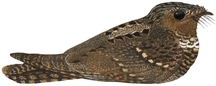
Chuck-will's-widows are larger than their well-known cousins, whip-poor-wills (Caprimulgus vociferus), but similar in overall appearance. They are the largest species of nightjar in North America. Chuck-will's-widows are cryptically colored in mottled, cinnamon-brown, cream, and black feathers that help to camouflage them when they roost during the day on tree branches or the ground. They are from 28 to 32 cm long, with wings from 20 to 22.5 cm long, and weighing approximately 110 g. Their tails are long, projecting beyond the wings when they are at rest, from 12.8 to 15.1 cm long. Males have white on the outer 3 tail feathers and a rufous with white collar on the throat. Females have a buffy collar on the throat and lack the white on their tail feathers. Males are also slightly larger than females. Immature individuals resemble females and there is no seasonal variation in plumage. No subspecies are recognized. Chuck-will's-widows are most often recognized by their voice, they are rarely seen. Chuck-will's-widows may hibernate like their western cousins, poorwills (Phalaenoptilus nuttallii), but this has yet to be confirmed. (Straight and Cooper, 2000)
- Other Physical Features
- endothermic
- bilateral symmetry
- Sexual Dimorphism
- male larger
- sexes colored or patterned differently
-
- Average mass
- 110 g
- 3.88 oz
-
- Range length
- 28 to 32 cm
- 11.02 to 12.60 in
Reproduction
Chuck-will's-widow males defend mating territories, chasing other males away. They use their songs to attract females and advertise territories. Males also perform courtship displays where they spread their tail, puff themselves up, drop the wings, and hop around on the ground near the female, coming alongside her when finished. They may also growl and "dance" near a female. There is some evidence that males and females rejoin to breed again from year to year in the same place. (Straight and Cooper, 2000)
- Mating System
- monogamous
Most populations arrive on breeding grounds in March and begin breeding in April. Pairs form within 10 days of females arriving on the breeding grounds. Females lay one neutral colored egg every other day for 3 days, resulting in a clutch size of 2 (although 1 to 4 is possible). Eggs are laid in a simple scrape on the ground, usually under some kind of vegetation. Incubation takes 20 days and starts with the first egg laid. Adults do not flush easily from nests, possibly because their cryptic colors help to camouflage the eggs and young. There is no information on how long nestlings or fledglings are dependent on parents, but estimates based on whippoorwills (Caprimulgus vociferus) and nighthawks (Chordeiles minor) suggest young are dependent on parents for about 50 days after hatching. They can fly at 17 days and remain dependent on parents for another 14 days. Chuck-will's-widows will continue to replace eggs or clutches that are preyed on up to 4 times in a season but generally raise only 1 brood each year. The age of sexual maturity is not known. (Straight and Cooper, 2000)
- Key Reproductive Features
- iteroparous
- seasonal breeding
- gonochoric/gonochoristic/dioecious (sexes separate)
- sexual
- oviparous
-
- Breeding interval
- Chuck-will's-widows breed once yearly.
-
- Breeding season
- Chuck-will's-widows breed from April through June.
-
- Range eggs per season
- 1 to 4
-
- Average eggs per season
- 2
-
- Average time to hatching
- 20 days
-
- Average fledging age
- 17 days
-
- Average time to independence
- 14 days
Females only develop an incubation patch, but males have also been observed incubating eggs. Both adults are protective of the nest. Some evidence suggests males may feed females on the nest. Young are altricial at hatching, can fly at 17 days, and remain dependent on adults for another 14 days after fledging. (Straight and Cooper, 2000)
- Parental Investment
- altricial
-
pre-fertilization
- provisioning
-
protecting
- female
-
pre-hatching/birth
-
provisioning
- female
-
protecting
- male
- female
-
provisioning
-
pre-weaning/fledging
-
provisioning
- male
- female
-
protecting
- male
- female
-
provisioning
-
pre-independence
-
provisioning
- male
- female
-
protecting
- male
- female
-
provisioning
Lifespan/Longevity
There is little information on lifespan in Chuck-will's-widows, the longevity record based on banding is 14 years and 10 months old. (Straight and Cooper, 2000)
-
- Range lifespan
Status: wild - 14.83 (high) years
- Range lifespan
Behavior
Not much is known about behavior in Chuck-will's-widows because of their very effective crypsis and their nocturnal habits. There has been little research done on these nightjars. They fly silently from a few to 20 meters above ground and may dive to grab insects. They roost along tree branches or on the ground among vegetation. Chuck-will's-widows are crepuscular and active on nights with sufficient moonlight. They are usually solitary, except in family groups after nesting and in groups during migration. (Straight and Cooper, 2000)
Chuck-will's-widows are migratory, with the exception of populations in southern Florida and along the Gulf of Mexico in Texas, Louisiana, and Alabama. In spring they begin migrating from February to May, with most populations arriving on the breeding grounds in March and April. Departure from the breeding grounds is estimated to occur from late August through October. Chuck-will's-widows don't call during migration, so migratory behavior is based on relatively few observations. (Straight and Cooper, 2000)
Home Range
Home range sizes in Chuck-will's-widows aren't known, but densities have been recorded up to 30 birds per 40 hectares.
Communication and Perception
Chuck-will's-widows get their common name from the sound of their call, which often has the emphasis on the 2nd and 3rd syllable. Much of what we know about Chuck-will's-widows comes from detecting them through their vocalizations. Their nocturnal habits and cryptic colors make them difficult to observe. Males sing from 16 to 30 times per minute from a perch, females don't sing but may answer muted calls from males on the nest. Males sing through courtship, discontinue singing during the nesting period, and begin to sing again before fall migration. Songs occur at dusk and when the moon is out, more singing occurs on warmer nights. Songs are thought to be to attract mates and advertise a breeding territory. Chuck-will's-widows also have different kinds of calls used when startled or in territorial defense. They also hiss when threatened. (Straight and Cooper, 2000)
- Communication Channels
- acoustic
Food Habits
Chuck-will's-widows eat nocturnal flying insects, especially beetles and moths, especially geometrid moths (Geometridae). They fly just above the ground, often along woodland edges, to capture insects in their large mouths. They may also forage over water or fly out to capture passing insects from perches. They forage mainly at dusk and dawn and when there is sufficient moonlight for low-light visual detection of flying insects. Chuck-will's-widows use their rictal bristles, the bristles around their mouths, to scoop up insects. They may also forage on the ground for insects or frogs, especially when they are molting, and they sometimes pursue and capture small birds, including palm warblers (Dendroica palmarum), yellow warblers (Dendroica petechia), worm-eating warblers (Helmitheros), hooded warblers (Wilsonia citrina), swamp sparrows (Melospiza georgiana), Carolina wrens (Thryothorus ludovicianus), Cuban emeralds (Chlorostilbon ricordii), common yellowthroats (Geothlypis trichas), and Cape May warblers (Dendroica tigrina). Chuck-will's-widows are often observed on roads where they collect rocks, presumably to help them grind and digest their insect prey. (Straight and Cooper, 2000)
- Primary Diet
- carnivore
- Animal Foods
- birds
- amphibians
- insects
Predation
Their cryptic coloration and nocturnality make Chuck-will's-widows less vulnerable to predation, although their ground-nesting habits make them somewhat vulnerable to terrestrial predators. There is little information on predation on Chuck-will's-widows, but snakes and mammalian predators are suspected nest predators. When disturbed near a nest, adults will attack a threat or perform a distraction display, such as dragging their wings on the ground as they walk away while hissing. (Straight and Cooper, 2000)
- Anti-predator Adaptations
- cryptic
Ecosystem Roles
Chuck-will's-widows are important predators of night-flying insects, filling a similar ecological role to large, insectivorous bats. Two species of louse flies are known to parasitize nests (Pseudolynchia brunnea and Pseudolynchia rufipes). (Straight and Cooper, 2000)
- louse flies (Pseudolynchia brunnea)
- louse flies (Pseudolynchia rufipes)
Economic Importance for Humans: Positive
Chuck-will's-widows may help to control insect pest populations.
- Positive Impacts
- controls pest population
Economic Importance for Humans: Negative
There are no known adverse effects of Caprimulgus carolinensis on humans.
Conservation Status
Chuck-will's-widow populations seem to be declining in the eastern United States, although there may be insufficient data to draw conclusions. They may be vulnerable to pesticides that affect their insect prey and mortality occurs when they are hit by cars as they land on roads to collect pebbles. Habitat changes may be causing whippoorwills (Caprimulgus vociferus) to expand their range, potentially impacting Caprimulgus carolinensis) populations. (Straight and Cooper, 2000)
-
- IUCN Red List
-
Least Concern
More information
-
- IUCN Red List
-
Least Concern
More information
-
- US Migratory Bird Act
- Protected
-
- US Federal List
- No special status
-
- CITES
- No special status
-
- State of Michigan List
- No special status
Other Comments
Chuck-will's-widows are thought to be most closely related to rufous nightjars (Caprimulgus rufus) in the genus Caprimulgus. They have similar plumage and vocalizations. Some have suggested, based on morphology, that Chuck-will's-widows should be placed in their own genus: Antrostomus. (Straight and Cooper, 2000)
Contributors
Tanya Dewey (author), Animal Diversity Web.
Glossary
- Nearctic
-
living in the Nearctic biogeographic province, the northern part of the New World. This includes Greenland, the Canadian Arctic islands, and all of the North American as far south as the highlands of central Mexico.

- acoustic
-
uses sound to communicate
- agricultural
-
living in landscapes dominated by human agriculture.
- altricial
-
young are born in a relatively underdeveloped state; they are unable to feed or care for themselves or locomote independently for a period of time after birth/hatching. In birds, naked and helpless after hatching.
- bilateral symmetry
-
having body symmetry such that the animal can be divided in one plane into two mirror-image halves. Animals with bilateral symmetry have dorsal and ventral sides, as well as anterior and posterior ends. Synapomorphy of the Bilateria.
- carnivore
-
an animal that mainly eats meat
- chemical
-
uses smells or other chemicals to communicate
- cryptic
-
having markings, coloration, shapes, or other features that cause an animal to be camouflaged in its natural environment; being difficult to see or otherwise detect.
- endothermic
-
animals that use metabolically generated heat to regulate body temperature independently of ambient temperature. Endothermy is a synapomorphy of the Mammalia, although it may have arisen in a (now extinct) synapsid ancestor; the fossil record does not distinguish these possibilities. Convergent in birds.
- forest
-
forest biomes are dominated by trees, otherwise forest biomes can vary widely in amount of precipitation and seasonality.
- insectivore
-
An animal that eats mainly insects or spiders.
- iteroparous
-
offspring are produced in more than one group (litters, clutches, etc.) and across multiple seasons (or other periods hospitable to reproduction). Iteroparous animals must, by definition, survive over multiple seasons (or periodic condition changes).
- migratory
-
makes seasonal movements between breeding and wintering grounds
- monogamous
-
Having one mate at a time.
- motile
-
having the capacity to move from one place to another.
- native range
-
the area in which the animal is naturally found, the region in which it is endemic.
- nocturnal
-
active during the night
- oviparous
-
reproduction in which eggs are released by the female; development of offspring occurs outside the mother's body.
- riparian
-
Referring to something living or located adjacent to a waterbody (usually, but not always, a river or stream).
- scrub forest
-
scrub forests develop in areas that experience dry seasons.
- seasonal breeding
-
breeding is confined to a particular season
- sexual
-
reproduction that includes combining the genetic contribution of two individuals, a male and a female
- solitary
-
lives alone
- suburban
-
living in residential areas on the outskirts of large cities or towns.
- tactile
-
uses touch to communicate
- temperate
-
that region of the Earth between 23.5 degrees North and 60 degrees North (between the Tropic of Cancer and the Arctic Circle) and between 23.5 degrees South and 60 degrees South (between the Tropic of Capricorn and the Antarctic Circle).
- terrestrial
-
Living on the ground.
- tropical
-
the region of the earth that surrounds the equator, from 23.5 degrees north to 23.5 degrees south.
- visual
-
uses sight to communicate
References
Straight, C., R. Cooper. 2000. Chuck-will's-widow (Caprimulgus carolinensis). The Birds of North America Online, 499: 1-20. Accessed May 06, 2009 at http://bna.birds.cornell.edu/bna/species/499.