Capra nubianaNubian ibex


Geographic Range
Capra nubiana, or the Nubian ibex, is the only ibex species adapted to life in hot, arid regions of the world. Capra nubiana was once widespread in the mountainous regions of northeastern Africa and the Middle East. Estimates of the full extent of this geographic range are based on ancient drawings and bone remnants. Presently, C. nubiana occurs in isolated populations in pockets of the coastal regions of northeastern Africa, the Sinai Peninsula, and the southeastern tip and western portion of the Arabian Peninsula. (Mendelssohn, 1990; Osborn and Osbornová, 1998; Shackleton, 1997)
- Biogeographic Regions
- palearctic
Habitat
Nubian ibex inhabit mountainous regions including gorges, outcrops, and scree areas in arid regions with sparse vegetation. They occur at varying elevations, from sea level to 3,000 meters. Generally, Nubian ibex inhabit the most remote, highest, and steepest cliffs. (Schaller, 1977)
- Habitat Regions
- temperate
- terrestrial
- Terrestrial Biomes
- desert or dune
- mountains
-
- Range elevation
- 0 to 3000 m
- 0.00 to 9842.52 ft
Physical Description
Nubian ibex are one of the smallest ibex species and are sexually dimorphic. A female ibex is, on average, about one-third the size of a male. Males have an average weight of 62.5 kg, females average 26.5 kg. Shoulder height averages 75 cm in males and 65 cm in females. Total body length is 125 cm in males and 105 cm in females. (Gross, et al., 1995; Mendelssohn, 1990; Nowak, 1990)
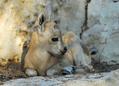
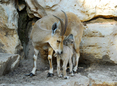
The overall color of Capra nubiana individuals is a uniform tan (matching the surrounding rocky arid environs) with patches of black and white on the legs and a white underbelly. There is a color change that begins in August, where males become dark brown to black on their necks, chests, shoulders, sides of the belly, front side of the thighs, and upper forelegs. Males have long dark beards, which are used for scent marking and to excite the females during rutting. Older females also grow beards. (Gross, et al., 1995; Mendelssohn, 1990; Nowak, 1990)
Both males and females have horns, which are used for fighting, sexual selection, and territorial defense. A male’s horns are large, dark, and semi-circular, with annual rings on the back. The annuli grow twelve to twenty centimeters during the first five years of life, and then grow between two to four centimeters per year thereafter. Total length of the horns may reach 120 cm. The horns on an individual may have shorter annuli because of physical hardships during periods of drought or disease. The horn length in females reaches around 35 cm. (Gross, et al., 1995; Mendelssohn, 1990; Nowak, 1990)
- Other Physical Features
- endothermic
- homoiothermic
- bilateral symmetry
- Sexual Dimorphism
- male larger
- sexes colored or patterned differently
- male more colorful
- ornamentation
-
- Range mass
- 25 to 70 kg
- 55.07 to 154.19 lb
-
- Range length
- 105 to 125 cm
- 41.34 to 49.21 in
Reproduction
During most of the year females and their young, as well as males under three years old remain in isolated herds of ten to twenty individuals. Adult males congregate in bachelor groups, displaying a marked system of dominance hierarchy. Males and females come together for the rutting season around October. The rutting season may continue into December. The mating system is polygynous, with only a few males siring many of the young. (Gross, et al., 1995; Kingdon, 1997; Nowak, 1990)
Throughout most of the year older males are solitary. They join females during the rut and try to drive off other males. Males will follow individual females and try to disrupt female herds. During the rut courting males seldom feed and expend much energy fighting or mating, resulting in severe deterioration of their physical condition. Both sexes exhibit crouching behaviors, tongue-flicking, and scent marking on the tail, beard and chest as part of their reproductive behavior. Reproductive success of male goats is directly correlated with body strength and horn size. Males often engage in forceful fights, whereby they crash against one another with their horns and try to overpower their opponents. Nubian ibex will erect the long dark hairs of the back while fighting. Females typically mate two or three times during estrous, which typically lasts 24 hours. Males will often become excited during the rutting season, and spontaneous ejaculation has been reported, as well as masturbation via taking the penis tip in their mouths. (Kingdon, 1997; Mendelssohn, 1990; Schaller, 1977)
- Mating System
- polygynous
Gestation lasts 150 to 165 days, after which the young (usually one, but occasionally two) are born between May and June. Females reach sexual maturity at two years, and males at age three to six. For the first several days of their life, the kids are in hiding before joining their mother. (Gross, et al., 1995; Kingdon, 1997; Nowak, 1990)
- Key Reproductive Features
- iteroparous
- seasonal breeding
- gonochoric/gonochoristic/dioecious (sexes separate)
- sexual
- viviparous
-
- Breeding interval
- Nubian ibex breed once a year during the rutting season.
-
- Breeding season
- The breeding season is from October to December.
-
- Range number of offspring
- 1 to 2
-
- Average number of offspring
- 1
-
- Range gestation period
- 5 to 5.5 months
-
- Average weaning age
- 3 months
-
- Average age at sexual or reproductive maturity (female)
- 2 years
-
- Range age at sexual or reproductive maturity (male)
- 3 to 6 years
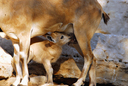
Nubian ibex exhibit a high degree of parental investment in their offspring. Time to weaning averages two months. Over this period the females nurse their young daily and gradually teach them to forage independently and establish their position in the social hierarchy. Female ibex will only nurse their own offspring and are hostile to alien kids or females. This is presumably a result of the high reproductive effort that mothers invest in their offspring. (Kohlmann, et al., 1996; Muller, et al., 1995)
Most species of ungulates in mountainous regions depend on steep terrain to avoid predation. A grouping pattern unique to Nubian ibex among all other caprines has been observed in herds in the Avedat Canyon in Israel. Females leave their kids unattended in nursery groups in a steep-walled canyon with many other kids. The nursery is most likely an accidental trap that the kids have fallen into and cannot surmount the cliff walls to climb out. Mothers visit the nursery often to feed the kids, which stay in the nursery until they are mature enough to follow along on the steep cliffs. (Kohlmann, et al., 1996; Muller, et al., 1995)
- Parental Investment
- precocial
-
pre-fertilization
- provisioning
-
protecting
- female
-
pre-hatching/birth
-
provisioning
- female
-
protecting
- female
-
provisioning
-
pre-weaning/fledging
-
provisioning
- female
-
protecting
- female
-
provisioning
Lifespan/Longevity
The oldest known individual of Capra nubiana lived 17 years in captivity. It is thought, however, that wild animals have much shorter life spans. Capra ibex, a related species, has been reported to live 10 to 16 years in the wild. (Jordan, 1969; Mendelssohn, 1990)
-
- Range lifespan
Status: captivity - 17 (high) years
- Range lifespan
-
- Average lifespan
Status: captivity - 18.9 years
- AnAge
- Average lifespan
Behavior
Nubian ibex are most active in the twilight period, resting and ruminating occurs in the afternoon or at night. During the winter months, Nubian ibex will seek shelter such as rock outcroppings or caves to avoid the cold, wind, or rain. They often hollow out shallow depressions in the ground in which to rest. Along the shores of the Dead Sea and on the Arabian Peninsula, temperatures may exceed 38 degrees Celsius. During warm periods like these, Nubian ibex will often lie down or occasionally turn on their sides to stay cool. They often spend the hot periods of the day in shaded areas. (Kingdon, 1997; Mendelssohn, 1990)
- Key Behaviors
- cursorial
- terricolous
- crepuscular
- motile
- territorial
- social
- colonial
- dominance hierarchies
Home Range
Most groups have ranges of only a few square kilometers, dominated by either females or males which will fight other encroaching members of the same sex. Males are the dispersing sex, and it has been shown that females within a group are highly related to one another. Groups are sexually separated in part due to the need to separate feeding areas for nutritional demands and to find water sources. (Gross, et al., 1995; Kingdon, 1997; Levy and Bernadsky, 1991)
Communication and Perception
Goats and ibexes are considered relatively non-vocal, but they have evolved a complex system of visual signals for aggression. Courtship displays are the most intensively studied component of communication in caprines, and are largely similar across all members of this groups. Males will display to other males with their horns, body movements, tongue or lips. They will also display to females. Females often bleat during estrus, and males may make several clicking, nasal sounds, or bleats. The rump patch is shown when animals are indicating submissiveness. (Fraser, 1986; Schaller, 1977)
During the rut, males will attempt to gain access to females by sniffing them, licking their anal areas, or nuzzling. If a female urinates, the male will then sniff her carefully, often curling his upper lip, which is a posture known as flehmen that further opens his olfactory senses. Non-receptive females will refrain from urinating, and simply continue grazing or occasionally run away. (Fraser, 1986; Schaller, 1977)
Horns are used for fighting, specifically for ramming rather than puncturing. Typically two males will spar, clashing their horns together to establish dominance. Occasionally females will also use their horns for aggression towards upstart young males or other females. Sparring between individuals seldom results in serious damage or bodily injury. (Fraser, 1986; Schaller, 1977)
- Other Communication Modes
- pheromones
- scent marks
Food Habits
Due to heat and water constraints, Nubian ibex usually feed during the night or twilight hours, and occasionally during the day. They descend to lower elevations to feed. The main diet includes herbs, shrubs, tree foliage (especially Acacia), buds, fruits, and occasionally grass. Nubian ibex especially prefer cadaba (Cadaba spp.) and camphorweed (Pluchea spp.). Nubian ibex forage in patches of high quality and where water is in close proximity. They drink water every day if available. (Hochman and Kotler, 2006; Kingdon, 1997)
- Plant Foods
- leaves
- wood, bark, or stems
- seeds, grains, and nuts
- flowers
Predation
Probable predators of Nubian ibex include leopards (Panthera pardus), wolves (Canis lupus), striped hyenas (Hyaena hyaena) and humans. Young ibex may also be preyed on by golden eagles (Aquila chrysaetos) and eagle owls (Bubo bubo). Proximity to cliff edges directly reduces the risk of predation, and Nubian ibex therefore spends much of their time on rock faces. The risk of predation for adult males is low; hence they may live in smaller group sizes. (Gross, et al., 1995; Hochman and Kotler, 2006; Levy and Bernadsky, 1991; Shkedy and Saltz, 2000)
-
- Known Predators
-
- leopards (Panthera pardus)
- wolves (Canis lupus)
- striped hyenas (Hyaena hyaena)
- humans (Homo sapiens)
- golden eagles (Aquila chrysaetos)
- eagle owls (Bubo bubo)
Ecosystem Roles
Caprinae as a group is catholic in their diet, exhibiting a large range of foraging niches, with a generalized and adaptive diet. They often live in habitats with low primary productivity. Nubian ibex are expanding specialist feeders, meaning individuals forage selectively on plants of higher quality in large patches, and hence increase herbivory on all the plants in the patch.
Grackles (Quiscalus sp.) have been known to groom Nubian ibex in a reciprocally beneficial act. They eat insects and parasites on skin of the ibexes. (Hochman and Kotler, 2006; Schaller, 1977; Yosef and Yosef, 1991)
- grackles (Quiscalus)
Economic Importance for Humans: Positive
Nubian ibex have been hunted for meat and trophies, and even used as an offering during the Dynastic period in Egypt. Hunting is now illegal in most of the countries in which C. nubiana occurs. However, poaching is still widespread and protected areas are poorly enforced. Nubian ibex have been extirpated in Syria and Lebanon due to over-hunting. Ziswiller 1967 (as cited by Osborn 1998) lists several folk uses from nearly every part of the ibex for humans. Folk uses include the blood for gall stone easement, the heel bone for diseases of the spleen, feces for anemia, the heart for strength, and stomach fluids for many healthful properties. (Osborn and Osbornová, 1998; Shackleton, 1997)
- Positive Impacts
- body parts are source of valuable material
- ecotourism
- source of medicine or drug
- research and education
Economic Importance for Humans: Negative
Nubian ibex are likely to compete with domesticated goats (Capra hircus) and camels (Camelus dromedarius) as well as other herd animals for food and habitat. Foraging ibex in Israel have been recorded damaging orchards and other crops. (Hochman and Kotler, 2006; Shackleton, 1997)
Conservation Status
Capra nubiana is listed as an endangered species with an EN C2a classification on the IUCN Red List of Threatened Species. EN means endangered, and C2a means that the the population estimate is less than 2,500 mature individuals, with no subpopulations greater then 250 mature individuals and an overall declining population trend. Nubian ibex are not listed by the Convention on International Trade in Endangered Species (CITES) or the United States Fish and Wildlife Service (USFWS). Nubian ibex are protected in Israel, Jordan, and Oman. The population is thought to be at carrying capacity in Israel, but otherwise critically endangered in other areas. Threats to C. nubiana include habitat loss (via agriculture, livestock, and infrastructure development), hunting, pollution, and competition with non-native species. Protecting corridors which connect populations is particularly important for preventing population bottlenecks in this species. (Shackleton, 1997; Shkedy and Saltz, 2000)
-
- IUCN Red List
-
Vulnerable
More information
-
- IUCN Red List
-
Vulnerable
More information
-
- US Federal List
- No special status
-
- CITES
- No special status
-
- State of Michigan List
- No special status
Other Comments
Capra nubiana was first described by F. Cuvier in 1825 as a subspecies of Capra ibex, and synonyms for the species include C. arabica, C. beden, C. mengesi, and C. sinaitica. In 1987 C. nubiana was formally recognized as a distinct species.
In biomes with rich, lush habitats, caprines are typically replaced by cervids and larger bovids. In Africa, gazelles dominate the drier open steppes and grasslands. Thus Caprinae species have adapted to life in difficult environments. In a recent controversial study by Ropiquetet al. (2006), it was proposed that the common ancestor of wild goats arose from interspecific hybridization between ancestral goats (proto-Capra) and ancestral tahr (proto-Hemitragus). The product was a goat with a mitochondrial genome better adapted to high altitudes and with more efficient mitochondria, thus allowing them a special advantage to life in the mountains. (Grubb, 1993; Kingdon, 1982; Mendelssohn, 1990; Ropiquet and Hassanin, 2006; Uerpmann, 1987)
Despite their endangered status and elusive nature, Capra nubiana populations have become major tourist attractions in several areas. At the oasis of Engedi, on the Dead Sea, a certain subpopulation has become rather accustomed to humans, and males often predictably venture to a special watering hole popular with tourists. (Kingdon, 1982; Mendelssohn, 1990)
Contributors
Tanya Dewey (editor), Animal Diversity Web.
Jan Tomsen (author), University of Alaska Fairbanks, Link E. Olson (editor, instructor), University of Alaska Fairbanks.
Glossary
- Palearctic
-
living in the northern part of the Old World. In otherwords, Europe and Asia and northern Africa.

- acoustic
-
uses sound to communicate
- bilateral symmetry
-
having body symmetry such that the animal can be divided in one plane into two mirror-image halves. Animals with bilateral symmetry have dorsal and ventral sides, as well as anterior and posterior ends. Synapomorphy of the Bilateria.
- chemical
-
uses smells or other chemicals to communicate
- colonial
-
used loosely to describe any group of organisms living together or in close proximity to each other - for example nesting shorebirds that live in large colonies. More specifically refers to a group of organisms in which members act as specialized subunits (a continuous, modular society) - as in clonal organisms.
- crepuscular
-
active at dawn and dusk
- desert or dunes
-
in deserts low (less than 30 cm per year) and unpredictable rainfall results in landscapes dominated by plants and animals adapted to aridity. Vegetation is typically sparse, though spectacular blooms may occur following rain. Deserts can be cold or warm and daily temperates typically fluctuate. In dune areas vegetation is also sparse and conditions are dry. This is because sand does not hold water well so little is available to plants. In dunes near seas and oceans this is compounded by the influence of salt in the air and soil. Salt limits the ability of plants to take up water through their roots.
- dominance hierarchies
-
ranking system or pecking order among members of a long-term social group, where dominance status affects access to resources or mates
- drug
-
a substance used for the diagnosis, cure, mitigation, treatment, or prevention of disease
- ecotourism
-
humans benefit economically by promoting tourism that focuses on the appreciation of natural areas or animals. Ecotourism implies that there are existing programs that profit from the appreciation of natural areas or animals.
- endothermic
-
animals that use metabolically generated heat to regulate body temperature independently of ambient temperature. Endothermy is a synapomorphy of the Mammalia, although it may have arisen in a (now extinct) synapsid ancestor; the fossil record does not distinguish these possibilities. Convergent in birds.
- folivore
-
an animal that mainly eats leaves.
- herbivore
-
An animal that eats mainly plants or parts of plants.
- iteroparous
-
offspring are produced in more than one group (litters, clutches, etc.) and across multiple seasons (or other periods hospitable to reproduction). Iteroparous animals must, by definition, survive over multiple seasons (or periodic condition changes).
- motile
-
having the capacity to move from one place to another.
- mountains
-
This terrestrial biome includes summits of high mountains, either without vegetation or covered by low, tundra-like vegetation.
- native range
-
the area in which the animal is naturally found, the region in which it is endemic.
- pheromones
-
chemicals released into air or water that are detected by and responded to by other animals of the same species
- polygynous
-
having more than one female as a mate at one time
- scent marks
-
communicates by producing scents from special gland(s) and placing them on a surface whether others can smell or taste them
- seasonal breeding
-
breeding is confined to a particular season
- sexual
-
reproduction that includes combining the genetic contribution of two individuals, a male and a female
- sexual ornamentation
-
one of the sexes (usually males) has special physical structures used in courting the other sex or fighting the same sex. For example: antlers, elongated tails, special spurs.
- social
-
associates with others of its species; forms social groups.
- tactile
-
uses touch to communicate
- temperate
-
that region of the Earth between 23.5 degrees North and 60 degrees North (between the Tropic of Cancer and the Arctic Circle) and between 23.5 degrees South and 60 degrees South (between the Tropic of Capricorn and the Antarctic Circle).
- terrestrial
-
Living on the ground.
- territorial
-
defends an area within the home range, occupied by a single animals or group of animals of the same species and held through overt defense, display, or advertisement
- visual
-
uses sight to communicate
- viviparous
-
reproduction in which fertilization and development take place within the female body and the developing embryo derives nourishment from the female.
- young precocial
-
young are relatively well-developed when born
References
Fraser, A. 1986. Reproductive behavior in ungulates. London: Academic Press.
Gross, J., P. Alkon, M. Demment. 1995. Grouping patterns and spatial segregation by Nubian ibex. Journal of Arid Environments, 30: 423-439.
Grubb, P. 1993. Order Artiodactyla. Pp. 405-406 in D Wilson, D Reeder, eds. Mammal Species of the World: A Taxonomic Reference. Washington: Smithsonian Institution Press.
Hochman, V., B. Kotler. 2006. Effects of food quality, diet preference and water on patch use by Nubian ibex. Oikos, 112: 547-554.
Jordan, E. 1969. Animal Atlas of the World. New Jersey: Hammond Incorporated.
Kingdon, J. 1982. East African Mammals: an atlas of evolution in Africa. London and New York: Academic Press.
Kingdon, J. 1997. The Kingdon field guide to African Mammals. London and New York: Academic Press.
Kohlmann, S., D. Muller, P. Alkon. 1996. Antipredator constraints on lactating Nubian ibex. Journal of Mammalogy, 744: 1122-1131.
Levy, N., G. Bernadsky. 1991. Creche behavior of Nubian ibex (Capra ibex nubiana) in the Negev Desert Highlands, Israel.. Israel Journal of Zoology, 37: 125-137.
Mendelssohn, H. 1990. Nubian Ibex. Pp. 525-527 in B Grzimek, ed. Grzimek's Encyclopedia of Mammals. New York: Mcgraw-Hill Publishing Company.
Muller, D., S. Kohlman, P. Alkon. 1995.
A Nubian ibex nursery: crèche or natural trap?. Israel Journal of Zoology, 41: 163-174.
Nowak, R. 1990. Walker's Mammals of the World. Baltimore and London: John Hopkins University Press.
Osborn, D., J. Osbornová. 1998. The mammals of ancient Egypt.. England: Aris and Phillips Ltd..
Ropiquet, A., A. Hassanin. 2006. Hybrid origin of the Pliocene ancestor of wild goats. Molecular Phylogenetics and Evolution, 41: 395-404.
Schaller, G. 1977. Mountain Monarchs: Wild Sheep and Goats of the Himalaya. Chicago: University of Chicago Press.
Shackleton, D. 1997. Wild Sheep and Goats and their Relatives: Status Survey and Conservation Action Plan. Switzerland and Cambridge: IUCN/SSC Caprinae Specialist Group IUCN.
Shkedy, Y., D. Saltz. 2000. Characterizing Core and Corridor Use by Nubian Ibex in the Negev Desert, Israel. Conservation Biology, 14 (1): 200-206.
Uerpmann, H. 1987. The ancient distribution of ungulate mammals in the Middle East. Naturwissenschaften, 27: 1-173.
Yosef, R., D. Yosef. 1991. Tristram's grackles groom Nubian ibex. The Wilson Bulletin, 103 (3): 518-520.