Calomyscidaemouse-like hamsters
Diversity
Calomyscidae is a small family of muroid rodents, with 8 species in 1 genus, Calomyscus. The members of this family are known as the mouselike hamsters. (Musser and Carleton, 2005; Steppan, et al., 2004)
Geographic Range
Calomyscids range from western Pakistan throughout Afghanistan and Iran to southwest Syria, and north to southern Turkmenistan. (Nowak, 1999)
- Biogeographic Regions
- palearctic
Habitat
These rodents inhabit barren, rocky hills in the dry parts of their range, and hillsides covered with evergreen oaks in the parts of their range that receive monsoons. They live at elevations from 400 to 3500 meters. (Nowak, 1999; Tofts, 2003)
- Habitat Regions
- temperate
- terrestrial
- Terrestrial Biomes
- desert or dune
- chaparral
- scrub forest
Physical Description
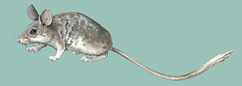
Calomyscids are small and mouselike in overall appearance, hence the common name of the family. The length of the head and body ranges from 61 to 98 mm, the length of the tail ranges from 72 to 102 mm, and the weight ranges from 15 to 30 grams. There is no apparent sexual dimorphism. The tail is at least as long as the head and body combined, and the ears are large and prominent. The fur is fine and soft; the dorsal surface is pinkish, sandy or gray-brown and the paws and venter are white. The top of the tail is dark and the underside is white, it is covered in thick fur and has a tuft at the tip. There are six mammae. Unlike hamsters in the subfamily Cricetinae, calomyscids lack cheek pouches and sebaceous flank glands. (Nowak, 1999; Tofts, 2003; Vorontsov and Potapova, 1979)

- Other Physical Features
- endothermic
- homoiothermic
- bilateral symmetry
- Sexual Dimorphism
- sexes alike
Reproduction
No information is available on the mating system of mouselike hamsters.
Calomyscids have a long breeding season that begins in March and may last through December. In captivity, breeding may take place year round. The gestation period is about 21 days. Normally females have two litters per year, with 3 to 7 young per litter. (Nowak, 1999; Tofts, 2003)
- Key Reproductive Features
- iteroparous
- seasonal breeding
- gonochoric/gonochoristic/dioecious (sexes separate)
- sexual
- fertilization
- viviparous
Female calomyscids build nests of grasses and other soft materials in which to give birth. The young are altricial, and the eyes open about 13 days after birth. Also at about this time, the young grow their first coat of soft gray fur. Females nurse their offspring for about 17 days, and the young leave their mother 4 to 13 days later. Juveniles become sexually mature at four months of age, but do not reach full adult size and color for another two to four months. (Nowak, 1999; Tofts, 2003)
- Parental Investment
- altricial
-
pre-fertilization
- provisioning
-
protecting
- female
-
pre-hatching/birth
-
provisioning
- female
-
protecting
- female
-
provisioning
-
pre-weaning/fledging
-
provisioning
- female
-
protecting
- female
-
provisioning
Lifespan/Longevity
No information is available on the longevity of mouselike hamsters, although it is likely that they live only about 1 to 2 years in the wild.
Behavior
Calomyscids are active year round. In summer they are strictly nocturnal, but they are active at any time of the day or night in the fall and winter. They are good climbers, but never forage far from a rock crevice where they can seek shelter quickly. Calomyscids are not highly social; however, they sometimes nest in the same rock crevices or huddle together for warmth. In captivity, individuals can coexist peacefully in the same cage. Captive individuals are reported to be inquisitive and eager to investigate any disturbance that takes place near their enclosure. (Nowak, 1999; Tofts, 2003)
Communication and Perception
Like many other muroid rodents, calomyscids probably have keen senses of smell and touch. Their large, prominant ears indicate that they have a good sense of hearing as well. They are usually silent, but they do sometimes emit high-pitched chirps that may function in communication. (Tofts, 2003)
- Communication Channels
- acoustic
Food Habits
Seeds make up the main portion of the calomyscid diet, but flowers and leaves are eaten as well. In addition, these rodents readily eat animal matter, including insects and sometimes carrion. (Nowak, 1999; Tofts, 2003)
Predation
There are no reports of predation on calomyscids. However, they are most likely eaten by predators that consume other rodents, such as owls, snakes, and small carnivorous mammals. Calomyscids are extremely agile and adept at escaping would-be predators. When threatened, they dart into the nearest rock crevice for shelter. If caught in the open, they are capable of running very fast and jumping over 30 cm into the air to evade pursuers. (Nowak, 1999; Tofts, 2003)
-
- Known Predators
-
- owls Strigiformes
- snakes Serpentes
- carnivorous mammals Carnivora
Ecosystem Roles
Mouselike hamsters are primary and secondary consumers and they are, in turn, consumed by other animals.
Economic Importance for Humans: Positive
Calomyscids have been imported into Europe by zoos in recent years and are sometimes kept as pets by rodent enthusiasts. They have also been used for research in Russian laboratories. (Tofts, 2003)
- Positive Impacts
- pet trade
- research and education
Economic Importance for Humans: Negative
There are no known negative impacts of calomyscids on humans.
Conservation Status
Hotson's mouse-like hamster (Calomyscus hotsoni) is listed as endangered by the IUCN. Three other species are listed as lower risk: Afghan mouse-like hamster (Calomyscus mystax), Tsolov's mouse-like hamster (Calomyscus tsolovi), and Urarstk mouse-like hamster (Calomyscus urartensis). Sightings of calomyscids in the wild are rare, and much research is still needed to fully understand the biology of this family of rodents and to assess the status of their populations. (IUCN, 2004; Tofts, 2003)
-
- IUCN Red List [Link]
- Not Evaluated
Other Comments
The earliest known calomyscid fossils are from upper Pleiocene deposits on the Isle of Rhodes in the Aegean Sea. (Vorontsov and Potapova, 1979)
Contributors
Allison Poor (author), University of Michigan-Ann Arbor, Tanya Dewey (editor), Animal Diversity Web.
Glossary
- Palearctic
-
living in the northern part of the Old World. In otherwords, Europe and Asia and northern Africa.

- acoustic
-
uses sound to communicate
- altricial
-
young are born in a relatively underdeveloped state; they are unable to feed or care for themselves or locomote independently for a period of time after birth/hatching. In birds, naked and helpless after hatching.
- bilateral symmetry
-
having body symmetry such that the animal can be divided in one plane into two mirror-image halves. Animals with bilateral symmetry have dorsal and ventral sides, as well as anterior and posterior ends. Synapomorphy of the Bilateria.
- carnivore
-
an animal that mainly eats meat
- chaparral
-
Found in coastal areas between 30 and 40 degrees latitude, in areas with a Mediterranean climate. Vegetation is dominated by stands of dense, spiny shrubs with tough (hard or waxy) evergreen leaves. May be maintained by periodic fire. In South America it includes the scrub ecotone between forest and paramo.
- chemical
-
uses smells or other chemicals to communicate
- desert or dunes
-
in deserts low (less than 30 cm per year) and unpredictable rainfall results in landscapes dominated by plants and animals adapted to aridity. Vegetation is typically sparse, though spectacular blooms may occur following rain. Deserts can be cold or warm and daily temperates typically fluctuate. In dune areas vegetation is also sparse and conditions are dry. This is because sand does not hold water well so little is available to plants. In dunes near seas and oceans this is compounded by the influence of salt in the air and soil. Salt limits the ability of plants to take up water through their roots.
- diurnal
-
- active during the day, 2. lasting for one day.
- endothermic
-
animals that use metabolically generated heat to regulate body temperature independently of ambient temperature. Endothermy is a synapomorphy of the Mammalia, although it may have arisen in a (now extinct) synapsid ancestor; the fossil record does not distinguish these possibilities. Convergent in birds.
- fertilization
-
union of egg and spermatozoan
- folivore
-
an animal that mainly eats leaves.
- granivore
-
an animal that mainly eats seeds
- herbivore
-
An animal that eats mainly plants or parts of plants.
- insectivore
-
An animal that eats mainly insects or spiders.
- internal fertilization
-
fertilization takes place within the female's body
- iteroparous
-
offspring are produced in more than one group (litters, clutches, etc.) and across multiple seasons (or other periods hospitable to reproduction). Iteroparous animals must, by definition, survive over multiple seasons (or periodic condition changes).
- motile
-
having the capacity to move from one place to another.
- native range
-
the area in which the animal is naturally found, the region in which it is endemic.
- nocturnal
-
active during the night
- omnivore
-
an animal that mainly eats all kinds of things, including plants and animals
- pet trade
-
the business of buying and selling animals for people to keep in their homes as pets.
- scavenger
-
an animal that mainly eats dead animals
- scrub forest
-
scrub forests develop in areas that experience dry seasons.
- seasonal breeding
-
breeding is confined to a particular season
- sedentary
-
remains in the same area
- sexual
-
reproduction that includes combining the genetic contribution of two individuals, a male and a female
- solitary
-
lives alone
- tactile
-
uses touch to communicate
- temperate
-
that region of the Earth between 23.5 degrees North and 60 degrees North (between the Tropic of Cancer and the Arctic Circle) and between 23.5 degrees South and 60 degrees South (between the Tropic of Capricorn and the Antarctic Circle).
- terrestrial
-
Living on the ground.
- visual
-
uses sight to communicate
- viviparous
-
reproduction in which fertilization and development take place within the female body and the developing embryo derives nourishment from the female.
References
Carleton, M., G. Musser. 1984. Muroid rodents. Pp. 289-379 in S Anderson, J Jones Jr., eds. Orders and Families of Recent Mammals of the World. New York: John Wiley and Sons.
Chaline, J., P. Mein, F. Petter. 1977. Les grandes lignes d'une classification évolutive des Muroidea. Mammalia, 41: 245-252.
Ellerman, J. 1941. The Families and Genera of Living Rodents, vol. 2. London: British Museum (Natural History).
Ellerman, J. 1940. The Families and Genera of Living Rodents, vol. I. London: British Museum (Natural History).
IUCN, 2004. "IUCN Red List of Threatened Species" (On-line). Accessed March 28, 2005 at www.redlist.org.
Jansa, S., M. Weksler. 2004. Phylogeny of muroid rodents: relationships within and among major lineages as determined by IRBP gene sequences. Molecular Phylogenetics and Evolution, 31: 256-276.
Michaux, J., A. Reyes, F. Catzeflis. 2001. Evolutionary history of the most speciose mammals: molecular phylogeny of Muroid rodents. Molecular Biology and Evolution, 18(11): 2017-2031.
Musser, G., M. Carleton. 2005. Superfamily Muroidea. D Wilson, D Reeder, eds. Mammal Species of the World. Baltimore and London: Johns Hopkins University Press.
Nowak, R. 1999. Walker's Mammals of the World, v. 2. Baltimore and London: The Johns Hopkins University Press.
Pavlinov, I. 1980. Taxonomic status of Calomyscus Thomas (Rodentia, Cricetidae) on the basis of the structure of auditory ossicles. Zoologichesky Zhurnal, 59: 312-316.
Steppan, S., R. Adkins, J. Anderson. 2004. Phylogeny and divergence-date estimates of rapid radiations in Muroid rodents based on multiple nuclear genes. Systematic Biology, 53(4): 533-553.
Tofts, R. 2003. "The Mouselike Hamster (Calomyscus sp.)" (On-line). Accessed March 29, 2005 at http://www.napak.com/mouselike_hamster.html.
Vorontsov, N., E. Potapova. 1979. Taxonomy of the genus Calomyscus (Cricetidae). 2. Status of Calomyscus in the system of Cricetinae. Zoologichesky Zhurnal, 58: 1391-1397.