Callipepla californicaCalifornia quail(Also: Californian quail)



Geographic Range
Western United States, British Columbia, Chile, and New Zealand: The California Quail Callipepla californica can be found in the Pacific coast region of the United States. Its original range stretched from Baja California to a small portion of Western Nevada and the southern counties of Oregon. The California Quail is kept as a pet and is favored as a game bird. Because of this, the California Quail has been successfully introduced to other regions of the United States such as Northern Nevada, New Mexico, Hawaii, and Utah. It has also been introduced in Chile, New Zealand, and British Columbia (National Geographic: Field Guide to the Birds of North America 1999;Leopold 1977).
- Biogeographic Regions
- nearctic
- neotropical
- australian
Habitat
California quail are most commonly found in the west coast regions of the United States. California quail prefer living in open woodlands, bushy foothills, valleys with streams, and suburbs. They can also live in brushland and agricultural land (National Geographic 1999; Handbook of the Birds of the World, Volume 2).
- Habitat Regions
- temperate
- terrestrial
- Terrestrial Biomes
- savanna or grassland
- chaparral
- forest
- scrub forest
Physical Description
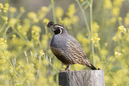
Average weight of California quail is between 150.6 g to 189.5 g (5 - 7 oz.). Males are slightly heavier. An adult California quail grows to be 25 cm (9.8 in) in length. They have a distinctive black and white pattern on the face and belly has black and brown feather tips which makes the California quail look like it has scaled underparts. The overall color is blue-grey and brown. The crown is chestnut colored with streaking along the sides. California quail have black bills and grey legs. Sexes are dimorphic. The males have a black throat and the females have more of a greyish colored throat with black streaks. California quail can be identified by their prominent teardrop-shaped plume or a double plume on the forehead. Immature California quail have general coloration of mostly greys and browns which gives it a cryptic look (National Geographic 1999;World Book 2000;Handbook of the Birds of the World. Volume 2).
- Other Physical Features
- endothermic
- homoiothermic
- bilateral symmetry
- Sexual Dimorphism
- male larger
- sexes colored or patterned differently
- ornamentation
-
- Range mass
- 150.6 to 189.5 g
- 5.31 to 6.68 oz
Reproduction
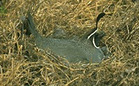
When the winter days start to lengthen, the pituitary glands of California quail start to release gonadotropic hormones. The blood stream then carries these hormones to the gonads, which initiates the growth and development of ovaries and testes. The most typical time for egg fertilization is during May, June, and July. These three months are when viable sperm is at its highest concentration in males. Females lay their eggs between May and June. If California quail do not successfully nest on their first attempt, they then make a second nesting attempt later in the summer. Their nests are made in shallow scrapes in the ground lined with grass. They can lay from 6 to 28 eggs, with 13 to 17 eggs being the average. Eggs are pointed ovals which measure on average 31.6 by 24.1 mm (1.24 by .95 in). The eggs are creamy white in color with light golden brown spots. ("Grzimek's Animal Encyclopedia", 1972; Leopold, 1977; National Geographic, 1999)
- Key Reproductive Features
- iteroparous
- seasonal breeding
- gonochoric/gonochoristic/dioecious (sexes separate)
- sexual
- fertilization
- oviparous
-
- Breeding interval
- Breeding occurs once yearly.
-
- Breeding season
- Breeding occurs between May and July.
-
- Range eggs per season
- 6 to 28
-
- Average eggs per season
- 14
- AnAge
-
- Range time to hatching
- 22 to 23 days
Females incubate the eggs with the male close at hand to tend to her. Incubation lasts 22 to 23 days. In the event of the female's death, the male may assume incubation duties. Chicks hatch synchronously and begin running about within an hour of hatching (precocial) (Leopold 1977;Grizmek's Animal Encyclopedia 1972). ("Grzimek's Animal Encyclopedia", 1972; Leopold, 1977)
- Parental Investment
- precocial
- male parental care
- female parental care
Lifespan/Longevity
-
- Average lifespan
Status: wild - 83 months
- Bird Banding Laboratory
- Average lifespan
Behavior
In fall, California Quail are quite social and travel in small groups, or coveys. These vary in size, typically ranging from 25 to 40 birds but coveys in excess of 1000 birds have been reprted. In spring, when mating and nesting season starts, coveys disintegrate as individual birds begin to pair up and males defend teritories as well as mates. After pairing California quail find a well hidden area so they can prepare their scrapes. Females then lay eggs and incubate them with the male close at hand until the eggs hatch. These family groups avoid confrontations with others until the chicks are grown. California quail are sedentary birds and maximum movements have been recorded up to 27 km (16.8 miles). California quail have been timed in flight at 61.2 to 93 km (38 to 58 miles) per hour. Their ground speed has been timed at 19.3 km (12 miles) per hour (Leopold 1977;Grizmek's Animal Encyclopedia 1972). ("Grzimek's Animal Encyclopedia", 1972; Leopold, 1977)
- Key Behaviors
- terricolous
- flies
- diurnal
- motile
- sedentary
- territorial
- social
Communication and Perception
Food Habits
The primary daily diet of California quailconsists of seeds from broad-leafed plants, such as Lupinus, Lotus, Erodium, Trifolium, Medicago, and Amsinckia. If available, they also eat fruits, berries, and insects(Leopold 1977). (Leopold, 1977)
- Animal Foods
- insects
- Plant Foods
- seeds, grains, and nuts
- fruit
Economic Importance for Humans: Positive
California quail are sometimes kept as pets and are hunted as a source of food. (Leopold 1977).
Economic Importance for Humans: Negative
There are no negative impacts of California quail on humans.
Conservation Status
-
- IUCN Red List
-
Least Concern
More information
-
- IUCN Red List
-
Least Concern
More information
-
- US Federal List
- No special status
-
- CITES
- No special status
Other Comments
The California Quail is so seclusive and secretive in leaving and approaching their nests that relatively few nests have ever been found (Leopold 1977).
Contributors
Zebulon Price (author), Fresno City College, Carl Johansson (editor), Fresno City College.
Glossary
- Australian
-
Living in Australia, New Zealand, Tasmania, New Guinea and associated islands.

- Nearctic
-
living in the Nearctic biogeographic province, the northern part of the New World. This includes Greenland, the Canadian Arctic islands, and all of the North American as far south as the highlands of central Mexico.
- Neotropical
-
living in the southern part of the New World. In other words, Central and South America.
- acoustic
-
uses sound to communicate
- bilateral symmetry
-
having body symmetry such that the animal can be divided in one plane into two mirror-image halves. Animals with bilateral symmetry have dorsal and ventral sides, as well as anterior and posterior ends. Synapomorphy of the Bilateria.
- chaparral
-
Found in coastal areas between 30 and 40 degrees latitude, in areas with a Mediterranean climate. Vegetation is dominated by stands of dense, spiny shrubs with tough (hard or waxy) evergreen leaves. May be maintained by periodic fire. In South America it includes the scrub ecotone between forest and paramo.
- chemical
-
uses smells or other chemicals to communicate
- diurnal
-
- active during the day, 2. lasting for one day.
- endothermic
-
animals that use metabolically generated heat to regulate body temperature independently of ambient temperature. Endothermy is a synapomorphy of the Mammalia, although it may have arisen in a (now extinct) synapsid ancestor; the fossil record does not distinguish these possibilities. Convergent in birds.
- female parental care
-
parental care is carried out by females
- fertilization
-
union of egg and spermatozoan
- food
-
A substance that provides both nutrients and energy to a living thing.
- forest
-
forest biomes are dominated by trees, otherwise forest biomes can vary widely in amount of precipitation and seasonality.
- granivore
-
an animal that mainly eats seeds
- herbivore
-
An animal that eats mainly plants or parts of plants.
- internal fertilization
-
fertilization takes place within the female's body
- introduced
-
referring to animal species that have been transported to and established populations in regions outside of their natural range, usually through human action.
- iteroparous
-
offspring are produced in more than one group (litters, clutches, etc.) and across multiple seasons (or other periods hospitable to reproduction). Iteroparous animals must, by definition, survive over multiple seasons (or periodic condition changes).
- male parental care
-
parental care is carried out by males
- motile
-
having the capacity to move from one place to another.
- native range
-
the area in which the animal is naturally found, the region in which it is endemic.
- oviparous
-
reproduction in which eggs are released by the female; development of offspring occurs outside the mother's body.
- pet trade
-
the business of buying and selling animals for people to keep in their homes as pets.
- riparian
-
Referring to something living or located adjacent to a waterbody (usually, but not always, a river or stream).
- scrub forest
-
scrub forests develop in areas that experience dry seasons.
- seasonal breeding
-
breeding is confined to a particular season
- sedentary
-
remains in the same area
- sexual
-
reproduction that includes combining the genetic contribution of two individuals, a male and a female
- sexual ornamentation
-
one of the sexes (usually males) has special physical structures used in courting the other sex or fighting the same sex. For example: antlers, elongated tails, special spurs.
- social
-
associates with others of its species; forms social groups.
- suburban
-
living in residential areas on the outskirts of large cities or towns.
- tactile
-
uses touch to communicate
- temperate
-
that region of the Earth between 23.5 degrees North and 60 degrees North (between the Tropic of Cancer and the Arctic Circle) and between 23.5 degrees South and 60 degrees South (between the Tropic of Capricorn and the Antarctic Circle).
- terrestrial
-
Living on the ground.
- territorial
-
defends an area within the home range, occupied by a single animals or group of animals of the same species and held through overt defense, display, or advertisement
- tropical savanna and grassland
-
A terrestrial biome. Savannas are grasslands with scattered individual trees that do not form a closed canopy. Extensive savannas are found in parts of subtropical and tropical Africa and South America, and in Australia.
- savanna
-
A grassland with scattered trees or scattered clumps of trees, a type of community intermediate between grassland and forest. See also Tropical savanna and grassland biome.
- temperate grassland
-
A terrestrial biome found in temperate latitudes (>23.5° N or S latitude). Vegetation is made up mostly of grasses, the height and species diversity of which depend largely on the amount of moisture available. Fire and grazing are important in the long-term maintenance of grasslands.
- visual
-
uses sight to communicate
- young precocial
-
young are relatively well-developed when born
References
1972. Grzimek's Animal Encyclopedia. New York: Van Nostrand Reinhold Company.
2000. World Book Millenium 2000. Chicago: World Book Inc..
Hoyo, J., A. Elliot, J. Sargatal. 1999. Handbook of the Birds of the World, Volume 2. Barcelona: Lynx Edicions.
Leopold, A. 1977. The California Quail. Berkeley, Los Angeles, California: University of California Press.
National Geographic, 1999. National Geographic: Field Guide to the Birds of North America. Washington, D.C.: National Geographic.