Caiman latirostrisBroad-snouted caiman



Geographic Range
Broad-snouted caimans (Caiman latirostris) are found in northeastern South America. Their geographic range extends from northeast Argentina to southeastern Bolivia and Paraguay to the northern portion of Uruguay. This species thrives in swampy slow-moving freshwater and warmer climates. (Britton, 2010; Verdade, 2008)
- Biogeographic Regions
- neotropical
Habitat
Broad-snouted caiman habitat overlaps with that of Yacare caimans (Caiman yacare). In places where overlap occurs, C. latirostris has adapted to life in mangroves with heavy vegetation, swamps and they have been increasingly found in cattle stock ponds. They are also often found in drainage ditches from the Atlantic ocean. Both species are found at elevations of approximately 600 m. This seems to be due to their darker coloration, which allows each species to absorb more sunlight and to regulate their body temperatures at higher, cooler elevations. (Britton, 2010; Pina, 2002; Verdade, 2008)
- Habitat Regions
- tropical
- terrestrial
- freshwater
- Aquatic Biomes
- lakes and ponds
- brackish water
- Wetlands
- swamp
- Other Habitat Features
- agricultural
- estuarine
-
- Range elevation
- 600 (high) m
- 1968.50 (high) ft
Physical Description
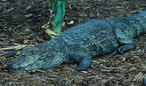
Broad-snouted caimans are medium-sized crocodilians with a reported maximum length of 3.5 m. Average length is 2 m in captivity. Compared to related species like black caimans (Melanosuchus niger), which can exceed 5m in length, broad-snouted caimans are considered small. Their coloration ranges from black and brown to an olive-greenish hue. They have a tubercle, a small projection of the scales, between the eyes. Broad-snouted caimans have soft hides that are one of the most highly coveted of all crocodile skins. It is a subject of debate wether or not true subspecies exists. Some say Argentinian populations of C. latirostris that are small (less than 2m) should be classified as C. latirostris chacoensis. (Britton, 2010; Pina, 2002; Verdade, 2008)
- Other Physical Features
- ectothermic
- heterothermic
- bilateral symmetry
- Sexual Dimorphism
- male larger
-
- Range length
- 3.5 (high) m
- 11.48 (high) ft
-
- Average length
- 2 m
- 6.56 ft
Development
Embryos of C. latirostris hatch after 70 days. Embryos have a notochord by day 2, blood vessels are present by day 5, and limbs are starting to form around day 18. From day 60 on, not much new development occurs, the yolk sac becomes nourishhment for the embryo and the yolk scar begins to form. Sex is determined by temperature. There is a specific period during incubation where the egg can become either sex with the application or reduction of heat. After this temperature sensitive period the sex can no longer be changed. All C. latirostris eggs incubated at temperatures of 29 to 31 degrees become females, while hatchlings incubated at 33 degrees are all males. (Iungman, et al., 2008; Pina and Larriera, 2003)
- Development - Life Cycle
- temperature sex determination
Reproduction
Mating behavior in broad-snouted caimans is not well described in the literature. (Pina and Larriera, 2003; Verdade, 2008)
- Mating System
- polygynandrous (promiscuous)
Each clutch contains between 20 and 50 eggs. Nest predation decreases clutch size and sometimes larger broad-snouted caimans will eat hatchlings and eggs. The gestation period is about 70 days. The gestational period has been broken down in 28 phases or steps of development that monitor size and the specialization of tissues. It is thought that the first rains may stimulate ovulation in female broad-snouted caimans. Other crocodilians of similar size to C. latirostris have hatchlings that measure an average of 30 g at birth. (Larriera, et al., 2006; Verdade, 2008)
The age of sexual reproduction is not yet known, though females as young a 4 years, 10 months have laid eggs. The hatchlings emerge as small versions of mature broad-snouted caimans. (Pina and Larriera, 2003)
- Key Reproductive Features
- iteroparous
- seasonal breeding
- gonochoric/gonochoristic/dioecious (sexes separate)
- sexual
- induced ovulation
- oviparous
-
- Breeding interval
- Broad snouted caimans breed during the rainy season each year. It is thought that the first rains stimualte ovulation in females.
-
- Breeding season
- Breeding and nesting vary by region. In Brazil, breeding occurs from August to January. In Uruguay they breed in January and, in Argentina, these caimans breed from January to March.
-
- Range number of offspring
- 20 to 50
-
- Average number of offspring
- 30
-
- Average gestation period
- 70 days
-
- Range age at sexual or reproductive maturity (female)
- 4 to 10 years
-
- Average age at sexual or reproductive maturity (female)
- 5 years
-
- Range age at sexual or reproductive maturity (male)
- 4 to 6 years
Though broad-snouted caiman mothers invest in their young through supplying eggs with nutrition and building and protecting nests, it is unknown how long that investment lasts or when independence is achieved. A female C. latirostris is very protective of her nest and will guard it with some help from the father (only seen in captive populations). Hatchlings communicate with their mother through hatching calls a few days prior to hatching. Similar to other reptiles, they have an egg tooth on the top of the snout, with which they chip at the egg. Mothers may gently take the egg in her jaws and apply slight pressure in order to help crack the egg. There may be some protection of young after hatching, as in other crocodilians. (Amavet, et al., 2009)
- Parental Investment
- male parental care
- female parental care
-
pre-fertilization
-
protecting
- male
-
protecting
-
pre-hatching/birth
-
provisioning
- female
-
protecting
- male
- female
-
provisioning
-
pre-weaning/fledging
-
provisioning
- female
-
provisioning
Lifespan/Longevity
Broad-snouted caimans have been reported to live 22 years (maximum lifespan) in captivity. (Snider and Bowler, 1992)
-
- Range lifespan
Status: captivity - 22 (high) years
- Range lifespan
Behavior
Broad-snouted caimans are prized for their ultra-soft hides and have been sought after by hunters for the last 100 years. As a result, a large portion of broad-snouted caimans today live in captive ranching programs in South America. Much less is known about broad-snouted caimans in the wild. A recent observation of this species in the wild, however, described its exhibition of passive feeding behavior. One caiman sat, mouth open, under a small flow of water. Every few minutes, prey would land in its mouth and it would close and swallow. More research will be conducted, as this was only observed in one individual.
It has been suggested that there may be differences in behavior between captive and wild populations. For example, in captive populations, C. latirostris males sometimes aid females with nest-building. This behavior has never been documented in wild populations. (Pina, et al., 2003; Verdade, 2008)
- Key Behaviors
- natatorial
- crepuscular
- motile
- sedentary
- aestivation
- solitary
- territorial
- dominance hierarchies
Home Range
These crocodilians are thought to have a established home ranges, as they are highly territorial when approached. However, territory size has not yet been documented.
Communication and Perception
Specific information on broad-snouted caimans is not available. Crocodilian communication has received relatively little study. However, among several species, different calls have been identified. It is known that crocodilians communicate acoustically and that most noises are short, monosyllabic, and very repetitive. They become less vocal as they mature.
There are two variations of calls, those of juveniles and those of adults. Juveniles emit hatching calls, which include the noises that can be heard pre-hatching. These calls function to maintain synchrony among hatchlings. One hatched they emit contact calls which aid in location and keeping them close together. Hatchlings also displays distress calls that may induce parental protection.
Among the adult population, communication dwindles with maturity, though audible communication is a large part of courtship rituals. Mates will bellow during courship, usually when the crocodile is in the water. Maternal growls are the way in which mothers communicate with their hatchlings while still in the egg and is thought to facilitate offspring recognition. Hisses may be used when the mother in defending her nest against predators, and may actually deter predators. (Britton, 2010; Kelly, 2006; Larriera, et al., 2004; Larriera, et al., 2006; Pina, et al., 2007a; Pina, et al., 2007b; Pina, 2002; Pina, et al., 2003)
- Communication Channels
- acoustic
- Other Communication Modes
- vibrations
- Perception Channels
- visual
- tactile
- acoustic
- vibrations
- chemical
Food Habits
Broad-snouted caimans have a diverse diet consisting of aquatic snails, small fish, and amphibians. As they mature, they are able to eat larger prey, such as larger fish, reptiles, and amphibians. The broad snout of these caimans are well-suited for crushing mollusc shells. (Britton, 2010; Verdade, 2008)
- Primary Diet
-
carnivore
- eats terrestrial vertebrates
- piscivore
- molluscivore
- Animal Foods
- amphibians
- reptiles
- fish
- insects
- mollusks
- aquatic crustaceans
Predation
The only predator of mature broad-snouted caimans appears to be humans. Broad-snouted caimans are in high demand because of their skin, which is one of the softest available. They were poached nearly to extinction in the early's 1990's but have made a significant recovery due to ranching programs, like Proyecto Yacare in Argentina. Ranching programs harvest eggs and raise hatchlings to be reintroduced into the wild. Eggs and young broad-snouted caimans may be eaten by a wide variety of medium to large sized predators. Broad-snouted caimans are cryptically colored to prevent predators and prey from seeing them. (Britton, 2010; Pina and Larriera, 2003; Pina, et al., 2003)
- Anti-predator Adaptations
- cryptic
-
- Known Predators
-
- humans (Homo sapiens)
Ecosystem Roles
Little is known about the roles these crocodilians play in their ecosystem. They are likely to be important predators of small animals in their aquatic habitats. (Simoncini, et al., 2009; Simoncini, et al., 2009)
- Ecosystem Impact
- creates habitat
Economic Importance for Humans: Positive
Broad-snouted caimans are prized for their ultra-soft hides. Hunting in the 1990's led to severe population declines. This species was placed on the Endangered Species List in 1994. They are now making a recovery due to ranching programs. (Britton, 2010; Larriera, et al., 2006; Verdade, 2008)
- Positive Impacts
- body parts are source of valuable material
Economic Importance for Humans: Negative
In areas where their habitat overlaps with C. yacare, C. latirostris has colonized cattle stock ponds. Here they are considered a potential nuisance for farmers and their livestock. (Iungman, et al., 2008)
Conservation Status
Commercial hunting has threatened wild populations of C. latirostris. Most hunting occurs for its skin, especially well-suited to tanning. Their skin is considered more valuable that that of other species of caiman. Caiman latirostris was placed on the Endangered Species List in 1994, as populations declined with over-hunting. This species continues to be listed in CITES Appendix I (threatened with extinction) throughout its natural range, except in Argentina, where populations have begun to rebound in response to ranching programs like Proyecto Yacare. As a result of ranching programs, Argentinian populations have been elevated to Appendix II status (no longer threatened with extinction, but a species for which trade needs to be controlled). Some illegal hunting of C. latirostris still occurs, but is considered less of a threat than in the past, because other species are more readily available for hunting. The size of wild C. latirostris populations is estimated at approximately 250,000 to 500,000 individuals. Currently, habitat destruction and water pollution are the greatest threat to C. latirostris populations, most notably deforestation for agriculture (land clearing and draining) and hydroelectric power throughout its range in Brazil and Uruguay. (Britton, 2010; Pina and Larriera, 2003)
-
- IUCN Red List
-
Lower Risk - Least Concern
More information
-
- IUCN Red List
-
Lower Risk - Least Concern
More information
-
- US Federal List
- Endangered
-
- CITES
- Appendix I Appendix II
-
- State of Michigan List
- No special status
Contributors
Kelsey Rayburn (author), Radford University, Christine Small (editor), Radford University, Tanya Dewey (editor), University of Michigan-Ann Arbor.
Glossary
- Neotropical
-
living in the southern part of the New World. In other words, Central and South America.

- acoustic
-
uses sound to communicate
- agricultural
-
living in landscapes dominated by human agriculture.
- bilateral symmetry
-
having body symmetry such that the animal can be divided in one plane into two mirror-image halves. Animals with bilateral symmetry have dorsal and ventral sides, as well as anterior and posterior ends. Synapomorphy of the Bilateria.
- brackish water
-
areas with salty water, usually in coastal marshes and estuaries.
- carnivore
-
an animal that mainly eats meat
- chemical
-
uses smells or other chemicals to communicate
- crepuscular
-
active at dawn and dusk
- cryptic
-
having markings, coloration, shapes, or other features that cause an animal to be camouflaged in its natural environment; being difficult to see or otherwise detect.
- dominance hierarchies
-
ranking system or pecking order among members of a long-term social group, where dominance status affects access to resources or mates
- ectothermic
-
animals which must use heat acquired from the environment and behavioral adaptations to regulate body temperature
- estuarine
-
an area where a freshwater river meets the ocean and tidal influences result in fluctuations in salinity.
- female parental care
-
parental care is carried out by females
- freshwater
-
mainly lives in water that is not salty.
- heterothermic
-
having a body temperature that fluctuates with that of the immediate environment; having no mechanism or a poorly developed mechanism for regulating internal body temperature.
- induced ovulation
-
ovulation is stimulated by the act of copulation (does not occur spontaneously)
- iteroparous
-
offspring are produced in more than one group (litters, clutches, etc.) and across multiple seasons (or other periods hospitable to reproduction). Iteroparous animals must, by definition, survive over multiple seasons (or periodic condition changes).
- male parental care
-
parental care is carried out by males
- molluscivore
-
eats mollusks, members of Phylum Mollusca
- motile
-
having the capacity to move from one place to another.
- natatorial
-
specialized for swimming
- native range
-
the area in which the animal is naturally found, the region in which it is endemic.
- oviparous
-
reproduction in which eggs are released by the female; development of offspring occurs outside the mother's body.
- piscivore
-
an animal that mainly eats fish
- polygynandrous
-
the kind of polygamy in which a female pairs with several males, each of which also pairs with several different females.
- seasonal breeding
-
breeding is confined to a particular season
- sedentary
-
remains in the same area
- sexual
-
reproduction that includes combining the genetic contribution of two individuals, a male and a female
- solitary
-
lives alone
- swamp
-
a wetland area that may be permanently or intermittently covered in water, often dominated by woody vegetation.
- tactile
-
uses touch to communicate
- terrestrial
-
Living on the ground.
- territorial
-
defends an area within the home range, occupied by a single animals or group of animals of the same species and held through overt defense, display, or advertisement
- tropical
-
the region of the earth that surrounds the equator, from 23.5 degrees north to 23.5 degrees south.
- vibrations
-
movements of a hard surface that are produced by animals as signals to others
- visual
-
uses sight to communicate
References
Amavet, P., E. Rosso, R. Markariani, C. Pina. 2008. Microsatellite DNA Markers Applied to Detection of Multiple Paternity in C. latirostris in Santa Fe, Argentina. Journal or Experimental Zoology, 309A: 637-642.
Amavet, P., J. Villardi, E. Rosso, B. Saidman. 2009. Genetic and Morphometric Variability in Caiman latirostris (broad-snouted caiman). Journal of Experimental Zoology, 311A/4: 258-269.
Britton, A. 2010. "Crocodilian Species - Broad-snouted Caiman (Caiman latirostris)" (On-line). Crocodilians: Natural History & Conservation: Crocodilian.com. Accessed October 10, 2010 at http://www.flmnh.ufl.edu/cnhc/csp_clat.htm.
Iungman, J., C. Pina, P. Siroski. 2008. Embryological Development of Caiman latirostris. Genesis, 46: 401-417.
Kelly, L. 2006. Evolution's Greatest Survivor Crocodile. Crows Nest, Australia: Allen and Unwin.
Larriera, A., C. Pina, P. Siroski, L. Verdade. 2004. Allometry of Reproduction in Wild Broad-Snouted Caimans (Caiman latirostris). Society for the Study of Amphibians and Reptiles, 38/2: 301-304.
Larriera, A., P. Siroski, C. Pina, A. Imhof. 2006. Sexual Maturity of Farm-Released Caiman latirostris (Crocodylia: Alligatoridae) in the Wild. Hepretological Review, 37/1: 26-28.
Pina, C., A. Larriera, M. Cabrera. 2003. Effect of Incubation Temperature on Incubation Period, Sex Ratio, Hatching Success, and Survivorship in Caiman latirostris. Journal of Herpetology, 37/1: 199-202.
Pina, C., P. Siroski, A. Larriera, V. Lance, L. Verdade. 2007. The temperature-sensitive period (TSP) during incubation of broad-snouted caiman (Caiman latirostris) eggs. Amphibia-Reptilia, 28: 123-128.
Pina, C. 2002. Thermoregulation. Herpetological Review, 33/2: 133.
Pina, C., A. Larriera. 2003. Crocodylia. Herpetological Review, 34/1: 72.
Pina, C., A. Larriera, M. Medina, G. Webb. 2007. Effects of Incubation Temperature on the Size of Caiman latirostris (Crocodylia: Alligatoridae) at Hatching and after One Year. Journal of Herpetology, 41/2: 205-210.
Poletta, G., A. Larierra, E. Kleinsorge, M. Mudry. 2007. Caiman latirostris (broad-snouted caiman) as a sentinel organism for genotoxic monitoring: Basal values determination of micronucleus and comet assay. Science Direct:College Edition, 650/2: 202-209.
Simoncini, M., C. Pina, P. Siroski. 2009. Clutch size of Caiman latirostris (Crocodylia: Alligatoridae) varies on a latitudinal gradient. North-Western Journal of Zoology, 5/1: 191-196.
Snider, A., J. Bowler. 1992. Longevity of reptiles and amphibians in North American collections, 2nd edition. Oxford, OH: Society for the Study of Amphibians and Reptiles.
Verdade, L. 2008. "Species List-Caiman Latirostris" (On-line). Crocodile Specialist Group. Accessed October 02, 2010 at http://iucncsg.org/ph1/modules/Home/.