Cacatua galeritasulphur-crested cockatoo


Geographic Range
Cacatua galerita is native to the Australian Region and occurs in large numbers in the north and east of Australia. It has been introduced to western Australia, New Zealand and New Guinea. ("Australian Museum", 2003; Berra, 1998)
- Biogeographic Regions
- australian
- oceanic islands
Habitat
Sulphur-crested cockatoos dwell in a variety of timbered habitats such as tropical and subtropical rainforests. They are also found in the vast savannas of northern Australia. Sulphur-crested cockatoos also occur in suburban and urban areas, especially in parks and gardens. (Cody, 1993; Sibley and Monroe, 1990)
- Habitat Regions
- tropical
- terrestrial
- Terrestrial Biomes
- savanna or grassland
- forest
-
- Range elevation
- 0 to 1450 m
- 0.00 to 4757.22 ft
-
- Average elevation
- 300-600 m
- ft
Physical Description
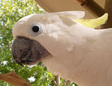
Sulphur-crested cockatoos are large birds, measuring 45 to 50 centimeters in length. Their average weight is 800 grams. Sulphur-crested cockatoos are white with a distinctive sulphur-yellow crest which can be erected or held folded down on top of head. The underside of their wings and tail is pale yellow. Females and males are similar in appearance (monomorphic); however, females can be identified at close range by their red tinted brown eyes, whereas males have darker brown eyes. There are four subspecies of sulphur-crested cockatoos. Cacatua galerita fitzroyi differs from C. g. galerita in having a pale blue eye ring instead of white, the yellow feathers are slightly darker, and the crest feathers are longer. Cacatua galerita eleonora and C. g. triton both average smaller in overall size than C. g. galerita. ("Australian Museum", 2003; Bell, 1969; Dobbs and Highfill, 2003)
- Other Physical Features
- endothermic
- homoiothermic
- bilateral symmetry
- Sexual Dimorphism
- sexes colored or patterned differently
-
- Range mass
- 700 to 950 g
- 24.67 to 33.48 oz
-
- Average mass
- 800 g
- 28.19 oz
-
- Average length
- 50 cm
- 19.69 in
-
- Average wingspan
- 103 cm
- 40.55 in
-
- Average basal metabolic rate
- 3.419 W
- AnAge
Reproduction
Sulphur-crested cockatoos are monogamous birds. Signs of courtship include raising of the crest, bobbing of the head, and moving the head from side to side in a figure-of-eight pattern while uttering soft chattering notes. Before mating, the birds usually preen each other's plumage. (Forshaw, 2002)
- Mating System
- monogamous
In the northern parts of their range, sulphur-crested cockatoos breed from May to September, whereas birds in the southern parts of their range breed from August to January. They generally nest in a high tree hollow, usually near water. They breed once yearly, producing a clutch containing 2 to 3 white oval eggs. Eggs hatch after an incubation period of 27 to 30 days. Fledging generally occurs at approximately 70 days. Offspring will leave the nest after this 70 day period but will remain with the parents year round. Family units will remain together indefinitely. Both male and female Cacatua galerita reach reproductive maturity around the age of 3 to 4 years. ("", 1991; "", 1985; Forshaw, 2002)
- Key Reproductive Features
- iteroparous
- seasonal breeding
- gonochoric/gonochoristic/dioecious (sexes separate)
- sexual
- oviparous
-
- Breeding interval
- Sulphur crested cockatoos breed once yearly.
-
- Breeding season
- Sulphur-crested cockatoos breed between August and January in the southern parts of their range and between May and September in the northern parts of their range.
-
- Range eggs per season
- 2 to 3
-
- Average eggs per season
- 2
- AnAge
-
- Average time to hatching
- 27 days
-
- Average time to hatching
- 27 days
- AnAge
-
- Average fledging age
- 70 days
-
- Average age at sexual or reproductive maturity (female)
- 3 to 4 years
-
- Average age at sexual or reproductive maturity (male)
- 3 to 4 years
Both parents incubate their clutch. Once the eggs hatch, chicks are fed by both parents. (Dobbs and Highfill, 2003; Forshaw, 2002)
- Parental Investment
- altricial
-
pre-fertilization
- provisioning
-
protecting
- female
-
pre-hatching/birth
-
provisioning
- female
-
protecting
- male
- female
-
provisioning
-
pre-weaning/fledging
-
provisioning
- male
- female
-
protecting
- male
- female
-
provisioning
-
pre-independence
-
provisioning
- male
- female
-
protecting
- male
- female
-
provisioning
- post-independence association with parents
Lifespan/Longevity
Sulphur-crested cockatoos can live for decades in the wild. Average lifespan is about 40 years, but they can live up to 100 years. In captivity, sulphur-crested cockatoos that are well-cared for can live for 65 years on average and up to 120 years. (Bell, 1969; "", 1991)
-
- Range lifespan
Status: wild - 57 (high) years
- Range lifespan
-
- Average lifespan
Status: wild - 40 years
- Average lifespan
-
- Range lifespan
Status: captivity - 120 (high) years
- Range lifespan
-
- Average lifespan
Status: captivity - 65 years
- Average lifespan
-
- Average lifespan
Status: wild - 40 years
- Average lifespan
-
- Average lifespan
Status: captivity - 65 years
- Average lifespan
-
- Average lifespan
Status: captivity - 57 years
- AnAge
- Average lifespan
Behavior
Cacatua galerita is a gregarious species, often forming flocks of a dozen to several hundred birds. When foraging for food these large flocks will often split into small groups, coming together again at the evening roost site. Feeding is often done on the ground, and in such situations some of the flock will be sentry birds in trees, and alert the flock of approaching danger. Sulfur-crested cockatoos generally stay sheltered during the middle of the day, resuming feeding in late afternoon and evening before drinking and returning to roost. ("", 1985; Forshaw, 2002; Perrins, 1990)
The distinctive raucous call of C. galerita is very loud; it is meant to travel great distances through the forested environment. The cacophony created by a large flock of sulphur-crested cockatoos can be deafening. (Cody, 1993; Forshaw, 2002)
Home Range
Cacatua galerita often travel long distances in a day to forage, almost always returning to their original roost site. Sulphur-crested cockatoos remain in the same general area year round. The exact home range size of C. galerita is not well documented. (Berra, 1998; Dobbs and Highfill, 2003)
Communication and Perception
Sulphur-crested cockatoos are noisy birds. Their primary method of communication is their screeching voices. They also use their crest to communicate emotion. They will raise and spread their magnificent crests when excited, such as when danger is detected or during mating. (Forshaw, 2002; Perrins, 1990)
- Other Communication Modes
- mimicry
Food Habits
Sulphur-crested cockatoos are primarily granivores in the wild, feeding both on the ground and in trees. They feed mainly on seeds, nuts, fruits, blossoms, insects and insect larvae. They will also attack newly planted and ripening grain crops. (Berra, 1998; Dobbs and Highfill, 2003; Perrins, 1990)
In captivity, C. galerita are mainly fed a diet of fresh fruits, vegetables, seeds, nuts, pellets, legumes and grains. They have a high rate of obesity so high fat foods such as peanuts and seeds are fed sparingly. (Berra, 1998; Dobbs and Highfill, 2003; Perrins, 1990)
- Animal Foods
- insects
- Plant Foods
- seeds, grains, and nuts
- fruit
- flowers
Predation
Sulphur-crested cockatoos have one primary method of detecting and avoiding predators. When feeding, a few 'sentinel' birds will perch in a tree looking out for predators. They unleash their deafening warning call when a potential predator is sighted. Their large size also protects them from predation by all but the largest birds of prey. (Bell, 1969; Forshaw, 2002; Perrins, 1990)
During the incubation period and 6 to 10 weeks thereafter, both parent birds are intentionally very quiet in order not to attract predators to their nest. ("Australian Museum", 2003)
Sulphur-crested cockatoos are known to be preyed on by powerful owls (Ninox strenua). Goannas (Varanus) are also potential predators of birds on the ground, fledglings, and nestlings. Other potential predators include common avian nest predators such as pied currawongs (Strepera graculina), butcherbirds (Cracticus), and ravens. (Forshaw, 2002)
-
- Known Predators
-
- powerful owls (Ninox strenua)
Ecosystem Roles
The role of sulphur-crested cockatoos in the ecosystems they inhabit is not well documented. They feed on seeds and nuts and may play a role in seed dispersal. (Berra, 1998; Dobbs and Highfill, 2003; Perrins, 1990)
- Ecosystem Impact
- disperses seeds
Economic Importance for Humans: Positive
Sulphur-crested cockatoos are popular pets and companion birds. Their yellow feathers have been used in ceremonial headdresses. (Forshaw, 2002)
- Positive Impacts
- pet trade
- ecotourism
Economic Importance for Humans: Negative
Sulphur-crested cockatoos can be so numerous in crop growing areas that they are often shot or poisoned as pests. Government permit is required, though, as they are a protected species under the Australian Commonwealth Law. Aside from crops, they can also be harmful to wooden structures and ornamental trees as they chew and rip at timber on houses and tree limbs. (Bell, 1969; "", 1991)
- Negative Impacts
- crop pest
Conservation Status
Sulphur-crested cockatoos are generally common and abundant. Their population is approximated at more than 500,000 individuals. It is no longer legal to import these birds to the United States as a result of the Wild Bird Conservation Act. (Berra, 1998; Forshaw, 2002; Perrins, 1990)
-
- IUCN Red List
-
Least Concern
More information
-
- IUCN Red List
-
Least Concern
More information
-
- US Migratory Bird Act
- No special status
-
- US Federal List
- No special status
-
- CITES
- Appendix II
-
- State of Michigan List
- No special status
Contributors
Tanya Dewey (editor), Animal Diversity Web.
Kyle Thomas (author), Kalamazoo College, Ann Fraser (editor, instructor), Kalamazoo College.
Glossary
- Australian
-
Living in Australia, New Zealand, Tasmania, New Guinea and associated islands.

- acoustic
-
uses sound to communicate
- altricial
-
young are born in a relatively underdeveloped state; they are unable to feed or care for themselves or locomote independently for a period of time after birth/hatching. In birds, naked and helpless after hatching.
- arboreal
-
Referring to an animal that lives in trees; tree-climbing.
- bilateral symmetry
-
having body symmetry such that the animal can be divided in one plane into two mirror-image halves. Animals with bilateral symmetry have dorsal and ventral sides, as well as anterior and posterior ends. Synapomorphy of the Bilateria.
- chemical
-
uses smells or other chemicals to communicate
- diurnal
-
- active during the day, 2. lasting for one day.
- ecotourism
-
humans benefit economically by promoting tourism that focuses on the appreciation of natural areas or animals. Ecotourism implies that there are existing programs that profit from the appreciation of natural areas or animals.
- endothermic
-
animals that use metabolically generated heat to regulate body temperature independently of ambient temperature. Endothermy is a synapomorphy of the Mammalia, although it may have arisen in a (now extinct) synapsid ancestor; the fossil record does not distinguish these possibilities. Convergent in birds.
- forest
-
forest biomes are dominated by trees, otherwise forest biomes can vary widely in amount of precipitation and seasonality.
- frugivore
-
an animal that mainly eats fruit
- granivore
-
an animal that mainly eats seeds
- herbivore
-
An animal that eats mainly plants or parts of plants.
- introduced
-
referring to animal species that have been transported to and established populations in regions outside of their natural range, usually through human action.
- iteroparous
-
offspring are produced in more than one group (litters, clutches, etc.) and across multiple seasons (or other periods hospitable to reproduction). Iteroparous animals must, by definition, survive over multiple seasons (or periodic condition changes).
- mimicry
-
imitates a communication signal or appearance of another kind of organism
- monogamous
-
Having one mate at a time.
- motile
-
having the capacity to move from one place to another.
- native range
-
the area in which the animal is naturally found, the region in which it is endemic.
- oceanic islands
-
islands that are not part of continental shelf areas, they are not, and have never been, connected to a continental land mass, most typically these are volcanic islands.
- oviparous
-
reproduction in which eggs are released by the female; development of offspring occurs outside the mother's body.
- pet trade
-
the business of buying and selling animals for people to keep in their homes as pets.
- seasonal breeding
-
breeding is confined to a particular season
- sedentary
-
remains in the same area
- sexual
-
reproduction that includes combining the genetic contribution of two individuals, a male and a female
- social
-
associates with others of its species; forms social groups.
- suburban
-
living in residential areas on the outskirts of large cities or towns.
- tactile
-
uses touch to communicate
- terrestrial
-
Living on the ground.
- tropical
-
the region of the earth that surrounds the equator, from 23.5 degrees north to 23.5 degrees south.
- tropical savanna and grassland
-
A terrestrial biome. Savannas are grasslands with scattered individual trees that do not form a closed canopy. Extensive savannas are found in parts of subtropical and tropical Africa and South America, and in Australia.
- savanna
-
A grassland with scattered trees or scattered clumps of trees, a type of community intermediate between grassland and forest. See also Tropical savanna and grassland biome.
- temperate grassland
-
A terrestrial biome found in temperate latitudes (>23.5° N or S latitude). Vegetation is made up mostly of grasses, the height and species diversity of which depend largely on the amount of moisture available. Fire and grazing are important in the long-term maintenance of grasslands.
- urban
-
living in cities and large towns, landscapes dominated by human structures and activity.
- visual
-
uses sight to communicate
References
Cambridge University Press. 1991. Pp. 33 in M Brooke, T Birkhead, eds. The Cambridge Encyclopedia of Ornithology. Cambridge: Cambridge University Press.
Equinox. 1985. Pp. 220-230 in D Perrins, D Middleton, eds. The Encyclopedia of Birds. New York: Facts on File, Inc..
Australian Museum. 2003. "Australian Museum" (On-line). Factsheets: Sulphur-crested cockatoo. Accessed October 12, 2006 at http://www.amonline.net.au/factSheets/sulphur_crested_cockatoo.htm.
2006. "IUCN 2006" (On-line). 2006 IUCN Red List of Threatened Species. Accessed October 13, 2006 at http://www.iucnredlist.org.
Bell, A. 1969. Common Australian Birds. London: Oxford University Press.
Berra, T. 1998. A Natural History of Australia. San Diego, CA: Academic Press.
Cody, M. 1993. Bird diversity components within and between habitats in Australia. Pp. 147-158 in R Ricklefs, D Schluter, eds. Species Diversity in Ecological Communities: Historical and Geographical Perspectives. Chicago, IL: The University of Chicago Press.
Dobbs, S., C. Highfill. 2003. "Birds n Ways" (On-line). Accessed October 12, 2006 at http://www.birdsnways.com/cockatoo/sc.htm.
Forshaw, J. 2002. Parrots. Pp. 275-298 in J Jackson, W Bock, D Olendorf, M Hutchins, eds. Grzimek's Animal Life Encyclopedia, Vol. Volume 9, Second Edition. Detroit: Gale.
Perrins, D. 1990. The Illustrated Encyclopedia of Birds. New York: Prentice Hall Press.
Sibley, C., B. Monroe. 1990. Distribution and Taxonomy of Birds of the World. New Haven: Yale University Press.