Cabassous tatouaygreater naked-tailed armadillo
Geographic Range
Cabassous tatouay is found in Brazil, Uruguay, Paraguay and Argentina. (Eisenberg and Redford, 1999; Grzimek, 2003; Nixon, 2004)
- Biogeographic Regions
- neotropical
Habitat
Cabassous tatouay mainly inhabits temperate forests, but can be found in a variety of different environments including along rivers and in grassland communities. They tolerate second-growth habitats, but cannot survive in agricultural areas. (Carter and Encarnacao, 1983; da Fonseca and Rylands, 2004; Grzimek, 2003; Linares, 1998; Nixon, 2004)
- Habitat Regions
- terrestrial
- Terrestrial Biomes
- savanna or grassland
- forest
- scrub forest
Physical Description
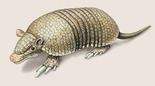
Greater naked-tailed armadillos appear very similar to giant armadillos except for their smaller size and lack of armor on their tails (which range from 90 to 200mm in length). Cabassous tatouay can be distinguised from C. unicinctus by its larger size, and because C. tatouay has a larger, funnel-shaped ear that continues past the head. Both the snout and the head are short and somewhat broad, and their dentition formula is 9/8. Each forefoot has five large claws; the largest claw appears on the third digit.
The armor of greater naked-tailed armadillos is dark brown or black with yellow edges, their undersides are grayish. There can be anywhere from 10 to 13 moveable bands of armor on the back. The bodies of greater naked-tailed armadillos are covered with sparse, coarse hair. Their core body temperature ranges from 32 to 34 degrees C and the basal metabolic rate of the related species C. centralis is 4.8170 W
Cabassous tatouay skulls have a narrow mandible, with the height of the condyloid process greater than the coronoid process. The teeth of C. tatouay are peg-like, and members of this species posses tympanic rings rather than bullae.
The feces of C. tatouay are pelleted and composed of insect remains and soil. (Eisenberg and Redford, 1999; Grzimek, 2003; Nixon, 2004; Weigl, 2005; Wetzel, 1980)
- Other Physical Features
- endothermic
- homoiothermic
- bilateral symmetry
-
- Average mass
- 5.35 kg
- 11.78 lb
-
- Average length
- 63.7 cm
- 25.08 in
Reproduction
There is currently no information available on the mating systems of C. tatouay or of the related species C. unicinctus and C. centralis. (Grzimek, 2003)
Cabassous tatouay gives birth to one offspring per year. There is no other available information on the species, although the related species C. centralis produces one offspring that is born hairless, and with closed eyes and pinnae. The average weight of newborn offspring of C. centralis is 100g for males and 113g for females. (Grzimek, 2003; Nixon, 2004; Wetzel, 1980)
- Key Reproductive Features
- iteroparous
- gonochoric/gonochoristic/dioecious (sexes separate)
- sexual
- viviparous
-
- Average number of offspring
- 1
There is currently no information available on the parental investment given by C. tatouay, or of related species. As in all mammals, greater naked-tailed armadillo females care for and nurse their young until they become independent. (Grzimek, 2003; Nixon, 2004)
- Parental Investment
-
pre-fertilization
- provisioning
-
protecting
- female
-
pre-hatching/birth
-
provisioning
- female
-
protecting
- female
-
provisioning
-
pre-weaning/fledging
-
provisioning
- female
-
provisioning
Lifespan/Longevity
No information could be found on the lifespan of C. tatouay, however, a specimen of the closely related C. unicinctus lived seven and a half years in captivity and a C. centralis specimen lived eight years in captivity. (Weigl, 2005)
Behavior
Greater naked-tailed armadillos are nocturnal foragers, though they have been known to continue to forage until dawn. They are extensively fossorial, using the powerful claw on their third digits to dig holes into termite mounds. Greater naked-tailed armadillos can completely bury themselves while digging for prey.
When pursued C. tatouay runs rapidly, and, during locomotion, walks on the claws of the forefeet and the soles of their hindfeet. Their most frequent means of avoiding predators, however, is burrowing completely into the ground (which they can do in a matter of minutes). Greater naked-tailed armadillos have also been observed entering water to escape pursuit. (Grzimek, 2003; Nixon, 2004)
Greater naked-tailed armadillos sleep in burrows, though the burrows are sequentially occupied by many different individuals; each armadillo spends only one night in a burrow and never returns. Their burrows are generally oblong, such that the width of the opening is larger than the height, and their average slope is 47.7 degrees. Burrows are most often dug in open ground or close to the base of an embankment and often have a strong, musky odor. (Carter and Encarnacao, 1983; da Fonseca and Rylands, 2004; Grzimek, 2003; Linares, 1998; Nixon, 2004)
Home Range
No information is currently available on the home range or territory size of C. tatouay.
Communication and Perception
When handled, male C. tatouay make a grunting sound similar to that of a pig, but females are generally silent.
Greater naked-tailed armadillos have a well developed sense of smell, which they use as their primary way of locating prey hidden in the soil or leaf litter. (Cuellar and Noss, 2003; Grzimek, 2003; Nixon, 2004)
Food Habits
Greater naked-tailed armadillos are mostly myrmecophagous, eating primarily ants and termites. They use their large claws on the third digit to dig holes into insect mounds or rotting stumps, then use their long, sticky tongues to remove prey from their tunnels. While feeding on ants and termites, C. tatouay may also injest incidental invertebrates found during foraging and soil. (Eisenberg and Redford, 1999; Grzimek, 2003; Nixon, 2004)
- Primary Diet
- carnivore
- Animal Foods
- insects
- terrestrial non-insect arthropods
- terrestrial worms
Predation
Humans are the most frequent predators of greater naked-tailed armadillos. Their most common anti-predator behavior is burrowing underground to hide from pursuit, which they do using the large claws on their third digits and by rotating their carapace back and forth. (da Fonseca and Rylands, 2004; Grzimek, 2003)
-
- Known Predators
-
- humans (Homo sapiens)
Ecosystem Roles
Cabassous tatouay has an impact on the soil of its habitat due to its extensive burrowing and churning of soil. It is an insectivore and may affect termite and ant density. (da Fonseca and Rylands, 2004)
- Ecosystem Impact
- soil aeration
- None known.
- None known.
- None known.
Economic Importance for Humans: Positive
Cabassous tatouay is sometimes hunted and eaten. (da Fonseca and Rylands, 2004)
- Positive Impacts
- food
Economic Importance for Humans: Negative
Cabassous tatouay is often hunted in agricultural areas due to the damage caused by its excessive burrowing, which can disrupt crops. (da Fonseca and Rylands, 2004)
- Negative Impacts
- crop pest
Conservation Status
The main threats to greater naked-tailed armadillos are habitat destruction and fires, as well as persecution because of their negative effects on agriculture. These armadillos have been driven to extinction in a number of areas. No conservation efforts, however, are currently in place for greater naked-tailed armadillos.
-
- IUCN Red List
-
Least Concern
More information
-
- IUCN Red List
-
Least Concern
More information
-
- US Federal List
- No special status
-
- CITES
- No special status
Contributors
Tanya Dewey (editor), Animal Diversity Web.
Lara Zajic (author), University of Michigan-Ann Arbor, Phil Myers (editor, instructor), Museum of Zoology, University of Michigan-Ann Arbor.
Glossary
- Neotropical
-
living in the southern part of the New World. In other words, Central and South America.

- acoustic
-
uses sound to communicate
- bilateral symmetry
-
having body symmetry such that the animal can be divided in one plane into two mirror-image halves. Animals with bilateral symmetry have dorsal and ventral sides, as well as anterior and posterior ends. Synapomorphy of the Bilateria.
- carnivore
-
an animal that mainly eats meat
- chemical
-
uses smells or other chemicals to communicate
- endothermic
-
animals that use metabolically generated heat to regulate body temperature independently of ambient temperature. Endothermy is a synapomorphy of the Mammalia, although it may have arisen in a (now extinct) synapsid ancestor; the fossil record does not distinguish these possibilities. Convergent in birds.
- food
-
A substance that provides both nutrients and energy to a living thing.
- forest
-
forest biomes are dominated by trees, otherwise forest biomes can vary widely in amount of precipitation and seasonality.
- fossorial
-
Referring to a burrowing life-style or behavior, specialized for digging or burrowing.
- insectivore
-
An animal that eats mainly insects or spiders.
- iteroparous
-
offspring are produced in more than one group (litters, clutches, etc.) and across multiple seasons (or other periods hospitable to reproduction). Iteroparous animals must, by definition, survive over multiple seasons (or periodic condition changes).
- motile
-
having the capacity to move from one place to another.
- native range
-
the area in which the animal is naturally found, the region in which it is endemic.
- nocturnal
-
active during the night
- scrub forest
-
scrub forests develop in areas that experience dry seasons.
- sedentary
-
remains in the same area
- sexual
-
reproduction that includes combining the genetic contribution of two individuals, a male and a female
- soil aeration
-
digs and breaks up soil so air and water can get in
- solitary
-
lives alone
- tactile
-
uses touch to communicate
- terrestrial
-
Living on the ground.
- tropical savanna and grassland
-
A terrestrial biome. Savannas are grasslands with scattered individual trees that do not form a closed canopy. Extensive savannas are found in parts of subtropical and tropical Africa and South America, and in Australia.
- savanna
-
A grassland with scattered trees or scattered clumps of trees, a type of community intermediate between grassland and forest. See also Tropical savanna and grassland biome.
- temperate grassland
-
A terrestrial biome found in temperate latitudes (>23.5° N or S latitude). Vegetation is made up mostly of grasses, the height and species diversity of which depend largely on the amount of moisture available. Fire and grazing are important in the long-term maintenance of grasslands.
- visual
-
uses sight to communicate
- viviparous
-
reproduction in which fertilization and development take place within the female body and the developing embryo derives nourishment from the female.
References
Carter, T., C. Encarnacao. 1983. Characteristics and use of burrows by four species of armadillos in Brazil. Journal of Mammalogy, 64: 103-8.
Cuellar, E., A. Noss. 2003. Mamiferos del Chaco Y de la Chiquitania de Santa Cruz, Bolivia. Bolivia: Fundacion para la Conservacion del Bosque Chiquitano.
Eisenberg, J., K. Redford. 1999. Mammals of the Neotropics. London: University of Chicago Press.
Grzimek, B. 2003. Grzimek's Animal Life Encyclopedia Mammals. Germany: Thomson Gale.
Hilario, S., V. Imperatriz-Fonseca. 2003. Thermal evidence of the invasion of a stingless bee nest by a mammal. Brazilian Journal of Biology, 63: 457-462.
Linares, O. 1998. Mamiferos de Venezuela. Caracas: Sociedad Conservacionista Audubon de Venezuela.
Nixon, J. 2004. "Cabassous Tatouay" (On-line). Armadillos Online. Accessed March 18, 2006 at www.msu.edu/~nixonjos/armadillo/cabassous.html.
Weigl, R. 2005. Longevity of Mammals in Captivity. Stuttgert: Kleine Senckenberg-Reihe 48.
Wetzel, R. 1980. Revision of the Naked-Tailed Armadillos, Genus Cabassous McMurtrie. Annals of Carnegie Museum, 49: 323-357.
da Fonseca, G., A. Rylands. 2004. Edentata. The Newsletter of the IUCN Edentate Specialist Group, 6: 1-78.