Bucorvus abyssinicusnorthern ground hornbill(Also: northern ground-hornbill)
Geographic Range
Northern ground hornbills (Bucorvus abyssinicus) are found in the Ethiopian region across a wide area of north-central Africa, from southern Mauritania and Guinea in the west to Ethiopia, northwest Somalia, northeast Kenya, and northern Uganda in the east. (Kemp, 2001)
Habitat
Bucorvus abyssinicus is found in savanna, sub-desert scrub, and rocky areas, preferring short vegetation which facilitates foraging. This species generally inhabits drier areas than southern ground hornbills (Bucorvus leadbeateri). Bucorvus abyssinicus tolerates disturbed areas but does require large trees for nesting sites. (Kemp, 2001)
- Habitat Regions
- tropical
- terrestrial
- Terrestrial Biomes
- desert or dune
- savanna or grassland
-
- Range elevation
- 3257 (high) m
- 10685.70 (high) ft
Physical Description
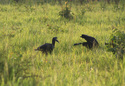
The two species of ground hornbills, Bucorvus abyssinicus and Bucorvus leadbeateri differ from other hornbills in having an extra neck vertebra (giving them a total of 15), longer legs, thick upper eyelid lashes, and a larger body size. The longer legs adapt them well to their primarily terrestrial foraging method, while other hornbills are mainly arboreal. Northern ground hornbills are black, large-bodied birds average 4000 g in mass and 100 cm in length (Kemp, 2001). They have high, rounded, grooved casques (a bony elaboration of the upper mandible covered with a thin sheath of keratin) that is abruptly truncated distally, and a long, deep, curved beak, which they use to catch and subdue prey (Perrins, 2003). The primaries are white and are highly visible in flight. Northern and southern ground hornbills (Bucorvus leadbeateri) can be distinguished by differences in throat skin coloration and casque shape. Northern ground hornbill males have blue and red throat skin and a blue area around the eye, females have only bare blue skin both around the eye and throat. Southern ground hornbills (Bucorvus leadbeateri) have only bare red skin in both areas, and a smaller, shallower, non-truncated casque. Juveniles have brown feathers and less brilliantly colored throat patches. Northern ground hornbills have a yellowish patch at the base of the upper mandible. (Elbel, 1967; Kemp, 2001; Perrins, 2003)
- Other Physical Features
- endothermic
- homoiothermic
- bilateral symmetry
- Sexual Dimorphism
- sexes colored or patterned differently
- ornamentation
-
- Average mass
- 4000 g
- 140.97 oz
-
- Average length
- 100 cm
- 39.37 in
-
- Range wingspan
- 495 to 595 mm
- 19.49 to 23.43 in
Reproduction
Northern ground hornbills are monogamous, with males tending to females and young during the incubation stage. (Kemp, 2001)
- Mating System
- monogamous
The breeding season depends on location, with West African populations breeding in June through August, Nigerian and Ugandan populations breeding in January, and Kenyan pairs breeding as late as November. The nest is constructed in a cavity of a large tree, with baobabs and palm stumps being preferred. However, they may also accept rock holes or man-made cavities such as bee-hive logs or baskets as nesting sites. Unlike other hornbills, in Bucorvus species females are not completely sealed into a nesting cavity. Instead, they are only partially sealed in by a mixture of mud and vegetation. They also does not undergo the typical synchronous flight feather molt typical of other incubating female hornbills. Males prepare the cavity by lining it with dry leaves, then the female enters and lays one or two eggs over approximately 5 days. Incubation begins with the first egg, so that one hatchling matures more quickly and grows faster than its nest mates. After 37 to 41 days of incubation, during which nest sanitation is not practiced and the male provides food items to the incubating female, the first egg will hatch, with the second hatching later. Newly hatched chicks weigh approximately 70 g. First-hatched chicks grow rapidly at the expense of the later-hatched sibling, which usually dies of starvation within 4 days, when the older sibling may weigh as much as 350 g. After 21 to 33 days the female will leave the nest to help the male in food acquisition and after 80 to 90 days the surviving hatchling fledges. (Kemp, 2001)
- Key Reproductive Features
- iteroparous
- seasonal breeding
- gonochoric/gonochoristic/dioecious (sexes separate)
- sexual
- oviparous
-
- Breeding interval
- Northern ground hornbills breed about once every 3 years, with on average one chick surviving to adulthood every 9 years.
-
- Breeding season
- The breeding season varies by region, from January to November overall.
-
- Range eggs per season
- 2 (high)
-
- Average eggs per season
- 2
-
- Range time to hatching
- 37 to 41 days
-
- Average fledging age
- 85 days
-
- Average time to independence
- 3 years
Northern ground hornbill males and females both invest heavily in their offspring. Males provide food for females who are walled into nest cavities with eggs during incubation. Both males and females protect and provide food for hatchlings. Fledged juveniles remain with their parents for up to 3 years, although sex can be determined visually at approximately one year of age. An average of one offspring is raised to independence every 9 years and investment per offspring is exceptionally high. (Kemp, 2001)
- Parental Investment
- altricial
-
pre-fertilization
- provisioning
-
protecting
- female
-
pre-hatching/birth
-
provisioning
- female
-
protecting
- male
- female
-
provisioning
-
pre-weaning/fledging
-
provisioning
- male
- female
-
protecting
- male
- female
-
provisioning
-
pre-independence
-
provisioning
- male
- female
-
protecting
- male
- female
-
provisioning
- post-independence association with parents
- extended period of juvenile learning
Lifespan/Longevity
Lifespan in captivity is 40 years. (Kemp, 2001)
-
- Range lifespan
Status: captivity - 40 (high) years
- Range lifespan
Behavior
Northern ground hornbills are primarily terrestrial, though they will fly to capture prey or defend territory, and they roost in trees at night, possibly to avoid predation. They are often seen in pairs, though larger groups are encountered. Groups may form due to juveniles remaining in the parental home range for several years after they reach maturity. Juveniles of many hornbill (Bucerotidae) species, including both ground hornbill species (Bucorvidae), have been observed playing with vegetation and engaging in bill-wrestling. This may refine their motor skills for practical application in foraging and object manipulation as adults. (Kemp, 2001)
- Key Behaviors
- terricolous
- flies
- diurnal
- motile
- sedentary
- territorial
- social
-
- Range territory size
- 260 (high) m^2
-
- Average territory size
- 100 m^2
Home Range
Groups of a few to up to 20 (rarely) individuals will defend a territory that may be as large as 260 m^2. (Kemp, 2001)
Communication and Perception
Males and females sing in booming duets (Kemp, 2001). (Kemp, 2001)
- Other Communication Modes
- duets
Food Habits
Northern ground hornbills are primarily carnivorous. They eat reptiles, including puff adders (Bitis), cobras (Naja), tortoises (Testudinidae), and lizards, and mammals such as hares (Lepus) and mongooses (Herpestes). Arthropods, mainly insects and arachnids, make up most of their animal diet. They sometimes takes carrion to supplement live prey. Northern ground hornbills follow ungulate herds and forest fires to feed on prey items fleeing these disturbances. Individuals walk up to 11 km per day, overtaking and consuming edible animals in their path. They also dig for arthropods and honeycomb, and rarely consume plant matter. The strong beak is used to grab prey and disarm it. (Kemp, 2001)
- Primary Diet
-
carnivore
- eats terrestrial vertebrates
- insectivore
- eats non-insect arthropods
- scavenger
- Animal Foods
- mammals
- reptiles
- carrion
- insects
- terrestrial non-insect arthropods
Predation
Predators of this species include large carnivores, such as leopards. Human predation for food is common in some places, such as northern Cameroon and Burkina Faso. Eggs and nestlings may be preyed on by smaller, terrestrial predators. (Thiollay, 2001; Thiollay, 2006)
-
- Known Predators
-
- leopards (Panthera pardus)
Ecosystem Roles
Bucorvus abyssinicus is a host for the mallophagan parasites Bucorvellus docophorus, Bucerophagus productus, and Bucerophagus africanus. It also hosts the nematode species Histiocephalus bucorvi and the cestodes Chapmania unilateralis, Idiogenes bucorvi, Ophryocotyloides pinguis, and Paruterina daouensis. A captive, wild-caught individual perished from Aeromonas hydrophila, a common fish pathogen that was previously not known to affect wild populations. This species has also been known to perish in captivity in North America from West Nile Virus. (Canaris and Gardner, 2003; Clay, 1955; Elbel, 1967; Gretillat, 1967; Komar, 2003; Ocholi, RA and Kalejaiye, 1990)
- Bucorvellus docophorus
- Aeromonas hydrophila
- Histiocephalus bucorvi
- Bucerophagus productus
- Bucerophagus africanus
- Chapmania unilateralis
- Idiogenes bucorvi
- Ophryocotyloides pinguis
- Paruterina daouensis
Economic Importance for Humans: Positive
Bucorvus abyssinicus is not often sold or hunted commercially, although they are commonly held in zoos. The species has cultural value in some areas, where hunters may tie the severed head and neck to their own to facilitate stalking of ungulates. The call is often imitated and some villages have entire songs about the male and female duets. (Kemp, 2001)
- Positive Impacts
- pet trade
- body parts are source of valuable material
- ecotourism
Economic Importance for Humans: Negative
In some areas northern ground hornbills are killed for breaking windows (by attacking their reflection) and for being cultural symbols of bad luck. (Kemp, 2001)
- Negative Impacts
- household pest
Conservation Status
Bucorvus abyssinicus is not currently threatened, but destruction of suitable nesting trees could impact the species negatively in the future. Disturbed grassland areas are actually preferred for hunting, and therefore it is unlikely that mild to moderate disturbance would have a negative impact on the population. However, where they are hunted for food, such as in northern Cameroon and Burkina Faso, they can be severely depleted or locally extirpated. (Kemp, 2001; Thiollay, 2001; Thiollay, 2006)
-
- IUCN Red List
-
Least Concern
More information
-
- IUCN Red List
-
Least Concern
More information
-
- US Migratory Bird Act
- No special status
-
- US Federal List
- No special status
-
- CITES
- No special status
Contributors
Tanya Dewey (editor), Animal Diversity Web.
Brianne Krause (author), Michigan State University, Pamela Rasmussen (editor, instructor), Michigan State University.
Glossary
- Ethiopian
-
living in sub-Saharan Africa (south of 30 degrees north) and Madagascar.

- acoustic
-
uses sound to communicate
- altricial
-
young are born in a relatively underdeveloped state; they are unable to feed or care for themselves or locomote independently for a period of time after birth/hatching. In birds, naked and helpless after hatching.
- bilateral symmetry
-
having body symmetry such that the animal can be divided in one plane into two mirror-image halves. Animals with bilateral symmetry have dorsal and ventral sides, as well as anterior and posterior ends. Synapomorphy of the Bilateria.
- carnivore
-
an animal that mainly eats meat
- carrion
-
flesh of dead animals.
- chemical
-
uses smells or other chemicals to communicate
- desert or dunes
-
in deserts low (less than 30 cm per year) and unpredictable rainfall results in landscapes dominated by plants and animals adapted to aridity. Vegetation is typically sparse, though spectacular blooms may occur following rain. Deserts can be cold or warm and daily temperates typically fluctuate. In dune areas vegetation is also sparse and conditions are dry. This is because sand does not hold water well so little is available to plants. In dunes near seas and oceans this is compounded by the influence of salt in the air and soil. Salt limits the ability of plants to take up water through their roots.
- diurnal
-
- active during the day, 2. lasting for one day.
- duets
-
to jointly display, usually with sounds in a highly coordinated fashion, at the same time as one other individual of the same species, often a mate
- ecotourism
-
humans benefit economically by promoting tourism that focuses on the appreciation of natural areas or animals. Ecotourism implies that there are existing programs that profit from the appreciation of natural areas or animals.
- endothermic
-
animals that use metabolically generated heat to regulate body temperature independently of ambient temperature. Endothermy is a synapomorphy of the Mammalia, although it may have arisen in a (now extinct) synapsid ancestor; the fossil record does not distinguish these possibilities. Convergent in birds.
- insectivore
-
An animal that eats mainly insects or spiders.
- iteroparous
-
offspring are produced in more than one group (litters, clutches, etc.) and across multiple seasons (or other periods hospitable to reproduction). Iteroparous animals must, by definition, survive over multiple seasons (or periodic condition changes).
- monogamous
-
Having one mate at a time.
- motile
-
having the capacity to move from one place to another.
- native range
-
the area in which the animal is naturally found, the region in which it is endemic.
- oviparous
-
reproduction in which eggs are released by the female; development of offspring occurs outside the mother's body.
- pet trade
-
the business of buying and selling animals for people to keep in their homes as pets.
- scavenger
-
an animal that mainly eats dead animals
- seasonal breeding
-
breeding is confined to a particular season
- sedentary
-
remains in the same area
- sexual
-
reproduction that includes combining the genetic contribution of two individuals, a male and a female
- sexual ornamentation
-
one of the sexes (usually males) has special physical structures used in courting the other sex or fighting the same sex. For example: antlers, elongated tails, special spurs.
- social
-
associates with others of its species; forms social groups.
- tactile
-
uses touch to communicate
- terrestrial
-
Living on the ground.
- territorial
-
defends an area within the home range, occupied by a single animals or group of animals of the same species and held through overt defense, display, or advertisement
- tropical
-
the region of the earth that surrounds the equator, from 23.5 degrees north to 23.5 degrees south.
- tropical savanna and grassland
-
A terrestrial biome. Savannas are grasslands with scattered individual trees that do not form a closed canopy. Extensive savannas are found in parts of subtropical and tropical Africa and South America, and in Australia.
- savanna
-
A grassland with scattered trees or scattered clumps of trees, a type of community intermediate between grassland and forest. See also Tropical savanna and grassland biome.
- temperate grassland
-
A terrestrial biome found in temperate latitudes (>23.5° N or S latitude). Vegetation is made up mostly of grasses, the height and species diversity of which depend largely on the amount of moisture available. Fire and grazing are important in the long-term maintenance of grasslands.
- visual
-
uses sight to communicate
References
Canaris, A., S. Gardner. 2003. Bibliography of helminth species described from African vertebrates 1800-1967. Pp. 1-101 in A Canaris, S Gardner, eds. A guide to helminth species described from African vertebrates. Lincoln, Nebraska: University of Nebraska, Digital Commons. Accessed February 01, 2009 at http://digitalcommons.unl.edu/cgi/viewcontent.cgi?article=1003&context=parasitologyfacpubs.
Clay, T. 1955. A New Genus of Ishnocera (Mallophaga). Proceedings of the Royal Entomological Society of London, B(24): 1-7. Accessed September 13, 2008 at http://www.phthiraptera.org/Publications/0211.pdf.
Elbel, R. 1967. Amblyceran Mallophaga (biting lice) found on the Bucerotidae (hornbills). Proceedings of the United States National Museum, 120: 1-75. Accessed February 01, 2009 at http://www.phthiraptera.org/Publications/1280.pdf.
Gretillat, S. 1967. [Helminths, parasitic to wild animals in Senegal. Histiocephalus bucorvi n.sp. (Hedruridae, Nematoda) parasite of the succenturiate ventricle of Bucorvus abyssinicus (Boddaert) (grand calao of Abyssinia)]. Annales de Parasitologie Humaine et Comparee (Paris), 42(5): 533-542. Accessed February 01, 2009 at http://www.ncbi.nlm.nih.gov/pubmed/6083111.
Kemp, . 2001. Family Bucerotidae (Hornbills). Pp. 437-487 and 488-489 in J del Hoyo, A Elliott, J Sargatal, eds. Handbook of the Birds of the World, Vol. 6 From Mousebirds to Hornbills, 2001 Edition. Barcelona: Lynx Edicions.
Komar, N. 2003. West Nile Virus: Epidemiology and ecology in North America. Advances in Virus Research, 61: 185-234. Accessed February 01, 2009 at http://www.westnile.state.pa.us/action/WNV_Komar_Adv_Vir_Res_61.pdf.
Ocholi, RA, R., J. Kalejaiye. 1990. Aeromonas hydrophila as cause of hemorrhagic septicemia in a ground-hornbill (Bucorvus abyssinicus). Avian Diseases, 34(2): 495-496.
Perrins, C. 2003. Firefly encyclopedia of birds. Toronto, Canada: Firefly Books.
Thiollay, J. 2006. Large bird declines with increasing human pressure in savanna woodlands (Burkina Faso). Biodiversity and Conservation, 15: 2085-2108. Accessed February 01, 2009 at http://www.springerlink.com/content/km1357601m762762/fulltext.pdf?page=1.
Thiollay, J. 2001. Long-term changes of raptor populations in northern Cameroon. The Journal of Raptor Research, 35(3): 173-186. Accessed February 01, 2009 at http://elibrary.unm.edu/sora/jrr/v035n03/p00173-p00186.pdf.