Bothus lunatusFlounder(Also: Peacock Flounder)
Geographic Range
Peacock flounders, Bothus lunatus, live in the the West Atlantic Ocean in both tropical and subtropical regions. They are found off the coasts of Florida, Bermuda, and down the coast of South America to Brazil. They have also been recorded in the Central Atlantic near the shelf of Ascension and the St. Helen Islands as well as in the Eastern Atlantic in the Gulf of Guinea. (Evseenko, 2008; Miller, et al., 1991; Robins and Ray, 1986)
- Biogeographic Regions
- atlantic ocean
Habitat
Peacock flounders are marine flatfish, living in clear oceanic waters. They live a benthic lifestyle on sand and rock bottoms, including coral reef environments. They can be found at depths as great as 80 m. (Miller, et al., 1991; Robins and Ray, 1986)
- Habitat Regions
- tropical
- saltwater or marine
-
- Range depth
- 0 to 80 m
- 0.00 to 262.47 ft
Physical Description
Like their near relatives, adult peacock flounders are flattened and circular in shape, with both eyes located on one side of their body. In members of the family Bothidae, including peacock flounders, eyes appear on the left side, which is also more brightly colored. Members of this family possess unequal pelvic fins; the fin on the eye-side is longer. Adults average 35 mm in length and can measure as much as 45 mm.
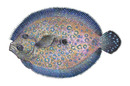
Peacock flounders are brown in color, decorated with bright blue rings and additional blue spots near the head and fin area. There are usually 2 to 3 dark smudges along the lateral line. Unlike other species in the genus Bothus, peacock flounders have a deep notch in front of their eyes. Like most other flounders, adults can rapidly change color, which is used to blend in with the sea bottom. (Miller, et al., 1991; Robins and Ray, 1986)
Male and female peacock flounder look similiar, although males have threadlike upper-pectoral fin rays that females lack. Males occasionally have a longer pectoral fin on the eye-side than females. (Evseenko, 2008)
Peacock flounder larvae look very different than adults. Larvae are 5.5 to 39.5 mm in length, with each eye on a separate side of the flattened body. Dorsal and anal fins are fully formed in the larval stage, and an elongated ray emerges from the dorsal fin. Larvae are almost free of pigment, making them nearly transparent. The only pigmentation appears as a cluster of melanophores at the base of the elongated ray of the dorsal fin. Larvae also have no teeth. (Evseenko, 2008)
- Other Physical Features
- ectothermic
- heterothermic
- bilateral symmetry
- Sexual Dimorphism
- sexes shaped differently
-
- Range length
- 45 (high) cm
- 17.72 (high) in
-
- Average length
- 35 cm
- 13.78 in
Development
Peacock flounders have three stages of life: egg, larval, and adult. Larvae and adults differ in coloration, body shape, and symmetry. As larvae become adults, body depth increases and shape becomes more circular. The swim bladder present in larvae disappears, and adults develop teeth. Another considerable change in morphology is the migration of the right eye to the left side of the body. As this migration occurs, peacock flounders become asymmetrical and blind on the right side. Eye migration occurs through a slit formed during separation of the dorsal fin from the cranium. This method is distinctive of this species; other closely related species utilize a hole in their head for this process. (Evseenko, 2008)
Changes in pigmentation also occur during metamorphosis of peacock flounders. Similar to those in related flatfishes, larval melanophores (pigment-cells) are present on both sides of the body, but are not abundant. During metamorphosis, melanophores disappear from the blind side and are present only on the eye-side. The final pattern is determined by differentiation of adult pigment cells. (Bolker and Hill, 2005)
Sex differentiation of peacock flounders is controlled by the endocrine system. Hermaphrodites are rare. Levels of various sex steroid hormones have direct effect on germ cell development, leading to the formation of different gonads, either male or female sex organs and associated secondary sex characteristics. (Devlin and Nagahama, 2002; Konstantinou, 1994)
- Development - Life Cycle
- metamorphosis
Reproduction
Peacock flounders have a "harem" mating system, in which one male mates with multiple females. Several females have sub-territories within a male's territory. On average, one male mates with 6 females. Males are defensive of their territory and the females within their territory, denying access to other males.
Mating activities usually begin just before dusk. At this time, a male and a female approach each other with the ocular pectoral fin erect. The two fish arch their backs and touch snouts. After this interaction the female swims away, and the male sometimes follows, approaching the female again from the left side. At this point the male pectoral fin is erect and the female pectoral fin moves up and down, possibly signaling willingness to mate. The male then positions himself underneath the female and mating begins. This process consists of a mating rise, during which the female and male rise in the water column together. On average, these rises last about 15 seconds. At the highest point of this rise, usually around 2 m above the substrate, gametes from both fish are simultaneously released, producing a cloud of sperm and eggs. Once the couple returns from the rise, the male "checks" to make sure mating was successful, and the pair separates quickly, swimming away from each other in opposite directions. Not all mating rises are successful, and the process of "checking" is thus important. The exact purpose of the mating rise in these flounders unknown; possible reasons for rising include better dispersal of gametes and predator avoidance. (Konstantinou, 1994; Miller, et al., 1991)
- Mating System
- polygynous
Peacock flounders have extended spawning periods and participate in "serial spawning." Females produce eggs in large batches, and therefore many eggs are fertilized at once. This strategy is used by many families of fish, including bothids, soles, tonguefish, and other fish that live at lower latitudes.
Spawning may be triggered by warming and cooling trends. Individuals in the mid-Atlantic travel north during spring and south during autumn to spawn.
Peacock flounders do not reach sexual maturity directly after metamorphosis, but rather spend time as juveniles. This time varies among individuals, particularly among individuals living in different areas with different resources. (Gibson, 1994; Konstantinou, 1994; Miller, et al., 1991; van der Veer, et al., 2005)
- Key Reproductive Features
- year-round breeding
- sexual
- fertilization
- broadcast (group) spawning
- oviparous
-
- Breeding interval
- Peacock flounders breed serially.
-
- Breeding season
- Peacock flounders breed year-round.
Because peacock flounders practice broadcast spawning, many small eggs are produced at once, which suggests no post-zygotic parental involvement. The survival rate for individual zygotes or larvae is very low. (Thresher, 1988)
- Parental Investment
- no parental involvement
-
pre-fertilization
-
protecting
- male
-
protecting
Lifespan/Longevity
Little information is available regarding the lifespan of peacock flounders, though it is likely similiar to that of other flounders living in the same geographic range.
Behavior
Peacock flounders are solitary, motile, and live a benthic lifestyle.
Male flounders have distinct territories that do not overlap. Each male defends its own territory and exhibits defensive behavior when other males enter their claimed area. Males chase off intruders and display aggressive behavior toward other males. Females, however, do not usually display aggressive behavior. Females do not have the same types of territories, but rather have designated subunits that are smaller in area. Daytime territories are not the same as night retirement sites for members of either sex. Males retire closer to shore and females in deeper water, returning to their daytime territories early in the morning.
When peacock flounders are threatened, they dive into the substrate. They stay hidden, partly covered in sand, until the predator or other disturbance is gone. (Konstantinou, 1994; Miller, et al., 1991; Shulman, 1985)
Many flatfishes, including peacock flounders, have the capacity to induce changes in their coloration, often in order to match their background, the bottom of the ocean. This behavior is controlled through neurotransmitters, which send signals that mediate changes in the melanophores. Different colors result from different concentrations of pigment granules in different areas. These changes are always reversible. (Bolker and Hill, 2005)
- Key Behaviors
- natatorial
- diurnal
- motile
- territorial
-
- Range territory size
- 20 to 360 m^2
Home Range
Although individuals spend their days and nights in separate areas, the overall home range of peacock flounders is not large. Male flounders inhabit territories anywhere from 50 to 360 sq m, and females inhabit smaller areas within these territories, from 20 to 50 sq m. Although peacock flounders occasionally migrate in order to spawn, this is not typical. (Konstantinou, 1994)
Communication and Perception
Peacock flounders have a lateral line, a sense organ that detects movements and vibrations in the water. The eyes on the top of the adult body are used as visual organs. Potential mates communicate through touch, using the ocular pectoral fin. After the mating process, males perform a behavior called "checking" in order to make sure mating was successful. Some kind of signal is sent between organisms at this time, but it is unknown whether this is a visual signal or a chemical (pheromonal) signal. (Konstantinou, 1994)
- Other Communication Modes
- vibrations
- Perception Channels
- visual
- tactile
- vibrations
- chemical
Food Habits
Adult peacock flounders are restricted to feeding on other benthic organisms. They are active predators, mostly eating other fish; however, peacock flounders can also feed on marine invertebrates, such as crustaceans and sometimes octopi. (Danilowicz and Sale, 1999; Gochfeld and Olsen, 2009; Kaufman and Ebersole, 1984; Konstantinou, 1994)
Peacock flounders have also been observed feeding on French grunts and Caribbean sharpnose puffers. The latter is somewhat toxic, and it has been speculated that peacock flounders have a unique feeding behavior to effectively stun prey. (Danilowicz and Sale, 1999; Gochfeld and Olsen, 2009)
The food of larval and juvenile peacock flounders is not well documented. However, the diet of juveniles of other flounder species commonly includes drift and benthic algae. (Shulman, 1985)
- Animal Foods
- fish
- mollusks
- aquatic crustaceans
- other marine invertebrates
- Plant Foods
- algae
Predation
Predators of adult and larval peacock flounders include large fish, sharks, and rays. Adults are also preyed upon by various species of snappers, including mahogany snappers and yellowtail snappers. (Shulman, 1985)
Because peacock flounders are at a high risk for predation, they have acquired several adaptions to avoid being eaten. One important adaption is their ability to change color to blend in with surroundings. When they are spotted, however, they often dive into the substrate, hiding in the sand to avoid capture. Spawning at dusk reduces the chance of predation during mating, because there are not as many potential predators in the water column at this time. The upward mating rise may also confuse predators. Finally, living primarily in shallow waters lowers the risk of predation, as fewer larger fish live in these areas. (Gibson, 1994; Kaufman and Ebersole, 1984; Miller, et al., 1991)
- Anti-predator Adaptations
- cryptic
-
- Known Predators
-
- Mahogany snapper Kytjanus mahogoni
- Yellowtail snapper Olyurus chrysurus
- sharks Selachimorpha
- rays Batoidea
Ecosystem Roles
Peacock flounders act as prey for larger fish and as predators to smaller fish and marine invertebrates. They do not have significant parasites. (Kaufman and Ebersole, 1984; Shulman, 1985)
Economic Importance for Humans: Positive
Peacock flounders are of minor importance in commercial fishing, and they occasionally appear in the aquarium trade. (Froeser and Bailly, 2004)
Economic Importance for Humans: Negative
There are no known adverse effects of peacock flounders on humans.
Conservation Status
Peacock flounders are generally not considered threatened, but they have not been evaluated by the IUCN or the US Fish and Wildlife Service.
-
- IUCN Red List
- Not Evaluated
-
- US Federal List
- No special status
-
- CITES
- No special status
-
- State of Michigan List
- No special status
Other Comments
Common names for Bothus lunatus include "peacock flounder" and "plate fish."
Contributors
Kelsey Otterbein (author), University of Michigan-Ann Arbor, Phil Myers (editor), University of Michigan-Ann Arbor, Gail McCormick (editor), Animal Diversity Web Staff.
Glossary
- Atlantic Ocean
-
the body of water between Africa, Europe, the southern ocean (above 60 degrees south latitude), and the western hemisphere. It is the second largest ocean in the world after the Pacific Ocean.

- bilateral symmetry
-
having body symmetry such that the animal can be divided in one plane into two mirror-image halves. Animals with bilateral symmetry have dorsal and ventral sides, as well as anterior and posterior ends. Synapomorphy of the Bilateria.
- carnivore
-
an animal that mainly eats meat
- chemical
-
uses smells or other chemicals to communicate
- coastal
-
the nearshore aquatic habitats near a coast, or shoreline.
- cryptic
-
having markings, coloration, shapes, or other features that cause an animal to be camouflaged in its natural environment; being difficult to see or otherwise detect.
- diurnal
-
- active during the day, 2. lasting for one day.
- ectothermic
-
animals which must use heat acquired from the environment and behavioral adaptations to regulate body temperature
- external fertilization
-
fertilization takes place outside the female's body
- fertilization
-
union of egg and spermatozoan
- food
-
A substance that provides both nutrients and energy to a living thing.
- heterothermic
-
having a body temperature that fluctuates with that of the immediate environment; having no mechanism or a poorly developed mechanism for regulating internal body temperature.
- metamorphosis
-
A large change in the shape or structure of an animal that happens as the animal grows. In insects, "incomplete metamorphosis" is when young animals are similar to adults and change gradually into the adult form, and "complete metamorphosis" is when there is a profound change between larval and adult forms. Butterflies have complete metamorphosis, grasshoppers have incomplete metamorphosis.
- motile
-
having the capacity to move from one place to another.
- natatorial
-
specialized for swimming
- native range
-
the area in which the animal is naturally found, the region in which it is endemic.
- oviparous
-
reproduction in which eggs are released by the female; development of offspring occurs outside the mother's body.
- pet trade
-
the business of buying and selling animals for people to keep in their homes as pets.
- piscivore
-
an animal that mainly eats fish
- polygynous
-
having more than one female as a mate at one time
- reef
-
structure produced by the calcium carbonate skeletons of coral polyps (Class Anthozoa). Coral reefs are found in warm, shallow oceans with low nutrient availability. They form the basis for rich communities of other invertebrates, plants, fish, and protists. The polyps live only on the reef surface. Because they depend on symbiotic photosynthetic algae, zooxanthellae, they cannot live where light does not penetrate.
- saltwater or marine
-
mainly lives in oceans, seas, or other bodies of salt water.
- sexual
-
reproduction that includes combining the genetic contribution of two individuals, a male and a female
- tactile
-
uses touch to communicate
- territorial
-
defends an area within the home range, occupied by a single animals or group of animals of the same species and held through overt defense, display, or advertisement
- tropical
-
the region of the earth that surrounds the equator, from 23.5 degrees north to 23.5 degrees south.
- vibrations
-
movements of a hard surface that are produced by animals as signals to others
- visual
-
uses sight to communicate
- year-round breeding
-
breeding takes place throughout the year
References
Bolker, J., C. Hill. 2005. Pigmentation development in hatchery-reared flatfishes. Journal of Fish Biology, 56/5: 1029 - 1052.
Danilowicz, B., P. Sale. 1999. Relative Intensity of Predation on the French Grunt, Haemulon flavolineatum, During Diurnal, Dusk, and Nocturnal Periods on a Coral Reef. Marine Biology, 133/2: 337-343.
Devlin, R., Y. Nagahama. 2002. Sex Determination and Sex Differentiation in Fish: An Overview of Genetic, Physiological, and Environmental Influences. Aquaculture, 208/3-4: 191-364.
Evseenko, S. 2008. Early Life Stages of Peacock Flounder "Bothus Lunatus" (Bothidae) from the Western and Central Tropical Atlantic. Journal of Ichthyology, 48/7: 515-524.
Froeser, R., N. Bailly. 2004. "Fishbase" (On-line). Accessed April 21, 2010 at http://www.fishbase.us/summary/SpeciesSummary.php?id=978.
Gibson, R. 1994. Impact of Habitat Quality and Quantity on the Recruitment of Juvenile Flatfishes. Netherlands Journal of Sea Research, 32/2: 191-206.
Gochfeld, D., J. Olsen. 2009. A Novel Feeding Behavior by an Ambush Predator on Toxic Prey. Coral Reefs, 28/1: 155.
Kaufman, L., J. Ebersole. 1984. Microtapography and the Organization of Two Assemblages of Coral Reef Fishes in the West Indies. Journal of Experimental Marine Biology and Ecology, 78: 253-268.
Konstantinou, 1994. The social and reproductive behavior of the eyed flounder, Bothus ocellatus, with notes on the spawning of Bothus lunatus and Bothus ellipticus. Environmental biology of fishes, 44/4: 311-324.
Miller, J., J. Burke, G. Fitzhugh. 1991. Early Life History Patterns of Atlantic American Flatfish: Likely (and Unlikely) Factors Controlling Recruitment. Netherlands Journal of Sea Research, 27/3: 261-275.
Nelson, J. 2006. Fishes of the World, Fourth Edition. Hoboken, NJ: John Wiley & Sons, Inc..
Oystein, S., H. Smaradittir, K. Pittman. 2006. Twisted Story of Eye Migration in Flatfish. Journal of Morhphology, 267/6: 730-788.
Randall, J. 1967. Food Habits of Reef Fishes of the West Indies. Stud. Trop. Oceanagr., 5: 665-847.
Robins, C., C. Ray. 1986. A Field Guide to Atlantic Coast Fishesof North America. Boston, U.S.A.: Houghton Mifflin Company.
Shulman, M. 1985. Recruitment of Coral Reef Fishes: Effects of Distribution of Predators and Shelter. Ecology, 66/3: 1056-1066.
Sumner, F. 2005. The adjustment of flatfishes to various backgrounds: A study of adaptive color change. Journal of Experimental Zoology, 10/4: 409-506.
Thresher, R. 1988. Latitudinal Variation in Egg Sizes of Tropical and Sub-tropical North Atlantic Shore Fishes. Environmental Biology of Fishes, 21/1: 17-25.
van der Veer, H., R. Burghahn, J. Miller, A. Rijinsdorp. 2005. Recruitment in Flatfish, with Special Emphasis on North Atlantic Specis: Progress Made by the Flatfish Symposia. ICES Journal of Marine Science, 57/2: 202-215.