Bothriechis schlegeliiEyelash Viper
Geographic Range
Eyelash pit vipers, also known as eyelash palm pit vipers (Bothriechis schlegelii), are widely distributed throughout moist lowland and montane forests from Chiapas, Mexico (the southernmost state in Mexico), through northwestern Ecuador and western Venezuela. In Central America and northern South America, they occur in portions of Costa Rica, Panama, Columbia, Ecuador, Peru, and Venezuela. This species is considered to be one of the most widely distributed of the arboreal vipers. (Parkinson, 1999; Berthold, 2010; O'Shea, 2005; Parkinson, 1999)
- Biogeographic Regions
- neotropical
Habitat
Eyelash pit vipers occupy a wide range of wooded or shrubby habitats, particularly in moist tropical forests. They occur in near sea-level and streamside vegetation in moist lowlands and mountain foothills to high-elevation montane and cloud forests. They have been found at elevations ranging from 860 to 2500 m. Habitats in close proximity to water appear to provide them with a large number and diversity of prey, particularly small birds, amphibians, and reptiles.
Eyelash pit vipers spend very little time on the forest floor, where predation rates are generally higher than in areas lacking thick vegetation for camouflage. Instead, they are found most often in dense shrub thickets, low hanging tree branches, vines, or in the coarse bark of various palm species. They also are frequently reported in plantations, on the branches of coffee trees. (O'Shea, 2005; Savage, 2002; Sorrell, 2009)
- Habitat Regions
- tropical
- terrestrial
- Terrestrial Biomes
- forest
- rainforest
- Other Habitat Features
- agricultural
-
- Range elevation
- 860 to 2500 m
- 2821.52 to 8202.10 ft
Physical Description
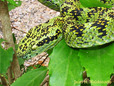
The genus Bothriechis is represented by nine species, each characterized by the presence of a prehensile tail (used for climbing) and typically bright green or yellow dorsal coloration. Eyelash pit vipers are extremely variable in appearance, displaying a wide range of color morphs within populations and even within litters. This species is unusual, as its dorsal ground color is most often olive green. Other color morphs common in eyelash pit vipers are bright yellow, pink, green, silver or dark grey, or brown. Yellow eyelash pit vipers typically show little additional coloration, whereas other morphs typically have speckled markings or crossbands of black, green, red, orange, yellow, and/or silver or pale green. In all morphs, the tip of the tail is yellow or green and the ventral body surface pale yellow, sometimes with darker mottles or stripes.
Habitat plays an important role in eyelash pit viper coloration, as they rely heavily on camouflage when ambushing prey. Yellow eyelash pit vipers often inhabit areas where bananas are plentiful, as they are capable of blending in with the brightly colored fruits. Here they wait to ambush bats or other organisms that visit to feed on the bananas. Similarly, eyelash pit vipers with red coloration will camouflage themselves within red-colored bromeliads, where they ambush and feed on small amphibians. (Berthold, 2010; Berthold, 2010; O'Shea, 2005; Savage, 2002)
Bothriechis schlegelii is considered a small- to medium-sized pit viper. Adult body length ranges from 55 to 82 cm, with females (35 to 82 cm) typically longer and more variable in size than males (37 to 69 cm). The tail is short to moderate, comprising 13 to 19% of total body length.
Because of their arboreal habit, eyelash pit vipers weigh less and are considerably shorter than most terrestrial pit vipers (in comparison to fer-de-lances or bushmasters). This size difference has been attributed to the habitats in which they live and the manner in which they feed. In particular, these snakes must be small and light to effectively maneuver through shrubs and trees and avoid perception by prey. (Guyer and Donnelly, 1990; Guyer and Donnelly, 1990; O'Shea, 2005; Savage, 2002)
Eyelash pit vipers are named for the small, bristly, keeled scales just above each eye. The function of these "eyelashes" or horn-like modified scales is not clear, but it has been suggested that they protect the eyes as the snake moves through dense vegetation. In contrast to the lance-shaped heads of closely related vipers in the genus Bothrops, eyelash pit vipers have relatively wide, triangular heads. Their fangs are relatively long and can deliver a venomous bite to prey.
The scales of eyelash pit vipers are rough to the touch or keeled. This distinguishes eyelash pit vipers from other snake species such as 'fer-de-lances Bothrops asper' and 'bushmasters Lachesis muta' that have smooth scales. The smooth scales of other species allow them to glide quickly over a wide variety of surfaces. Instead, the rough scales of eyelash pit vipers provide protection from rough branches and allow for a "velcro-like" grip that aids in moving and anchoring on vines in their arboreal habitat. (O'Shea, 2005; Savage, 2002)
- Other Physical Features
- heterothermic
- venomous
- Sexual Dimorphism
- female larger
-
- Range length
- 35 to 82 cm
- 13.78 to 32.28 in
Development
Aside from their small size, eyelash pit vipers are born fully developed and do not undergo any type of metamorphosis. Young snakes are capable of injecting venom, although they typically do not feed until after their first molt. Small frogs are common as early prey. Perhaps because of their diet, young pit vipers generally to spend greater amounts of time on the ground than adults. However, this trend seems less pronounced in eyelash pit vipers than other species. Like most snakes, eyelash pit vipers exhibit indeterminate growth and will increase in size throughout their lives. (Hunziker, 2001)
- Development - Life Cycle
- indeterminate growth
Reproduction
Eyelash pit vipers reach sexual maturity at approximately two years of age. These snakes have a keen sense of smell and chemical sensing pits that are used to locate potential mates. Courtship behavior is an important part of mating. Males participate in a “dance of the adders” which is a courtship ritual in which two males face one another in an upright, cobra-like stance. Through posturing, males attempt to intimidate one another, often until one is pushed away or falls to the ground. This courtship ritual typically does not harm either participant, as biting does not occur. This ritual may continue for many hours. Like most snakes, eyelash pit vipers are polygynous. (Antonio, 1980; "Eyelash Viper (Bothriechis Schlegelli)", 2010; Vitt and Caldwell, 2008)
- Mating System
- polygynous
Eyelash pit vipers reproduce throughout the year in warm environments. Mating typically occurs at night. Pregnant females show an enlarged lower abdomen, with continued anterior expansion over time. Females often stop feeding in the final stages of pregnancy.
Females incubate eggs internally for an approximately six month gestation period. Eyelash pit vipers are ovoviviparous, meaning that after gestation, the eggs hatch inside the mother's body, where they complete their development. These vipers typically bear 2 to 20 live young per brood. Except for body size (15 to 20 cm), the young are physically similar to adults. (Hunziker, 2001; O'Shea, 2005; "Eyelash Viper (Bothriechis Schlegelli)", 2010; Santos-Barrera, et al., 2008)
- Key Reproductive Features
- iteroparous
- year-round breeding
- sexual
- fertilization
- ovoviviparous
-
- Breeding interval
- Eyelash vipers appear to have no specific breeding season and usually breed once to twice per year.
-
- Breeding season
- Gestation lasts approximately six months. After giving birth, females are immediately ready to reproduce again.
-
- Range number of offspring
- 2 to 25
-
- Average number of offspring
- 6 to 20
-
- Range gestation period
- 3 to 5 (low) months
-
- Average gestation period
- 6 months
-
- Average time to independence
- 0 days
-
- Average age at sexual or reproductive maturity (female)
- 2 years
-
- Average age at sexual or reproductive maturity (male)
- 2 years
Male eyelash pit vipers are present only during fertilization. Females eyelash pit vipers have a significantly greater investment, as the eggs hatch and the young develop inside of her for 3 to 5 months. As she gains body mass while pregnant, she may be at greater risk of predation. Females invest very little time in the young once they are born as they are fully equipped for immediate independence. ("Eyelash Viper (Bothriechis Schlegelli)", 2010)
- Parental Investment
- no parental involvement
-
pre-fertilization
- provisioning
-
protecting
- female
-
pre-hatching/birth
-
provisioning
- female
-
protecting
- female
-
provisioning
Lifespan/Longevity
Because eyelash pit vipers are arboreal and relatively reclusive, they have been difficult to study in their natural habitat. Instead, most lifespan records are for animals in captivity. Estimated lifespan for wild eyelash pit vipers is approximately 10 years. ("Eyelash Viper Fact Sheet", 2010; Antonio, 1980; O'Shea, 2005)
Many zoos keep eyelash pit vipers because of their aesthetic qualities. Zoos have reported ages of eyelash pit vipers in captivity ranging from 16 to over 20 years. This is due to the lack of predation and consistent food supply. ("Eyelash Viper Fact Sheet", 2010; O'Shea, 2005)
-
- Range lifespan
Status: captivity - 20 (high) years
- Range lifespan
-
- Typical lifespan
Status: wild - 6 to 10 years
- Typical lifespan
-
- Average lifespan
Status: wild - 10 years
- Average lifespan
-
- Typical lifespan
Status: captivity - 16 to 20 years
- Typical lifespan
-
- Average lifespan
Status: captivity - 16 years
- Average lifespan
Behavior
Eyelash pit vipers are nocturnal and generally solitary. They have been known to return to a familiar ambush site in order to take advantage of a prey’s migration pattern. Because eyelash vipers live in trees, their time is spent camouflaged against the leaves, waiting for prey and drinking from water droplets accumulated in the trees. ("Eyelash Viper (Bothriechis Schlegelli)", 2010)
Home Range
No information exists regarding territory size or home range for eyelash pit vipers.
Communication and Perception
Like all pit vipers, B. schlegelii has a pair of heat-sensitive pits set between its eyes and nostrils. They have well-developed binocular vision and pupils with long vertical slits that increase their visual perception. Eyelash pit vipers, like most other viper species, rely on "heat imaging" to sense their environment, particularly sensing danger and prey. Like most other snakes, they also have a long tongue which they "flick" in order to sense chemical changes in the air around them. Because of their illusive nature, not much is known about the communication between members of the same species or potential mates. Males utilize visual intimidation in their competitive "dances" to secure mates during the breeding season. Like all snakes, eyelash pit vipers have primitive ear structures that sense nearby vibrations rather than sound. ("Eyelash Viper Fact Sheet", 2010)
- Perception Channels
- visual
- infrared/heat
- vibrations
- chemical
Food Habits
Eyelash pit vipers feed on a wide variety of small vertebrate animals, including (but not limited to) frogs, lizards, birds, bats, rodents, and marsupials. In most cases, these snakes will prey upon any animal small enough to be subdued and ingested without confrontation. While they are not considered an aggressive species, eyelash pit vipers have been known to bite humans who venture too close.
Eyelash pit vipers are primarily nocturnal predators, although they also capture moving prey from the safety of their diurnal perch. They typically use a "sit-and-wait" form of predation to surprise and ambush their prey. After capture, they paralyze their prey by injecting hemotoxic venom (toxins capable of destroying red blood cells). This venom contains procoagulants and haemorrhagins, and affects both the central nervous system and the cardiovascular system, making it highly toxic. (O'Shea, 2005; Sorrell, 2009)
- Primary Diet
-
carnivore
- eats terrestrial vertebrates
- Animal Foods
- birds
- mammals
- amphibians
- reptiles
Predation
Eyelash pit vipers are slow-moving ambush predators. Because of their predatory habits, they are vulnerable to predation themselves. In response to this, eyelash vipers have developed unique adaptations to avoid being attacked or eaten. The "eyelashes" actually break up the shape of the head and allow it to be easily camouflaged. The patterns found on eyelash pit vipers vary greatly and allow them to blend in with their surrounding environment. Along with camouflage, they also rely on a hemotoxic and neurotoxic venom, which affects the blood stream and central nervous system to deter potential predators. Common predators include hedgehogs, badgers, foxes, humans, and cats. ("Eyelash Viper (Bothriechis Schlegelli)", 2010)
- Anti-predator Adaptations
- cryptic
-
- Known Predators
-
- Hedgehogs
- Badgers
- Fox
- Humans
- Cats
Ecosystem Roles
Eyelash pit vipers are important predators of small vertebrate animals in their moist, wooded tropical environments. (O'Shea, 2005; Savage, 2002)
Economic Importance for Humans: Positive
Because of their colorful appearance, eyelash pit vipers are one of the most common arboreal vipers collected and kept in captivity. ("Eyelash Viper Fact Sheet", 2010)
- Positive Impacts
- pet trade
Economic Importance for Humans: Negative
Eyelash pit vipers are relatively docile unless threatened. It is not uncommon for people encounter this ambush predator unexpectedly in their natural habitat. Although no fatalities from eyelash pit viper bites have been reported, they are venomous and potentially harmful. Because of their relatively small size and ability to become camouflaged among bright yellow fruit, yellow eyelash pit vipers have been accidentally shipped throughout the world in boxes of bananas. ("Eyelash Viper Fact Sheet", 2010; O'Shea, 2005; Savage, 2002)
- Negative Impacts
-
injures humans
- bites or stings
- venomous
Conservation Status
Eyelash pit vipers were removed from CITIES Appendix III in December of 2002. They are no longer listed as threatened on any endangered species list. Like many arboreal, tropical species, eyelash pit vipers are likely threatened by habitat loss as a result of increased deforestation for the timber industry, agriculture, or urbanization. ("Eyelash Viper Fact Sheet", 2010)
-
- IUCN Red List
- Not Evaluated
-
- CITES
- No special status
Contributors
Katy Sinnett (author), Radford University, Christine Small (editor), Radford University, Rachelle Sterling (editor), Special Projects.
Glossary
- Neotropical
-
living in the southern part of the New World. In other words, Central and South America.

- agricultural
-
living in landscapes dominated by human agriculture.
- arboreal
-
Referring to an animal that lives in trees; tree-climbing.
- carnivore
-
an animal that mainly eats meat
- chemical
-
uses smells or other chemicals to communicate
- cryptic
-
having markings, coloration, shapes, or other features that cause an animal to be camouflaged in its natural environment; being difficult to see or otherwise detect.
- fertilization
-
union of egg and spermatozoan
- forest
-
forest biomes are dominated by trees, otherwise forest biomes can vary widely in amount of precipitation and seasonality.
- heterothermic
-
having a body temperature that fluctuates with that of the immediate environment; having no mechanism or a poorly developed mechanism for regulating internal body temperature.
- indeterminate growth
-
Animals with indeterminate growth continue to grow throughout their lives.
- infrared/heat
-
(as keyword in perception channel section) This animal has a special ability to detect heat from other organisms in its environment.
- iteroparous
-
offspring are produced in more than one group (litters, clutches, etc.) and across multiple seasons (or other periods hospitable to reproduction). Iteroparous animals must, by definition, survive over multiple seasons (or periodic condition changes).
- native range
-
the area in which the animal is naturally found, the region in which it is endemic.
- nocturnal
-
active during the night
- ovoviviparous
-
reproduction in which eggs develop within the maternal body without additional nourishment from the parent and hatch within the parent or immediately after laying.
- pet trade
-
the business of buying and selling animals for people to keep in their homes as pets.
- polygynous
-
having more than one female as a mate at one time
- rainforest
-
rainforests, both temperate and tropical, are dominated by trees often forming a closed canopy with little light reaching the ground. Epiphytes and climbing plants are also abundant. Precipitation is typically not limiting, but may be somewhat seasonal.
- sedentary
-
remains in the same area
- sexual
-
reproduction that includes combining the genetic contribution of two individuals, a male and a female
- solitary
-
lives alone
- terrestrial
-
Living on the ground.
- tropical
-
the region of the earth that surrounds the equator, from 23.5 degrees north to 23.5 degrees south.
- venomous
-
an animal which has an organ capable of injecting a poisonous substance into a wound (for example, scorpions, jellyfish, and rattlesnakes).
- vibrations
-
movements of a hard surface that are produced by animals as signals to others
- visual
-
uses sight to communicate
- year-round breeding
-
breeding takes place throughout the year
References
Sacramento Zoo. 2010. "Eyelash Viper (Bothriechis Schlegelli)" (On-line). Sacramento Zoo. Accessed October 12, 2010 at http://www.saczoo.com/Document.Doc?id=367.
2010. "Eyelash Viper Fact Sheet" (On-line). Smithsonian National Zoological Park. Accessed September 19, 2010 at http://nationalzoo.si.edu/Animals/ReptilesAmphibians/Facts/FactSheets/Eyelashpalmpitviper.cfm.
Antonio, F. 1980. Mating behavior and reproduction of the eyelash viper (Bothrops schlegeli) in captivity. Herpetologica, 36/3: 231-233.
Berenzweig, R. 2002. "New Final: Venomous Snakes Found in Costa Rica" (On-line). Accessed September 15, 2010 at http://jrscience.wcp.muohio.edu/fieldcourses01/TropEcoCostaRicaArticles/NEWFINAL.VenomousSnakesFo.html.
Berthold, 2010. "Bothriechis schlegelii (Berthold, 1846)" (On-line). The Reptile Database. Accessed September 17, 2010 at http://reptile-database.reptarium.cz/species.php?genus=Bothriechis&species=schlegelii.
Castoe, T., C. Parkinson. 2006. Bayesian mixed models and the phylogeny of pitvipers (Viperidae: Serpentes). Molecular Phylogenetics and Evolution, 39/1: 91-110.
Chiszar, D., C. Radcliffe. 1989. The predatory strike of the jumping viper (Porthidium nummifer). Copeia, 1989/4: 1037-1039.
Fernandez, J., B. Lomonte, L. Sanz, A. Yamileth, J. Gutirerez, J. Calvete. 2010. Snake venomics of Bothriechis nigroviridis reveals extreme variability among palm pitviper venoms: different evolutionary solutions for the same trophic purpose. Journal of Proteome Research, 9/8: 4234–4241.
Gutierrez, J., G. Rojas, B. Lamonte, J. Gene, C. Luis. 1986. Comparitive study of the edema-forming activity of Costa Rican snake venoms and its neutralization by a polyvalent antivenom. Comp. Biochem. Physiol., 85C/1: 171-175.
Guyer, C., M. Donnelly. 1990. Length-mass relationships among an assemblage of tropical snakes in Costa Rica. Journal of Tropical Ecology, 6/1: 65-76.
Hunziker, R. 2001. The Guide to Owning Eyelash and Temple Vipers. Neptune City, NJ: TFH Publications.
O'Shea, M. 2005. Venomous Snakes of the World. Princeton, NJ: Princeton University Press.
Parkinson, C. 1999. Molecular systematics and geographical history of pitvipers as determined by mitochondrial ribosomal dna sequences. Copeia, 1999/3: 576-586.
Richardson, A. 2004. Pit Vipers. Mankato, Minnesota: Capstone Press. Accessed September 15, 2010 at http://books.google.com/books?hl=en&lr=&id=LSRoB7Exj_MC&oi=fnd&pg=PA7&dq=physical+description+of+eyelash+pit+viper&ots=kA_RgpxFYL&sig=xRHV2_bFGhJtOJHr0MLrk2Rsi9E#v=onepage&q&f=false.
Santos-Barrera, G., J. Pacheco, F. Mendoza-Quijano, F. Bolaños, G. Cháves, G. Daily, P. Ehrlich, G. Ceballos. 2008. Diversity, natural history and conservation of amphibians and reptiles from the San Vito Region, southwestern Costa Rica. Rev. Biol. Trop., 56/2: 755-778.
Savage, J. 2002. The Amphibians and Reptiles of Costa Rica: a Herpetofauna between Two Continents, between Two Seas. Chicago: University of Chicago Press.
Sorrell, G. 2009. Diel movement and predation activity patterns of the eyelash palm-pitviper (Bothriechis schlegelii). Copeia, 2009/1: 105-109.
Taylor, E. 1951. A brief review of the snakes of Costa Rica. The University of Kansas Science Bulletin, 34/1: 3-188.
Vitt, L., J. Caldwell. 2008. Herpetology. Missouri: Academic Press.
Whiting, M. 1998. Review: serpentine mystique unravelled. American Institute of Biological Sciences, 48/12: 1039-1041.
Wuster, W. 2005. The venomous reptiles of the western hemisphere. International Journal of Toxicology, 24: 187-188.