Bombycilla garrulusBohemian waxwing


Geographic Range
Bohemian waxwings are native to the Nearctic and Palearctic regions. Their range during times of breeding in the Nearctic region spans as far west as central Alaska and as far east as the central part of Ontario. Most breeding regions do not extend any farther south than the most southern part of British Columbia. They normally do not breed north of Alaska or Nova Scotia. In March and April, this species migrates south to southwest British Columbia and the northern United States. In the Palearctic region breeding occurs in the northern parts of Eurasia, most commonly in Scandinavia, Russia and Siberia. These populations migrate south to central Europe and east to central Japan in the non-breeding season. (Witmer, 2002)
- Biogeographic Regions
- nearctic
- palearctic
- Other Geographic Terms
- holarctic
Habitat
During the breeding season, Bohemian waxwings are most common in woodlands ranging from coniferous to coniferous-deciduous. This species also inhabits areas around lakes, streams, and swamps. Typically, they inhabit areas where they can forage for fruits and insects in plentiful amounts. During spring and fall migration they abandon woodlands to seek areas high in fruit abundance, including urban habitats. When food resources diminish, they relocate. During winter seasons, Bohemian waxwings are found in woodland or scrub areas with fruit that remains on branches. (Ehrlich, et al., 1988; Witmer, 2002)
- Habitat Regions
- temperate
- terrestrial
- Terrestrial Biomes
- taiga
- forest
- scrub forest
- Other Habitat Features
- urban
- suburban
- agricultural
- riparian
Physical Description
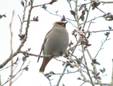
Bohemian waxwings are described as starling-sized, having sleek crests, gray overall, with face washed in chestnut. The tip of the tail has a yellow band. Adult males have a throat patch that is larger than that of females and a broader yellow tip to the tail. The common name, "waxwing," comes from the red waxy tips on their secondary feathers. A similar species, cedar waxwings (Bombycilla cedrorum), are smaller, having a pale yellow belly, and wings that are not as colorful. Juvenile Bohemian waxwings have plumage that is more gray than that of adults, with a whitish throat, and streaked underparts. (Alderfer, 2006; Tyne and Berger, 1976; Witmer, 2002)
- Other Physical Features
- endothermic
- homoiothermic
- bilateral symmetry
- Sexual Dimorphism
- male larger
-
- Range mass
- 46.5 to 69.0 g
- 1.64 to 2.43 oz
-
- Range length
- 159 to 203 mm
- 6.26 to 7.99 in
-
- Range wingspan
- 30 to 36 cm
- 11.81 to 14.17 in
Reproduction
Bohemian waxwings find mates during winter and spring flocks through courtship feeding behavior and courtship hopping. Courtship feeding and hopping happens when the male and female are perched and they in turn hop toward one another until they are close enough to touch bills. Once they are close, they pass food or other objects back and forth while hopping away and then back toward the mate before returning the object. This exchange can happen several times. It is thought that red wax on the wings is used to attract females. The older, and potentially more experienced, males have the largest amount of waxy substance on the tips of their secondary feathers. Males with more wax are preferred by females. (Baicich and Harrison, 1997; Baughman, 2003; Witmer, 2002)
- Mating System
- monogamous
Breeding season of Bohemian waxwings occurs at the same time as the ripening of fruit in the summer. This species breeds later than most birds, even later than their close relatives, cedar waxwings (Bombycilla cedrorum). The typical breeding season is between March and April or as late as May to late June. The typical brood consists of 4 to 6 smooth, glossy eggs that are pale blue-gray marked with black dots and wavy lines. Eggs are sub-elliptical to oval and 25 x 17 mm. Hatchlings are naked, with a red mouth with purple bands and a purplish tongue. Fledging time is 15 to 17 days. Young leave the nest barely able to fly, after 18 days. Fledging occurs from mid-June to mid-August, with most fledging in July. (Baicich and Harrison, 1997; Burton and Kress, 2005; Ehrlich, et al., 1988; Tyne and Berger, 1976; Witmer, 2002)
- Key Reproductive Features
- iteroparous
- seasonal breeding
- gonochoric/gonochoristic/dioecious (sexes separate)
- sexual
- oviparous
-
- Breeding interval
- Breeding occurs once a year, occasionally twice a year if the first breeding attempt is prior to March.
-
- Breeding season
- Breeding occurs from March to late June.
-
- Range eggs per season
- 4 to 6
-
- Range time to hatching
- 13 to 14 days
-
- Range fledging age
- 15 to 17 days
Female Bohemian waxwings incubate their eggs for 14 to 15 days. Although incubation is only completed by females, both females and males feed the young. Males may spend more time feeding the young once they have hatched. Both parents may continue to feed young after fledging for up to two weeks. (Baicich and Harrison, 1997; Witmer, 2002)
- Parental Investment
- altricial
-
pre-fertilization
- provisioning
-
protecting
- female
-
pre-hatching/birth
-
provisioning
- female
-
protecting
- male
- female
-
provisioning
-
pre-weaning/fledging
-
provisioning
- male
- female
-
protecting
- male
- female
-
provisioning
Lifespan/Longevity
The longest reported lifespan for a banded bird in North America was 5 years 10 months. This species is recorded living as long as 12 years in Europe. The main causes of mortality are predation, competition between similar species, and failure to fully metabolize ethanol produced from the consumption of fruits (intoxication). (Witmer, 2002)
-
- Range lifespan
Status: wild - 12 (high) years
- Range lifespan
Behavior
Bohemian waxwings are often seen fluttering from perch to perch in shrubs and trees. They rarely walk on the ground. Bohemian waxwings perform self-maintenance by scratching the head with a foot over a partially extended wing, they also bathe in shallow puddles that gather from rainfall. The only form of behavioral aggression noted in Bohemian waxwings is mate-guarding. Male Bohemian waxwings will ward off other intruders attempting courtship-hopping with their paired female. Males adopt a threat posture and uses their bill to snap at intruders. Bohemian waxwings are found mainly in flocks that travel together to forage and in migration. They use calls constantly as a form of social cohesion, call volume increases when the flock is about to depart. Most flocks are between 50 and 300 birds, but some have been recorded at over 3000. Flocks exhibit "gift-passing," in which birds pass fruit to their flock mates for consumption. (Witmer, 2002)
Home Range
Bohemian waxwings are not territorial. Even at the nest, males are not aggressive unless another male approaches to court their mate. Nests are often clumped and found at highest densities near fruiting shrubs and trees. (Witmer, 2002)
Communication and Perception
Bohemian waxwings usually communicate through vocalizations, similar to their close relatives, cedar waxwings. Social calls are described as a trilling "zeee". Hatchlings also use a quiet trill with parents. The basic call is a high pitched, rapid trill that has a variety of frequencies and is generally lower in pitch than that of cedar waxwings When mates are within range of each other contact calls are used. These are normally softer and higher in pitch than the social call. A courtship call consists of a very wide frequency spread. Both mates give courtship calls during nest-building and courtship interaction. Females continue to give courtship calls while feeding and sitting in the nest. A disturbance call is normally characterized by a long descending whistle. The disturbance call is used during nest-building and incubation. No injury or begging calls have been reported in Bohemian waxwings. (Alderfer, 2006; Witmer, 2002)
Food Habits
Bohemian waxwings are frugivorous and insectivorous. The main source of food is sugary fruits. Bohemian waxwings have a large liver which helps convert sugar to energy. They also have the ability to metabolize ethanol from the fermentation of those sugary fruits. Favorite fruits in North America include juniper (Juniperus virginiana) and mountain ash (Sorbus americana). Bohemian waxwings also feed on aerial insects during the summer. In late spring and early summer insects, especially midges (Chironomidae) and mosquitos (Culicidae), make up about 37% of their diet. Insects are also favored during nesting. When preferred food sources are less abundant, they feed on flowers and sap from trees. (Baughman, 2003; Burton and Kress, 2005; Witmer, 2002)
- Animal Foods
- insects
- Plant Foods
- fruit
- flowers
- sap or other plant fluids
Predation
Bohemian waxwings are preyed on mainly by birds of prey, including merlins (Falco columbarius), which prey extensively on winter flocks, prairie falcons (Falco mexicanus), rough-legged hawks (Buteo lagopus), and Eurasian sparrowhawks (Accipiter nisus). When approached, Bohemian waxwings adopt a cryptic posture with neck and bill extended skyward while they remain very still. If the cryptic posture fails to be effective, they fly upward and chatter loudly to warn other waxwings of a threat. (Witmer, 2002)
- Anti-predator Adaptations
- cryptic
-
- Known Predators
-
- merlins (Falco columbarius)
- prairie falcons (Falco mexicanus)
- rough-legged hawks (Buteo lagopus)
- Eurasian sparrowhawks (Accipiter nisus)
Ecosystem Roles
Bohemian waxwings are preyed on by falcons and hawks. They are important seed dispersers and prey on small, flying insects. There are 2 types of protozoan parasites documented in Bohemian waxwings: Leucocytozoon and Trypanosoma. (Stabler and Kitzmiller, 1970; Witmer, 2002)
- Ecosystem Impact
- disperses seeds
- Leucocytozoon
- Trypanosoma
Economic Importance for Humans: Positive
Bohemian waxwings are sought after by bird watchers and they provide important ecosystem services by dispersing the seeds of the fruiting trees and shrubs they eat. (Witmer, 2002)
Economic Importance for Humans: Negative
There are no known adverse effects of Bohemian waxwings on humans.
Conservation Status
Bohemian waxwing populations are increasing due to conservation of shrub lands in the United States. Some of the problems facing Bohemian waxwing populations are collisions with windows, automobile collisions, and the toxic effects of pesticides. (Baughman, 2003; Witmer, 2002)
-
- IUCN Red List
-
Least Concern
More information
-
- IUCN Red List
-
Least Concern
More information
-
- US Migratory Bird Act
- Protected
-
- US Federal List
- No special status
-
- CITES
- No special status
-
- State of Michigan List
- No special status
Contributors
Tanya Dewey (editor), Animal Diversity Web.
Crystal Wilson (author), Radford University, Karen Powers (editor, instructor), Radford University.
Glossary
- Nearctic
-
living in the Nearctic biogeographic province, the northern part of the New World. This includes Greenland, the Canadian Arctic islands, and all of the North American as far south as the highlands of central Mexico.

- Palearctic
-
living in the northern part of the Old World. In otherwords, Europe and Asia and northern Africa.
- acoustic
-
uses sound to communicate
- agricultural
-
living in landscapes dominated by human agriculture.
- altricial
-
young are born in a relatively underdeveloped state; they are unable to feed or care for themselves or locomote independently for a period of time after birth/hatching. In birds, naked and helpless after hatching.
- arboreal
-
Referring to an animal that lives in trees; tree-climbing.
- bilateral symmetry
-
having body symmetry such that the animal can be divided in one plane into two mirror-image halves. Animals with bilateral symmetry have dorsal and ventral sides, as well as anterior and posterior ends. Synapomorphy of the Bilateria.
- carnivore
-
an animal that mainly eats meat
- chemical
-
uses smells or other chemicals to communicate
- choruses
-
to jointly display, usually with sounds, at the same time as two or more other individuals of the same or different species
- colonial
-
used loosely to describe any group of organisms living together or in close proximity to each other - for example nesting shorebirds that live in large colonies. More specifically refers to a group of organisms in which members act as specialized subunits (a continuous, modular society) - as in clonal organisms.
- cryptic
-
having markings, coloration, shapes, or other features that cause an animal to be camouflaged in its natural environment; being difficult to see or otherwise detect.
- diurnal
-
- active during the day, 2. lasting for one day.
- duets
-
to jointly display, usually with sounds in a highly coordinated fashion, at the same time as one other individual of the same species, often a mate
- endothermic
-
animals that use metabolically generated heat to regulate body temperature independently of ambient temperature. Endothermy is a synapomorphy of the Mammalia, although it may have arisen in a (now extinct) synapsid ancestor; the fossil record does not distinguish these possibilities. Convergent in birds.
- forest
-
forest biomes are dominated by trees, otherwise forest biomes can vary widely in amount of precipitation and seasonality.
- frugivore
-
an animal that mainly eats fruit
- herbivore
-
An animal that eats mainly plants or parts of plants.
- holarctic
-
a distribution that more or less circles the Arctic, so occurring in both the Nearctic and Palearctic biogeographic regions.
Found in northern North America and northern Europe or Asia.
- insectivore
-
An animal that eats mainly insects or spiders.
- iteroparous
-
offspring are produced in more than one group (litters, clutches, etc.) and across multiple seasons (or other periods hospitable to reproduction). Iteroparous animals must, by definition, survive over multiple seasons (or periodic condition changes).
- migratory
-
makes seasonal movements between breeding and wintering grounds
- monogamous
-
Having one mate at a time.
- motile
-
having the capacity to move from one place to another.
- native range
-
the area in which the animal is naturally found, the region in which it is endemic.
- oviparous
-
reproduction in which eggs are released by the female; development of offspring occurs outside the mother's body.
- riparian
-
Referring to something living or located adjacent to a waterbody (usually, but not always, a river or stream).
- scrub forest
-
scrub forests develop in areas that experience dry seasons.
- seasonal breeding
-
breeding is confined to a particular season
- sexual
-
reproduction that includes combining the genetic contribution of two individuals, a male and a female
- social
-
associates with others of its species; forms social groups.
- suburban
-
living in residential areas on the outskirts of large cities or towns.
- tactile
-
uses touch to communicate
- taiga
-
Coniferous or boreal forest, located in a band across northern North America, Europe, and Asia. This terrestrial biome also occurs at high elevations. Long, cold winters and short, wet summers. Few species of trees are present; these are primarily conifers that grow in dense stands with little undergrowth. Some deciduous trees also may be present.
- temperate
-
that region of the Earth between 23.5 degrees North and 60 degrees North (between the Tropic of Cancer and the Arctic Circle) and between 23.5 degrees South and 60 degrees South (between the Tropic of Capricorn and the Antarctic Circle).
- terrestrial
-
Living on the ground.
- urban
-
living in cities and large towns, landscapes dominated by human structures and activity.
- visual
-
uses sight to communicate
References
Alderfer, J. 2006. Complete Birds of North America. Washington, D.C.: National Geographic Society.
Anderson, R. 1909. Nesting of the Bohemian Waxwing (Bombycilla garrulus). The Auk, Vol. 26, No. 1: 10-12.
Baicich, P., C. Harrison. 1997. A Guide to the Nests, Eggs, and Nestlings of North American Birds. San Diego, California: Academic Press.
Baughman, M. 2003. Reference ATLAS to the Birds of North America. Washington, D.C: National Geographic Society.
Berthhold, P. 1976. The Waxwing Bombycilla garrulus as a Frugivorous Feeding Specialist. Experientia, 32/11.
Burton, R., S. Kress. 2005. North American Birdfeeder Guide. London, England: DK Publishing Inc..
Chapman, F. 1932. Handbook of Birds of Eastern North America. New York: D. Appleton and Company.
Cruickshank, A. 1953. Cruickshank's Pocket Guide to the Birds. New York: Dodd, Mead & Company.
Cvitanic, A. 1958. Observation on the Waxwings Bombycilla garullus Nutrition in Captivity. Larus, 13: 49-50.
Ehrlich, P., D. Dobkin, D. Wheye. 1988. The Birder's Handbook. New York, New York: Simon & Schuster Inc..
Fernbach, F. 1960. Waxwings Bombycilla garrulus in Winter 1959-1960 in Subotica. Larus, 15: 154.
Skoracki, M. 2002. Three new species of the ectoparasitic mites of teh genus Syringophiloidus Kethley, 1970 (Acari: Syringophilidae) from passeriform birds from Slovakia. Folia Parasitologica, 49/4: 305-313.
Spicer, G. 1978. A New Species and Several New Host Records of Avian Nasal Mites Acarin. The Journal of Parsitology, 64/5: 891-894.
Stabler, R., N. Kitzmiller. 1970. Hematozoa from Colorado birds. III. Passeriformes. Journal of Parasitology, 56/1: 12-16.
Tyne, J., A. Berger. 1976. Fundamentals of Ornithology. New York: John Wiley and Sons.
Witmer, M. 2002. Bohemian Waxwing (Bombycilla Garrulus). The Birds of North America, Vol. 714. Philadelphia, PA: The Birds of North America Inc.. Accessed October 16, 2008 at http://bna.birds.cornell.edu/bna/species/714 doi:10.2173/bna.714.