Axis porcinushog deer


Geographic Range
Axis porcinus has a native geographic range throughout India, including the Himalayan foothill zone and Southeast Asia, including Burma and Thailand. The majority inhabits the Indus River Forest Reserves of Sindh. Humans have introduced free-ranging populations of A. porcinus in Sri Lanka, Australia (specifically the coastal regions of south and east Gippsland), and the United States, including Texas, Florida, and Hawaii.
- Biogeographic Regions
- nearctic
- palearctic
- oriental
- australian
Habitat
Axis porcinus appears to prefer dense forests; however, they are often observed in clearings, grasslands and occasionally wet grasslands. This variation is usually associated with time of year and food distribution.
- Terrestrial Biomes
- forest
Physical Description
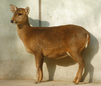
Built for creeping/bush-hugging, A. porcinus is a relatively small yet powerful cervid, with a stocky, muscular body. The limbs are noticeably short and delicate; the hindlimbs are longer than the forelimbs, raising the rump to a height greater than that of the shoulders. The face is short and wedge shaped.
Adult A. porcinus have pelage that is coarse and the overall coloration is a dark olive brown; however, the guard hairs have white tips. Fawns are born with a pale sandy-yellow color and with cream colored horizontally distributed spots along their flanks. At approximately six months this coloration gradually gives way to the adult coloration. Often, in the summer, the coat of an adult A. porcinus changes to reveal spots that are distributed such as those found on the fawn. The rhinarium is always naked and brown. One distinctive feature of A. porcinus is the unusually large round ears that are fringed with white hairs. Also, the tail is particularly bushy due to long hairs that lie in a dorso-ventral pattern.
This species exhibits sexual dimorphism. The females are slightly smaller than males and lack antlers. The males have noticeably thick muscular necks. They also have antlers that tend to be small and unimpressive compared to other members of the genus Axis as well as the entire Family Cervidae. Typically the antlers are three-tined; however, extra points are not uncommon. The antlers are covered in velvet for much of the year and project from conspicuous hairy pedicles.
- Other Physical Features
- endothermic
- bilateral symmetry
-
- Range mass
- 36 to 50 kg
- 79.30 to 110.13 lb
-
- Range length
- 125 to 135 cm
- 49.21 to 53.15 in
Reproduction
During the breeding season, male A. porcinus are extremely aggressive, frequently challenging one another. Typically, challenges do not result in any physical harm. They are a test of strength and endurance where two males lower their heads, interlock antlers and push until one animal surrenders. Males mate with as many females as is possible; however, it is not uncommon for a male to court and defend a single female. It is not known how many males a female A. porcinus will allow to mate with her during a given breeding season.
- Mating System
- polygynous
Sexual maturity in A. porcinus occurs at 8-12 months of age. From this point mature individuals mate yearly from August to October. Breeding seasons, however, vary slightly in the introduced populations.
- Key Reproductive Features
- seasonal breeding
- gonochoric/gonochoristic/dioecious (sexes separate)
- sexual
-
- Range number of offspring
- 1 to 2
-
- Average number of offspring
- 1
-
- Average number of offspring
- 1
- AnAge
-
- Average gestation period
- 8 months
-
- Average gestation period
- 232 days
- AnAge
-
- Average weaning age
- 6 months
-
- Average age at sexual or reproductive maturity (female)
- 8-12 months
-
- Average age at sexual or reproductive maturity (female)
Sex: female - 304 days
- AnAge
- Average age at sexual or reproductive maturity (female)
-
- Average age at sexual or reproductive maturity (male)
- 8-12 months
Gestation lasts for approximately eight months, thus A. porcinus births occur from May to July. Newly born fawns are dropped in dense reed beds or grass thickets where they remain concealed from predators for several days while the mother feeds, returning only periodically to suckle. Young are precocial at birth. Weaning occurs at approximately six months.
- Parental Investment
- precocial
- female parental care
Lifespan/Longevity
Hog deer live 10-20 years both in captivity and in the wild, although the averages differ.
-
- Average lifespan
Status: wild - 20 years
- Average lifespan
-
- Average lifespan
Status: captivity - 20 years
- Average lifespan
-
- Average lifespan
Status: wild - 10 years
- Average lifespan
-
- Average lifespan
Status: captivity - 17 years
- Average lifespan
-
- Average lifespan
Status: captivity - 20.0 years
- Max Planck Institute for Demographic Research
- Average lifespan
Behavior
Hog deer are solitary creatures, but they are sometimes spotted feeding as small groups in open fields when food there is plentiful. Small family groups are not entirely uncommon either. For the most part, A. porcinus is sedentary and does not migrate. Males tend to be territorial and mark their territory with glandular secretions.
- Key Behaviors
- nocturnal
- motile
- sedentary
- solitary
- territorial
Communication and Perception
Food Habits
Hog deer feed nocturnally. They both graze and browse, but seem to prefer grazing. Typical foods include grasses, leaves, and occasionally fruit.
Foods commonly eaten include: Saccharum spontaneum (wild cane), Saccharum munja, Tamarix dioica, Populus euphratica and Zizyphus jujuba.
- Plant Foods
- leaves
- fruit
Predation
Hog deer are capable swimmers and often enter the water when threatened. If water is not available, they run, with a trotting gait, with their head held low, instead of leaping like other cervids (this, along with the animal's coloration, accounts for its common name). Another anti-predator adaptation is interspecies signaling. When threatened, they raise their tail to expose white hairs, alerting others to danger. Also, A. porcinus makes warning barks.
-
- Known Predators
-
- jackals (Canis)
- Jungle Cat (Felis chaus)
- wolves (Canis lupus)
Ecosystem Roles
- Ecosystem Impact
- disperses seeds
Economic Importance for Humans: Positive
Recently, A. porcinus has become a sought after source of venison particularly in the United States. The meat was judged best tasting wild game meat by the Exotic Wildlife Association and is considered fat free (contains less than 1% fat). Commercialized hunting of A.porcinus is also important to many, both in its native and introduced ranges.
- Positive Impacts
- food
- ecotourism
Economic Importance for Humans: Negative
In Hawaii, A. porcinus populations have multiplied and spread and are blamed for ecological damage.
Conservation Status
No conservations efforts are underway.
-
- IUCN Red List
-
Endangered
More information
-
- IUCN Red List
-
Endangered
More information
-
- US Federal List
- No special status
-
- CITES
- No special status
Other Comments
Although once plentiful throughout its native range, A. porcinus faces serious decline, especially in Pakistan and surrounding areas due to habitat destruction and hunting pressure. As a result of human control over the Indus River flood, a large part of the natural habitat of A. porcinus is drying out.
Contributors
Andrea Michelin (author), University of Michigan-Ann Arbor, Bret Weinstein (editor), University of Michigan-Ann Arbor.
Glossary
- Australian
-
Living in Australia, New Zealand, Tasmania, New Guinea and associated islands.

- Nearctic
-
living in the Nearctic biogeographic province, the northern part of the New World. This includes Greenland, the Canadian Arctic islands, and all of the North American as far south as the highlands of central Mexico.
- Palearctic
-
living in the northern part of the Old World. In otherwords, Europe and Asia and northern Africa.
- bilateral symmetry
-
having body symmetry such that the animal can be divided in one plane into two mirror-image halves. Animals with bilateral symmetry have dorsal and ventral sides, as well as anterior and posterior ends. Synapomorphy of the Bilateria.
- chemical
-
uses smells or other chemicals to communicate
- ecotourism
-
humans benefit economically by promoting tourism that focuses on the appreciation of natural areas or animals. Ecotourism implies that there are existing programs that profit from the appreciation of natural areas or animals.
- endothermic
-
animals that use metabolically generated heat to regulate body temperature independently of ambient temperature. Endothermy is a synapomorphy of the Mammalia, although it may have arisen in a (now extinct) synapsid ancestor; the fossil record does not distinguish these possibilities. Convergent in birds.
- female parental care
-
parental care is carried out by females
- folivore
-
an animal that mainly eats leaves.
- food
-
A substance that provides both nutrients and energy to a living thing.
- forest
-
forest biomes are dominated by trees, otherwise forest biomes can vary widely in amount of precipitation and seasonality.
- herbivore
-
An animal that eats mainly plants or parts of plants.
- introduced
-
referring to animal species that have been transported to and established populations in regions outside of their natural range, usually through human action.
- motile
-
having the capacity to move from one place to another.
- native range
-
the area in which the animal is naturally found, the region in which it is endemic.
- nocturnal
-
active during the night
- oriental
-
found in the oriental region of the world. In other words, India and southeast Asia.
- polygynous
-
having more than one female as a mate at one time
- seasonal breeding
-
breeding is confined to a particular season
- sedentary
-
remains in the same area
- sexual
-
reproduction that includes combining the genetic contribution of two individuals, a male and a female
- solitary
-
lives alone
- tactile
-
uses touch to communicate
- temperate
-
that region of the Earth between 23.5 degrees North and 60 degrees North (between the Tropic of Cancer and the Arctic Circle) and between 23.5 degrees South and 60 degrees South (between the Tropic of Capricorn and the Antarctic Circle).
- territorial
-
defends an area within the home range, occupied by a single animals or group of animals of the same species and held through overt defense, display, or advertisement
- tropical
-
the region of the earth that surrounds the equator, from 23.5 degrees north to 23.5 degrees south.
- young precocial
-
young are relatively well-developed when born
References
"Australia's Wild Deer" (On-line). Accessed November 13, 2001 at http://home.vicnet.net.au/~adrf/Common/page03.html.
Comanche Spring Ranch, "Formal Paper about Axis Deer" (On-line). Accessed November 14, 2001 at http://www.venison.com/axis_formal.htm.
Huffman, B. "HOG DEER" (On-line). Accessed November 13, 2001 at http://www.ultimateungulate.com/hogdeer.html.
Kurt, F. 1990. Grzimek's Encyclopedia of Mammals Vol.5. p. 148-151: McGraw-Hill Publishing Company.
Roberts, T. 1997. The Mammals of Pakistan. p. 246-249: Oxford University Press.