Axis axischital


Geographic Range
The axis deer occurs historically in India and Ceylon. They have been introduced to Texas and Hawaii.
Habitat
In their native lands, the deer occupy grasslands and very rarely move into areas of dense jungle that may occur adjacent to them. Short grasslands are an important area for them due to a lack of cover for predators such as the tiger (Moe and Wegge, 1994). Riverine forests within the Bardia National Park in lowland Nepal are highly utilized by the deer for shade and cover during the dry season. The forest also provides good foraging with regard to fallen fruit and leaves that are high in nutrients needed by the deer. Therefore, the deer require open areas as well as forested areas within their home ranges for optimum habitat. Their total range incorporates a core area of about 32 hectares(ha) surrounded by foraging and cover areas of about 140 ha for females and 195 ha for males (Moe and Wegge, 1994). Some variation in range size occurs depending on the season as well as the sex.
- Habitat Regions
- tropical
- terrestrial
- Terrestrial Biomes
- savanna or grassland
- Other Habitat Features
- riparian
Physical Description
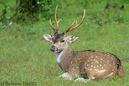
The Axis deer stands 0.6 to 1 m tall at the shoulder and has a body length of about 1.5 m (Walker, 1964). The body color is reddish with white on the belly, inner legs, and underneath their short tail. The males tend to be darker and to have black facial markings. They also have antlers composed of three tines which can reach lengths of almost a meter. Characteristic white spots occur in both sexes and run longitudinally in rows throughout the duration of the animal's life (Ables,1977). A dark dorsal stripe runs the length of the animal's back. (Albes, 1977; Walker, 1964)
- Other Physical Features
- endothermic
- homoiothermic
- bilateral symmetry
- Sexual Dimorphism
- sexes colored or patterned differently
- ornamentation
-
- Range mass
- 27 to 45 kg
- 59.47 to 99.12 lb
Reproduction
Males tend to bellow during the mating season which may be a good indicator of when breeding begins. (Walker, 1964)
Axis deer breed in April or May and have a gestation of about 7.5 months. They usually have two fawns but one or three is not uncommon(Walker, 1964). The number of fawns produced as well as the mating season may vary for deer in captivity; only one fawn is usually produced and mating may take place from May to August (Ables, 1977). First pregnancies usually occur between the ages of 14 to 17 months. The female usually maintains nursing until the fawn can safely roam with the herd (Walker, 1964).
- Key Reproductive Features
- iteroparous
- seasonal breeding
- gonochoric/gonochoristic/dioecious (sexes separate)
- sexual
- fertilization
- viviparous
-
- Breeding interval
- Axis deer breed once yearly.
-
- Breeding season
- Breeding occurs in April and May.
-
- Range number of offspring
- 1 to 3
-
- Average number of offspring
- 1.03
- AnAge
-
- Average gestation period
- 7.5 months
-
- Average gestation period
- 226 days
- AnAge
-
- Range age at sexual or reproductive maturity (female)
- 14 to 17 months
-
- Average age at sexual or reproductive maturity (male)
Sex: male - 913 days
- AnAge
- Average age at sexual or reproductive maturity (male)
Lifespan/Longevity
-
- Average lifespan
Status: captivity - 15.0 years
- Max Planck Institute for Demographic Research
- Average lifespan
-
- Average lifespan
Status: captivity - 20.8 years
- Max Planck Institute for Demographic Research
- Average lifespan
Behavior
Axis deer occur in several different kinds of herds depending on their age and sex. Matriarchal herds are common and composed of adult females and their young from the present and previous year. Sexually active males follow these groups during the mating season while less active males form bachelor herds. One other type of herd that occurs frequently are called nursery herds which include females with fawns less than 8 weeks old. The males participate in a dominance-based hierarchial system where older and larger males dominate younger and smaller males. There are four different aggressive displays among males; head-down or scare threat, present threat, head-up, and antler threat. Females also partake in aggressive behavior but it is mostly associated with over-crowding at feeding sites. Biting, striking, and chasing are the behaviors most commonly seen among females and occasionally between females and other sexes and age classes (Ables, 1977). (Albes, 1977)
- Key Behaviors
- terricolous
- diurnal
- motile
- nomadic
- social
- dominance hierarchies
Communication and Perception
Axis deer have several vocalizations besides the bellowing that occurs during the mating season. They have a bark that is used during times of alarm or when an unusual object has been observed. This usually occurs among females and juveniles and is repeated back and forth. Another kind is squealing which is used by fawns when they get separated from their mothers. Moaning is associated with males during aggressive displays or when resting (Ables, 1977).
Food Habits
The main foods utilized by these deer are grasses as well as flowers and fruits which fall from the forest trees. They will occasionally browse when it is necessary. During the monsoon season, grass and sedge species in a sal forest are an important food source. Another source of nutrition may come from mushrooms which are high in proteins and nutrients and are also found in sal forests (Moe and Wegge, 1994). (Moe and Wegge, 1994)
- Plant Foods
- leaves
- wood, bark, or stems
- fruit
Economic Importance for Humans: Positive
Axis deer have become an important resource for hunting in the United States.
Conservation Status
The axis deer has been introduced into Texas and Hawaii with good results. They do very well in captivity and can be seen at Zoos in the United States. Most are on private lands in the U.S., however, some are free-ranging.
-
- IUCN Red List
-
Least Concern
More information
-
- IUCN Red List
-
Least Concern
More information
-
- US Federal List
- No special status
-
- CITES
- No special status
Contributors
Barbara Lundrigan (author), Michigan State University, Carry Gardner (author), Michigan State University.
Glossary
- Nearctic
-
living in the Nearctic biogeographic province, the northern part of the New World. This includes Greenland, the Canadian Arctic islands, and all of the North American as far south as the highlands of central Mexico.

- acoustic
-
uses sound to communicate
- bilateral symmetry
-
having body symmetry such that the animal can be divided in one plane into two mirror-image halves. Animals with bilateral symmetry have dorsal and ventral sides, as well as anterior and posterior ends. Synapomorphy of the Bilateria.
- chemical
-
uses smells or other chemicals to communicate
- diurnal
-
- active during the day, 2. lasting for one day.
- dominance hierarchies
-
ranking system or pecking order among members of a long-term social group, where dominance status affects access to resources or mates
- endothermic
-
animals that use metabolically generated heat to regulate body temperature independently of ambient temperature. Endothermy is a synapomorphy of the Mammalia, although it may have arisen in a (now extinct) synapsid ancestor; the fossil record does not distinguish these possibilities. Convergent in birds.
- fertilization
-
union of egg and spermatozoan
- folivore
-
an animal that mainly eats leaves.
- herbivore
-
An animal that eats mainly plants or parts of plants.
- internal fertilization
-
fertilization takes place within the female's body
- introduced
-
referring to animal species that have been transported to and established populations in regions outside of their natural range, usually through human action.
- iteroparous
-
offspring are produced in more than one group (litters, clutches, etc.) and across multiple seasons (or other periods hospitable to reproduction). Iteroparous animals must, by definition, survive over multiple seasons (or periodic condition changes).
- motile
-
having the capacity to move from one place to another.
- native range
-
the area in which the animal is naturally found, the region in which it is endemic.
- nomadic
-
generally wanders from place to place, usually within a well-defined range.
- oriental
-
found in the oriental region of the world. In other words, India and southeast Asia.
- riparian
-
Referring to something living or located adjacent to a waterbody (usually, but not always, a river or stream).
- seasonal breeding
-
breeding is confined to a particular season
- sexual
-
reproduction that includes combining the genetic contribution of two individuals, a male and a female
- sexual ornamentation
-
one of the sexes (usually males) has special physical structures used in courting the other sex or fighting the same sex. For example: antlers, elongated tails, special spurs.
- social
-
associates with others of its species; forms social groups.
- tactile
-
uses touch to communicate
- terrestrial
-
Living on the ground.
- tropical
-
the region of the earth that surrounds the equator, from 23.5 degrees north to 23.5 degrees south.
- tropical savanna and grassland
-
A terrestrial biome. Savannas are grasslands with scattered individual trees that do not form a closed canopy. Extensive savannas are found in parts of subtropical and tropical Africa and South America, and in Australia.
- savanna
-
A grassland with scattered trees or scattered clumps of trees, a type of community intermediate between grassland and forest. See also Tropical savanna and grassland biome.
- temperate grassland
-
A terrestrial biome found in temperate latitudes (>23.5° N or S latitude). Vegetation is made up mostly of grasses, the height and species diversity of which depend largely on the amount of moisture available. Fire and grazing are important in the long-term maintenance of grasslands.
- visual
-
uses sight to communicate
- viviparous
-
reproduction in which fertilization and development take place within the female body and the developing embryo derives nourishment from the female.
References
Albes, E. 1977. The Axis deer in Texas. Texas Agricultural Experimental Station, Texas A&M University.: Caesar Kleberg Research Program in Wildllife Ecology and Department of Wildlife and Fisheries Sciences.
Moe, S., P. Wegge. 1994. Spacing behavior and habitat use of Axis deer (Axis axis) in lowland Nepal. Canadian Journal of Zoology, 72(10): 1735-1743.
Walker, E. 1964. Mammals of the World. Baltimore: Johns Hopkins Press.