Atractosteus spatulaGemfish
Geographic Range
Atractosteus spatula is found in the Ohio River in southwestern Ohio and the Mississippi river south to the Gulf of Mexico. They are found in drainages throughout the southeastern coastal United States (Alligator Gar, 2005). They are found in parts of Florida, Georgia, Alabama, Tennessee, Arkansas, Oklahoma, and Texas (Knopf, 2002; Shultz, 2004). Their range is from 44° to 20° north latitude and 101° to 82° west longitude (Agbayani, 2005). ("Alligator Gar", 2005; Agbayani, 2005; Knopf, 2002; Schultz, 2004)
Habitat
Alligator gar are found in large lakes, rivers, and bayous. Typically they are found in backwaters and bottomland swamps. They are found in both freshwater and brackish waters, they rarely enter marine waters (Etnier, 1993; Knopf, 2002). (Etnier and Starnes, 1993; Knopf, 2002)
- Habitat Regions
- temperate
- freshwater
- Aquatic Biomes
- lakes and ponds
- rivers and streams
- brackish water
- Other Habitat Features
- estuarine
-
- Range depth
- 0-1 (low) m
- (low) ft
Physical Description
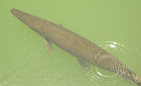
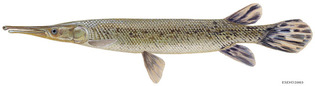
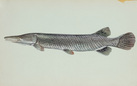
Alligator gar are grayish green to brown color on their dorsal surface and yellowish or white colored ventrally (Page and Burr, 1991). They may also have brownish spots on their dorsal surface. They are alligator-like in appearance, with their long, slender body, jaws armed with many teeth, and their habit of floating at the water surface (Goddard 2005). Their eyes are small. They have a heterocercal tail. Their swim bladder can function as a lung. The snout is short and broad with two rows of teeth on the upper jaw (Etnier 1993, Knopf, 2002). They are protected by a thick set of ganoid scales (Knopf 2002). This species is the largest of the gars and one of the largest freshwater fishes in North America, growing to nearly 3 meters long and up to 137 kg. Lateral line scales number 58 to 62 (Etnier, 1993). (Etnier and Starnes, 1993; Goddard, 2005; Knopf, 2002; Page and Burr, 1991)
- Other Physical Features
- ectothermic
- heterothermic
- bilateral symmetry
- Sexual Dimorphism
- female larger
-
- Range mass
- 137 (high) kg
- 301.76 (high) lb
-
- Range length
- 3 (high) m
- 9.84 (high) ft
Development
Young alligator gars develop from eggs and then float to the water's surface, resembling sticks (Shultz, 2004). They have a disc on the bottom of their snouth that allows them to attach to rocks and other objects until their yolk is absorbed (Goddard, 2005). Shortly afterwards, the young begin searching for food. (Goddard, 2005; Schultz, 2004)
Reproduction
Mating behaviors in this species are not known. (Goddard, 2005)
Female alligator gars lay eggs that are dark green or red and stick to rocks and vegetation. The eggs are poisonous if eaten. Alligator gar may take many years to reach sexual maturity, although little is known about reproduction in this species. (Goddard, 2005; Schultz, 2004)
- Key Reproductive Features
- iteroparous
- seasonal breeding
- gonochoric/gonochoristic/dioecious (sexes separate)
- sexual
- fertilization
- oviparous
-
- Breeding interval
- Alligator gar probably breed once yearly.
-
- Breeding season
- Breeding occurs from May to July.
-
- Range number of offspring
- 138,000 (high)
-
- Average number of offspring
- 77,000
-
- Range time to hatching
- 6 to 8 days
-
- Average age at sexual or reproductive maturity (female)
- 11 years
-
- Average age at sexual or reproductive maturity (male)
- 6 years
Alligator gars are oviparous. Once the eggs are laid, the young are left to survive on their own (Shultz, 2004). (Schultz, 2004)
- Parental Investment
- no parental involvement
-
pre-fertilization
- provisioning
-
protecting
- female
Lifespan/Longevity
Females generally live longer than males and are larger, they may live from 26 to 50 years in the wild (Etnier and Starnes, 1993). (Etnier and Starnes, 1993; Goddard, 2005)
-
- Typical lifespan
Status: wild - 50 (high) years
- Typical lifespan
-
- Average lifespan
Status: wild - 26 years
- Average lifespan
Behavior
Little is known about alligator gar behavior. They are not known to be extensively social or to migrate.
- Key Behaviors
- natatorial
- motile
- solitary
-
- Average territory size
- Unknown cm^2
Home Range
Home ranges of alligator gar are unknown.
Communication and Perception
Not much information is known about communication in alligator gars. Their lateral line system is used to detect motion in the water. They are also likely to use chemical cues and vision to some extent.
Food Habits
Alligator gars are opportunistic carnivores and sit-and-wait predators. They appear to be sluggish, but can ambush prey with short bursts of speed (Goddard, 2005). They feed on almost anything, including fish, ducks, turtles, small mammals, and carrion (Schultz, 2004). (Goddard, 2005; Schultz, 2004)
- Animal Foods
- birds
- mammals
- amphibians
- reptiles
- fish
- carrion
- aquatic crustaceans
Predation
Alligator gars have few predators. They may be eaten by larger fish as eggs, fry, and juveniles . Because of their large size, their only natural predators as adults are American alligators (Alligator mississippiensis). Humans also prey on adult alligator gars. (Goddard, 2005)
-
- Known Predators
-
- American alligators (Alligator mississippiensis)
- humans (Homo sapiens)
Ecosystem Roles
Alligator gars are generalist predators and eat anything they can find. They are especially important as top predators in aquatic systems (Goddard, 2005). (Goddard, 2005)
Economic Importance for Humans: Positive
Alligator gars have been fished commercially (Knopf, 2002). In Lousiana, they are fished for food, acting as a substitute for lobster (Etnier and Starnes, 1993). Like many other fish, they are also collected for aquaria. (Etnier and Starnes, 1993; Knopf, 2002)
Economic Importance for Humans: Negative
Because these fish are predators, they consume gamefish, (Shultz, 2004). In turn, they cause a problem for humans in terms of sport fishing and consumption. There are several undocumented reports of injuries to humans. Their eggs are poinsonous if consumed (Goddard, 2005). (Goddard, 2005; Schultz, 2004)
- Negative Impacts
-
injures humans
- bites or stings
- poisonous
Conservation Status
Alligator gar are not currently listed as endangered, threatened, or of special concern. There are some concerns about overfishing and indications that populations have declined in areas where their preferred habitat, bottomland swamps, has been destroyed through channelization and and the building of levees. (Goddard, 2005)
-
- IUCN Red List
- Not Evaluated
-
- US Federal List
- No special status
-
- CITES
- No special status
-
- State of Michigan List
- No special status
Contributors
Tanya Dewey (editor), Animal Diversity Web.
Denise Roberts (author), Eastern Kentucky University, Sherry Harrel (editor, instructor), Eastern Kentucky University.
Glossary
- Nearctic
-
living in the Nearctic biogeographic province, the northern part of the New World. This includes Greenland, the Canadian Arctic islands, and all of the North American as far south as the highlands of central Mexico.

- bilateral symmetry
-
having body symmetry such that the animal can be divided in one plane into two mirror-image halves. Animals with bilateral symmetry have dorsal and ventral sides, as well as anterior and posterior ends. Synapomorphy of the Bilateria.
- brackish water
-
areas with salty water, usually in coastal marshes and estuaries.
- carnivore
-
an animal that mainly eats meat
- carrion
-
flesh of dead animals.
- chemical
-
uses smells or other chemicals to communicate
- ectothermic
-
animals which must use heat acquired from the environment and behavioral adaptations to regulate body temperature
- estuarine
-
an area where a freshwater river meets the ocean and tidal influences result in fluctuations in salinity.
- external fertilization
-
fertilization takes place outside the female's body
- fertilization
-
union of egg and spermatozoan
- food
-
A substance that provides both nutrients and energy to a living thing.
- freshwater
-
mainly lives in water that is not salty.
- heterothermic
-
having a body temperature that fluctuates with that of the immediate environment; having no mechanism or a poorly developed mechanism for regulating internal body temperature.
- iteroparous
-
offspring are produced in more than one group (litters, clutches, etc.) and across multiple seasons (or other periods hospitable to reproduction). Iteroparous animals must, by definition, survive over multiple seasons (or periodic condition changes).
- motile
-
having the capacity to move from one place to another.
- natatorial
-
specialized for swimming
- native range
-
the area in which the animal is naturally found, the region in which it is endemic.
- oviparous
-
reproduction in which eggs are released by the female; development of offspring occurs outside the mother's body.
- pet trade
-
the business of buying and selling animals for people to keep in their homes as pets.
- piscivore
-
an animal that mainly eats fish
- poisonous
-
an animal which has a substance capable of killing, injuring, or impairing other animals through its chemical action (for example, the skin of poison dart frogs).
- seasonal breeding
-
breeding is confined to a particular season
- sexual
-
reproduction that includes combining the genetic contribution of two individuals, a male and a female
- solitary
-
lives alone
- tactile
-
uses touch to communicate
- temperate
-
that region of the Earth between 23.5 degrees North and 60 degrees North (between the Tropic of Cancer and the Arctic Circle) and between 23.5 degrees South and 60 degrees South (between the Tropic of Capricorn and the Antarctic Circle).
- visual
-
uses sight to communicate
References
2005. "Alligator Gar" (On-line). Accessed October 20, 2005 at http://en.wikipedia.org/wiki/Alligator_gar.
Agbayani, E. 2005. "Atractosteus spatula" (On-line). Accessed October 20, 2005 at http://www.fishbase.org/Summary/SpeciesSummary.php?id=1073.
Etnier, D., W. Starnes. 1993. The Fishes of Tennessee. Knoxville, TN: University OF Tennessee Press.
Goddard, N. 2005. "Alligator Gar" (On-line). Ichthyology at the Florida Museum of Natural History. Accessed December 03, 2005 at http://www.flmnh.ufl.edu/fish/Gallery/Descript/AlligatorGar/AlligatorGar.html.
Knopf, A. 2002. National Audubon Society: Field Guide to Fishes. New York: Chanticleer Press, Inc..
Page, L., B. Burr. 1991. Peterson Field Guides: Freshwater Fishes. Boston, Massachusetts: Houghton Mifflin Company.
Schultz, K. 2004. Ken Shultz’s Field Guide to Freshwater Fish. Hoboken, New Jersey: John Wiley & Sons, Inc..