Atlides halesus
Geographic Range
Atlides halesus, butterflies commonly known as great purple hairstreaks, are found from Guatemala north to the southern United States. Although they have been seen as far north as Maryland and Oregon, in the interior states they generally stay below the 38th parallel. (Scott, 1986; Struttman, 2001; Tveten and Tveten, 1996)
- Biogeographic Regions
- nearctic
- neotropical
Habitat
Atlides halesus live in wooded areas, especially those that are infested with mistletoe, Phoradendron spp. (Scott, 1986; Struttman, 2001)
- Habitat Regions
- temperate
- Terrestrial Biomes
- forest
Physical Description
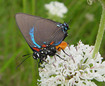
Atlides halesus are relatively large butterflies, with a wingspan ranging from 30mm to 50mm. The upper side of their wings is black with brilliant iridescent blue. Below, the wings are a purplish black color with gold iridescent markings near the tails. Atlides halesus have two tails attached to each hind wing, one shorter than the other. The underside also has red spots near the attachment to the abdomen. The abdomen is blue on top and red-orange underneath. Females are slightly larger and duller than males.
Atlides halesus larvae are green with dark green bands, yellow stripes, and a narrow green mid-dorsal line. They are also covered in short orange and green hairs.
The pupae are mottled brown and black. (Hall and Butler, 1999; Milne and Milne, 1992; Scott, 1986; Struttman, 2001; Tveten and Tveten, 1996)
- Other Physical Features
- ectothermic
- heterothermic
- bilateral symmetry
- Sexual Dimorphism
- female larger
- male more colorful
-
- Range wingspan
- 30 to 50 mm
- 1.18 to 1.97 in
Development
Female Atlides halesus scatter their eggs over mistletoe, Phoradendron spp. The larvae hatch and eat the mistletoe until they are fully grown. Then they journey to crevices under the bark or at the base of the host tree where they can safely pupate throughout the winter; in the spring, butterflies emerge. (Hall and Butler, 1999; Tveten and Tveten, 1996)
- Development - Life Cycle
- metamorphosis
Reproduction
Male Atlides halesus will wait on treetops or hilltops from noon to untill sundown (earlier on colder days) for a female to fly by. This mating system is called landmark based. Males will move their wings up and down to attract females. After mating, females will scatter their eggs over mistletoe, Phoradendron spp., so that the larvae will be able to eat. They breed from March through November, each female laying several broods each. (Preston-Mafham and Preston-Mafham, 1993; Scott, 1986; Tveten and Tveten, 1996)
- Mating System
- polygynandrous (promiscuous)
Male Atlides halesus often return to the same treetop or hilltop for days at a time to await new mates. (Scott, 1986)
- Key Reproductive Features
- seasonal breeding
- sexual
- fertilization
- oviparous
-
- Breeding season
- March-November
After female Atlides halesus lay their eggs it is up to the larvae to feed and protect themselves. (Tveten and Tveten, 1996)
- Parental Investment
- no parental involvement
-
pre-fertilization
- provisioning
-
protecting
- female
Lifespan/Longevity
After emerging from the pupae, Atlides halesus live for about 24 days. (Scott, 1986)
-
- Average lifespan
Status: wild - 24 days
- Average lifespan
Behavior
Male Atlides halesus remain local, returning often to the same treetop or hilltop to await a mate. The flowers adults frquent for nectar do not grow at this elevation, so treetops and hilltops serve only as a place to find mates. This is called hilltopping. While hilltopping, they move their wings up and down to attract mates and can trick predators into going after their false head on their wings. When they fly, they do so very slowly. Larvae also move fairly slowly and are slug-like. The adults make several flights through March and November, and fly all year in Florida and South Texas. The pupae hibernate through the winter. (Hall and Butler, 1999; Milne and Milne, 1992; Preston-Mafham and Preston-Mafham, 1993; Scott, 1986)
- Key Behaviors
- flies
- diurnal
- motile
- migratory
- hibernation
- social
Communication and Perception
Atlides halesus communicate with potential mates by flapping their wings up and down while on treetops or hilltops. (Hall and Butler, 1999; Preston-Mafham and Preston-Mafham, 1993)
- Communication Channels
- visual
- Perception Channels
- visual
Food Habits
The larvae of Atlides halesus eat only mistletoe. The younger caterpillars eat the epidermis of the leaf while the older larvae eat the entire leaf. Adults drink the nectar of various flowers in the family Asteraceae, including goldenrods and ragworts. (Scott, 1986; Tveten and Tveten, 1996)
- Primary Diet
- herbivore
- Plant Foods
- leaves
- nectar
Predation
Adult Atlides halesus protect themselves from predators by moving their wings up and down to draw attention to their false heads made by the tails and spots on the hind wings. Thus, if a predator attacks a butterfly by grabbing its tail, the tail will break off and the butterfly can escape.
Camouflage protects both larvae and pupae from large prey, but Atlides halesus have not developed a mechanism to protect the pupae from parasitoid wasps and tachinid flies. (Hall and Butler, 1999; Tveten and Tveten, 1996)
-
- Known Predators
-
- Parasitoid wasps
- Tachinid flies Tachinidae
Ecosystem Roles
Adult Atlides halesus help to pollinate various flowers in the family Asteraceae. Larvae help control mistletoe populations by eating the mistletoe leaves. The pupae provide a home and food for the developing parasitoid wasps and tachinid flies. (Hall and Butler, 1999; Scott, 1986; Tveten and Tveten, 1996)
- Ecosystem Impact
- pollinates
- creates habitat
Economic Importance for Humans: Positive
None known
Economic Importance for Humans: Negative
None known
Conservation Status
The Nature Conservancy Global Rank gives Atlides halesus a ranking of G5, which means that the species is secure globally, although it may be rare in the periphery of its habitat range. (Struttman, 2001)
-
- IUCN Red List
- No special status
-
- US Migratory Bird Act
- No special status
-
- US Federal List
- No special status
-
- CITES
- No special status
Other Comments
Atlides halesus are the only species within the genus Atlides. (Arnett, 1985; Holland, 1910)
Contributors
Sara Diamond (editor), Animal Diversity Web.
Camilia VanCamp (author), Southwestern University, Stephanie Fabritius (editor), Southwestern University.
Glossary
- Nearctic
-
living in the Nearctic biogeographic province, the northern part of the New World. This includes Greenland, the Canadian Arctic islands, and all of the North American as far south as the highlands of central Mexico.

- Neotropical
-
living in the southern part of the New World. In other words, Central and South America.
- bilateral symmetry
-
having body symmetry such that the animal can be divided in one plane into two mirror-image halves. Animals with bilateral symmetry have dorsal and ventral sides, as well as anterior and posterior ends. Synapomorphy of the Bilateria.
- diurnal
-
- active during the day, 2. lasting for one day.
- ectothermic
-
animals which must use heat acquired from the environment and behavioral adaptations to regulate body temperature
- fertilization
-
union of egg and spermatozoan
- folivore
-
an animal that mainly eats leaves.
- forest
-
forest biomes are dominated by trees, otherwise forest biomes can vary widely in amount of precipitation and seasonality.
- herbivore
-
An animal that eats mainly plants or parts of plants.
- heterothermic
-
having a body temperature that fluctuates with that of the immediate environment; having no mechanism or a poorly developed mechanism for regulating internal body temperature.
- hibernation
-
the state that some animals enter during winter in which normal physiological processes are significantly reduced, thus lowering the animal's energy requirements. The act or condition of passing winter in a torpid or resting state, typically involving the abandonment of homoiothermy in mammals.
- internal fertilization
-
fertilization takes place within the female's body
- metamorphosis
-
A large change in the shape or structure of an animal that happens as the animal grows. In insects, "incomplete metamorphosis" is when young animals are similar to adults and change gradually into the adult form, and "complete metamorphosis" is when there is a profound change between larval and adult forms. Butterflies have complete metamorphosis, grasshoppers have incomplete metamorphosis.
- migratory
-
makes seasonal movements between breeding and wintering grounds
- motile
-
having the capacity to move from one place to another.
- native range
-
the area in which the animal is naturally found, the region in which it is endemic.
- nectarivore
-
an animal that mainly eats nectar from flowers
- oviparous
-
reproduction in which eggs are released by the female; development of offspring occurs outside the mother's body.
- polygynandrous
-
the kind of polygamy in which a female pairs with several males, each of which also pairs with several different females.
- seasonal breeding
-
breeding is confined to a particular season
- sexual
-
reproduction that includes combining the genetic contribution of two individuals, a male and a female
- social
-
associates with others of its species; forms social groups.
- temperate
-
that region of the Earth between 23.5 degrees North and 60 degrees North (between the Tropic of Cancer and the Arctic Circle) and between 23.5 degrees South and 60 degrees South (between the Tropic of Capricorn and the Antarctic Circle).
- visual
-
uses sight to communicate
References
Arnett, R. 1985. American Insects. New York: Van Nostrand Reinhold Company.
Hall, D., J. Butler. 1999. "University of Florida Department of Entomology and Nematology" (On-line). Accessed November 28, 2001 at http://creatures.ifas.ufl.edu/bfly/purple_hairstreak.htm.
Holland, W. 1910. The Butterfly Book. Golden City, New York: Doubleday, Page, & Company.
Milne, L., M. Milne. 1992. The Audubon Society Field Guide to North American Insects and Spiders. New York: Alfred A. Knopf, Inc..
Preston-Mafham, R., K. Preston-Mafham. 1993. The Encyclopedia of Land Invertebrate Behavior. Cambridge, Massachusetts: The MIT Press.
Scott, J. 1986. The Butterflies of North America. Stanford, California: Stanford University Press.
Struttman, J. 2001. "National Prairie Wildlife Research Center" (On-line). Accessed November 28, 2001 at http://www.npwrc.usgs.gov/resource/distr/lepid/bflyusa/nj/282.htm.
Tveten, J., G. Tveten. 1996. Butterflies of Houston & Southeast Texas. Austin, Texas: University of Texas Press.