Atherurus macrourusAsiatic brush-tailed porcupine
Geographic Range
Atherurus macrourus (Asiatic brush-tailed porcupines) are distributed across southeast Asia. They are found in Cambodia, Indonesia, Laos, Malaysian Peninsula, Malacca by Lyon, eastern Assam (India), Hupei, Hainan, southcentral China (Yunnan, Szechuan, and Guangxi provinces), Sumatra, Burma, Myanmar, Thailand, Vietnam, and adjacent Indo-chinese islands. (Corbet and Hill, 1991; Wilson, 1993; Asian Regional Centre for Biodiversity Conservation, et al., 2004; Corbet and Hill, 1991; Grzimek, et al., 2003; Wilson, 1993)
- Biogeographic Regions
- oriental
- oceanic islands
Habitat
Asiatic brush-tailed porcupines are terrestrial and nocturnal. They rest during the day in burrows, crevices, termitaries, under and in fallen trees, in holes among tree roots, caves, or cavities along stream banks. They can live in elevations up to altitudes of 3000 meters. Asiatic brush-tailed porcupines prefer to live by plantations or cultivated areas, river forests, forest islands, as well as primary and secondary forests. These animals may dig burrows in soft floors of rainforests, and are often found near water. Rock dens are found to be intricate, having three entries spaced 2 meters apart, feeding into tunnels 3.5 meters long, showing that species of hystricids can be productive lodge diggers. Asiatic brush-tailed porcupines do not cushion their dens with plant materials. (Asian Regional Centre for Biodiversity Conservation, et al., 2004; Gould, et al., 1998; Grzimek, et al., 2003; Storch and Parker (Editor), 1990; Wilson, 1993)
- Habitat Regions
- tropical
- terrestrial
- Terrestrial Biomes
- forest
- rainforest
- scrub forest
- Other Habitat Features
- agricultural
- riparian
- caves
-
- Range elevation
- 3000 (high) m
- 9842.52 (high) ft
Physical Description
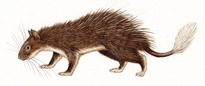
Asiatic brush-tailed porcupines are rat-like and quite slender. They have an almost entirely spiny body, though quills are soft on the under parts, head, and legs. Fur coloration on the upper back is black-brown to grey-brown. These animals possess short and stout limbs, with short, rounded ears. Eyes and ears are quite small. Individual hairs have whitish tips. The underside (ventral side) fur coloration is dirty white to light brown. Their roundish spines are flattened and stiletto-like, with fluted grooves on the upper surface. On the lower back, round and thicker bristles are interspersed between the spines resulting in a distinct terminal tuft. The tuft is whitish to creamy buff in color. Each bristle is thick and scaly and contains a chain of flattened disks that rattles when shaken. This serves as a warning to deter predators. On the upper back, flexible spines are between the fluted spikes, and the longest spines are located on the mid-upper side region. Spines can be about 10 cm long. They have a brush-like tuft on the tip of the tail.
These animals are agile and can run, climb, and swim well. Their fore- and hind-feet are five toed, partially webbed and possess blunt, straight claws. However, the large toe is reduced. The soles are naked and are fitted with pads. The skull lacks or has a very weak postorbital process. (Asian Regional Centre for Biodiversity Conservation, et al., 2004; Gotch, 1979; Gould, et al., 1998; Grzimek, et al., 2003)
- Other Physical Features
- endothermic
- homoiothermic
- bilateral symmetry
- Sexual Dimorphism
- sexes alike
- ornamentation
-
- Range mass
- 1.0 to 4.3 kg
- 2.20 to 9.47 lb
-
- Range length
- 36.5 to 60 cm
- 14.37 to 23.62 in
Reproduction
The spines on the backs of females can make mating problematic for male brush-tailed porcupines. Females can be aggressive and rapidly move backward into a male (backward attack). African brush-tailed porcupine (Atherurus africanus) females are not aggressive toward males they are familiar with, but are very aggressive when meeting unfamiliar males. Therefore, a complicated ritual of appeasement performed by males. In other members of the genus Hystrix, the female puts her tail up and the male stands on his hind legs, supporting himself with his hands on the back of the female during mating. (Storch and Parker (Editor), 1990)
- Mating System
- monogamous
Both parents participate in raising the young. They breed throughout the year in regions with more favorable climates, otherwise breeding seasonally in the most favorable season. They have 1 to 2 litters a year, with 1 to 2 offspring per litter. No information was found concerning the gestation period of this species, but the related Atherurus africanus has a pregnancy that lasts 100 to 110 days. Females have two pairs of lateral thoracic mammae, and give birth in maternity chambers cushioned with grass or fallen leaves.
- Key Reproductive Features
- iteroparous
- seasonal breeding
- year-round breeding
- gonochoric/gonochoristic/dioecious (sexes separate)
- sexual
- viviparous
-
- Breeding interval
- Females give birth to 1 to 2 litters per year.
-
- Breeding season
- Breeding occurs throughout the year in regions with more favorable climates, and during the most favorable season in more temperate regions.
-
- Range number of offspring
- 1 to 2
-
- Average number of offspring
- 1.25
- AnAge
-
- Range gestation period
- 100 to 110 days
-
- Average weaning age
- 2 months
-
- Range time to independence
- 1 to 2 years
-
- Average age at sexual or reproductive maturity (female)
- 2 years
-
- Average age at sexual or reproductive maturity (male)
- 2 years
Newborns are very active and agile within hours after they are born. They are highly developed nidifugous animals, with eyes open soon after birth. Because they are very small in size, (3% of the mother's body weight) they have to be nursed for a long time. Both parents participate in guarding the young, taking them for their first excursions and watching over them. (Storch and Parker (Editor), 1990)
- Parental Investment
- precocial
-
pre-fertilization
- provisioning
-
protecting
- female
-
pre-hatching/birth
-
provisioning
- female
-
protecting
- male
- female
-
provisioning
-
pre-weaning/fledging
-
provisioning
- male
- female
-
protecting
- male
- female
-
provisioning
-
pre-independence
-
provisioning
- male
- female
-
protecting
- male
- female
-
provisioning
Lifespan/Longevity
Hystrids are reported to be long-lived. However, not much is known about the lifespan of Atherurus macrourus in the wild. In captivity, Atherurus africanus has been reported to live 23 years, Hystrix brachyura, 21. (Storch and Parker (Editor), 1990)
-
- Typical lifespan
Status: wild - 15 (high) years
- Typical lifespan
-
- Typical lifespan
Status: captivity - 20 (high) years
- Typical lifespan
Behavior
Atherurus macrourus live in family clans of up to four to eight members, who share common runs, trails, excrement depositories, feeding places, refuges, and territories. Dwellings are, as a rule, not inhabited by one animal, but rather by a group. Typical groups consist of an adult couple and a varying number of young and growing animals. Asiatic brush-tailed porcupines provide extensive care of the young. These animals forage nocturnally and alone, but shelter in groups during the day. Atherurus macrourus individuals are extremely cautious and quiet after they have left their dens, and seem nervous when foraging for food. Porcupines move quickly and can also climb. If these animals are disturbed or pursued, they can run fast enough to get away from humans. Atherurus macrourus settle in any area with sufficient food and natural refuges, or where they can build their own dens. These animals are highly adaptive and can find homes in many different habitats. If food supplies become sparse permanently, these animals leave. (Grzimek, et al., 2003; Storch and Parker (Editor), 1990)
-
- Average territory size
- 15 km^2
Home Range
Asiatic brush-tailed porcupines in search of food may range widely, travelling distances of up to 15 km (9 miles) per night, depending on the availability of the food in the area. Family clans can have widely overlapping territories, refuges, extrement depositories, feeding places, runs and trails. They can have tunnels about 3.5m (11 feet) long. (Storch and Parker (Editor), 1990)
Communication and Perception
The tendency towards inflation of the facial portion of the skull, and the enlargement of nasal bones is less pronounced in Asiatic brush-tailed porcupines than in other porcupines. The enlarged nasal cavity may allow the animals to have a heightened sense of smell, or it may serve to help retrieving moisture from the air. As in most mammals, chemical cues are widely used in communication. Atherurus macrourus rattle the small cups at the end of their tails, which discourages their predators. (Gould, et al., 1998; Storch and Parker (Editor), 1990)
- Other Communication Modes
- pheromones
- scent marks
- vibrations
- Perception Channels
- visual
- tactile
- acoustic
- vibrations
- chemical
Food Habits
These animals strictly forage during the night. They are herbivorous and usually feed on vegetation. They enjoy tree bark, roots, tubers, leaves, bulbs, and fallen fruits. However, they sometimes also feed on cultivated crops, insects, and carrion. (Gould, et al., 1998; Grzimek, et al., 2003)
- Animal Foods
- carrion
- insects
- Plant Foods
- leaves
- roots and tubers
- wood, bark, or stems
- seeds, grains, and nuts
- fruit
- flowers
Predation
Large carnivores such as leopards, humans, large owls, canids, and other cats, hunt porcupines. Atherurus species are protected from most predators by their defensive spines. (Grzimek, et al., 2003; Rabinowitz and Walker, 1991; Storch and Parker (Editor), 1990; WCMC Collaborators, 2005)
- Anti-predator Adaptations
- aposematic
-
- Known Predators
-
- humans (Homo sapiens)
- leopards (Panthera pardus)
- tigers (Panthera tigris)
- dholes (Cuon alpinus)
- clouded leopards (Neofelis nebulosa)
- golden jackals (Canis aureus)
- domestic dogs (Canis lupus familiaris)
Ecosystem Roles
Asiatic brush-tailed porcupines eat fallen seeds and may disperse some seeds. Such pits and holes created by porcupines can be an important small habitat for sensitive plants. Asiatic brush-tailed porcupines also burrow dens in rocks and soil, and tunneling may provide some aeration of the surrounding soil and create habitat for invertebrates and other, small vertebrates. (Murniati, et al., 2006; Storch and Parker (Editor), 1990; WCMC Collaborators, 2005)
- Ecosystem Impact
- disperses seeds
- creates habitat
- soil aeration
- Plasmodium atheruri
Economic Importance for Humans: Positive
Asiatic brush-tailed porcupines are hunted for their meat. (Grzimek, et al., 2003)
- Positive Impacts
- food
Economic Importance for Humans: Negative
Asiatic brush-tailed porcupines may overfeed on crops, including casava, sweet potatoes, bananas, peanuts, maize, pineapple, mango, and sugarcane. Their habit of eating the a ring of cambium layer around the base of trees results in the death of trees when their vascular tissue is destroyed. Atherurus africanus is known to be a carrier of the malaria parasite, Plasmodium atheruri. (Grzimek, et al., 2003; Storch and Parker (Editor), 1990)
- Negative Impacts
-
injures humans
- bites or stings
- carries human disease
- crop pest
Conservation Status
Asiatic brush-tailed porcupines are not yet endangered nor threatened (Grzimek, et al., 2003; Storch and Parker (Editor), 1990)
-
- IUCN Red List
-
Least Concern
More information
-
- IUCN Red List
-
Least Concern
More information
-
- US Federal List
- No special status
-
- CITES
- No special status
Contributors
Tanya Dewey (editor), Animal Diversity Web.
Ginn Choe (author), University of Michigan-Ann Arbor, Phil Myers (editor, instructor), Museum of Zoology, University of Michigan-Ann Arbor.
Glossary
- acoustic
-
uses sound to communicate
- agricultural
-
living in landscapes dominated by human agriculture.
- aposematic
-
having coloration that serves a protective function for the animal, usually used to refer to animals with colors that warn predators of their toxicity. For example: animals with bright red or yellow coloration are often toxic or distasteful.
- bilateral symmetry
-
having body symmetry such that the animal can be divided in one plane into two mirror-image halves. Animals with bilateral symmetry have dorsal and ventral sides, as well as anterior and posterior ends. Synapomorphy of the Bilateria.
- carrion
-
flesh of dead animals.
- chemical
-
uses smells or other chemicals to communicate
- endothermic
-
animals that use metabolically generated heat to regulate body temperature independently of ambient temperature. Endothermy is a synapomorphy of the Mammalia, although it may have arisen in a (now extinct) synapsid ancestor; the fossil record does not distinguish these possibilities. Convergent in birds.
- folivore
-
an animal that mainly eats leaves.
- food
-
A substance that provides both nutrients and energy to a living thing.
- forest
-
forest biomes are dominated by trees, otherwise forest biomes can vary widely in amount of precipitation and seasonality.
- fossorial
-
Referring to a burrowing life-style or behavior, specialized for digging or burrowing.
- herbivore
-
An animal that eats mainly plants or parts of plants.
- iteroparous
-
offspring are produced in more than one group (litters, clutches, etc.) and across multiple seasons (or other periods hospitable to reproduction). Iteroparous animals must, by definition, survive over multiple seasons (or periodic condition changes).
- monogamous
-
Having one mate at a time.
- motile
-
having the capacity to move from one place to another.
- native range
-
the area in which the animal is naturally found, the region in which it is endemic.
- nocturnal
-
active during the night
- oceanic islands
-
islands that are not part of continental shelf areas, they are not, and have never been, connected to a continental land mass, most typically these are volcanic islands.
- oriental
-
found in the oriental region of the world. In other words, India and southeast Asia.

- pheromones
-
chemicals released into air or water that are detected by and responded to by other animals of the same species
- rainforest
-
rainforests, both temperate and tropical, are dominated by trees often forming a closed canopy with little light reaching the ground. Epiphytes and climbing plants are also abundant. Precipitation is typically not limiting, but may be somewhat seasonal.
- riparian
-
Referring to something living or located adjacent to a waterbody (usually, but not always, a river or stream).
- scent marks
-
communicates by producing scents from special gland(s) and placing them on a surface whether others can smell or taste them
- scrub forest
-
scrub forests develop in areas that experience dry seasons.
- seasonal breeding
-
breeding is confined to a particular season
- sedentary
-
remains in the same area
- sexual
-
reproduction that includes combining the genetic contribution of two individuals, a male and a female
- sexual ornamentation
-
one of the sexes (usually males) has special physical structures used in courting the other sex or fighting the same sex. For example: antlers, elongated tails, special spurs.
- social
-
associates with others of its species; forms social groups.
- soil aeration
-
digs and breaks up soil so air and water can get in
- tactile
-
uses touch to communicate
- terrestrial
-
Living on the ground.
- tropical
-
the region of the earth that surrounds the equator, from 23.5 degrees north to 23.5 degrees south.
- vibrations
-
movements of a hard surface that are produced by animals as signals to others
- visual
-
uses sight to communicate
- viviparous
-
reproduction in which fertilization and development take place within the female body and the developing embryo derives nourishment from the female.
- year-round breeding
-
breeding takes place throughout the year
- young precocial
-
young are relatively well-developed when born
References
Asian Regional Centre for Biodiversity Conservation, , Various National Biodiversity Conservation Units (NBRUs), European Partner Institutions. 2004. "Biodiversity Information Sharing Service (BISS)" (On-line). Asean Regional Centre for Biodiversity Conservation. Accessed March 12, 2006 at http://www.arcbc.org/cgi-bin/abiss.exe/spd?tx=MA&spd=10887.
Corbet, G., J. Hill. 1991. A World List of Mammalian Species, Third edition. New York.: Natural History Museum Publications & Oxford University Press.
Gotch, A. 1979. Mammals: Their Latin Names Explained; A Guide to Animal Classification. Poole and Dorset, U.K: Blandford Press.
Gould, E., G. McKay, D. Kirshner (Illustrations). 1998. Rodents. Pp. 227 in Encyclopedia of Mammals, Vol. 1, 2nd Edition. San Diego, California.: Academic Press, A division of Harcourt Brace and Company..
Grzimek, B., N. Schlager, D. Olendorf. 2003. Atherurus macrourus. Pp. 363 in M McDade, ed. Grzimek's Animal Life Encyclopedia, Vol. 16, 2 Edition. Detroit: Thomson Gale.
Murniati, M., M. Parren, H. Ter Steege, M. Quiñones Fernandez, P. Verweij. 2006. "Sustainable management of rainforest in Cameroon: the Tropenbos approach." (On-line).
- Ecological Aspects of Forest Management.
Rabinowitz, A., S. Walker. 1991. The Carnivore Community in a Dry Tropical Forest Mosaic in Huai Kha Khaeng Wildlife Sancturay, Thiland. Journal of Tropical Ecology, 7, No.1: 37-47. Accessed April 02, 2006 at http://links.jstor.org/sici?sici=0266-4674(199102)7%3A1%3C37%3ATCCIAD%3E2.0.CO%3B2-J.
Storch, G., S. Parker (Editor). 1990. Porcupines. Pp. 300-307 in Grzimek's Encyclopedia, Vol. 3, 1st Edition. New York: McGraw-Hill Publishing Co.
WCMC Collaborators, U. 2005. "APPENDIX 7 SELECTED PROTECTED AREAS ACCOUNTS" (On-line). Accessed April 17, 2006 at http://www.wcmc.org.uk/infoserv/countryp/vietnam/app7.html.
Wikimedia Foundation, 2006. "Wikipedia, The Free Encyclopedia" (On-line). Porcupine. Accessed March 12, 2006 at http://en.wikipedia.org/wiki/Porcupine.
Wilson, D. 1993. Mammal Species of the World: A Taxonomic and Geographic Reference. 2nd Edition. Washington and London: Smithsonian Institution Press.
Wilson, D., R. Cole. 2000. Common Names if Mammals of The World. Washington and London: Smithsonian Institution Press.