Asteroidea

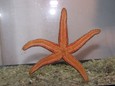

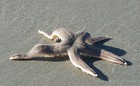

Diversity
There are approximately 1500 extant species in the Asteroidea. (Brusca and Brusca, 2003; Canada's Aquatic Environments, 2002)
Geographic Range
Mainly a marine group, asteroids are found in all the oceans. (Brusca and Brusca, 2003; Canada's Aquatic Environments, 2002)
- Biogeographic Regions
- arctic ocean
- indian ocean
- atlantic ocean
- pacific ocean
- mediterranean sea
Habitat
Except for a few species which inhabit brackish waters, asteroids are benthic organisms found in marine environments. (Brusca and Brusca, 2003; Canada's Aquatic Environments, 2002; Waggoner, 1994)
- Habitat Regions
- saltwater or marine
- Aquatic Biomes
- brackish water
- Other Habitat Features
- intertidal or littoral
Physical Description
Asteroids can range from less than 2 cm to over one m in diameter, although the majority are 12 to 24 cm. Arms extend from the body from a central disk and can be short or long. A majority have 5 arms, although some can have up to 40. Calcareous ossicles make up the internal skeleton.
The water vascular system of the sea stars open up at the madreporite, a perforated opening in the central part of the animal. Internally, the madreporite leads to a stone canal, made up of skeletal deposits. The stone canal is attached to a ring canal which leads to each of the five (or more) radial canals. Tiedemann’s bodies and polian vescicles are pouches on the ring canal whose function may be osmoregulation or hydraulic regulation within the water vascular system. Each radial canal ends in a terminal tube foot, which has a sensory function.

Each radial canal has a series of lateral canals that terminates at a tube foot. Each tube foot is made of an ampulla, podium, and usually a sucker.
The oral surface, under the central disc, is where the mouth is located. The hemal system parallels the water vascular system and probably distributes nutrients from the digestive tract. Hemal channels extend to the gonads.

Larvae are bilaterally symmetrical and adults are radially symmetrical. (Brusca and Brusca, 2003; Canada's Aquatic Environments, 2002)
- Other Physical Features
- ectothermic
- heterothermic
- bilateral symmetry
- radial symmetry
Development
Asteroids are deuterostomes. Fertilized eggs develop into bilaterally symmetrical planktonic larvae, which have 3-part paired coeloms. Embryonic coelomic structures have specific fates as the bilaterally symmetrical larvae metamorphose into radially symmetric adults. Adult pheromones may attract larvae, which tend to settle near conspecific adults. Metamorphosis in some species is triggered by adult pheromones. After settling, the larvae go through a sessile stage and metamorphose. (Anonymous, 2005; Barnes, 1987; Brusca and Brusca, 2003; Canada's Aquatic Environments, 2002)
- Development - Life Cycle
- metamorphosis
Reproduction
Asteroids can regenerate arms and some can reproduce asexually as the central disc divides. In sexual reproduction, asteroids are mainly gonochoristic (having separate sexes), but a few are hermaphroditic. Asteroids usually have two gonads in each arm and a gonopore opening to the oral surface. Gonopores are usually at the base of each arm. Most asteroids are free spawners, releasing sperm and eggs into the water. A few hermaphroditic species brood their young. Spawning is probably nocturnal. (Brusca and Brusca, 2003; Canada's Aquatic Environments, 2002)
- Key Reproductive Features
- gonochoric/gonochoristic/dioecious (sexes separate)
- simultaneous hermaphrodite
- sexual
- asexual
- fertilization
- viviparous
- oviparous
Although there is generally no parental investment beyond fertilization, a few hermaphroditic species brood their eggs. Brooding species are usually found in environments that are harsh for the larval stage. (Brusca and Brusca, 2003; Canada's Aquatic Environments, 2002)
- Parental Investment
-
pre-fertilization
- provisioning
-
pre-hatching/birth
-
protecting
- female
-
protecting
Lifespan/Longevity
Some sea stars can live up to 35 years. (Canada's Aquatic Environments, 2002)
Behavior
Asteroids move by using their water vascular system. Internal muscle contractions squeeze fluid to the tube feet, which then elongate. Cilia within the epithelium of the water vascular system moves the water. The end of the tube feet have suckers, which chemically adhere to the substrate. Another chemical bond is secreted to release the tube feet. Sea stars living on soft bottom substrates have pointed tube feet (rather than suckers) to help them move. (Brusca and Brusca, 2003; Canada's Aquatic Environments, 2002)
Communication and Perception
The non-centralized nervous system allows echinoderms to sense their environment from all sides. Sensory cells on the epidermis sense light, contact, chemicals and water currents. Higher densities of sensory cells are found in the tube feet and along feeding canal margins.
Red pigmented eye spots are found on the end of each arm. These function as photoreceptors and are clusters of pigment-cup occelli.
Adult pheromones may attract larvae, which tend to settle near conspecific adults. Metamorphosis in some species is triggered by adult pheromones. (Brusca and Brusca, 2003; Canada's Aquatic Environments, 2002)
- Communication Channels
- chemical
- Other Communication Modes
- pheromones
Food Habits
Asteroids are mainly scavengers and carnivores. In many areas where they are found they are high level predators. Asteroids feed on slow moving prey, including gastropods, bivalves, barnacles, polychaetes and other invertebrates. They feed by grasping the prey, then everting their stomach and secreting primary enzymes on the prey. The digestive juices break down the tissue of the prey, which the asteroids then suck up.
Some asteroids are suspension feeders. Plankton and organic detritus sticks to mucus on the body surface and is moved by cilia to the mouth. A few species that use their pedicellariae to capture prey may even feed on fish.
Asteroids have a complete digestive system. The mouth leads to the cardiac stomach, which is what the sea star everts to digest its prey. The cardiac stomach leads to a pyloric stomach. Digestive glands, or pyloric ceca located in each arm. Enzymes are secreted through pyloric ducts. A short intestine follows the pyloric stomach and leads to the anus. (Brusca and Brusca, 2003; Waggoner, 1994)
- Primary Diet
-
carnivore
- piscivore
- eats non-insect arthropods
- molluscivore
- scavenger
- Foraging Behavior
- filter-feeding
Predation
Planktonic larval stages are probably the most vulnerable to predation. Calcareous ossicles probably discourage predation of the adults. Other predators include Hyperoodon ampullatus, the northern bottlenose whale. Asteroids can lose arms to predators and regenerate the arms later. (Brusca and Brusca, 2003)
-
- Known Predators
-
- northern bottlenose whales (Hyperoodon ampullatus)
Ecosystem Roles
Some asteroids, such as Acanthaster planci, have increased in population and damage coral reefs as a result of their grazing. Many asteroids are top predators and keystone species. (Brusca and Brusca, 2003; Canada's Aquatic Environments, 2002; Waggoner, 1994)
- Ecosystem Impact
- keystone species
Economic Importance for Humans: Negative
Asteroids can damage coral reefs. They can also be a problem to commercial oyster beds. (Canada's Aquatic Environments, 2002; Waggoner, 1994)
Other Comments
Since most all asteroids are marine, they are osmoconformers. There is probably some ionic regulation, but very little. Outpockets of the body wall, called papulae, function in gas exchange and waste excretion. Coelomocytes, specialized cells, accumulate waste and are then released at the distal ends of the papulae. (Brusca and Brusca, 2003; Canada's Aquatic Environments, 2002)
Contributors
Renee Sherman Mulcrone (author).
Glossary
- Arctic Ocean
-
the body of water between Europe, Asia, and North America which occurs mostly north of the Arctic circle.
- Atlantic Ocean
-
the body of water between Africa, Europe, the southern ocean (above 60 degrees south latitude), and the western hemisphere. It is the second largest ocean in the world after the Pacific Ocean.

- Pacific Ocean
-
body of water between the southern ocean (above 60 degrees south latitude), Australia, Asia, and the western hemisphere. This is the world's largest ocean, covering about 28% of the world's surface.
- asexual
-
reproduction that is not sexual; that is, reproduction that does not include recombining the genotypes of two parents
- bilateral symmetry
-
having body symmetry such that the animal can be divided in one plane into two mirror-image halves. Animals with bilateral symmetry have dorsal and ventral sides, as well as anterior and posterior ends. Synapomorphy of the Bilateria.
- brackish water
-
areas with salty water, usually in coastal marshes and estuaries.
- carnivore
-
an animal that mainly eats meat
- chemical
-
uses smells or other chemicals to communicate
- ectothermic
-
animals which must use heat acquired from the environment and behavioral adaptations to regulate body temperature
- external fertilization
-
fertilization takes place outside the female's body
- fertilization
-
union of egg and spermatozoan
- filter-feeding
-
a method of feeding where small food particles are filtered from the surrounding water by various mechanisms. Used mainly by aquatic invertebrates, especially plankton, but also by baleen whales.
- heterothermic
-
having a body temperature that fluctuates with that of the immediate environment; having no mechanism or a poorly developed mechanism for regulating internal body temperature.
- intertidal or littoral
-
the area of shoreline influenced mainly by the tides, between the highest and lowest reaches of the tide. An aquatic habitat.
- keystone species
-
a species whose presence or absence strongly affects populations of other species in that area such that the extirpation of the keystone species in an area will result in the ultimate extirpation of many more species in that area (Example: sea otter).
- metamorphosis
-
A large change in the shape or structure of an animal that happens as the animal grows. In insects, "incomplete metamorphosis" is when young animals are similar to adults and change gradually into the adult form, and "complete metamorphosis" is when there is a profound change between larval and adult forms. Butterflies have complete metamorphosis, grasshoppers have incomplete metamorphosis.
- molluscivore
-
eats mollusks, members of Phylum Mollusca
- motile
-
having the capacity to move from one place to another.
- native range
-
the area in which the animal is naturally found, the region in which it is endemic.
- nocturnal
-
active during the night
- oviparous
-
reproduction in which eggs are released by the female; development of offspring occurs outside the mother's body.
- pheromones
-
chemicals released into air or water that are detected by and responded to by other animals of the same species
- piscivore
-
an animal that mainly eats fish
- radial symmetry
-
a form of body symmetry in which the parts of an animal are arranged concentrically around a central oral/aboral axis and more than one imaginary plane through this axis results in halves that are mirror-images of each other. Examples are cnidarians (Phylum Cnidaria, jellyfish, anemones, and corals).
- saltwater or marine
-
mainly lives in oceans, seas, or other bodies of salt water.
- scavenger
-
an animal that mainly eats dead animals
- sexual
-
reproduction that includes combining the genetic contribution of two individuals, a male and a female
- tactile
-
uses touch to communicate
- viviparous
-
reproduction in which fertilization and development take place within the female body and the developing embryo derives nourishment from the female.
References
Anonymous, 2005. "Class Asteroidea" (On-line). Accessed January 26, 2005 at http://www.encyclopedia.com/html/section/Echinode_ClassAsteroidea.asp.
Barnes, R. 1987. Invertebrate Zoology. Orlando, Florida: Dryden Press.
Brusca, R., G. Brusca. 2003. Invertebrates. Sunderland, Massachusetts: Sinauer Associates, Inc..
Canada's Aquatic Environments, 2002. "Asteroidea" (On-line). Invertebrates. Accessed January 26, 2005 at http://www.aquatic.uoguelph.ca/inverts/diver/marine/echinodermata/astero.htm.
Waggoner, B. 1994. "Introduction to the Asteroidea" (On-line). Accessed January 26, 2005 at http://www.ucmp.berkeley.edu/echinodermata/asteroidea.html.