Asio flammeusshort-eared owl



Geographic Range
Short-eared owls are one of the world's most widely distributed owls. They inhabit all of North and South America; this area includes the coast of the Arctic Ocean to Pantagonia. Short-eared owls can also be found on every continent except Australia and Antarctica. (Granlund et al., 1994; Welty, 1975; Pearson, 1936)
- Biogeographic Regions
- nearctic
- palearctic
- oriental
- ethiopian
- neotropical
- Other Geographic Terms
- cosmopolitan
Habitat
One of the world's most widely distributed owls, Asio flammeus can be found throughout much of North America and Eurasia. These owls prefer to live in marshes and bogs; they inhabit open, treeless areas. Their hunting and nesting habits make them well suited to relatively flat land. This species is migratory but uses relatively similar habitats during summer and winter. Short-eared owls have specialized eating habits and tend to stay where they can find ample food. They will leave an area to find preferred prey rather than eat other animals. Nests are usually located on dry sites and in open country supporting small mammals such as voles and lemmings.
(Martin, 1990; Sparks and Soper, 1989; Pearson, 1936)
- Habitat Regions
- temperate
- terrestrial
- Terrestrial Biomes
- savanna or grassland
- forest
- Other Habitat Features
- agricultural
Physical Description
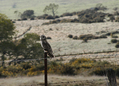
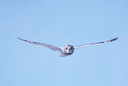
Short-eared owls range in length from 340 to 415 mm in males (mean 373 mm) and 340 to 423 mm in females (mean 382 mm). Wing length is from 279 to 307 mm in males and 267 to 314 mm in females. Wingspan is estimated at 950 to 1100 mm. Males and females are not easily distinguishable from each other externally, but females are usually slightly larger. Their feathers are yellow-white and dark brown; parts of the head and especially the legs and flanks are white. Individuals vary considerably in colors. The right and left ears occupy different vertical positions on the sides of their head, but the size and shape of the two ears are the same. (Holt and Leasure, 1993; Martin, 1990; Pearson, 1936) (Wiggins, et al., 2006)
- Other Physical Features
- endothermic
- homoiothermic
- bilateral symmetry
- Sexual Dimorphism
- female larger
-
- Range mass
- 206 to 475 g
- 7.26 to 16.74 oz
-
- Average mass
- 347 g
- 12.23 oz
-
- Range length
- 340 to 423 mm
- 13.39 to 16.65 in
-
- Range wingspan
- 950 to 1100 mm
- 37.40 to 43.31 in
-
- Average basal metabolic rate
- 313.375 cm3.O2/g/hr
Reproduction
The difficulty of owl reproduction lies in their usually individualistic habits; a great amount of the effort goes into learning mutual recognition as mating partners rather than prey or predator. They even have some difficulty identifying the gender of prospective mates from a distance. Male short-eared owls use an aerial display that includes wing clapping to alert the female of his presence and sex. Males also may offer food to females; this prevents females from considering the male as food.
Pair formation begins in mid-February and continues through June. Breeding usually begins in April. Short-eared owls are reported to also raise a second brood although this is not confirmed. To attract females, males perform sky dancing displays, day or night. The sky dance consists of song accompanied by aerial acrobatics. Short-eared owls are generally thought to be monogamous; however, the pair bond probably does not last beyond the breeding season. (Holt and Leasure, 1993)
- Mating System
- monogamous
After sufficient time and caution has been taken, the male mounts the female. One observer reported that copulation took 4 seconds, after which the male and female flew in different directions. Breeding usually takes place while in their summer habitat, but they may breed in their wintering area if food is plentiful. Short-eared owls nest on the ground in protection provided by tall grasses; they often return to the same nests. Each nest contains 4 to 7 white, unspotted eggs. The eggs have an average incubation of 21 days. Nestlings have been known to prey on their smaller nest mates. The young usually disperse from the nest when they are about 14 to 17 days old. They are independent 1 to 2 weeks after fledging. (Holt and Leasure, 1993; Sparks and Soper, 1989; Pearson, 1936; Welty, 1975)
- Key Reproductive Features
- iteroparous
- seasonal breeding
- gonochoric/gonochoristic/dioecious (sexes separate)
- sexual
- fertilization
- oviparous
-
- Breeding interval
- Short-eared owls typically breed once yearly in the spring. Second broods have been reported but data is still needed to confirm this.
-
- Breeding season
- Short-eared owls typically breed late March to June, but mostly in April. In the southern hemisphere, breeding begins in September.
-
- Range eggs per season
- 1 to 11
-
- Average eggs per season
- 5.6
-
- Average eggs per season
- 6
- AnAge
-
- Range time to hatching
- 21 to 37 days
-
- Range fledging age
- 24 to 36 days
-
- Range time to independence
- 31 to 43 minutes
-
- Average age at sexual or reproductive maturity (female)
- 1 years
-
- Average age at sexual or reproductive maturity (female)
Sex: female - 365 days
- AnAge
- Average age at sexual or reproductive maturity (female)
-
- Average age at sexual or reproductive maturity (male)
- 1 years
-
- Average age at sexual or reproductive maturity (male)
Sex: male - 365 days
- AnAge
- Average age at sexual or reproductive maturity (male)
Only females brood and feed nestlings, while male provide food and defend the nest with distraction displays and vocalizations. Females protect nestlings from some weather conditions by brooding when young, and mantling when larger. When they are born young are semi-altricial, which means that they are relatively immobile and helpless when they hatch, but are down-covered rather than naked. (Holt and Leasure, 1993)
- Parental Investment
- altricial
- male parental care
- female parental care
Lifespan/Longevity
Records are limited, but the longevity record for a wild short-eared owl is 4 yrs, 2 months. Causes of mortality include occasionally being hit by cars and airplanes, or being shot or trapped.
-
- Range lifespan
Status: wild - 21.8 (high) years
- Range lifespan
-
- Average lifespan
Status: wild - 53 months
- Bird Banding Laboratory
- Average lifespan
Behavior
In contrast with many other owls, short-eared owls begin foraging during daylight or early evening. These owls may continue to be active into the night, but usually cease activity after nightfall. They have a tendency to form communal roosts during the winter months. In different times of the year, they may live alone or together, but they always hunt alone.
After breeding, a mated pair remains together for the current breeding season. These owls defend their territories during the breeding season through skirmishes and chases; the size of this area depends on food availabiltiy. (Holt and Leasure, 1993; Martin, 1990; Sparks and Soper, 1989)
The individual spacing of short-eared owls is poorly known, but owls in communal winter and post-breeding season often roost within 1 meter of each other. There is a wide range in the size of breeding territories. Short-eared owls are thought to be highly migratory in the northern part of their range, above around 50 degrees north latitude. Additionally, data indicates seasonal north/south migration and west/southwest movements for some individuals at mid-latitudes. Nomadism in search of food, migration, and juvenile dispersal may be confused.
- Key Behaviors
- flies
- nocturnal
- crepuscular
- motile
- nomadic
- migratory
- solitary
- territorial
-
- Range territory size
- .18 to 2.42 km^2
Home Range
Breeding territories vary widely in size, depending on the density of resources in the area.
Communication and Perception
Short-eared owl nestlings give high pitched calls from within the egg, and from hatching until they are about 7 days old. These are probably begging calls or perhaps expressing discomfort. The vocal pitch changes at about 7 days and becomes lower. Adults sometimes direct calls at human territorial intruders. Both males and females bark, scream, whine, and give broken wing distraction displays to defend the nest and young from potential threats. In late February and March, territorial songs are sung. (Holt and Leasure, 1993)
Short-eared owls have keen vision, especially in low light. They also use their excellent sense of hearing to help locate and capture prey.
Food Habits
Short-eared owls prey primarily on voles, mice, and other small mammals. Their strong talons and sharp beak make them well adapted to 'picking up' their food while in flight. These owls may utilize a 'perch-and-pounce' hunting method if there is an adequate perching point available. Otherwise, they hunt by flying two meters above the ground in a regular, slow manner. Short-eared owls rely mainly on auditory clues; using these alone, they can catch prey that is under continuous grass cover. (Martin, 1990 and Pearson, 1936)
- Primary Diet
-
carnivore
- eats terrestrial vertebrates
- Animal Foods
- birds
- mammals
Predation
Short-eared owls are vulnerable primarily to mammalian predation due to the type of open habitat they occupy and their ground nesting habit. Short-eared owls fly fast and directly at an intruder, pulling up and presenting their talons at the last moment. They often use thermal updrafts during skirmishes and rise vertically, chasing and interacting with intruders. They may scream, whine, and distract predators on eggs or nestlings by pretending to have a broken wing.
-
- Known Predators
-
- northern goshawks (Accipiter gentilis)
- peregrine falcons (Falco peregrinus)
- gyrfalcons (Falco rusticolus)
- red-tailed hawks (Buteo jamaicensis)
- great horned owls (Bubo virginianus)
- snowy owls (Nyctea scandiaca)
- bald eagles (Haliaeetus leucocephalus)
- northern harriers (Circus cyaneus)
- common ravens (Corvus corax)
- herring gulls (Larus argentatus)
Ecosystem Roles
Short-eared owls are important predators on populations of many different types of small mammals and birds.
Economic Importance for Humans: Positive
Short-eared owls help manage animals that humans consider to be pests; a large portion of their diet is small rodents, such as mice and voles. In areas where small mammals can reach plague numbers, short-eared owls capitalize on the opportunity and settle in large numbers. (Sparks and Soper, 1989 and Pearson, 1936)
- Positive Impacts
- controls pest population
Economic Importance for Humans: Negative
There are no known negative effects of short-eared owls on humans.
Conservation Status
Due to their wide distribution, short-eared owls are not a federally endangered species; however, in the Great Lakes region of the United States, conditions are worse. This species is threatened by the diminishing area of marshes, bogs, and open grasslands. Nesting habits and nomadism make this species particularly vulnerable to habitat loss during any season. Due to these factors, short-eared owls are endangered in Michigan, Illinois, and Pennsylvania. They are also threatened in Minnesota and of special concern in Indiana and Ohio. They are among the rarest nesting owls in Michigan. There are no major efforts to help them recover in these areas. (Granlund et al., 1994)
-
- IUCN Red List
-
Least Concern
More information
-
- IUCN Red List
-
Least Concern
More information
-
- US Migratory Bird Act
- Protected
-
- US Federal List
- No special status
-
- CITES
- Appendix II
-
- State of Michigan List
- Endangered
Contributors
Nathan Doan (author), University of Michigan-Ann Arbor, Kathleen Bachynski (editor), University of Michigan-Ann Arbor, Tanya Dewey (editor), Animal Diversity Web.
Glossary
- Ethiopian
-
living in sub-Saharan Africa (south of 30 degrees north) and Madagascar.

- Nearctic
-
living in the Nearctic biogeographic province, the northern part of the New World. This includes Greenland, the Canadian Arctic islands, and all of the North American as far south as the highlands of central Mexico.
- Neotropical
-
living in the southern part of the New World. In other words, Central and South America.
- Palearctic
-
living in the northern part of the Old World. In otherwords, Europe and Asia and northern Africa.
- acoustic
-
uses sound to communicate
- agricultural
-
living in landscapes dominated by human agriculture.
- altricial
-
young are born in a relatively underdeveloped state; they are unable to feed or care for themselves or locomote independently for a period of time after birth/hatching. In birds, naked and helpless after hatching.
- bilateral symmetry
-
having body symmetry such that the animal can be divided in one plane into two mirror-image halves. Animals with bilateral symmetry have dorsal and ventral sides, as well as anterior and posterior ends. Synapomorphy of the Bilateria.
- bog
-
a wetland area rich in accumulated plant material and with acidic soils surrounding a body of open water. Bogs have a flora dominated by sedges, heaths, and sphagnum.
- carnivore
-
an animal that mainly eats meat
- chemical
-
uses smells or other chemicals to communicate
- cosmopolitan
-
having a worldwide distribution. Found on all continents (except maybe Antarctica) and in all biogeographic provinces; or in all the major oceans (Atlantic, Indian, and Pacific.
- crepuscular
-
active at dawn and dusk
- endothermic
-
animals that use metabolically generated heat to regulate body temperature independently of ambient temperature. Endothermy is a synapomorphy of the Mammalia, although it may have arisen in a (now extinct) synapsid ancestor; the fossil record does not distinguish these possibilities. Convergent in birds.
- female parental care
-
parental care is carried out by females
- fertilization
-
union of egg and spermatozoan
- forest
-
forest biomes are dominated by trees, otherwise forest biomes can vary widely in amount of precipitation and seasonality.
- internal fertilization
-
fertilization takes place within the female's body
- iteroparous
-
offspring are produced in more than one group (litters, clutches, etc.) and across multiple seasons (or other periods hospitable to reproduction). Iteroparous animals must, by definition, survive over multiple seasons (or periodic condition changes).
- male parental care
-
parental care is carried out by males
- marsh
-
marshes are wetland areas often dominated by grasses and reeds.
- migratory
-
makes seasonal movements between breeding and wintering grounds
- monogamous
-
Having one mate at a time.
- motile
-
having the capacity to move from one place to another.
- native range
-
the area in which the animal is naturally found, the region in which it is endemic.
- nocturnal
-
active during the night
- nomadic
-
generally wanders from place to place, usually within a well-defined range.
- oriental
-
found in the oriental region of the world. In other words, India and southeast Asia.
- oviparous
-
reproduction in which eggs are released by the female; development of offspring occurs outside the mother's body.
- seasonal breeding
-
breeding is confined to a particular season
- sexual
-
reproduction that includes combining the genetic contribution of two individuals, a male and a female
- solitary
-
lives alone
- swamp
-
a wetland area that may be permanently or intermittently covered in water, often dominated by woody vegetation.
- tactile
-
uses touch to communicate
- temperate
-
that region of the Earth between 23.5 degrees North and 60 degrees North (between the Tropic of Cancer and the Arctic Circle) and between 23.5 degrees South and 60 degrees South (between the Tropic of Capricorn and the Antarctic Circle).
- terrestrial
-
Living on the ground.
- territorial
-
defends an area within the home range, occupied by a single animals or group of animals of the same species and held through overt defense, display, or advertisement
- tropical savanna and grassland
-
A terrestrial biome. Savannas are grasslands with scattered individual trees that do not form a closed canopy. Extensive savannas are found in parts of subtropical and tropical Africa and South America, and in Australia.
- savanna
-
A grassland with scattered trees or scattered clumps of trees, a type of community intermediate between grassland and forest. See also Tropical savanna and grassland biome.
- temperate grassland
-
A terrestrial biome found in temperate latitudes (>23.5° N or S latitude). Vegetation is made up mostly of grasses, the height and species diversity of which depend largely on the amount of moisture available. Fire and grazing are important in the long-term maintenance of grasslands.
- visual
-
uses sight to communicate
References
Granlund, J., G.A. McPeek, and R.J. Adams. 1994. The Birds of Michigan. Indiana University Press, Bloomington.
Holt, D.W. 1993. The Birds of North America. The American Ornithologists' Union and The Academy of Natural Sciences of Philadelphia, Philadelphia.
Martin, G. 1990. Birds by Night. T& AD Poyser, London.
Pearson, T. G., ed. 1936. Birds of America. Garden City Books, Garden City.
Sparks, J. and T. Soper. 1989. Owls:Their Natural and Unnatural History. Facts on File, New York.
Wety, J.C. 1975. The Life of Birds. Second Edition. W.B. Saunder Company, Philadelphia.
Wiggins, D., D. Holt, S. Leasure. 2006. Short-eared Owl (Asio flammeus). Pp. 1-19 in A Poole, ed. The Birds of North America Online, Vol. 62. Ithaca, NY: Cornell Laboratory of Ornithology. Accessed July 26, 2007 at http://bna.birds.cornell.edu/BNA/account/Short-eared_Owl/.