Arthroleptidae

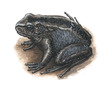

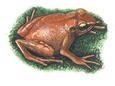
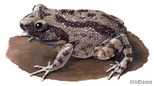
The common name for this group, screeching frogs, derives from the voices of Arthroleptis species.
This relatively small family of diverse frogs consists of two distinct subfamilies, in seven or eight genera, containing approximately 70 species. Arthroleptids are restricted in distribution to sub-Saharan Africa.
There are no synapomorphies for the Arthroleptidae. In contrast to the ranids, a group often considered to include them, arthroleptids have postzonal sternal elements that are cartilaginous (they are ossified in ranids). Additional characters that are shared among members of the family include the presence of eight holochordal procoelous presacral vertebrae; presacrals I and II that are unfused; a sacrum with cylindrical diapophyses and a bicondylar articulation with the coccyx; the presence of palatines; and astragalus and calcaneum bones that are fused only at the ends. Amplexus is axillary. Several characters differ between the two subfamilies, Arthroleptinae and Astylosterninae. Arthroleptines have two tarsalia; astylosternines have three. Pupils are horizontal among arthroleptines, vertically elliptical among astylosternines. Some arthroleptines lack teeth, while all astylosternines have dentate maxillae and premaxillae. Vertebral neural arches are nonimbricate in arthroleptines, imbricate in astylosternines. Diploid number for species in which it is known ranges from 14 -16 in arthroleptines, and from 28 - 54 in astylosternines.
The ecology of most species in this family is poorly known and, like morphological characters, varies widely between subfamilies. Arthroleptines are small frogs (less than 40 mm snout-vent length) characterized by direct development of eggs laid on the leaf litter, or in nest chambers. The genus Arthroleptis inhabits rainforests, where they lay small clutches of large eggs on land. Astylosternines are somewhat larger, and have indirect development. Their type IV tadpoles have beaks, denticles, and a sinistral spiracle. Females of the single species in the astylosternine genus Trichobatrachus, the hairy frog, lay eggs in streams. During the breeding season, males develop long, hairlike, highly vascularized projections on their thighs and flanks. These shaggy males attend clutches by sitting on eggs for long periods of time. The hairs are thought to aid in cutaneous respiration, allowing frogs to remain submerged for longer periods of time, thus minimizing time spent away from the eggs.
Arthroleptids are neobatrachians, but relationships among the families of these "advanced" frogs are almost wholly unresolved. Within the Neobatrachia, arthroleptids are members of the superfamily Ranoidea, a clade of derived forms that likely loses its monophyly if Dendrobatidae is included. Family relationships among the Ranoids are in a state of chaos, and should be considered unknown. Some researchers continue to regard the two arthroleptid subfamilies as part of Ranidae, rendering the family Arthroleptidae unnecessary. At least one author has pointed to several characters in common between the Arthroleptidae and the Hyperoliidae, suggesting a sister relationship between those two families. At the current time, we have no idea who the arthroleptids are related to, or even if they form a monophyletic group unto themselves.
No fossil arthroleptids are known.
Cannatella, D., L. Ford, and L. Bockstanz. 1996. Neobatrachia: Tree of Life. (Website.)http://tolweb.org/tree?group=Neobatrachia&contgroup=Salientia
Cannatella, D.. 1996. Arthroleptidae: Tree of Life. (Website.)http://tolweb.org/tree?group=Arthroleptidae&contgroup=Neobatrachia
Cogger, H. G., and R. G. Zweifel, editors. 1998. Encyclopedia of Reptiles and Amphibians, 2nd edition. Academic Press, San Diego.
Duellman, W. E., and L. Trueb. 1986. Biology of Amphibians. Johns Hopkins University Press, Baltimore, MD.
Ford, L. S., and D. Cannatella. 1993. The major clades of frogs. Herpetological Monographs 7:94-117.
Pough, F. H., R. M. Andrews, J. E. Cadle, M. L. Crump, A. H. Savitzky, and K. D. Wells. 1998. Herpetology. Prentice-Hall, Inc., Upper Saddle River, NJ.
Stebbins, R. C., and N. W. Cohen. 1995. A natural history of amphibians. Princeton University Press, Princeton.
Zug, G. R. 1993. Herpetology: an introductory biology of amphibians and reptiles. Academic Press, San Diego.
Contributors
Heather Heying (author).
Glossary
- bilateral symmetry
-
having body symmetry such that the animal can be divided in one plane into two mirror-image halves. Animals with bilateral symmetry have dorsal and ventral sides, as well as anterior and posterior ends. Synapomorphy of the Bilateria.
- ectothermic
-
animals which must use heat acquired from the environment and behavioral adaptations to regulate body temperature
- metamorphosis
-
A large change in the shape or structure of an animal that happens as the animal grows. In insects, "incomplete metamorphosis" is when young animals are similar to adults and change gradually into the adult form, and "complete metamorphosis" is when there is a profound change between larval and adult forms. Butterflies have complete metamorphosis, grasshoppers have incomplete metamorphosis.
- motile
-
having the capacity to move from one place to another.