Arion subfuscus

Geographic Range
Arion subfuscus is native to the Paleartic (Beyer and Saari, 1978) and has been introduced to northeastern North America, where it ranges from eastern Canada to South Carolina, and as far west as Indiana. In Europe its range has expanded to include the northwestern, central, and eastern regions (Pinceel et al. 2005). (Beyer and Saari, 1978; Pinceel, et al., 2005)
- Biogeographic Regions
- nearctic
- palearctic
- Other Geographic Terms
- holarctic
Habitat
Habitat use by the terrestrial gastropod Arion subfuscus varies seasonally. In fall A. subfuscus can be found foraging in moist plant debris and small crevices in the soil. As winter approaches, it usually moves deeper into the soil, returning to the leaf litter in spring. In summer A. subfuscus must find adequate shelter to prevent desiccation (Beyer and Saari 1978). (Beyer and Saari, 1978)
- Habitat Regions
- temperate
- Terrestrial Biomes
- forest
- Other Habitat Features
- urban
- suburban
- agricultural
Physical Description
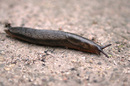
Arion subfuscus is a terrestrial slug. Like most slugs A. subfuscus has a tough body covered in mucus and lacks a visible shell. A. subfuscus individuals will have one of four color groups: reddish brown, black, orange or yellow, and lateral or mantle bands may or may not be present (Beyer and Saari, 359).
Arion subfuscus is a pulmonate gastropod and thus lacks gills but instead has a lung developed from the mantle cavity. The lung is open to the outside by a small pore called the pneumostome, which permits air exchange but limits water loss. The mantle sits on top of the body and lung. Internal shells are very reduced and present only as calcareous grains under the rear part of the mantle (Nichols, Cooke and Whiteley, 62). (Beyer and Saari, 1978; Nichols, et al., 1971; Pearse, et al., 1987)
- Other Physical Features
- ectothermic
- bilateral symmetry
- polymorphic
-
- Range length
- 5 to 7 cm
- 1.97 to 2.76 in
Development
Arion subfuscus generally has an annual life cycle where eggs hatch in autumn and adults die in summer. This can vary, however, depending on geographical location and habitat (Beyer and Saari 1978). Adults lay eggs which hatch directly into small juvenile slugs. The slugs grow slowly during the first few months, followed by rapid growth resulting in sexual maturity. During the period of rapid growth, the hermaphrodite gland becomes enlarged and the ratio of gland weight to body weight reaches a maximum as body weight reaches a maximum in the spermatozoon stage. During the reproductive stage, body weight remains constant but the hermaphrodite gland decreases in size as the slugs move into post-reproductive phase (Barker 1991). (Barker, 1991; Beyer and Saari, 1978)
Reproduction
Arion subfuscus is hermaphroditic and can both self- and cross-fertilize, depending on the conditions and habitat stability (McCraken and Selander 1980). (McCraken and Selander, 1980)
During copulation slugs exchange sperm through their protruding genitalia. Fertilization is internal, and several days after mating the slug will lay hundreds of eggs in the soil. Most adult slugs die soon after breeding and there is no parental care (Barker 1991).
In Arion and other genera, some individuals engage in apophallation: during sperm transfer male genitalia can become entangled. In such a case, the slugs may bite off each others penises to free themselves. Following apophallation the slug effectively becomes a female and never regains male functioning. (Barker, 1991)
- Key Reproductive Features
- semelparous
- seasonal breeding
- simultaneous hermaphrodite
- sexual
- fertilization
- oviparous
- sperm-storing
- delayed fertilization
-
- Breeding season
- autumn or spring to late summer
-
- Average number of offspring
- several dozen
-
- Range gestation period
- 3 to 4 weeks
Species such as A. subfuscus that belong to genus Arion lay their eggs in clusters in the soil. Although the eggs are left alone and there is no parental care, the eggs are chemically protected by a diterpene called miriamin. This chemical is a caustive agent that prevents the eggs from being eaten or damaged (Schroeder et al. 1999). (Schroeder, et al., 1999)
- Parental Investment
- no parental involvement
-
pre-hatching/birth
- protecting
Lifespan/Longevity
A. subfuscus is an annual species with a lifespan ranging from 8-12 months. Arion slugs generally hatch sometime between autumn and winter. They typically undergo a period of slow growth during winter followed by a period of rapid growth culminating in reproductive maturity. Slugs usually die post reproduction, but this can vary depending on the conditions and geographical location (Barker 1991). (Barker, 1991)
-
- Typical lifespan
Status: wild - 8 to 12 months
- Typical lifespan
Behavior
Arion subfuscus utilizes a muscular “foot” to creep slowly through vegetation and litter. A. subfuscus is most active during dusk or night to avoid desiccation(Beyer and Sarri 1977). (Beyer and Saari, 1978)
- Key Behaviors
- terricolous
- nocturnal
- crepuscular
- sedentary
Home Range
Home range is relatively confined because of its generalist feeding habits and avoidance of dessication (Beyer and Saari 1978). (Beyer and Saari, 1978)
Communication and Perception
In general terrestrial gastropods have poor ability to perceive objects by vision, and have little or no auditory perception. The primary sense used in perception is smell. The olfactory organs on a slug are located at the tips of the tentacles. The 4 tentacles can regenerate if they are removed and the olfactory organ will regenerate with it. Slugs also have chemoreceptors to detect toxins. The chemoreceptors are located on the lips. They eyes of the slugs are not primarily for vision. They are thought to be used to perceive light and to set its circadian rhythm (Barker, 2001). (Barker, 2001)
- Communication Channels
- chemical
Food Habits
Arion subfuscus uses its radula to scrape and consume its food (Pearse et al., 1987). It appears to have a broad diet which includes fungi and decaying plants as major components, but also yellowed foliage, exposed plant parts, animal feces, insect larvae, dead or injured earthworms, and algae. A. subfuscus was observed foraging 6 m from the ground on tree trunks (Beyer and Sarri, 1977). (Beyer and Saari, 1978; Pearse, et al., 1987)
- Primary Diet
- mycophage
- detritivore
- Plant Foods
- leaves
- algae
- Other Foods
- fungus
- detritus
- dung
Predation
Arion subfuscus is preyed upon by a wide variety of organisms including insects, amphibians, reptiles, birds and small mammals (Martin, 2000). (Martin, 2000)
-
- Known Predators
-
- Beetles (Coleoptera)
- snakes (Serpentes)
- shrews (Soricidae)
- crows (Corvidae)
Ecosystem Roles
Arion subfuscus is an example of a generalist species and has been found living in woodlands, arable lands, edge habitats, and around human habitations. They can survive in a variety of soils and microhabitats including soil, plant litter and vegetation. As generalist herbivores, slugs could be a major factor in limiting the geographical ranges of plants (Scheidel and Bruelheide, 1999).
Because terrestrial slugs store environmental chemicals in their bodies, these toxic residues may be passed along the food chain and ultimately affect the biodiversity of an ecosystem (Martin, 2000). (Martin, 2000; Scheidel and Bruelheide, 1999)
Economic Importance for Humans: Positive
A. subfuscus and other slugs are potentially useful as indicators of metals and other contaminants in the environment. (Martin, 2000)
- Positive Impacts
- research and education
Economic Importance for Humans: Negative
Slugs are significant agricultural pests. Given its continued growth in abundance and range, Arion subfuscus is among the most important slug pests in North America (Frank 2003). (Frank, 2003)
- Negative Impacts
- crop pest
Conservation Status
A. subfuscus is not listed as endangered, threatened, vulnerable in any part of its range.
-
- IUCN Red List
- Not Evaluated
-
- US Federal List
- No special status
-
- CITES
- No special status
-
- State of Michigan List
- No special status
Contributors
Kelly Amanda (author), Rutgers University, Jessica Mazzara (author), Rutgers University, Christen McCoy (author), Rutgers University, Philip Nicodemo (author), Rutgers University, David V. Howe (editor), Rutgers University, Renee Mulcrone (editor), Special Projects.
Glossary
- Nearctic
-
living in the Nearctic biogeographic province, the northern part of the New World. This includes Greenland, the Canadian Arctic islands, and all of the North American as far south as the highlands of central Mexico.

- Palearctic
-
living in the northern part of the Old World. In otherwords, Europe and Asia and northern Africa.
- agricultural
-
living in landscapes dominated by human agriculture.
- bilateral symmetry
-
having body symmetry such that the animal can be divided in one plane into two mirror-image halves. Animals with bilateral symmetry have dorsal and ventral sides, as well as anterior and posterior ends. Synapomorphy of the Bilateria.
- chemical
-
uses smells or other chemicals to communicate
- crepuscular
-
active at dawn and dusk
- delayed fertilization
-
a substantial delay (longer than the minimum time required for sperm to travel to the egg) takes place between copulation and fertilization, used to describe female sperm storage.
- detritivore
-
an animal that mainly eats decomposed plants and/or animals
- detritus
-
particles of organic material from dead and decomposing organisms. Detritus is the result of the activity of decomposers (organisms that decompose organic material).
- ectothermic
-
animals which must use heat acquired from the environment and behavioral adaptations to regulate body temperature
- fertilization
-
union of egg and spermatozoan
- forest
-
forest biomes are dominated by trees, otherwise forest biomes can vary widely in amount of precipitation and seasonality.
- holarctic
-
a distribution that more or less circles the Arctic, so occurring in both the Nearctic and Palearctic biogeographic regions.
Found in northern North America and northern Europe or Asia.
- internal fertilization
-
fertilization takes place within the female's body
- introduced
-
referring to animal species that have been transported to and established populations in regions outside of their natural range, usually through human action.
- mycophage
-
an animal that mainly eats fungus
- native range
-
the area in which the animal is naturally found, the region in which it is endemic.
- nocturnal
-
active during the night
- oviparous
-
reproduction in which eggs are released by the female; development of offspring occurs outside the mother's body.
- polymorphic
-
"many forms." A species is polymorphic if its individuals can be divided into two or more easily recognized groups, based on structure, color, or other similar characteristics. The term only applies when the distinct groups can be found in the same area; graded or clinal variation throughout the range of a species (e.g. a north-to-south decrease in size) is not polymorphism. Polymorphic characteristics may be inherited because the differences have a genetic basis, or they may be the result of environmental influences. We do not consider sexual differences (i.e. sexual dimorphism), seasonal changes (e.g. change in fur color), or age-related changes to be polymorphic. Polymorphism in a local population can be an adaptation to prevent density-dependent predation, where predators preferentially prey on the most common morph.
- seasonal breeding
-
breeding is confined to a particular season
- sedentary
-
remains in the same area
- semelparous
-
offspring are all produced in a single group (litter, clutch, etc.), after which the parent usually dies. Semelparous organisms often only live through a single season/year (or other periodic change in conditions) but may live for many seasons. In both cases reproduction occurs as a single investment of energy in offspring, with no future chance for investment in reproduction.
- sexual
-
reproduction that includes combining the genetic contribution of two individuals, a male and a female
- sperm-storing
-
mature spermatozoa are stored by females following copulation. Male sperm storage also occurs, as sperm are retained in the male epididymes (in mammals) for a period that can, in some cases, extend over several weeks or more, but here we use the term to refer only to sperm storage by females.
- suburban
-
living in residential areas on the outskirts of large cities or towns.
- tactile
-
uses touch to communicate
- temperate
-
that region of the Earth between 23.5 degrees North and 60 degrees North (between the Tropic of Cancer and the Arctic Circle) and between 23.5 degrees South and 60 degrees South (between the Tropic of Capricorn and the Antarctic Circle).
- urban
-
living in cities and large towns, landscapes dominated by human structures and activity.
- visual
-
uses sight to communicate
References
Barker, G. 2001. The Biology of Terrestrial Molluscs. New York, NY: CABI Publishing.
Barker, G. 1991. Biology of slugs (Agriolimacidae and Arionidae: Mollusca) in New Zealand hill country pastures. Oecologia, Vol. 85, No. 4: 581-595.
Beyer, W., D. Saari. 1978. Activity and ecological distribution of the slug, Arion subfuscus (Draparnaud) (Stylommotophora, Arionidae). American Midland Naturalist, 100/2: 359-367.
Cook, A. 1992. The function of trail following in the pulmonate slug, Limax pseudoflavus. Animal Behaviour, 43/5: 813-821.
Davison, A., C. Wade, P. Mordan, S. Chiba. 2005. Sex and darts in slugs and snails (Mollusca: Gastropoda: Stylommatophora). Journal of Zoology, 267: "329-338".
Frank, T. 2003. Influence of slug herbivory on the vegetation development in an experimental wildflower strip. Basic and Applied Ecology, 4/2: "139-147".
Leonard, J., J. Pearse, A. Harper. 2002. Comparative reproductive biology of Ariolimax californicus and A. dolichophallus. Invertebrate reproduction & development, 41/1-3: "83-93".
Martin, S. 2000. Terrestrial snails and slugs (Mollusca: Gastropoda) of Maine. Northeastern Naturalist, 7/1: 33-88.
McCraken, G., R. Selander. 1980. Self-fertilization and monogenic strains in natural populations of terrestrial slugs. Proceedings of the National Academy of Sciences of the United States, 77/1: "684-688".
Nichols, D., J. Cooke, D. Whitely. 1971. The Oxford Book of Invertebrates. London: Oxford University Press.
Pearse, V., J. Pearse, M. Buschbaum, R. Buschbaum. 1987. Living Invertebrates. California: Blackwell Scientific Publications and The Boxwood Press.
Pinceel, J., K. Jordaens, N. Van Houtte, G. Bernon, T. Backeljau. 2005. Population genetics and identity of an introduced terrestrial slug: Arion subfuscus s.l. in the north-east USA (Gastropoda, Pulmonata, Arionidae). Genetica, 125: 155-171.
Scheidel, U., H. Bruelheide. 1999. Selective slug grazing on montane meadow plants. Journal of Ecology, 87: 828-838.
Schroeder, F., A. Gonzàlez, T. Eisner, J. Meinwald. 1999. Miriamin, a defensive diterpene from the eggs of a land slug (Arion sp.). Proceedings of the National Academy of Sciences of the United States, 96/24: "13620-13625".