Arctocephalus gazellaAntarctic fur seal
Geographic Range
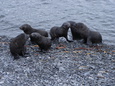
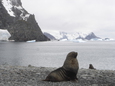
Arctocephalus gazella, the Antarctic fur seal, has a very wide distribution. They are mostly found in waters south of the Antarctic Convergence, but some do inhabit areas slightly north of the Convergence. Most breeding populations are found on South Georgia Island and Bird Island, while other populations are found in the south Prince Edward, Crozet, Kerguelen, and Macquarie Islands. Vagrants, however, have been observed in the southern part of South America and the Juan Fernandez Islands. Populations in the south Indian Ocean, south of the polar front, are found on Heard and McDonald Islands and north of the polar front on distances and have been seen from these breeding islands up to the ice edge of the polar front. Females leave the breeding islands during the winter and between breeding seasons travelling south to the marginal ice zone and across the polar front. Bulls often remain at the breeding islands during winter. Pups stay close to the beaches where they were born but usually move on to the ocean as winter progresses. (Forcada and Staniland, 2009; Jefferson, et al., 2008)
- Biogeographic Regions
- antarctica
Habitat
Antarctic fur seals spend much of their time in the ocean, hunting for food. While on land, they prefer to stay in rocky habitats but will go to beaches and zones of vegetation. Males can dive up to a maximum of 350 meters, while females can only reach up to 210 meters. Females can travel long distances in the open ocean for long periods of time between breeding. (Forcada and Staniland, 2009; Jefferson, et al., 2008)
- Habitat Regions
- polar
- terrestrial
- saltwater or marine
-
- Range depth
- 350 (high) m
- 1148.29 (high) ft
Physical Description
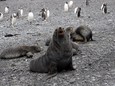
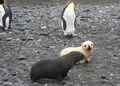
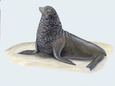
Sexual dimorphism is very evident in Antarctic fur seals. Males are four to five times heavier than females and one and a half times longer. The average length of the males is 180 cm while the average length of females is 129 cm. The average weight of males is 133 kg and for females it is just 34 kg. Their body is covered in hair except for the areas around the rhinarium (area around the nostrils), ear tips, and the palmar surface of the flippers. They have two different layers of hair, the under-pelt, which is made up of fine fur for insulation, and the other layer, which has two different types of guard hairs. These seals have nails on their hind flippers that are well developed and used for grooming. Antarctic fur seals also have the longest facial vibrissae, or whiskers, of any other pinniped, reaching up to 45 cm in bulls. The bodies in both males and females are thick, with long necks. Males are grayish brown in color, while their face is a darker gray. The chest may appear to be a silvery gray color as well. They have a heavy, grizzled mane. Female coats are also grayish brown in color, but their chest and neck are often white to gray. Pups are born black, with a grayish brown belly. They later molt to be completely grayish brown. About one out of every 100 pups born is born with leucistic morph resulting in a creamy white or yellow white exposed skin, which is normally pigmented. They have large canines that are used in territorial fights among males. A strong correlation has been found between canina length, mass, and width in male Antarctic fur seals and body size. (Acevedo, et al., 2008; Forcada and Staniland, 2009; Hoffman, et al., 2010)
- Other Physical Features
- endothermic
- bilateral symmetry
- Sexual Dimorphism
- male larger
- ornamentation
-
- Range mass
- 34 to 133 kg
- 74.89 to 292.95 lb
-
- Range length
- 129 to 180 cm
- 50.79 to 70.87 in
Reproduction
Antarctic fur seals are polygynous and breed in colonies. Adult males arrive and establish territories, about one month before breeding females come ashore, which is around mid October or early November. Females give birth to pups conceived from the previous season. They mate again around six to seven days post-birth. Maintaining territories is very costly for males. They lose about 1.5 kg in weight per day and obtain face injuries from territorial disputes. Consequently, males do not tend to hold territory until they are at least eight years old. This also encourages a dominance hierarchy on the breeding beaches. The most successful males defend the most desirable territories (those near the water but above the high water mark). The weaker males occupy territories higher up the beach. Each territorial male is associated with, on average, 15 females or between 1 to 27 females. (Hoffman and Forcada, 2011; Hoffman, et al., 2003; Nowak and Walker, 2003)
- Mating System
- polygynous
Once returning to shore females give birth to one pup, on average, conceived from the previous year. The gestation period is 11.75 months and implantation is possibly delayed. Newborn pups weigh 6 kg on average. Males and females return to breeding sites, even within a few meters of previous territories. Survival of their young from previous years probably encourages returning to the same spot year after year. Pups are born in October or early November and weigh about six kilograms on average. While the mother is away, pups roam about and interact with each other. By early January some pups are already going to the water but cannot swim well until March. Females use vocalizations to find the pup once she is back on land and confirms the pup by scent. Pups are weaned at about 117 days and become reproductively mature at three or four years old. (Hoffman, et al., 2003; Nowak and Walker, 2003)
- Key Reproductive Features
- gonochoric/gonochoristic/dioecious (sexes separate)
- sexual
- delayed implantation
-
- Breeding interval
- Antarctic fur seals breed once a year.
-
- Breeding season
- Antarctic fur seals breed during the month of December.
-
- Range number of offspring
- 0 to 2
-
- Average number of offspring
- 1
- AnAge
-
- Average gestation period
- 11.75 months
-
- Average gestation period
- 257 days
- AnAge
-
- Average weaning age
- 117 days
-
- Range age at sexual or reproductive maturity (female)
- 3 to 4 years
-
- Range age at sexual or reproductive maturity (male)
- 3 to 4 years
Female Antarctic fur seals have to regularly forage for food during the growth of their pups. Females alternate foraging trips with short suckling bouts until the pups are weaned after about 117 days. They forage at sea for 1 to 13 days at a time with an average trip duration of 5 days. They then return to feed the pup for about two days before returning to sea. (Hoffman and Forcada, 2011; Hoffman, et al., 2003; Nowak and Walker, 2003)
- Parental Investment
- female parental care
-
pre-hatching/birth
-
protecting
- female
-
protecting
-
pre-weaning/fledging
-
provisioning
- female
-
protecting
- female
-
provisioning
-
pre-independence
-
provisioning
- female
-
protecting
- female
-
provisioning
Lifespan/Longevity
In captivity the lifespan of Antarctic fur seals has not been well studied and it remains unknown. In the wild, males live up to 15 years, while females can live up to 25 years. (de Magalhaes and Costa, 2009)
-
- Range lifespan
Status: wild - 25 (high) years
- Range lifespan
-
- Average lifespan
Sex: female
Status: wild - 23.0 years
- Max Planck Institute for Demographic Research
- Average lifespan
-
- Average lifespan
Sex: male
Status: wild - 13.0 years
- Max Planck Institute for Demographic Research
- Average lifespan
Behavior
Antarctic fur seals are considered to be one of the most terrestrial pinnipeds along with the leopard seal. They are able to move across slippery rocks and through the dense grasses faster than humans. On a smooth surface, they are able to reach up to 20 km per hour. They can exceed this speed while swimming. After the breeding season is over and pups are weaned, the seals move to sea during winter months of May through November. It is not known where they go and if it is a directional migration or simply dispersal. Some adult males and juvenile seals stay ashore all year round. When foraging, dives usually average about 30 m in depth and last about two minutes. (Hoffman, et al., 2003; Nowak and Walker, 2003)
- Key Behaviors
- motile
- territorial
- dominance hierarchies
-
- Range territory size
- 22 to 60 m^2
Home Range
Due to competition among males, territory size shrinks from 60 square meters in mid November to about 22 square meters in December. A dominance hierarchy maintains territories. (Hoffman, et al., 2003; Nowak and Walker, 2003)
Communication and Perception
Antarctic fur seals use vocalizations to communicate. Males use two main calls. One is a threatening roar which is directed towards other males. Else, it is used as a response to a specific threat, such as a predator. The other call they make is a "huff-chuff". This call is used when moving around breeding territories, interacting with females, and is used as a sign of status. Females can roar and "huff-chuff", but their main form of communication is with their pups. They use both sound and smell to establish a bond. The sound is a high pitched call that is reinforced after the pup is born so when the mother returns from hunting trips she can make the sound and the pup will recognize it. The mother and pup use smell at close distances to confirm each other's identity. (Forcada and Staniland, 2009)
Food Habits
Antarctic fur seals mainly feed on fish, krill, crustacean, and cephalopods, such as squid and octopods. Fish consitute almost 75% of the diet in non-winter months. At the South Georgia Islands, the main fish prey is the mackerel icefish. However, they also consume krill in large quantities as well. Lactating females mainly feed on krill. If krill is unavailable, they turn to fish. During winter months, adult and sub-adult males feed on 50% krill and 50% fish. They also prey on some smaller penguins (4-8 kg) as well, such as rockhopper and macaroni penguins. Previous studies suggested that fur seals only attacked king penguins on land, but Charbonnier et al. (2007) observed that adult males attack king penguins at sea, too. Although adult male and female Antarctic fur seals chased king penguins at sea, only adult males were successful in catching and killing or injuring the penguins. (Casaux, et al., 1998; Charbonnier, et al., 2007)
- Animal Foods
- birds
- fish
- aquatic crustaceans
Predation
One major predator of Antarctic fur seeals are the leopard seals. They are a major contributor to high seal pup mortality rates especially between January and March before the pups are weaned. This has limited the growth of the colony at Elephant and Livingston Islands in the South Shetlands. Antarctic fur seals also are also preyed upon by killer whales and sharks. (Boveng, et al., 1998)
-
- Known Predators
-
- Leopard seal (Hydrurga leptonyx)
- killer whales (Orcinus orca)
- sharks
Ecosystem Roles
Members of Antarctic fur seals are key predators of krill and various species of fish and squid. It has been found that there is a correlation between size of breeding colonies and prey availability, based upon short term environmental changes and the effect it has on the reproductive success of females.
Lungworms infect three members of the fur seals group. These parasites infect the lungs of their host. ("Proposal to De-list Antarctic Fur Seals as Specially Protected Species", 2006; Dailey,, 2009)
- lungworms Parafilaroides species
Economic Importance for Humans: Positive
In the 1800 and 1900s Antarctic fur seals were widely hunted for their fur. Since this time, however, Antarctic fur seals have had little economic importance to humans. Although, increasing commercial krill harvesting could affect populations in the future. ("Proposal to De-list Antarctic Fur Seals as Specially Protected Species", 2006; "Proposal to De-list Antarctic Fur Seals as Specially Protected Species", 2006)
Economic Importance for Humans: Negative
There are no known adverse effects of Antarctic fur seals on humans.
Conservation Status
The number of Antarctic fur seals were reduced to below 3,000 individuals in the 1800s. In 1964, they became a “specially protected species,” which is a term given only to the “most vulnerable and endangered species,” (Proposal to De-list, 2006). Since then, Antarctic fur seals have greatly extended their range and are at little risk of extinction. Total population numbers are estimated at four to seven million seals and are increasing. In the CITES appendices Antarctic fur seals are listed in Appendix II, indicating that while they are not currently threatened with extinction they may become so unless trade is closely controlled. ("Proposal to De-list Antarctic Fur Seals as Specially Protected Species", 2006)
-
- IUCN Red List
-
Least Concern
More information
-
- IUCN Red List
-
Least Concern
More information
-
- US Federal List
- No special status
-
- CITES
- Appendix II
-
- State of Michigan List
- No special status
Contributors
Carson Widener (author), Radford University, Karen Powers (editor), Radford University, Kiersten Newtoff (editor), Radford University, Melissa Whistleman (editor), Radford University, Laura Podzikowski (editor), Special Projects.
Glossary
- Antarctica
-
lives on Antarctica, the southernmost continent which sits astride the southern pole.
- acoustic
-
uses sound to communicate
- bilateral symmetry
-
having body symmetry such that the animal can be divided in one plane into two mirror-image halves. Animals with bilateral symmetry have dorsal and ventral sides, as well as anterior and posterior ends. Synapomorphy of the Bilateria.
- carnivore
-
an animal that mainly eats meat
- chemical
-
uses smells or other chemicals to communicate
- coastal
-
the nearshore aquatic habitats near a coast, or shoreline.
- delayed implantation
-
in mammals, a condition in which a fertilized egg reaches the uterus but delays its implantation in the uterine lining, sometimes for several months.
- dominance hierarchies
-
ranking system or pecking order among members of a long-term social group, where dominance status affects access to resources or mates
- endothermic
-
animals that use metabolically generated heat to regulate body temperature independently of ambient temperature. Endothermy is a synapomorphy of the Mammalia, although it may have arisen in a (now extinct) synapsid ancestor; the fossil record does not distinguish these possibilities. Convergent in birds.
- female parental care
-
parental care is carried out by females
- motile
-
having the capacity to move from one place to another.
- native range
-
the area in which the animal is naturally found, the region in which it is endemic.
- pelagic
-
An aquatic biome consisting of the open ocean, far from land, does not include sea bottom (benthic zone).
- piscivore
-
an animal that mainly eats fish
- polar
-
the regions of the earth that surround the north and south poles, from the north pole to 60 degrees north and from the south pole to 60 degrees south.
- polygynous
-
having more than one female as a mate at one time
- saltwater or marine
-
mainly lives in oceans, seas, or other bodies of salt water.
- sexual
-
reproduction that includes combining the genetic contribution of two individuals, a male and a female
- sexual ornamentation
-
one of the sexes (usually males) has special physical structures used in courting the other sex or fighting the same sex. For example: antlers, elongated tails, special spurs.
- tactile
-
uses touch to communicate
- terrestrial
-
Living on the ground.
- territorial
-
defends an area within the home range, occupied by a single animals or group of animals of the same species and held through overt defense, display, or advertisement
- visual
-
uses sight to communicate
References
Antarctic Treaty Consultative Meeting. Proposal to De-list Antarctic Fur Seals as Specially Protected Species. WP039. Edinburgh: Secretariat of the Antarctic Treaty. 2006. Accessed April 24, 2012 at http://www.scar.org/treaty/atcmxxix/atcm29_wp039.pdf.
Acevedo, J., D. Torres, A. Aguayo-Lobo. 2008. Rare piebald and partially leucistic Antarctic fur seals, Arctocephalus gazella, at Cape Shirreff, Livingston Island, Antarctica. Polar Biology, 32/1: 41-45.
Boveng, P., L. Hiruki, M. Schwartz, J. Bengston. 1998. Population growth of the Antarctic fur seals: Limitation by a top predator, the leopard seal?. Ecology Society of America, 79/8: 2863-2877.
Boyd, I., A. Murray. 2001. Monitoring a marine ecosystem using responses of upper trophic level predators. Journal of Animal Ecology, 70/5: 747-760.
Casaux, R., A. Baroni, A. Carlini. 1998. The diet of the Antarctic fur seal Arctocephalus gazella at Harmony Point, Nelson Island, South Shetland Islands. Polar Biology, 20/6: 424-428.
Charbonnier, Y., K. Delord, J. Theibot. 2007. King-size fast food for Antarctic fur seals. Polar Biology, 33/5: 721-724.
Dailey,, M. 2009. A new species of Parafilaroides (Nematoda: Filaroididae) in three species of fur seals (Carnivora: Otariidae) from the Southern Hemisphere. American Society of Parasitologists, 95/1: 156-159.
Forcada, J., I. Staniland. 2009. Antarctic Fur Seal Arctocephalus gazella. Pp. 36-42 in W Perrin, B Wursig, J Thewissen, eds. Encyclopedia of Marine Mammals, Vol. 2, 2nd Edition. New York: Elsevier.
Gastebois, C., M. Viviant, C. Guinet. 2011. Ontogeny of aquatic behaviours in Antarctic fur seal (Arctocephalus gazella) pups in relation to growth performances at Kerguelen Islands. Polar Biology, 34/7: 1097-1103.
Hoffman, J., I. Boyd, W. Amos. 2003. Male reproductive strategy and the importance of maternal status in the Antarctic fur seal Arctocephalus gazella. Evolution, 57/8: 1917-1930.
Hoffman, J., J. Forcada. 2011. Extreme natal philopatry in female Antarctic fur seals (Arctocephalus gazella). Mammalian Biology, 77/1: 71-73.
Hoffman, J., N. Hanson, J. Forcada, P. Trathan, W. Amos. 2010. Getting long in the tooth: A strong positive correlation between canine size and heterozygosity in Antarctic fur seals Arctocephalus gazella. Journal of Heredity, 101/5: 527-538.
Jabour, J. 2008. Successful conservation- then what? The de-listing of Arctocephalus fur seal species in Antarctica. Journal of International Wildlife and Policy, 11/1: 1-29.
Jefferson, T., M. Webber, R. Pitman. 2008. Marine Mammals of the World. New York: Elsevier.
Lea, M., M. Hindell, C. Guinet, S. Goldsworthy. 2001. Variability in the diving activity of Antarctic fur seals, Arctcephalus gazella, at Iles Kerguelen. Polar Biology, 25/4: 269-279.
Luque, S., J. Arnould, E. Miller, Y. Cherel, C. Guinet. 2007. Foraging behaviour of sympatric Antarctic and subantarctic fur seals: Does their contrasting duration of lactation make a difference?. Marine Biology, 152/1: 213-224.
Makhado, A., M. Bester, S. Kirkman, P. Pistorius, J. Ferguson, N. Klages. 2007. Prey of the Antarctic fur seal Arctocephalus gazella at Marion Island. Polar Biology, 31/5: 575-581.
Nowak, R., E. Walker. 2003. Arctocephalus gazella. Pp. 77-78 in Walker's Marine Mammals of the World, Vol. 6, Sixth Edition. Baltimore: The Johns Hopkins University Press.
Osman, L., R. Hucke- Gaete, C. Moreno, D. Torres. 2003. Feeding ecology of Antarctic fur seals at Cape Shirreff, South Shetlands, Antarctica. Polar Biology, 27/2: 92-98.
Reid, K., J. Croxall. 2001. Environmental response of upper-trophic level predators reveals a system change in an Antarctic marine ecosystem. Proceedings: Biological Sciences, 268/1465: 377-384.
Staniland, I., I. Boyd, K. Reid. 2007. An energy–distance trade-off in a central-place forager, the Antarctic fur seal (Arctocephalus gazella). Marine Biology, 152/2: 233-241.
Torres, D., J. Acevedo, D. Torres, R. Vargas, A. Aguayo-Lobo. 2011. Vagrant Subantarctic fur seal at Cape Shirreff, Livingston Island, Antarctica. Polar Biology, 35/3: 469-473.
de Magalhaes, J., J. Costa. 2009. A database of vertebrate longevity records and their relation to other life history traits. Journal of Evolutionary Biology, 22/8: 1770-1774.