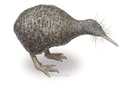
Apteryx oweniilittle spotted kiwi
Geographic Range
The little spotted kiwi is found on Kapiti Island and in remote forests of South Island (New Zealand)
- Biogeographic Regions
- australian
Habitat
The little spotted kiwi lives in temperate, evergreen, broadleaf forests and shrublands. They are strictly terrestrial.
- Terrestrial Biomes
- forest
- scrub forest
Physical Description
- Other Physical Features
- endothermic
- bilateral symmetry
Reproduction
The little spotted kiwi mates in the early spring, mostly within the first few weeks of September. They nest in burrows on the forest floor, laying one to two egg clutches. The kiwi produces relatively few but large offspring, perhaps so that the well-developed chicks have the best possible chance to survive under bad conditions such as food shortage or unfavorable weather.
- Key Reproductive Features
- iteroparous
- gonochoric/gonochoristic/dioecious (sexes separate)
- sexual
- oviparous
Behavior
Unlike most other birds, the little spotted kiwi senses its environment by sound and smell, rather than by sight. They are nocturnal forest dwellers, and they remain in a shelter burrow during daylight hours. Little spotted kiwis are dispersed in strongly territorial pairs, relying on calls to maintain their territory. They may maintain the same territorial pairs for years.
- Key Behaviors
- motile
Communication and Perception
Food Habits
Kiwis are omnivorous, eating both invertebrates and the fruit from forest trees and shrubs. The little spotted kiwi finds food on the forest floor and by probing in the soil to the full depth of its bill. Earthworms, cockchafer beetle larvae, catepillars, cranefly larvae, and spiders are the most common food sources in the little spotted kiwi's diet. Fruit off the hinau tree is also commonly consumed. Annelids make up the largest percentage of the bird's diet.
Economic Importance for Humans: Positive
Little spotted kiwis are charismatic species, conservation efforts aimed at kiwis help to protect habitat that is critical to other species and important in ecotourism.
- Positive Impacts
- ecotourism
Economic Importance for Humans: Negative
Little spotted kiwi conservation efforts may impact logging operations, but ecosystem, research, and ecotourism benefits might be assumed to outweigh those negative effects.
Conservation Status
The little spotted kiwi is the most endangered of all the kiwi species. Human destruction of habitat by logging, predation, fire, disease, and the introduction of mammal species have all contributed to the decline of kiwi poulations. Efforts to preserve the kiwi include setting aside Kaptiti Island as a reserve. Captive breeding has also been attempted, but it isn't very successful. Captive breeding of the little spotted kiwi first began in the mid-1970's; however, it was not until 1989 that the first chick was successfully reared.
-
- IUCN Red List
-
Near Threatened
More information
Other Comments
Little spotted kiwis have a unique way of raising their young. The male tends to the nest during the 70-day incubation period for about 21 hours a day. The female renews interest in the young after hatching, and both parents escort the chick at night for protection. Adult kiwis do not feed their young. After hatching, the chicks feed from the yolk sac in the egg for the first few days, and afterwards they probe the forest for food, independent of their parents ( except when the parents escort the chick for protection).
Contributors
Robert Naumann (author), University of Michigan-Ann Arbor.
Glossary
- Australian
-
Living in Australia, New Zealand, Tasmania, New Guinea and associated islands.

- acoustic
-
uses sound to communicate
- bilateral symmetry
-
having body symmetry such that the animal can be divided in one plane into two mirror-image halves. Animals with bilateral symmetry have dorsal and ventral sides, as well as anterior and posterior ends. Synapomorphy of the Bilateria.
- chemical
-
uses smells or other chemicals to communicate
- ecotourism
-
humans benefit economically by promoting tourism that focuses on the appreciation of natural areas or animals. Ecotourism implies that there are existing programs that profit from the appreciation of natural areas or animals.
- endothermic
-
animals that use metabolically generated heat to regulate body temperature independently of ambient temperature. Endothermy is a synapomorphy of the Mammalia, although it may have arisen in a (now extinct) synapsid ancestor; the fossil record does not distinguish these possibilities. Convergent in birds.
- forest
-
forest biomes are dominated by trees, otherwise forest biomes can vary widely in amount of precipitation and seasonality.
- iteroparous
-
offspring are produced in more than one group (litters, clutches, etc.) and across multiple seasons (or other periods hospitable to reproduction). Iteroparous animals must, by definition, survive over multiple seasons (or periodic condition changes).
- motile
-
having the capacity to move from one place to another.
- native range
-
the area in which the animal is naturally found, the region in which it is endemic.
- oviparous
-
reproduction in which eggs are released by the female; development of offspring occurs outside the mother's body.
- scrub forest
-
scrub forests develop in areas that experience dry seasons.
- sexual
-
reproduction that includes combining the genetic contribution of two individuals, a male and a female
- tactile
-
uses touch to communicate
- visual
-
uses sight to communicate
References
Errol Fuller ed. 1990. Kiwis: A Monograph of the Family Apterygidae. SeTo Publishers, Auckland New Zealand.