Apteryx australisbrown kiwi(Also: tokoeka)


Geographic Range
Apteryx australis, commonly known as brown kiwis, is located in the Australian biogeographic region. They are endemic to New Zealand, and reside on North Island (in Northland and Taranaki), South island (in Fiordland and Westland), and Stewart Island. ("Department of Conservation", 2002; Burton, 1985; "Answers to Kiwi Questions", 2006; Turbott, 1967)
Apteryx australis is considered by some authors to be made up of two, distinct species, corresponding to the previously recognized subspecies A. australis mantelli - now A. mantelli, and A. australis australis and A. australis lawryi - both retained within A. australis. North Island brown kiwis (A. mantelli) are the most common kind of kiwi, found only on the North Island of New Zealand. Apteryx australis includes populations on Stewart Island (A. a. lawryi) and South Island (A. a. australis), including populations in the Haast range and the fiordlands. Populations in the Haast range (Haast tokoekas) may represent a distinct species as well. (Baker, et al., 1995)
The population of brown kiwis found in Okarito forests on the western coast of the South Island was recently recognized as a distinct species, Apteryx rowi, Okarito brown kiwis or rowis. It is thought that this species is made up of only 200 individuals currently. (Tennyson, et al., 2003)
- Biogeographic Regions
- australian
- Other Geographic Terms
- island endemic
Habitat
Brown kiwis live in subtropical and temperate forests and grasslands. They prefer to live in large, dark forest areas, which allow camouflage for the birds as they sleep during the day. In undisturbed habitats, kiwis create burrows under stones, banks of streams, or in soft flat open ground. In disturbed areas, these birds have had to adapt to human presence by establishing burrows in rough farmland under logs and shrubs. ("Department of Conservation", 2002; "Answers to Kiwi Questions", 2006; Olliver, 2005; "", 2006; Turbott and Keulemans, 1967)
- Habitat Regions
- temperate
- terrestrial
- Terrestrial Biomes
- savanna or grassland
- forest
- scrub forest
- Other Habitat Features
- agricultural
-
- Range elevation
- 0 to 1,200 m
- 0.00 to ft
Physical Description
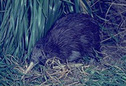
Brown kiwis are members of the flightless ratite group (Struthioniformes). They are unique in their small size and adaptations to forest floor life. These birds are roughly the size of a chicken, with the female being slightly larger. They range in size from 45 to 54 cm long, and weigh from 2.8 to 3.5 kg. They are brownish grey in color with long, soft feathers that look and feel very fur-like. Their skin is tough and they have whiskers at the base of their bill used for touch. This is especially important for these birds because they have small eyes and poor vision. These birds do not have a tail and their 5 cm long wings prevent them from flying. Brown kiwis have powerful legs and can run quickly. The nostrils are at the end of their long bills and they have a keen sense of smell. The birds thrust their bill into the ground, gather the food, and beat the prey on the ground before they consume it. Other characteristics include heavy bone marrow, a body temperature lower than most other birds, and underdeveloped pectoral muscles. Brown kiwis have body temperatures of 38 degrees Celsius. ("Department of Conservation", 2002; "Answers to Kiwi Questions", 2006; Turbott, 1967; "wikipedia", 2006; Williams, 1963; "Willowbank", 2006)
- Other Physical Features
- endothermic
- homoiothermic
- bilateral symmetry
- Sexual Dimorphism
- sexes alike
- female larger
-
- Range mass
- 2.8 to 3.5 kg
- 6.17 to 7.71 lb
-
- Range length
- 45 to 54 cm
- 17.72 to 21.26 in
-
- Average basal metabolic rate
- 4.029 W
- AnAge
Reproduction
Brown kiwis meet in nesting burrows every few days and call to each other at night to begin mating. This ritual occurs between March and June. The relationship is volatile and physical with the females primarily being the dominant one. They are monogamous unless a “better” mate comes along. (Turbott and Keulemans, 1967; "wikipedia", 2006; "Willowbank", 2006)
- Mating System
- monogamous
Brown kiwis breed throughout the year but only lay one egg at a time. A second egg might be laid four to six weeks after the first one. The eggs are unique because of their size relative to the adult bird's mass. Brown kiwi eggs are one-third of the female's mass, making them the largest eggs (relative to mass) of any bird. Incubation period lasts up to eleven weeks and the chicks are ready to leave the nest in approximately six to ten days. Females reach sexual maturity on average between the ages of three and five. Males reach this sexual maturity in approximately 18 months. ("Wildanimalonline", 2006; "Department of Conservation", 2002; Turbott, 1967)
- Key Reproductive Features
- iteroparous
- year-round breeding
- gonochoric/gonochoristic/dioecious (sexes separate)
- sexual
- oviparous
-
- Breeding interval
- Brown kiwis can reproduce as often as every 4 to 6 weeks. However, the massive energy investment that each female makes into any single egg means that she will not often lay eggs that frequently.
-
- Breeding season
- Brown kiwis breed throughout the year.
-
- Range eggs per season
- 1 to 1
-
- Average eggs per season
- 1
- AnAge
-
- Average time to hatching
- 11 weeks
-
- Average time to hatching
- 75 days
- AnAge
-
- Range fledging age
- 6 to 10 days
-
- Average age at sexual or reproductive maturity (female)
- 3- 5 years
-
- Average age at sexual or reproductive maturity (male)
- 18 months months
Female brown kiwis dig out the nest and deposit the kiwi eggs, which are smooth and are either ivory or light green in color. After the eggs are laid, males take over incubation and nest maintenance until the eggs hatch. During this time males lose one-third of their weight. After hatching, the chicks do not rely on parents for food. They survive from the copious amount of yolk in their belly. Kiwi chicks venture out of the burrow soon after hatching, although there have been reports of chicks being near their parents for up to a year. Because kiwi chicks are slow, small (weighting only 275 grams and being five inches), and unable to respond to predators, few survive to twelve months old. After that time, they reach a size that enables them to escape most predators. ("Wildanimalonline", 2006; Burton, 1985; "Kiwi", 2006; "Answers to Kiwi Questions", 2006)
- Parental Investment
- precocial
-
pre-fertilization
- provisioning
-
protecting
- female
-
pre-hatching/birth
-
provisioning
- female
-
protecting
- male
-
provisioning
Lifespan/Longevity
The expected lifespan of brown kiwis after their first twelve months of their life is approximately 20 years in the wild. When in captivity, these birds usually live to be 30 years old, but some have lived up to 40 years. ("Department of Conservation", 2002; "Kiwi", 2006; "Answers to Kiwi Questions", 2006; Olliver, 2005; "Willowbank", 2006)
-
- Average lifespan
Status: wild - 20 years
- Average lifespan
-
- Range lifespan
Status: captivity - 40 (high) years
- Range lifespan
-
- Average lifespan
Status: wild - 20 years
- Average lifespan
-
- Average lifespan
Status: captivity - 30 years
- Average lifespan
-
- Average lifespan
Status: captivity - 35.0 years
- Max Planck Institute for Demographic Research
- Average lifespan
Behavior
Brown kiwis are described as "honorary mammals" because they have some characteristics that are similary to many mammals. They are nocturnal, rely heavily on a sense of smell, and have feathers that resemble fur. Brown kiwis are shy and mainly solitary, but they will travel in companies of six to twelve. Being nocturnal is beneficial because it reduces competition, they can take advantage of food that is not available during the day, and the darkness brings safety from predators. Brown kiwis will attack if threatened but are more likely to try and escape a threatening interaction. During the day, brown kiwis will hide in their burrows and coil themselves into a ball until nightfall, when they search for food. (Burton, 1985; "Answers to Kiwi Questions", 2006; Turbott and Keulemans, 1967; "wikipedia", 2006)
- Key Behaviors
- cursorial
- terricolous
- nocturnal
- motile
- sedentary
- solitary
- territorial
-
- Range territory size
- 50,000 to 500, 000 m^2
Home Range
Their habitat ranges from sea level to areas that are 1,200 meters above ground. Territories range from five to 50 hectares, which is correlated to the quality of the area. Brown kiwis are known to be highly territorial. Once another bird enters their territory, they will cry out a call to warn that bird to leave or else prepare to fight. ("Wildanimalonline", 2006; Attenborough, 1998; "Kiwi", 2006; "Answers to Kiwi Questions", 2006; "Kiwi Club (Chemistry & New Zealand)", 2005; "wikipedia", 2006)
Communication and Perception
Brown kiwis communicate through a cry, which sounds like a prolonged whistle slightly ascending and descending. Males make a mournful shriek, "kee-wee," and females have a low hoarse cry. Chicks tend to make a clicking sound. The cry indicates their presence at night, and helps in finding mates. They also congregate in companies from six to twelve. To hear the cry of brown kiwis, click here:
http://www.nzbirds.com/birds/sound/brownkiwi2.wav
(Olliver, 2005; Turbott and Keulemans, 1967; "wikipedia", 2006)
Kiwis are unusual among birds in having a keen sense of smell. They have an enlarged olfactory bulb.
- Communication Channels
- acoustic
Food Habits
Brown kiwis are carnivorous, they feed mainly on soil and aquatic invertebrates such as worms, insects, crayfish, amphibians, and eels. They also eat fruit. At night, these birds use their long bills to dig deep into the ground to find creatures living on the ground. After they have caught something, they use their bills to beat the creature on the ground, or on stones to kill it before eating. Cone-shape holes left in the ground after hunting are easy ways to discover their occurrence in an area. ("Wildanimalonline", 2006; "Department of Conservation", 2002; "Willowbank", 2006)
- Primary Diet
-
carnivore
- insectivore
- eats non-insect arthropods
- vermivore
- Animal Foods
- amphibians
- fish
- insects
- terrestrial non-insect arthropods
- mollusks
- terrestrial worms
- aquatic crustaceans
- Plant Foods
- fruit
Predation
Brown kiwis have many introduced predators, although they had few predators before dogs, pigs, cats, brush-tailed possums, and stoats were introduced to New Zealand. Dogs, pigs and cats tend to feed on adult birds. Stoats and cats feed on the young, and possums and stoats destroy kiwi eggs. ("World: Asia-Pacific Kiwis 'freefall' to extinction", 2006; "Willowbank", 2006)
- Anti-predator Adaptations
- cryptic
-
- Known Predators
-
- domestic dogs (Canis lupus familiaris)
- pigs (Sus scrofa)
- ferrets (Mustela putorius)
- stoats (Mustela erminea)
- domestic cats (Felis silvestris)
- brush-tailed possums (Trichosurus)
Ecosystem Roles
Brown kiwis are important predators of invertebrates and may disperse seeds through their fruit eating. ("Answers to Kiwi Questions", 2006)
Economic Importance for Humans: Positive
Initially hunted to make cloaks and for food, kiwis, including brown kiwis, are the national symbol of New Zealand. Much pride is taken by displaying the kiwi on things such as the national currency, sports uniforms, road signs and mascots. ("Kiwi", 2006; "Answers to Kiwi Questions", 2006; "", 2006)
- Positive Impacts
- body parts are source of valuable material
- ecotourism
- research and education
Economic Importance for Humans: Negative
There are no known adverse affects of brown kiwis on humans.
Conservation Status
Brown kiwis are considered vulnerable by the IUCN. Currently, there are an estimated 27,000 brown kiwis. The primary threat to these birds is predation by introduced mammals. Populations seem to be declining. ("World: Asia-Pacific Kiwis 'freefall' to extinction", 2006)
-
- IUCN Red List
-
Vulnerable
More information
-
- IUCN Red List
-
Vulnerable
More information
-
- US Migratory Bird Act
- No special status
-
- US Federal List
- No special status
-
- CITES
- No special status
Other Comments
The government of New Zealand has declared that if avian flu threatens New Zealand, every kiwi will be vaccinated due to the alarming decrease of kiwis. ("New Zealand ready to vaccinate treasured kiwiw against bird flu", 2006)
Although they are currently only found in New Zealand, fossil evidence has shown ancestors of brown kiwis occurred in the North Hemisphere in the Paleocene and Eocene, 40-70 million years ago. ("Department of Conservation", 2002; Burton, 1985)
Contributors
Tanya Dewey (editor), Animal Diversity Web.
Smitha Gudipati (author), Kalamazoo College, Ann Fraser (editor, instructor), Kalamazoo College.
Glossary
- Australian
-
Living in Australia, New Zealand, Tasmania, New Guinea and associated islands.

- acoustic
-
uses sound to communicate
- agricultural
-
living in landscapes dominated by human agriculture.
- bilateral symmetry
-
having body symmetry such that the animal can be divided in one plane into two mirror-image halves. Animals with bilateral symmetry have dorsal and ventral sides, as well as anterior and posterior ends. Synapomorphy of the Bilateria.
- carnivore
-
an animal that mainly eats meat
- chemical
-
uses smells or other chemicals to communicate
- cryptic
-
having markings, coloration, shapes, or other features that cause an animal to be camouflaged in its natural environment; being difficult to see or otherwise detect.
- ecotourism
-
humans benefit economically by promoting tourism that focuses on the appreciation of natural areas or animals. Ecotourism implies that there are existing programs that profit from the appreciation of natural areas or animals.
- endothermic
-
animals that use metabolically generated heat to regulate body temperature independently of ambient temperature. Endothermy is a synapomorphy of the Mammalia, although it may have arisen in a (now extinct) synapsid ancestor; the fossil record does not distinguish these possibilities. Convergent in birds.
- forest
-
forest biomes are dominated by trees, otherwise forest biomes can vary widely in amount of precipitation and seasonality.
- insectivore
-
An animal that eats mainly insects or spiders.
- island endemic
-
animals that live only on an island or set of islands.
- iteroparous
-
offspring are produced in more than one group (litters, clutches, etc.) and across multiple seasons (or other periods hospitable to reproduction). Iteroparous animals must, by definition, survive over multiple seasons (or periodic condition changes).
- monogamous
-
Having one mate at a time.
- motile
-
having the capacity to move from one place to another.
- native range
-
the area in which the animal is naturally found, the region in which it is endemic.
- nocturnal
-
active during the night
- oviparous
-
reproduction in which eggs are released by the female; development of offspring occurs outside the mother's body.
- scrub forest
-
scrub forests develop in areas that experience dry seasons.
- sedentary
-
remains in the same area
- sexual
-
reproduction that includes combining the genetic contribution of two individuals, a male and a female
- solitary
-
lives alone
- tactile
-
uses touch to communicate
- temperate
-
that region of the Earth between 23.5 degrees North and 60 degrees North (between the Tropic of Cancer and the Arctic Circle) and between 23.5 degrees South and 60 degrees South (between the Tropic of Capricorn and the Antarctic Circle).
- terrestrial
-
Living on the ground.
- territorial
-
defends an area within the home range, occupied by a single animals or group of animals of the same species and held through overt defense, display, or advertisement
- tropical savanna and grassland
-
A terrestrial biome. Savannas are grasslands with scattered individual trees that do not form a closed canopy. Extensive savannas are found in parts of subtropical and tropical Africa and South America, and in Australia.
- savanna
-
A grassland with scattered trees or scattered clumps of trees, a type of community intermediate between grassland and forest. See also Tropical savanna and grassland biome.
- temperate grassland
-
A terrestrial biome found in temperate latitudes (>23.5° N or S latitude). Vegetation is made up mostly of grasses, the height and species diversity of which depend largely on the amount of moisture available. Fire and grazing are important in the long-term maintenance of grasslands.
- visual
-
uses sight to communicate
- year-round breeding
-
breeding takes place throughout the year
- young precocial
-
young are relatively well-developed when born
References
Tourism New Zealand. 2006. The Official Tourism New Zealand Site for Destination New Zealand. Accessed November 08, 2006 at http://www.newzealand.com/travel/about-nz/nature/nature-fauna.cfm.
FONZ. 2006. "Answers to Kiwi Questions" (On-line). Smithsonian National Zoological Park. Accessed November 08, 2006 at http://nationalzoo.si.edu/Animals/Birds/Ask_a_kori_bustard_question/kiwiQandAs.cfm.
Bank of New Zealand Kiwi Recovery™ Trust, Bank of New Zealand, and Department of Conservatio. 2002. "Department of Conservation" (On-line). Save the Kiwi. Accessed October 09, 2006 at http://www.savethekiwi.org.nz/AboutTheBird/KiwiLifeCycle/Mating.htm.
2004. "IUCN Red List of Threatened Species" (On-line). Threatened Species. Accessed October 06, 2006 at http://www.iucnredlist.org/search/details.php/1939/summ.
LA & HA Campbell. 2005. "Kiwi Club (Chemistry & New Zealand)" (On-line). Accessed October 10, 2006 at http://www.chemistry.co.nz/kiwibird.htm.
Data Koncepts. 2006. "Kiwi" (On-line). Kiwi Information. Accessed November 08, 2006 at http://www.mercurybay.co.nz/local/kiwiinfo.html.
CBS. 2006. "New Zealand ready to vaccinate treasured kiwiw against bird flu" (On-line). CBS News. Accessed November 08, 2006 at http://www.cbc.ca/health/story/2006/03/24/kiwi-flu060324.html.
2006. "Wildanimalonline" (On-line). BIRDS. Accessed October 13, 2006 at http://www.wildanimalsonline.com/birds/commonkiwi-brownkiwi.php.
Willowbank Reserve. 2006. "Willowbank" (On-line). Accessed October 10, 2006 at http://www.willowbank.co.nz/kiwi.asp.
2006. "World: Asia-Pacific Kiwis 'freefall' to extinction" (On-line). BBC News. Accessed September 06, 1999 at http://news.bbc.co.uk/2/hi/asia-pacific/449104.stm.
wikimedia. 2006. "wikipedia" (On-line). Kiwi. Accessed October 10, 2006 at http://en.wikipedia.org/wiki/Brown_Kiwi.
Attenborough, D. 1998. The Life of Birds. Princeton, New Jersey: Princeton University.
Baker, A., C. Daugherty, R. Colbourne, J. McLennan. 1995. Flightless Brown Kiwis of New Zealand Possess Extremely Subdivided Population Structure and Cryptic Species Like Small Mammals. Proceedings of the National Academy of Sciences, 92: 8254-8258.
Burton, R. 1985. Bird Behavior. New York, New York: Roxby Natural History Limited.
Olliver, N. 2005. "nzbirds" (On-line). North Island brown Kiwi. Accessed November 11, 2006 at http://www.nzbirds.com/birds/kiwinibrown.html.
Tennyson, A., R. Palma, H. Robertson, T. Worthy, B. Gill. 2003. A new species of kiwi (Aves, Apterygiformes) from Okarito, New Zealand. Records of the Auckland Museum, 40: 55-64.
Turbott, E., J. Keulemans. 1967. Buller's Birds of New Zealand. Tokyo: John Weatherhill.
Turbott, F. 1967. A Field Guide To The Birds Of New Zealand. Boston, Ma: The Riverside Press Cambridge.
Williams, G. 1963. Birds of New Zealand. 182 Wakefield Street, Wellington: Publishers of New Zealand Books.