Antilope cervicaprablackbuck

Geographic Range
The blackbuck is found in Pakistan and India.
- Biogeographic Regions
- palearctic
- oriental
Habitat
Blackbuck live on open woodlands and semi-desert areas, but also enjoy areas with thorn or dry deciduous forest. They like to stay near areas where grassland is available. On hot days blackbucks rest in the shade.
- Terrestrial Biomes
- savanna or grassland
Physical Description
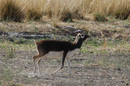
Adult bucks stand approximately 73.7 - 83.8cm at the shoulder and on average have a head and body length of 120cm. The blackbuck is one of the few antelope whose color differs between sexes. The males are rich dark brown above, on the sides, and on the outside of the legs. Females tend to be yellowish in the same areas. Both sexes exhibit white underparts and insides of the legs, and a prominent white circular patch around the eye. Also, males gradually become darker with age. Blackbucks have a graceful and slender built. The horns are borne only by males and range from 50 - 61 cm; they are ringed at the base and twist spirally up to approxiamtely 4 turns. The narrow muzzle is sheeplike, the tail is short, and the hooves are delicate and sharply pointed.
- Other Physical Features
- endothermic
- bilateral symmetry
-
- Range mass
- 32 to 43 kg
- 70.48 to 94.71 lb
Reproduction
Mating occurs throughout the year, with the most rutting activity in March - April and August - October. During the rut, the mature male establishes a territory by regularly depositing faeces in particular places. Males are extremely aggressive during this time and drive all other males from their territory by a throaty grunt and an ocassional horn fight. The gestation period is about six months, and most of the time a single young is born. The young is able to run about soon after birth.
- Key Reproductive Features
- gonochoric/gonochoristic/dioecious (sexes separate)
- sexual
-
- Range number of offspring
- 1 (low)
-
- Average number of offspring
- 1
-
- Average number of offspring
- 1
- AnAge
-
- Range gestation period
- 5 to 6 months
-
- Range weaning age
- 1.87 to 2.1 months
-
- Average weaning age
- 1.985 months
-
- Average age at sexual or reproductive maturity (female)
Sex: female - 466 days
- AnAge
- Average age at sexual or reproductive maturity (female)
- Parental Investment
- precocial
- post-independence association with parents
Lifespan/Longevity
-
- Average lifespan
Sex: female
Status: wild - 18.0 years
- Max Planck Institute for Demographic Research
- Average lifespan
-
- Average lifespan
Status: wild - 15.0 years
- Max Planck Institute for Demographic Research
- Average lifespan
Behavior
Blackbucks are gregarious and social animals with herds generally ranging from 5 to 50 animals. The herds are harems, with a single adult male and a number of adult females and their young. They tend to be diurnal during the cool season. In the hot season, they are active in the very early morning and late afternoon, resting in the shade at other times. Because of past persecutions, blackbuck are very shy and wary. Their sense of smell and hearing are not highly developed so they rely on eyesight in detecting danger. When in danger, a single animal bounds in the air and is soon followed by the rest of the herd. These animals have great speed and endurance; when in danger they can maintain a gallop with a speed of 40mi/hr for approximately 15 miles. They are usually silent, but sometimes females give a hissing noise that warns the herd of danger.
- Key Behaviors
- motile
- social
- dominance hierarchies
Communication and Perception
Food Habits
Blackbuck are grazers, they feed on short grass and various cultivated cereals. Concerning their drinking habits, T.J. Roberts writes, " It has been reliably established that they do not drink water even when it is available . . . It may be, that they can recirculate the nitrogen in their bodies rather than having to excrete it in their urine."
Economic Importance for Humans: Positive
The blackbuck is prized for its meat.
- Positive Impacts
- food
Economic Importance for Humans: Negative
Blackbucks have a tendency to raid crops, paticularly sorghum and millet. As a result, farmers lose crops and money. Many farmers set up traps and hunt the blackbuck to stop them from destroying crops.
Conservation Status
The blackbuck was once the most abundant hoofed mammal in India and Pakistan, but their populations have been greatly reducedthrough excessive hunting and loss of habitat due to agricultural development.
-
- IUCN Red List
-
Near Threatened
More information
-
- IUCN Red List
-
Near Threatened
More information
-
- US Federal List
- No special status
-
- CITES
- Appendix III
Contributors
Wojtek Nocon (author), University of Michigan-Ann Arbor.
Glossary
- Palearctic
-
living in the northern part of the Old World. In otherwords, Europe and Asia and northern Africa.

- bilateral symmetry
-
having body symmetry such that the animal can be divided in one plane into two mirror-image halves. Animals with bilateral symmetry have dorsal and ventral sides, as well as anterior and posterior ends. Synapomorphy of the Bilateria.
- chemical
-
uses smells or other chemicals to communicate
- dominance hierarchies
-
ranking system or pecking order among members of a long-term social group, where dominance status affects access to resources or mates
- endothermic
-
animals that use metabolically generated heat to regulate body temperature independently of ambient temperature. Endothermy is a synapomorphy of the Mammalia, although it may have arisen in a (now extinct) synapsid ancestor; the fossil record does not distinguish these possibilities. Convergent in birds.
- food
-
A substance that provides both nutrients and energy to a living thing.
- motile
-
having the capacity to move from one place to another.
- native range
-
the area in which the animal is naturally found, the region in which it is endemic.
- oriental
-
found in the oriental region of the world. In other words, India and southeast Asia.
- sexual
-
reproduction that includes combining the genetic contribution of two individuals, a male and a female
- social
-
associates with others of its species; forms social groups.
- tactile
-
uses touch to communicate
- tropical savanna and grassland
-
A terrestrial biome. Savannas are grasslands with scattered individual trees that do not form a closed canopy. Extensive savannas are found in parts of subtropical and tropical Africa and South America, and in Australia.
- savanna
-
A grassland with scattered trees or scattered clumps of trees, a type of community intermediate between grassland and forest. See also Tropical savanna and grassland biome.
- temperate grassland
-
A terrestrial biome found in temperate latitudes (>23.5° N or S latitude). Vegetation is made up mostly of grasses, the height and species diversity of which depend largely on the amount of moisture available. Fire and grazing are important in the long-term maintenance of grasslands.
- young precocial
-
young are relatively well-developed when born
References
Nowak, R. 1983. Walker's Mammals of the World, 4ht ed. John Hopkins U.P.
Roberts, T.J. 1977. The Mammals of Pakistan, 1st ed. Ernest Benn Limited.