Antidorcas marsupialisspringbok

Geographic Range
Springbok range includes south and southwestern Africa, mainly in the countries of Namibia, Botswana, Angola and the Republic of South Africa.
Habitat
Springboks are mostly confined to game reserves and farms in treeless savanna associated with the edges of dry lake beds.
- Terrestrial Biomes
- savanna or grassland
Physical Description
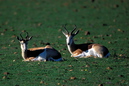
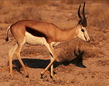
The springbok is a strikingly marked, gazellelike antelope. It has a white face with dark stripes from the mouth to the eyes, a reddish-brown coat that turns to a darker shade and then to white on the lower third of its body, and a white backside. It stands approximately 80cm high at the shoulders and is characterized by a fold of skin that runs from the midback to the rump. This fold can be opened in times of excitement to display a crest of white hair. Both sexes also have black, curved, lyre-shaped horns. Larger males can have horns 36-48cm in length.
- Other Physical Features
- endothermic
- bilateral symmetry
-
- Range mass
- 33 to 46 kg
- 72.69 to 101.32 lb
Reproduction
The springbok generally mates during the dry season and lactates during the hot, wet season when resources are most abundant. Birth takes place in Oct-Nov, the start of the wet season. Gestation is approximately 4-6 months and females generally reproduce every 2 years, starting between the ages of 1 and 2. Weaning usually occurs from 6 months to 1 year. The parental contribution is mainly by the mother, as springboks tend to live in herds of females and their offspring along with very few dominant males. Life expectancy of an average springbok is 7-9 years.
- Key Reproductive Features
- gonochoric/gonochoristic/dioecious (sexes separate)
- sexual
-
- Range number of offspring
- 1 to 2
-
- Average number of offspring
- 1.01
-
- Average number of offspring
- 1
- AnAge
-
- Range gestation period
- 5.57 to 5.7 months
-
- Range weaning age
- 4 to 4.07 months
-
- Average age at sexual or reproductive maturity (female)
Sex: female - 213 days
- AnAge
- Average age at sexual or reproductive maturity (female)
-
- Average age at sexual or reproductive maturity (male)
Sex: male - 400 days
- AnAge
- Average age at sexual or reproductive maturity (male)
- Parental Investment
- altricial
Lifespan/Longevity
-
- Average lifespan
Status: captivity - 19.0 years
- Max Planck Institute for Demographic Research
- Average lifespan
-
- Average lifespan
Status: wild - 20.0 years
- Max Planck Institute for Demographic Research
- Average lifespan
Behavior
During mating season, most males wander together in search of mates, while females live in herds with their offspring and very few dominant males. The wandering males are of lower status for a variety of reasons. Some are lower ranking due to being young or very old. Others have lost out in competition with dominant males for estrus females. When frightened or excited, a springbok makes a series of stiff-legged vertical leaps up to 3.5m high. This behavior is known as pronking and is performed with the head down, the hooves bunched, and the back arched. The leaps are said to distract predators, such as lions and cheetahs.
Springboks used to travel/live in mega-herds, known as "treks," but because springboks are now mostly confined to private farms and game reserves, treks are few and are limited to remote areas of Angola and Botswana.
- Key Behaviors
- motile
- migratory
- social
- dominance hierarchies
Communication and Perception
Food Habits
The springbok is an intermediate browser, using both grass and browse. The shift from one food source to the other takes place seasonally. It is largely due to the need for water in the hot, dry season when the natural water supplies are not constant, during which time flowers are eaten. These flowers have double the mean water content of the grass that is consumed in times of water availability (during the hot, wet season). Utilizing food resources in this way allows springboks to remain independent of a constant water supply, whether it be from man-made watering holes, natural water holes, or other water supplies. This is a great advantage in a climate where droughts are common.
Economic Importance for Humans: Positive
The springbok is the Republic of South Africa's sporting emblem. It is respected and honored in that country, which has lead to a moderate increase in protection. Only with special permission or a special license can hunters pursue the springbok. Springbok are popular attractions for tourists at game reserves and private farms. Previously, when hunting without a license for springbok was legal, the meat of springboks provided an abundant supply of protein to a growing population in southern Africa.
- Positive Impacts
- food
Economic Importance for Humans: Negative
Previously, when the springbok traveled in large numbers, they caused extensive crop damage to the Dutch farms.
Conservation Status
Springbok once traveled by the hundreds and even millions. Springbok were hunted by the Dutch farmers whose crops were ruined by "treks" of springbok travelling in search of food and water. Springbok are now being introduced in game reserves and private farms in an effort to preserve the species.
-
- IUCN Red List
-
Least Concern
More information
-
- IUCN Red List
-
Least Concern
More information
-
- US Federal List
- No special status
-
- CITES
- No special status
Contributors
June Barnard (author), University of Michigan-Ann Arbor.
Glossary
- Ethiopian
-
living in sub-Saharan Africa (south of 30 degrees north) and Madagascar.

- altricial
-
young are born in a relatively underdeveloped state; they are unable to feed or care for themselves or locomote independently for a period of time after birth/hatching. In birds, naked and helpless after hatching.
- bilateral symmetry
-
having body symmetry such that the animal can be divided in one plane into two mirror-image halves. Animals with bilateral symmetry have dorsal and ventral sides, as well as anterior and posterior ends. Synapomorphy of the Bilateria.
- chemical
-
uses smells or other chemicals to communicate
- dominance hierarchies
-
ranking system or pecking order among members of a long-term social group, where dominance status affects access to resources or mates
- endothermic
-
animals that use metabolically generated heat to regulate body temperature independently of ambient temperature. Endothermy is a synapomorphy of the Mammalia, although it may have arisen in a (now extinct) synapsid ancestor; the fossil record does not distinguish these possibilities. Convergent in birds.
- food
-
A substance that provides both nutrients and energy to a living thing.
- migratory
-
makes seasonal movements between breeding and wintering grounds
- motile
-
having the capacity to move from one place to another.
- native range
-
the area in which the animal is naturally found, the region in which it is endemic.
- sexual
-
reproduction that includes combining the genetic contribution of two individuals, a male and a female
- social
-
associates with others of its species; forms social groups.
- tactile
-
uses touch to communicate
- tropical savanna and grassland
-
A terrestrial biome. Savannas are grasslands with scattered individual trees that do not form a closed canopy. Extensive savannas are found in parts of subtropical and tropical Africa and South America, and in Australia.
- savanna
-
A grassland with scattered trees or scattered clumps of trees, a type of community intermediate between grassland and forest. See also Tropical savanna and grassland biome.
- temperate grassland
-
A terrestrial biome found in temperate latitudes (>23.5° N or S latitude). Vegetation is made up mostly of grasses, the height and species diversity of which depend largely on the amount of moisture available. Fire and grazing are important in the long-term maintenance of grasslands.
References
Nagy, Kenneth and Knight, Michael. 1994. Energy, Water and Food Use by Springbok Antelope in the Kalahari Desert. Journal of Mammalogy. Vol. 75:860-72.
"Springbok." Encyclopedia Britanica, Vol.11, p.180, 1994.
Plug, Ina. 1994. Springbok From the Past. Zeitschaft fuer Saegetierkunde. Vol. 59(4): 246-251.