Anthopleura xanthogrammicagiant green anemone
Geographic Range
Giant green anemones are primarily found along the west coast of North and Central America, from Alaska south to Panama. However, they have also been found in Hudson Bay, Canada, as well as on the eastern coast of Russia. ("Discover Life", 2013; Laroche, 2005; White, et al., 2012)
- Biogeographic Regions
- nearctic
- pacific ocean
Habitat
Giant green anemones are found in tide pools and intertidal/subtidal zones along rocky shores, at depths up to 15 m. They are typically seen attached to substrate (including manmade structures such as concrete pilings) in locations with cold waters and high wave activity. In captivity, they are known to thrive at water temperatures between 15.0-22.2° C. They are commonly found in mussel beds. ("Anthopleura xanthogrammica: Giant green anemone", 2013; Brough and McBirney, 1998; Laroche, 2005; Sebens, 1982; White, et al., 2012)
- Habitat Regions
- temperate
- saltwater or marine
- Other Habitat Features
- intertidal or littoral
-
- Range depth
- 0 to 15 m
- 0.00 to 49.21 ft
Physical Description
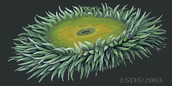
Giant green anemones have tube-like, columnar bodies, topped with a round cap bearing a crown of numerous tentacles. Column diameter may be up to 17 cm (tentacular cap crown diameter up to 25 cm) and they may grow to be as tall as 30 cm. The tentacular crown has at least 6 rings of tentacles with a mouth in the center. The tentacles contain stinging cells called cnidocytes, which hold venomous organelles called nematocysts, used to paralyze and capture prey, as well as to defend against attackers. Giant green anemones have a basal pedal disk, used to attach the animal to substrate (usually a rock or coral). Once attached to the substrate, they typically do not move; however, an anemone can use its foot to move to a new location if conditions are unfit for survival. The column is dark green to brown in color, with irregular tubercles on the surface. Disk and tentacles are green or blue to white, depending on how much sunlight the anenome receives. This is because the anemone has symbiotic algae living inside its tissues. When sunlight is plentiful, the algae grows, producing a bright green color. If the animal is in shade, these algae will be reduced in number or absent. ("Anthopleura xanthogrammica: Giant green anemone", 2013; Brough and McBirney, 1998; Laroche, 2005; Morris, et al., 1980)
- Other Physical Features
- ectothermic
- heterothermic
- radial symmetry
- venomous
- Sexual Dimorphism
- sexes alike
-
- Range length
- 30 (high) cm
- 11.81 (high) in
Development
A giant green anemone begins its life when an egg is externally fertilized in the water. Ova are spherical, 175- 225 µm in diameter, purple in color, and covered with spines, while sperm are 2-3 µm long and 2 µm in diameter, with tails 50 µm in length. Cell cleavage begins within 3 hours after fertilization and development continues to a planula stage, in which the larvae swim or float freely and have the ability to disperse long distances, potentially inhabiting new locations away from their parent organisms. During this stage, planulae eat zooplankton, phytoplankton, and even other larvae. Each planula secretes a mucus thread; food particles adhere to this thread and are drawn to the mouth where they are ingested. Settlement occurs at least 3 weeks after fertilization. Once larvae find suitable locations, they attach to substrate and develop their pedal disks, completing metamorphosis into adults. (Brough and McBirney, 1998; Hickman, et al., 2011; Laroche, 2005; Siebert, 1974; Smith and Potts, 1987)
- Development - Life Cycle
- metamorphosis
Reproduction
Spawning in this species seems to be triggered by warmer water temperatures. In one study, animals in captivity released gametes at night. Reproduction in giant green anemone occurs through external fertilization. Females release thousands of eggs at a time, and have been observed to do so multiple times within a short period. Males release sperm, which disperses rapidly. (Sebens, 1981; Siebert, 1974)
- Mating System
- polygynandrous (promiscuous)
Giant green anemones are gonochoristic; however, there are no noticeable differences in appearance between the sexes. Once an anemone reaches sexual maturity, at anywhere from 5-10 years old, it develops gonads. These anemones only reproduce sexually. (Brough and McBirney, 1998; France, 2004; Sebens, 1982; Siebert, 1974; Smith and Potts, 1987)
- Key Reproductive Features
- iteroparous
- seasonal breeding
- gonochoric/gonochoristic/dioecious (sexes separate)
- sexual
- fertilization
- broadcast (group) spawning
-
- Breeding interval
- Giant green anemones spawn once yearly, although they may release gametes in multiple waves during one spawning event.
-
- Breeding season
- Giant green anemones release their gametes during warmer months (typically late summer-early fall).
-
- Range number of offspring
- 3000 to 9000
-
- Range age at sexual or reproductive maturity (female)
- 5 to 10 years
-
- Range age at sexual or reproductive maturity (male)
- 5 to 10 years
These anemones are broadcast spawners; there is no parental involvement beyond the production of gametes. (Brough and McBirney, 1998)
- Parental Investment
- no parental involvement
Lifespan/Longevity
There is little information on the lifespan of this species; however, there is record of an individual being kept in captivity for 80 years. Their longevity in the wild has been estimated at 150 years. (Ricketts, et al., 1992; Sebens, 1982)
-
- Range lifespan
Status: captivity - 80 (high) years
- Range lifespan
-
- Typical lifespan
Status: wild - 150 (high) years
- Typical lifespan
Behavior
Adult giant green anemones are sessile and move very little. Although they are solitary, they are commonly found in groups at densities of up to 14 individuals per m^2. Individuals located in the same area will often maintain physical contact through their tentacle tips; they are not typically aggressive toward each other. When an anemone is removed from a rock in a densely populated colony, neighboring anemones do not move to the new empty space. Individuals that have been transplanted from one colony to another may induce aggressive behavior, including body inflation and use of acrorhagi (tentacles specialized for attacking) in surrounding anemones. These animals may retract their tentacles during low tide in order to avoid drying out. ("Anthopleura xanthogrammica: Giant green anemone", 2013; Batchelder and Gonor, 1981; Brough and McBirney, 1998; Sebens, 1984)
Home Range
Giant green anemones do not typically move far from the spot in which they settle after their larval stage; their home ranges do not extend beyond their bodies. ("Anthopleura xanthogrammica: Giant green anemone", 2013)
Communication and Perception
The nervous system of sea anemones has been described as elementary. Instead of a brain and central nervous system, they have a nerve net, which allows transmission of a signal in all directions instead of following a single pathway. This is beneficial because it permits response to stimuli from all sides of an anemone's radial body. Giant green anemones have shown response to electromagnetic radiation in experimental studies. Exposure to X-ray or ultraviolet light induces tentacle retraction and muscle contractions, both of which reduce height. These anemones also respond to mechanical and electrical stimuli, and their tentacles contain receptors that detect anthopleurin, a pheromone produced by wounded anemones. When anthopleurin is detected, an anemone shows an alarm response by retracting its oral disc and tentacles. If wounded or eaten, the anemone releases anthopleurin to warn its neighbors. (Clark and Kimeldorf, 1971; Hickman, et al., 2011; Howe, 1976; Kimeldorf and Fortner, 1971)
- Communication Channels
- chemical
- Other Communication Modes
- pheromones
Food Habits
Giant green anemones are carnivores, feeding mostly on sea urchins, detached mussels, crabs, and small fish; they settle preferentially in mussel beds to increase food availability. Once prey is in reach, an anemone stretches its tentacles and paralyzes its prey using the nematocysts on its tentacles. It then uses its tentacles to bring food directly to the mouth. Giant green anemones have an incomplete gut, meaning that the mouth functions to take in food as well as to expel waste. Once food is swallowed, it enters the gastrovascular cavity where it is digested, then waste products, including empty shells, travel back up and out of the mouth. Because this is a cold-water anemone, it has a relatively slow metabolism, requiring it to feed only once or twice a month. These anemones have photosynthetic algae (Zoochlorellae sp.) and dinoflagellates (Zooxanthellae sp.) living in their guts, from which they are able to derive additional nutrition. ("Anthopleura xanthogrammica: Giant green anemone", 2013; Brough and McBirney, 1998; France, 2004; Hickman, et al., 2011; Morris, et al., 1980; O'Brien, 1980)
- Primary Diet
-
carnivore
- piscivore
- eats non-insect arthropods
- molluscivore
- eats other marine invertebrates
- Animal Foods
- fish
- mollusks
- aquatic crustaceans
- echinoderms
- other marine invertebrates
Predation
Common predators of this anemone are sea spiders, which feed on an anemone’s central column, and sea snails, which feed on both the central column and tentacles. Other natural predators of the giant green anemone include crabs, sea stars, and nudibranchs. When threatened, an anemone may react by stinging the attacker with its nematocysts. (Brough and McBirney, 1998; Laroche, 2005; "Anthopleura xanthogrammica: Giant green anemone", 2013; Brough and McBirney, 1998; Laroche, 2005)
-
- Known Predators
-
- Shaggy mouse nudibranch (Aeolidia papillosa)
- Leather star (Dermasterias imbricata)
- Tinted wentletrap (Nitidiscala tincta)
- Tinted wentletrap (Nitidiscala tincta)
- Chace's wentletrap (Opalia chacei)
- Scallop-edged wentletrap (Opalia funiculata)
- Stearns' sea spider (Pycnogonum sternsi)
Ecosystem Roles
Giant green anemones play a role in many parts of the marine food web. They feed on a wide variety of prey including mussels, sea urchins, small fishes, and crabs, and are eaten by a wide variety of predators including sea slugs, sea snails, sea spiders, sea stars, and large crabs. They also serve as a host for symbiotic photosynthetic algae and dinoflagellates, benefiting from the nutrients they produce. Shells ejected by these anemones may serve as shelter for animals such as hermit crabs; blue-band hermit crabs (Pagurus samuelis), in particular, are often found associated with these anemones. They are even found walking on giant green anemones, unaffected by their nematocysts. It has been suggested that the crabs become so coated in mucous from the anemones that they are not recognized as a threat or prey. Giant green anemones may also be hosts to ectoparasites. ("Anthopleura xanthogrammica: Giant green anemone", 2013; Brough and McBirney, 1998; Fautin, 2013; Laroche, 2005)
- Zooxanthellae sp. (Class Dinophyceae, Phylum Dinoflagellata)
- Zoochlorellae sp. (Class Chlorophyceae, Division Chlorophyta)
- Doridicola confinis (Class Maxillopoda, Phylum Arthropoda)
- Pagurus samuelis (Class Malacostraca, Phylum Arthropoda)
Economic Importance for Humans: Positive
Venom from nematocysts of giant green anemones has proven very useful in the development of pharmaceutical drugs. Heart stimulants such as Anthopleurin-A and Anthopleurin-B have been derived from this venom; these toxins strengthen the heart's contractions without altering its rhythm. Protease inhibitors, such as AXPI-I and –II, have also been extracted and are particularly responsive towards trypsin, a potentially damaging enzyme produced in the pancreas. ("Anthopleura xanthogrammica: Giant green anemone", 2013; Minagawa, et al., 1997; Norton, 1981; Schlesinger, et al., 2009)
- Positive Impacts
- source of medicine or drug
Economic Importance for Humans: Negative
There are no known adverse effects of giant green anemones on humans; while their nematocysts do produce toxin, it is ineffective against humans and other vertebrates. ("Anthopleura xanthogrammica: Giant green anemone", 2013)
Conservation Status
Giant green anemones are not currently listed as threatened or endangered by any conservation agency. (IUCN, 2013)
-
- IUCN Red List
- Not Evaluated
-
- US Federal List
- No special status
-
- CITES
- No special status
-
- State of Michigan List
- No special status
Contributors
Kevin Ashley (author), Sierra College, Jennifer Skillen (editor), Sierra College, Jeremy Wright (editor), University of Michigan-Ann Arbor.
Glossary
- Nearctic
-
living in the Nearctic biogeographic province, the northern part of the New World. This includes Greenland, the Canadian Arctic islands, and all of the North American as far south as the highlands of central Mexico.

- Pacific Ocean
-
body of water between the southern ocean (above 60 degrees south latitude), Australia, Asia, and the western hemisphere. This is the world's largest ocean, covering about 28% of the world's surface.
- benthic
-
Referring to an animal that lives on or near the bottom of a body of water. Also an aquatic biome consisting of the ocean bottom below the pelagic and coastal zones. Bottom habitats in the very deepest oceans (below 9000 m) are sometimes referred to as the abyssal zone. see also oceanic vent.
- carnivore
-
an animal that mainly eats meat
- chemical
-
uses smells or other chemicals to communicate
- coastal
-
the nearshore aquatic habitats near a coast, or shoreline.
- colonial
-
used loosely to describe any group of organisms living together or in close proximity to each other - for example nesting shorebirds that live in large colonies. More specifically refers to a group of organisms in which members act as specialized subunits (a continuous, modular society) - as in clonal organisms.
- drug
-
a substance used for the diagnosis, cure, mitigation, treatment, or prevention of disease
- ectothermic
-
animals which must use heat acquired from the environment and behavioral adaptations to regulate body temperature
- electric
-
uses electric signals to communicate
- external fertilization
-
fertilization takes place outside the female's body
- fertilization
-
union of egg and spermatozoan
- heterothermic
-
having a body temperature that fluctuates with that of the immediate environment; having no mechanism or a poorly developed mechanism for regulating internal body temperature.
- intertidal or littoral
-
the area of shoreline influenced mainly by the tides, between the highest and lowest reaches of the tide. An aquatic habitat.
- iteroparous
-
offspring are produced in more than one group (litters, clutches, etc.) and across multiple seasons (or other periods hospitable to reproduction). Iteroparous animals must, by definition, survive over multiple seasons (or periodic condition changes).
- metamorphosis
-
A large change in the shape or structure of an animal that happens as the animal grows. In insects, "incomplete metamorphosis" is when young animals are similar to adults and change gradually into the adult form, and "complete metamorphosis" is when there is a profound change between larval and adult forms. Butterflies have complete metamorphosis, grasshoppers have incomplete metamorphosis.
- molluscivore
-
eats mollusks, members of Phylum Mollusca
- native range
-
the area in which the animal is naturally found, the region in which it is endemic.
- nocturnal
-
active during the night
- pheromones
-
chemicals released into air or water that are detected by and responded to by other animals of the same species
- piscivore
-
an animal that mainly eats fish
- polygynandrous
-
the kind of polygamy in which a female pairs with several males, each of which also pairs with several different females.
- radial symmetry
-
a form of body symmetry in which the parts of an animal are arranged concentrically around a central oral/aboral axis and more than one imaginary plane through this axis results in halves that are mirror-images of each other. Examples are cnidarians (Phylum Cnidaria, jellyfish, anemones, and corals).
- saltwater or marine
-
mainly lives in oceans, seas, or other bodies of salt water.
- seasonal breeding
-
breeding is confined to a particular season
- sedentary
-
remains in the same area
- sessile
-
non-motile; permanently attached at the base.
Attached to substratum and moving little or not at all. Synapomorphy of the Anthozoa
- sexual
-
reproduction that includes combining the genetic contribution of two individuals, a male and a female
- solitary
-
lives alone
- tactile
-
uses touch to communicate
- temperate
-
that region of the Earth between 23.5 degrees North and 60 degrees North (between the Tropic of Cancer and the Arctic Circle) and between 23.5 degrees South and 60 degrees South (between the Tropic of Capricorn and the Antarctic Circle).
- venomous
-
an animal which has an organ capable of injecting a poisonous substance into a wound (for example, scorpions, jellyfish, and rattlesnakes).
References
2013. "Anthopleura xanthogrammica: Giant green anemone" (On-line). SIMoN: Sanctuary Integrated Monitoring Network. Accessed December 16, 2013 at http://sanctuarysimon.org/species/anthopleura/xanthogrammica/giant-green-anemone.
2013. "Discover Life" (On-line image). Anthopleura xanthogrammica. Accessed March 30, 2013 at http://www.discoverlife.org/mp/20q?search=Anthopleura+xanthogrammica.
Batchelder, H., J. Gonor. 1981. Population characteristics of the intertidal green sea anemone, Anthopleura xanthogrammica , on the Oregon coast. Estuarine, Coastal and Shelf Science, 13/3: 235-245. Accessed May 08, 2013 at http://www.sciencedirect.com/science/article/pii/S0302352481800229.
Brough, C., C. McBirney. 1998. "Giant Green Anemone" (On-line). Animal World. Accessed March 31, 2013 at http://animal-world.com/Aquarium-Coral-Reefs/Giant-Green-Anemone.
Clark, E., D. Kimeldorf. 1971. Behavioral reactions of the sea anemone, Anthopleura xanthogrammica, to ultraviolet and visible radiations. Radiation Research, 45/1: 166-175. Accessed May 11, 2013 at http://www.jstor.org/stable/3573089.
Fautin, D. 2013. "Anthopleura xanthogrammica (Brandt, 1835)" (On-line). World Register of Marine Species. Accessed December 17, 2013 at http://www.marinespecies.org/aphia.php?p=taxdetails&id=283377.
France, S. 2004. Phylum Cnidaria, Class Anthozoa. Pp. 103-122 in N Schlager, ed. Grzimek's Animal Life Encyclopedia, Vol. 1: Lower Metazoans and Lesser Deuterostomes, 2nd Edition. Michigan: Gale.
Hickman, C., L. Roberts, S. Keen, D. Eisenhour, A. Larson, H. I'Anson. 2011. Integrated Principles of Zoology. New York, NY: Mc-Graw-Hill.
Howe, N. 1976. Behavior of sea anemones evoked by the alarm pheromone anthopleurine. Journal of Comparative Physiology, 107/1: 67-76. Accessed May 11, 2013 at http://link.springer.com/article/10.1007/BF00663919.
IUCN, 2013. "The IUCN Red List of Threatened Species. Version 2013.2" (On-line). Accessed December 17, 2013 at http://www.iucnredlist.org/search.
Kimeldorf, D., R. Fortner. 1971. The prompt detection of ionizing radiations by a marine coelenterate. Radiation Research, 46/1: 52-63. Accessed May 11, 2013 at http://www.jstor.org/stable/3573101.
Laroche, C. 2005. "Anthopleura xanthogrammica" (On-line). Racerocks.com. Accessed March 31, 2013 at http://www.racerocks.com/racerock/eco/taxalab/2005/anthopleurax/anthopleurax.htm.
Minagawa, S., M. Ishida, K. Shimakura, Y. Nagashima, K. Shiomi. 1997. Isolation and amino acid sequences of two Kunitz-type protease inhibitors from the sea anemone Anthopleura aff. xanthogrammica. Comparative Biochemistry and Physiology Part B: Biochemistry and Molecular Biology, 118/2: 381-386. Accessed May 10, 2013 at http://www.sciencedirect.com/science/article/pii/S0305049197001740.
Morris, R., D. Abbott, E. Haderlie. 1980. Intertidal Invertebrates of California. Stanford, California: Stanford University Press.
Norton, T. 1981. Cardiotonic polypeptides from Anthopleura xanthogrammica (Brandt) and A. elegantissima (Brandt). Federation Proceedings, 40/1: 21-25. Accessed May 10, 2013 at http://www.ncbi.nlm.nih.gov/pubmed/6108877.
O'Brien, T. 1980. The symbiotic association between intracellular zoochlorellae (chlorophyceae) and the coelenterate Anthopleura xanthogrammica. Journal of Experimental Zoology, 211/3: 343-355. Accessed March 05, 2013 at http://onlinelibrary.wiley.com/doi/10.1002/jez.1402110311/abstract.
Ricketts, E., J. Calvin, J. Hedgpeth, D. Phillips. 1992. Between Pacific Tides: Fifth Edition. Stanford, California: Stanford University Press. Accessed May 11, 2013 at http://books.google.com/books?id=tUl5ESavtRIC&pg=PA54&lpg=PA54&dq=anthopleura+between+pacific+tides+life+span&source=bl&ots=3WhGNFmFqs&sig=-d9Ooj7GR1OdGnGXVKnnikor1j4&hl=en&sa=X&ei=oLSOUY2MMsn0iQKb0YDwCg&ved=0CDYQ6AEwAg#v=onepage&q=anthopleura%20between%20pacific%20tides%20life%20span&f=false.
Schlesinger, A., E. Kramarsky-Winter, Y. Loya. 2009. Active nematocyst isolation via nudibranchs. Marine Biotechnology, 11/4: 441-444. Accessed May 10, 2013 at http://link.springer.com/article/10.1007%2Fs10126-008-9175-9.
Sebens, K. 1983. Population-dynamics and habitat suitability of the intertidal sea-anemones Anthopleura elegantissima and Anthopleura xanthogrammica. Ecological Monographs, 53: 405-433.
Sebens, K. 1984. Agonistic behavior in the intertidal sea anemone Anthopleura xanthogrammica. The Biological Bulletin, 166/3: 457-472. Accessed May 08, 2013 at http://www.biolbull.org/content/166/3/457.short.
Sebens, K. 1982. Recruitment and habitat selection in the intertidal sea anemones, Anthopleura elegantissima (Brandt) and A. xanthogrammica (Brandt). Journal of Experimental Marine Biology and Ecology, 59/2-3: 103-124. Accessed April 05, 2013 at http://www.sciencedirect.com/science/article/pii/0022098182901101.
Sebens, K. 1981. Reproductive ecology of the intertidal sea anemones Anthopleura xanthogrammica (Brandt) and A. elegantissima (Brandt): Body size, habitat, and sexual reproduction. Journal of Experimental Marine Biology and Ecology, 54/3: 225-250. Accessed May 09, 2013 at http://dx.doi.org/10.1016/0022-0981(81)90159-3.
Siebert, A. 1974. A description of the embryology, larval development, and feeding of the sea anemones Anthopleura elegantissima and A. xanthogrammica. Canadian Journal of Zoology, 52/11: 1383-1388. Accessed April 05, 2013 at http://www.nrcresearchpress.com/doi/abs/10.1139/z74-175?journalCode=cjz#.UVnYJ7_K9gu.
Smith, B., D. Potts. 1987. Clonal and solitary anemones (Anthopleura) of western North America: population genetics and systematics. Marine Biology, 94/4: 537-546. Accessed April 05, 2013 at http://link.springer.com/article/10.1007%2FBF00431400.
White, B., H. Helmstetler, D. Cowles. 2012. "
Anthopleura xanthogrammica Brandt (1835)" (On-line). Invertebrates of the Salish Sea. Accessed December 16, 2013 at http://www.wallawalla.edu/academics/departments/biology/rosario/inverts/Cnidaria/Class-Anthozoa/Subclass_Zoantharia/Order_Actiniaria/Anthopleura_xanthogrammica.html.