Antaresia perthensisPygmy Python
Geographic Range
Antaresia perthensis, commonly referred to as the pygmy or anthill python, is native to the Pilbara region of northwest Australia and occasionally in northwest Queensland. This species is normally seen outside of Australia only as a part the lucrative reptile pet trade. However, outside its native range, A. perthensis appears to adapt easily to many different environments. (Hardy, 1995; Hoser, 2000)
- Biogeographic Regions
- australian
Habitat
Pygmy pythons are abundant and widespread throughout the Pilbara. The Pilbara region is south of the Kimberly Tropical Savanna ecoregion and includes some of the hottest and driest areas of Australia. Although this region is extremely arid and has no formal wet or dry season, the small amount of rainfall that occurs is typically concentrated in the summer season. This habitat is composed mostly of flat land with sparse vegetation, which is generally composed of either Spinifex bushes (small grassy bushes which cover small rocky hills) or stunted eucalyptus trees.
Herpetologists find pygmy pythons by burning spinifex bushes, where they often hide in the bushes during the day to escape the blazing Australian sun. This snake is most easily found in large termite mounds, where they spend almost all daylight hours. Normally, A. perthensis is found sharing the large mounds with other species, including Stimson's pythons (Antaresia stimsoni), black-headed pythons (Aspidites melanocephalus), king brown snakes (Pseudechis australis), moon snakes (Furina ornate), broad-banded sand swimmers (Eremiascincus richardsoni), Pilbara geckoes (Gehyra pilbara), and depressed spiny skinks (Egernia depressa). It has been suggested that A. perthensis frequents these mounds because daytime temperatures in the mounds can reach up to 38 C, which are ideal conditions for these ectothermic pythons. While inside the mounds, A. perthensis and other snakes curl around each other into what looks like a large ball. Time spent in the mounds is normally used to rest and convert the heat around them into energy. In addition to spinifex bushes and termite mounds, A. perthensis can occasionally be found under rocks. (Government of Western Australia, 2009; Hoser, 1993; Hoser, 1995; Hoser, 1999; Hoser, 2000)
- Habitat Regions
- tropical
- terrestrial
- Terrestrial Biomes
- desert or dune
Physical Description
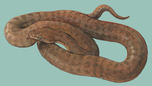
Pygmy pythons are the smallest pythons in the world, measuring only about 60 cm long and 200 g as an adult. At the time of hatching, this tiny snake is only about 17 cm long and 4 g. Females are slightly larger than males. The head is short and wedge shaped, while the neck and body are thick and muscular. The dorsal side is typically dark brick red and may be patterned. The pattern is made of approximately four regular black markings which give the impression of crossbars. Generally patterns and colors are brighter and more vivid in younger snakes, sometimes fading completely at maturity. On the ventral surface pygmy pythongs are creamy white. The scalation is as follows: 31-35 mid body rows, 205-255 ventral scales, a single anal scale, and 30-45 subcaudals.
All pythons, including A. perthensis, move by traveling forward in a straight line, known as rectilinear progression. This is accomplished by stiffening their ribs, to provide support, then lifting a set of ventral scales and moving them forward so the loose ends grip the surface of the ground, pushing the snake forward. This type of movement works on the ground as well as in trees. (Bartlett and Wagner, 1997; Bradshaw, 2000; Hoser, 1993; Hoser, 1995; Hoser, 2000; Mattison, 2007; Seigel, et al., 1987; "Pythons, boas, and anacondas, whats the differance", 2010)
- Other Physical Features
- heterothermic
- Sexual Dimorphism
- female larger
-
- Range mass
- 180 to 210 g
- 6.34 to 7.40 oz
-
- Average mass
- 200 g
- 7.05 oz
-
- Range length
- 42 to 62 cm
- 16.54 to 24.41 in
-
- Average length
- 55 cm
- 21.65 in
Development
Ensuring that A. perthensis eggs are incubated at sufficient temperatures is essential to the success of the eggs. Python eggs are particularly temperature sensitive and, if incubated at insufficient temperatures, many young fail to develop or develop birth defects such as spinal kyphosis. Cooler incubation temperatures can also result in abnormalities in a darkening or color or the presence of a stripped pattern. To aid in the hatching process, A. perthensis have a small egg tooth on the end of their nose. The egg tooth helps the hatching snakes to break through their tough shells and will fall off within a few weeks of hatching. (Bartlett and Wagner, 1997; Hoser, 1995; Hoser, 2000; Mattison, 2007; Seigel, et al., 1987)
Reproduction
Like most small snakes, pygmy pythons exhibit a trait called pairing behavior, where multiple males and females move about together. It is believed that this behavior is a result of males following the females specifically to mate, in response to a release of pheromones by the female. The female snake releases these pheromones in response to a drop in the surrounding temperature. Males rub their bodies along the female’s cloacal spurs, which are used to initiate the breeding response in females. This helps to entice the female before begining coppulation.The reproductive organs of male snakes are paired, forked hemipenes, which are stored, inverted, in the male's tail. The hemipenes are often grooved, hooked, or spindled in order to grip the walls of the female's cloaca. (Bartlett and Wagner, 1997; Seigel, et al., 1987)
- Mating System
- polyandrous
- polygynous
- polygynandrous (promiscuous)
This species is oviparous and lay eggs that are encased in a thin parchment-like shell. The eggs take about 2 months to hatch, during which time the mother python will stay coiled around her eggs to provide protection and warmth. (Bartlett and Wagner, 1997; Hoser, 1995; Hoser, 1999; Mattison, 2007; Seigel, et al., 1987)
- Key Reproductive Features
- iteroparous
- seasonal breeding
- sexual
- fertilization
- oviparous
-
- Breeding season
- eggs incubate for 2 to 3 months
-
- Range number of offspring
- 2 to 6
-
- Range gestation period
- 2 to 3 months
-
- Range time to independence
- 0 to 3 weeks
-
- Average time to independence
- 2 weeks
-
- Range age at sexual or reproductive maturity (female)
- 2 (low) years
-
- Range age at sexual or reproductive maturity (male)
- 2 (low) years
While there are no accounts of parental investment in the wild, female pythons generally stay coiled around their eggs to protect them while they develop, ensuring that the eggs do not get too cold. Once the eggs hatch, the young are independent. (Bartlett and Wagner, 1997; "Pythons, boas, and anacondas, whats the differance", 2010)
- Parental Investment
- female parental care
-
pre-fertilization
- provisioning
-
protecting
- female
-
pre-hatching/birth
-
provisioning
- female
-
protecting
- female
-
provisioning
Lifespan/Longevity
Pygmy pythons are known to live more than 25 years. Although these snakes do not live as long in captivity, they still have a fairly long life span, up to 20 years. (Bartlett and Wagner, 1997; Government of Western Australia, 2009; Hoser, 1989; Hoser, 1995; Mattison, 2007; "Pythons, boas, and anacondas, whats the differance", 2010)
-
- Range lifespan
Status: wild - 25 (high) years
- Range lifespan
-
- Range lifespan
Status: captivity - 15 to 23 years
- Range lifespan
-
- Average lifespan
Status: captivity - 18 years
- Average lifespan
-
- Typical lifespan
Status: captivity - 18 to 25 years
- Typical lifespan
-
- Average lifespan
Status: captivity - 20 years
- Average lifespan
Behavior
Pygmy pythons are largely solitary, only being found with other pygmy pythons during the mating season. Although these snakes are often found with other aggregations of snakes in termite mounds, these are opportunistic aggregations and there is little interaction. (Seigel, et al., 1987)
Home Range
Home range sizes have not been reported.
Communication and Perception
Pygmy pythons use scent to track their prey. They flick their forked tongues to collect airborne particles, then passing them to the vomeronasal or Jacobson's organ in the mouth. This fork in the tongue gives snakes a sort of directional sense of smell and taste simultaneously. Their tongues are kept it constant motion, sampling particles from the air, ground, and water, analyzing the chemicals found, and determining the presence of prey or predators in the local environment Pit vipers, pythons, and some species of boas have infrared-sensitive receptors in deep grooves between the nostril and eye. Also common in pythons are labial pits that are found on their upper lip just below the nostrils, these structures allows them to "see" the radiated heat of warm-blooded prey mammals. Pygmy python underbellies come in direct contact with the ground and are very sensitive to vibrations. This allows snakes to sense other animals approaching by detecting the faint vibrations in the air and on the ground. Research suggests that A. perthensis communicates like most other snake species, using mainly scent to find prey and communicate. (Bartlett and Wagner, 1997; Hoser, 1995; Seigel, et al., 1987)
- Other Communication Modes
- pheromones
- vibrations
- Perception Channels
- visual
- infrared/heat
- tactile
- vibrations
- chemical
Food Habits
Pygmy pythons kill prey by constriction. Though constriction appears to involve continuous squeezing, it actually occurs intermittently. Since muscles use large amounts of energy when they exert force, squeezing intermittently and only when necessary, the snakes conserve energy. Holding the constriction posture even when not squeezing allows a snake to squeeze again very quickly if the prey starts to move again.
Pygmy pythons are nocturnal hunters, hunting at night helps them to avoid the extreme temperatures experienced during the day in the Pilbara region. Their diet changes with age: young snakes generally eat small reptiles including geckos and skinks, at maturity their diet shifts to include small mammals, such as bats which it catches in an innovative way. The snake positions itself on ledges at cave entrances and strike at the bats as they fly in and out of the caves. Adult snakes also feed on amphibians. Digestion begins almost as the snake starts the swallowing process, because the saliva and stomach acids, which completely covers the prey, contains strong enzymes for breaking down food. The amount of time needed for digestion is heavily dependent on meal size and meal type, some meals can take extremely long, sometimes multiple days to digest. (Bartlett and Wagner, 1997; Hoser, 2000; Mattison, 2007; Shine and Slip, 1990)
- Primary Diet
-
carnivore
- eats terrestrial vertebrates
- insectivore
- Animal Foods
- birds
- mammals
- amphibians
- reptiles
- insects
- terrestrial non-insect arthropods
Predation
Pygmy python young are at high risk of predation. These snakes are eaten by a variety of birds, carnivorous mammals, large frogs, spiders, and other snakes. Though adult pygmy pythons are at a slightly lower risk, their small size still makes them easy prey. The dark red color of this species helps them to avoid capture somewhat, as it helps them to blend with their environment. (Bartlett and Wagner, 1997; Hoser, 1995; "Pythons, boas, and anacondas, whats the differance", 2010)
- Anti-predator Adaptations
- cryptic
-
- Known Predators
-
- Psuedechis australis
Ecosystem Roles
Little is known about A. perthensis in the wild. While they are eaten by larger reptiles, mammals, and birds, they are not the primary prey of any known species. (Hoser, 1989; Hoser, 1993; Hoser, 2000; "Pythons, boas, and anacondas, whats the differance", 2010)
- termites (Isoptera)
Economic Importance for Humans: Positive
While there is no direct benefit to humans, A. perthensis does eat other small, sometimes pestilent reptiles and small mammals. In fact, they are generally docile snakes and are sought after as pets. (Hoser, 1989)
- Positive Impacts
- pet trade
Economic Importance for Humans: Negative
There are no known adverse effects of A. perthensis on humans. (Bartlett and Wagner, 1997)
Conservation Status
Pygmy pythons are common throughout their natural habitat. The only significant threat to A. perthensis populations are cars and tourism, as they often cross roads during peak hours of the day. In addition, there have been increased attempts at smuggling this species out of Australia, an offense which is punishable by large fines and jail time.
-
- IUCN Red List
- No special status
-
- US Federal List
- No special status
-
- CITES
- No special status
-
- State of Michigan List
- No special status
Other Comments
Pythons (Pythonidae) are considered "primitive" snakes, with features that link them to their four-legged lizard ancestors. These features include a rudimentary pelvic girdle in the form of cloacal spurs and two equal sized lungs. (Bartlett and Wagner, 1997; Bradshaw, 2000; Hoser, 1993; Hoser, 1995; Hoser, 2000; Mattison, 2007; Seigel, et al., 1987; "Pythons, boas, and anacondas, whats the differance", 2010)
Contributors
Chelsea Blanchet (author), Radford University, Christine Small (editor), Radford University, Tanya Dewey (editor), University of Michigan-Ann Arbor.
Glossary
- Australian
-
Living in Australia, New Zealand, Tasmania, New Guinea and associated islands.

- carnivore
-
an animal that mainly eats meat
- chemical
-
uses smells or other chemicals to communicate
- cryptic
-
having markings, coloration, shapes, or other features that cause an animal to be camouflaged in its natural environment; being difficult to see or otherwise detect.
- desert or dunes
-
in deserts low (less than 30 cm per year) and unpredictable rainfall results in landscapes dominated by plants and animals adapted to aridity. Vegetation is typically sparse, though spectacular blooms may occur following rain. Deserts can be cold or warm and daily temperates typically fluctuate. In dune areas vegetation is also sparse and conditions are dry. This is because sand does not hold water well so little is available to plants. In dunes near seas and oceans this is compounded by the influence of salt in the air and soil. Salt limits the ability of plants to take up water through their roots.
- diurnal
-
- active during the day, 2. lasting for one day.
- female parental care
-
parental care is carried out by females
- fertilization
-
union of egg and spermatozoan
- heterothermic
-
having a body temperature that fluctuates with that of the immediate environment; having no mechanism or a poorly developed mechanism for regulating internal body temperature.
- infrared/heat
-
(as keyword in perception channel section) This animal has a special ability to detect heat from other organisms in its environment.
- insectivore
-
An animal that eats mainly insects or spiders.
- iteroparous
-
offspring are produced in more than one group (litters, clutches, etc.) and across multiple seasons (or other periods hospitable to reproduction). Iteroparous animals must, by definition, survive over multiple seasons (or periodic condition changes).
- native range
-
the area in which the animal is naturally found, the region in which it is endemic.
- nocturnal
-
active during the night
- oviparous
-
reproduction in which eggs are released by the female; development of offspring occurs outside the mother's body.
- pet trade
-
the business of buying and selling animals for people to keep in their homes as pets.
- pheromones
-
chemicals released into air or water that are detected by and responded to by other animals of the same species
- polyandrous
-
Referring to a mating system in which a female mates with several males during one breeding season (compare polygynous).
- polygynandrous
-
the kind of polygamy in which a female pairs with several males, each of which also pairs with several different females.
- polygynous
-
having more than one female as a mate at one time
- seasonal breeding
-
breeding is confined to a particular season
- sedentary
-
remains in the same area
- sexual
-
reproduction that includes combining the genetic contribution of two individuals, a male and a female
- tactile
-
uses touch to communicate
- terrestrial
-
Living on the ground.
- tropical
-
the region of the earth that surrounds the equator, from 23.5 degrees north to 23.5 degrees south.
- vibrations
-
movements of a hard surface that are produced by animals as signals to others
- visual
-
uses sight to communicate
References
Zoological Society of San Diego. 2010. "Pythons, boas, and anacondas, whats the differance" (On-line). San Diego Zoo's Animal bytes. Accessed November 14, 2010 at http://www.sandiegozoo.org/animalbytes/t-python.html.
Commonwealth of Australia. 2002. "Rangelands-Overview-Plibara" (On-line). Australian Natural Resource Atlas. Accessed December 01, 2010 at http://www.anra.gov.au/topics/rangelands/overview/wa/ibra-pil.html.
Bartlett, P., E. Wagner. 1997. Pythons: A complete pet owners manual. Hauppaauge, NY 11718: Barons Educactional Series, Inc.
Bradshaw, D. 2000. The Quarterly Review of Biology. Chicago, Il: The University of Chicago Press.
Government of Western Australia, 2009. "Pygmy Python" (On-line). Perth Zoo. Accessed September 17, 2010 at http://www.perthzoo.wa.gov.au/Animals--Plants/Australia/Reptile-Encounter/Pygmy-Python/.
Hardy, J. 1995. Common Names of Australian Reptiles. Australian Herpetology, 18/1: 2. Accessed September 17, 2010 at http://australianherpetology.com/commonP1.htm.
Hoser, R. 2000. A Revision of the Australian Pythons. Ophidia Review, 1/1: 7-27.
Hoser, R. 1989. Australian Reptiles and Frogs. Australia: Pierson & Co.
Hoser, R. 1999. Australia's Dwarf Pythons-Genus Antaresia. Journal of the Victorian Herpetological Society, 10/2: 24-32.
Hoser, R. 1981. Australian Pythons, Part 2. The Herptile, 6: 13-19.
Hoser, R. 1993. Children's Pythons and Lookalikes. The Reptilian, 1/7: 10-15 20-21. Accessed September 15, 2010 at http://www.smuggled.com/chicom1.htm.
Hoser, R. 1995. The Ant-Hill Python from Western Australia. Reptiles magazine, 3/5: 10-16. Accessed September 16, 2010 at http://www.smuggled.com/ant1.htm.
Mattison, C. 2007. The New Encyclopedia of Snakes. New Jersey: Princeton University Press.
Rose, R., W. Ross. 1983. A Synopsis of the Class Reptilia in Australia. The Australian Journal of Herpetology, 1/3.4: 50-52. Accessed September 15, 2010 at http://www.seaturtle.org/PDF/Wells_1984_.pdf.
Savitzky, A. 1992. Review of Australian reptiles & frogs. Herpetologica, 48/1: 144-148.
Seigel, R., J. Collins, S. Novak. 1987. Snakes: Ecology and Evolutionary Biology. New York, New York: Macmillan Publishing Co.
Shine, R., D. Slip. 1990. Aspects of the Adaptive Radiation of Australasian Pythons (Serpentes: Boidae). Herpetologica, 46/3: 283-290.
Underwood, G., A. Stimson. 1990. A classification of pythons (Serpentes, Pythoninae). The journal of Zoology, 221/4: 565-603.