Anser ansergreylag goose

Geographic Range
During the summer the Graylag Geese, Anser anser, live in Scotland, Iceland; Scandinavia and Eastward to Russia, as well as Poland and Germany. The Iceland birds migrate in autumn to the British Isles, and usually arrive in October. The Netherlands, Spain, France, eastern Mediterranean, and North Africa are places in which the rest of the European population spends winter. (Soothill & Whiteherd, 1996)
- Biogeographic Regions
- palearctic
Habitat
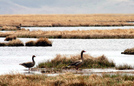
During the breeding season Greylag geese live in lowland marshes and fens that have a lot of vegetation, as well as offshore islands. Outside of the breeding season they spend time in fresh-and salt-water marshes, estuaries, stubble fields, pasture lands, and potato fields. (Soothill & Whiteherd, 1996)
- Habitat Regions
- temperate
- terrestrial
- Terrestrial Biomes
- tundra
- Other Habitat Features
- agricultural
- riparian
- estuarine
Physical Description
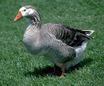
Greylag goose plumage is grayish-brown, with pale margins on feathers in the upper part. In the lower part it has a white belly, and grayish shading on the lower breast. Similar to all of this is the neck and the head. It has an orange, large bill. The feet and legs are flesh tissue colored, and in most adults there is spotting and blotching in most adults. Young birds do not have this characteristic, and have grayish legs. On average the length of a mature bird is 80 cm (31 inches). The mass of the birds tends to be in the range of 2500 to 4100 g. The average weight of males is 36 g (1.3 oz) and for females is 32 g (1 oz). Wingspan reaches 76 to 89 cm. (Soothill & Whiteherd, 1996; Dunning, 1993)
- Other Physical Features
- endothermic
- bilateral symmetry
-
- Range mass
- 2160 to 4560 g
- 76.12 to 160.70 oz
-
- Range length
- 76 to 89 cm
- 29.92 to 35.04 in
-
- Average length
- 80 cm
- 31.50 in
-
- Range wingspan
- 147 to 180 cm
- 57.87 to 70.87 in
-
- Average wingspan
- 163 cm
- 64.17 in
Reproduction
- Mating System
- monogamous
In Iceland, the breeding season starts in early May, and in Scotland it begins in late April. In middle Europe the breeding season starts a bit earlier. The nests are built among reeds and bushes. They are also build in high and elevated places, as well as marshy regions, and small isles to keep eggs and goslings safe from predators.
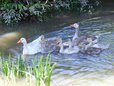
The number of eggs varies from three to twelve, but is usually only four to six. The eggs are creamy white, and about 85 x 58mm (3.3 to 2.3 inches) in size. The eggs are incubated only by the female, and take 27 to 28 days to hatch. After hatching, the goslings usually wait until drying out to leave the nest. With the supervision of their parents the young birds feed themselves, and in about eight weeks they are fully independent.
Geese take from 2 to 3 years to reach sexual maturity but usually mature at 3 years. (Soothill & Whiteherd, 1996; del Hoyo et al., 1992)
- Key Reproductive Features
- iteroparous
- seasonal breeding
- gonochoric/gonochoristic/dioecious (sexes separate)
- sexual
- oviparous
-
- Breeding season
- Spring
-
- Range eggs per season
- 3 to 12
-
- Average eggs per season
- 6
-
- Range time to hatching
- 27 to 28 days
-
- Range fledging age
- 50 to 60 days
-
- Range age at sexual or reproductive maturity (female)
- 2 to 3 years
-
- Range age at sexual or reproductive maturity (male)
- 2 to 3 years
- Parental Investment
- precocial
- male parental care
- female parental care
Lifespan/Longevity
Most Greylag geese live until they are twenty years old. (Lorenz, 1991)
Behavior
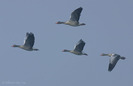
Sociable by nature, the Greylag geese occur in different size groups, from small families to flocks that go up to the thousands. They usually fly in v-patterns when traveling long distances. They are able to run rapidly in land, and move without difficulty to avoid predators. (Soothill & Whiteherd 1996)
Communication and Perception
Food Habits
Food include grasses, rhizomes of marsh plants, and roots, and some small aquatic animals. They also eat spilled grain in stubbles, and different kinds of root crops, as well as turnips, carrots, and potatoes. (Soothill & Whiteherd, 1996)
- Animal Foods
- amphibians
- fish
- insects
- mollusks
- aquatic crustaceans
- Plant Foods
- leaves
- roots and tubers
- seeds, grains, and nuts
- fruit
- algae
Predation
For Greylag geese, threats from the air include golden eagles, ravens, and hawks, and on the ground, prowling dogs, foxes, and humans. (Lorenz 1991)
-
- Known Predators
-
- golden eagles (Aquila chrysaetos)
- common ravens (Corvus corax)
- hawks (Accipitridae)
- domestic dogs (Canis lupus familiaris)
- red fox (Vulpes vulpes)
- Arctic fox (Vulpes lagopus)
Economic Importance for Humans: Positive
Thousands of years ago Greylag geese were domesticated and used for many purposes. One of the purposes of raising geese is because of the meat, which is very rich in flavor . The down (soft feathers) of the birds has also been very useful for many commodities such as stuffing in pillows, as a lightweight, mattresses, outdoor clothing sleeping bags, and insulating material. (Austic, 2001)
- Positive Impacts
- food
Economic Importance for Humans: Negative
Farming has been affected due to overpopulation. Greylag geese flocks have been known to harm potato and carrot fields in different parts of Europe. (Schneck, 1999)
- Negative Impacts
- crop pest
Conservation Status
Greylag Geese once were very common in Western Europe, but due to the draining of marshes there has been a severe drop in numbers. Currently, this species has increased in numbers up to a point of reaching flocks of tens of thousands. (Schneck 1999)
-
- IUCN Red List
-
Least Concern
More information
-
- IUCN Red List
-
Least Concern
More information
-
- US Migratory Bird Act
- No special status
-
- US Federal List
- No special status
-
- CITES
- No special status
Other Comments
An interesting fact about Greylag geese is that they were once considered sacred by the Romans after reportedly saving the city of Rome in 390 BC. When the Gauls tried to climb in, the geese warned the Romans with their loud calls about the attempted invasion. After this, Caesar believed that the geese were sacred and it was ordered that the geese were to not be eaten in Pre-Roman Britain. (Schneck 1999)
Contributors
Saul Vargas (author), Fresno City College, Carl Johansson (editor), Fresno City College.
Glossary
- Palearctic
-
living in the northern part of the Old World. In otherwords, Europe and Asia and northern Africa.

- acoustic
-
uses sound to communicate
- agricultural
-
living in landscapes dominated by human agriculture.
- bilateral symmetry
-
having body symmetry such that the animal can be divided in one plane into two mirror-image halves. Animals with bilateral symmetry have dorsal and ventral sides, as well as anterior and posterior ends. Synapomorphy of the Bilateria.
- chemical
-
uses smells or other chemicals to communicate
- endothermic
-
animals that use metabolically generated heat to regulate body temperature independently of ambient temperature. Endothermy is a synapomorphy of the Mammalia, although it may have arisen in a (now extinct) synapsid ancestor; the fossil record does not distinguish these possibilities. Convergent in birds.
- estuarine
-
an area where a freshwater river meets the ocean and tidal influences result in fluctuations in salinity.
- female parental care
-
parental care is carried out by females
- food
-
A substance that provides both nutrients and energy to a living thing.
- granivore
-
an animal that mainly eats seeds
- herbivore
-
An animal that eats mainly plants or parts of plants.
- iteroparous
-
offspring are produced in more than one group (litters, clutches, etc.) and across multiple seasons (or other periods hospitable to reproduction). Iteroparous animals must, by definition, survive over multiple seasons (or periodic condition changes).
- male parental care
-
parental care is carried out by males
- marsh
-
marshes are wetland areas often dominated by grasses and reeds.
- migratory
-
makes seasonal movements between breeding and wintering grounds
- monogamous
-
Having one mate at a time.
- motile
-
having the capacity to move from one place to another.
- native range
-
the area in which the animal is naturally found, the region in which it is endemic.
- oviparous
-
reproduction in which eggs are released by the female; development of offspring occurs outside the mother's body.
- riparian
-
Referring to something living or located adjacent to a waterbody (usually, but not always, a river or stream).
- seasonal breeding
-
breeding is confined to a particular season
- sexual
-
reproduction that includes combining the genetic contribution of two individuals, a male and a female
- social
-
associates with others of its species; forms social groups.
- swamp
-
a wetland area that may be permanently or intermittently covered in water, often dominated by woody vegetation.
- tactile
-
uses touch to communicate
- temperate
-
that region of the Earth between 23.5 degrees North and 60 degrees North (between the Tropic of Cancer and the Arctic Circle) and between 23.5 degrees South and 60 degrees South (between the Tropic of Capricorn and the Antarctic Circle).
- terrestrial
-
Living on the ground.
- tundra
-
A terrestrial biome with low, shrubby or mat-like vegetation found at extremely high latitudes or elevations, near the limit of plant growth. Soils usually subject to permafrost. Plant diversity is typically low and the growing season is short.
- visual
-
uses sight to communicate
- young precocial
-
young are relatively well-developed when born
References
Austic, R. 2001. "Discovery.com" (On-line). Accessed Nov 27, 2001 at http://www.discoveryschool.com/homeworkhelp/worldbook/atozscience/g/229700.html.
Bunning, JR, J. 1993. Avian Body Masses. Boca Raton, Florida: CRC Press,Inc..
Lorenz, K. 1991. Here Am I-where Are You? The behavior of the Grayland goose. New York, and San Diego: A Helen and Kurt Wolff Book. Harcourt Brace Jovanovich.
Lorenz, K. 1979. The Year of the Graylag Goose. New York and London: A Helen and Kurt Wolff Book. Harcourt Brace Jovanovich Inc..
Schneck, M. 1999. Ducks & Waterfowls, A portrait Of The Animal World. New York City: Robert M. Tod.
Soothill, E., P. Whitehead. 1996. Wildfowl, A World Guide. Singapore: Kyodo Printing Co..
del Hoyo, J., A. Elliott, J. Sargatal. 1992. Handbook of the Birds of the World. Barcelona: Lynx Edicions.