Anomalurus pusillusdwarf scaly-tailed squirrel
Geographic Range
Anomalurus pusillus (dwarf scaly-tailed squirrels) occurs in Central Africa from Cameroon and Gabon to west Uganda and the northwest shore of Lake Tanganyika. Dwarf scaly-tailed squirrels are also found in West Liberia on the Du River. (Haltenorth and Diller, 1988)
Habitat
Dwarf scaly-tailed squirrels depend entirely on primary tropical forest in lowland areas. This species is found at elevations up to 2000 m. (Haltenorth and Diller, 1988)
- Habitat Regions
- tropical
- terrestrial
- Terrestrial Biomes
- forest
-
- Range elevation
- 2000 (high) m
- 6561.68 (high) ft
Physical Description
Although there is no mass reported for A. pusillus, it is said to be the smallest species of anomalurid. (Macdonald, 1999)
Dwarf scaly-tailed squirrels have a head and body length ranging from 210 to 246 mm. Their tail length, which is one third the length of their body, ranges from 138 to 157 mm. Their hind feet, with a length varying from 37 to 47 mm, contain bristle hairs that are seen over the claws. (Kingdon, 1974)
The coloration of dwarf scaly-tailed squirrels varies from a tan, light gray color to a very dark gray. The belly of this species is usually a yellowish gray color. The tail is generally a blackish brown color on the tip. The head is generally gray without a facial pattern. (Haltenorth and Diller, 1988)
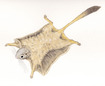
The genus Anomalurus in general has a distinctive feature which is a cape-like membrane stretched between the forelimbs and the hind limbs and between the hind legs and the tail. This feature allows them to glide from branch to branch. The membrane is supported in the front by a rod of cartilage extending from the elbow joint and attaching to the ankles at the rear. The name “scaly-tailed” refers to an area of rough, overlapping scales on the underside of the tail near the base. (Nowak, 1999)
- Other Physical Features
- endothermic
- homoiothermic
- bilateral symmetry
- Sexual Dimorphism
- sexes alike
-
- Range length
- 210 to 246 mm
- 8.27 to 9.69 in
Reproduction
There is no available information on the mating system of A. pusillus.
Specific reproductive information for dwarf scaly-tailed squirrels is not known, but information from related species of Anomalurus indicate that females may have 2 litters of 1 to 3 young per year. (Macdonald, 1999)
At birth, scaly-tailed squirrels are large, well-furred, and active and their eyes are completely open. (Nowak, 1999)
- Key Reproductive Features
- iteroparous
- gonochoric/gonochoristic/dioecious (sexes separate)
- sexual
- viviparous
-
- Breeding interval
- Dwarf scaly-tailed squirrels may breed twice yearly.
-
- Breeding season
- Breeding season in dwarf scaly-tailed squirrels is not known.
-
- Range number of offspring
- 1 to 3
Relatively little is known about parental investment in A. pusillus. In related species of Anomalurus, both parents bring food back to a well-hidden nest for their young until they become independent.
- Parental Investment
- precocial
-
pre-fertilization
- provisioning
-
protecting
- female
-
pre-hatching/birth
-
provisioning
- female
-
protecting
- female
-
provisioning
-
pre-weaning/fledging
-
provisioning
- male
- female
-
protecting
- male
- female
-
provisioning
Lifespan/Longevity
There is little available information for A. pusillus concerning their lifespan or longevity.
Behavior
Dwarf scaly-tailed squirrels often associate in pairs and occasionally in groups. Species of Anomaluridae usually have group sizes that vary from 6 or 8 animals to colonies of over 100 individuals of several species. Dwarf scaly-tailed squirrels roost in tree holes, cracks, and hollow trunks. They sometimes also spend the day clinging to the trunk of a tree. Like other anomalurids, they are nocturnal and remain close to their nest tree. Several scaly-tailed squirrels may inhabit the same tree. (Nowak, 1999)
Home Range
Dwarf scaly-tailed squirrels are likely to have a home range that resembles that of Anomalurus derbianus, which occupy the same nest hole throughout the year. (Haltenorth and Diller, 1988)
Communication and Perception
Dwarf scaly-tailed squirrels are social and are likely to employ some forms of communication. Little is known about social communication in this species, but it is likely to include chemical cues, sounds, touch, and visual cues. (Vaughan, et al., 2000)
Food Habits
Dwarf scaly-tailed squirrels feed primarily on bark and fruit. One particular dwarf scaly-tailed squirrel was recorded feeding exclusively on Musanga fruit. (Kingdon, 1974; Macdonald, 1999)
- Plant Foods
- wood, bark, or stems
- fruit
Predation
There is little available information on predation in A. pusillus. Like other anomalurids, their cryptic coloration and arboreal habits may protect them from some predation. They are likely to be preyed on by arboreal predators such as snakes, small cats, and birds of prey.
- Anti-predator Adaptations
- cryptic
Ecosystem Roles
Dwarf scaly-tailed squirrels are important members of the ecosystems in which they live.
Economic Importance for Humans: Positive
Since only a few specimens have been found, the economic importance of A. pusillus and the benefit it has for humans is poorly known.
Economic Importance for Humans: Negative
There are no known adverse effects of A. pusillus on humans.
Conservation Status
The only major threat to dwarf scaly-tailed squirrels is the extraction of wood from their habitat. According to the IUCN Red List of Threatened Species, even though this species is poorly known, the habitat within its known range is reasonably intact when compared with forested regions in West Africa. This suggests that dwarf scaly-tailed squirrels are unlikely to be experiencing population declines currently.
-
- IUCN Red List
-
Least Concern
More information
-
- IUCN Red List
-
Least Concern
More information
-
- US Federal List
- No special status
-
- CITES
- No special status
Contributors
Tanya Dewey (editor), Animal Diversity Web.
Kristine Endries (author), University of Wisconsin-Stevens Point, Chris Yahnke (editor, instructor), University of Wisconsin-Stevens Point.
Glossary
- Ethiopian
-
living in sub-Saharan Africa (south of 30 degrees north) and Madagascar.

- acoustic
-
uses sound to communicate
- arboreal
-
Referring to an animal that lives in trees; tree-climbing.
- bilateral symmetry
-
having body symmetry such that the animal can be divided in one plane into two mirror-image halves. Animals with bilateral symmetry have dorsal and ventral sides, as well as anterior and posterior ends. Synapomorphy of the Bilateria.
- chemical
-
uses smells or other chemicals to communicate
- cryptic
-
having markings, coloration, shapes, or other features that cause an animal to be camouflaged in its natural environment; being difficult to see or otherwise detect.
- endothermic
-
animals that use metabolically generated heat to regulate body temperature independently of ambient temperature. Endothermy is a synapomorphy of the Mammalia, although it may have arisen in a (now extinct) synapsid ancestor; the fossil record does not distinguish these possibilities. Convergent in birds.
- forest
-
forest biomes are dominated by trees, otherwise forest biomes can vary widely in amount of precipitation and seasonality.
- frugivore
-
an animal that mainly eats fruit
- herbivore
-
An animal that eats mainly plants or parts of plants.
- iteroparous
-
offspring are produced in more than one group (litters, clutches, etc.) and across multiple seasons (or other periods hospitable to reproduction). Iteroparous animals must, by definition, survive over multiple seasons (or periodic condition changes).
- motile
-
having the capacity to move from one place to another.
- native range
-
the area in which the animal is naturally found, the region in which it is endemic.
- nocturnal
-
active during the night
- sedentary
-
remains in the same area
- sexual
-
reproduction that includes combining the genetic contribution of two individuals, a male and a female
- social
-
associates with others of its species; forms social groups.
- tactile
-
uses touch to communicate
- terrestrial
-
Living on the ground.
- tropical
-
the region of the earth that surrounds the equator, from 23.5 degrees north to 23.5 degrees south.
- visual
-
uses sight to communicate
- viviparous
-
reproduction in which fertilization and development take place within the female body and the developing embryo derives nourishment from the female.
- young precocial
-
young are relatively well-developed when born
References
Haltenorth, T., H. Diller. 1988. The Collins Field Guide to the Mammals of Africa. New York, New York: The Stephen Greene Press, Inc.
Hutterer, R., J. Decher. 2004. "
Anomalurus pusillus" (On-line). The IUCN Red List of Threatened Species. Accessed November 12, 2006 at http://www.iucnredlist.org.
Kingdon, J. 1974. East African Mammals: An Atlas of Evolution in Africa. New York, New York: Academic Press Inc.
Macdonald, D. 1999. The Encyclopedia of Mammals. New York, New York: Andromeda Oxford Limited.
Nowak, R. 1999. Mammals of the World. Baltimore: The John Hopkins University Press.
Vaughan, T., J. Ryan, N. Czaplewski. 2000. Mammalogy. Orlando, FL: Saunders College Publishing.