Amphispiza bilineatablack-throated sparrow



Geographic Range
Amphispiza bilineata breeds in the southwest and central regions of North America, extending into the north-central mainland of Mexico. The summer range is much larger than the winter range in the United States. In the winters, it migrates to southern U.S. deserts (Clark,1999; Karl, 2000). (Clark, 1999; Karl, 2000)
Habitat
The black-throated sparrow prefers a sparse, isolated desert environment. Hot, dry weather in the desert uplands, creosote bush and scrub environments are the most frequent habitats. These sparrows prefer terrain that is either steeply sloped or very flat. Besides desert uplands, they also favor alluvial fans and hill slopes, usually with much exposed rock and gravel pavement (INRIN; Karl, 2000).
Plants that are closely associated with this species include creosote bush and cholla cactus, catclaw, small mesquite, artemisia, rabbit-brush, purshia, dwarf juniper, yucca, agave, and sagebrush (Robbins, 1966).
- Habitat Regions
- terrestrial
- Terrestrial Biomes
- desert or dune
Physical Description
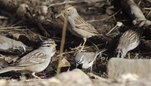
Amphispiza bilineata have dark, conical bills and a black coat, throat and mask. A white supercilium and malar streak are also present. Their crown, back and wings are grey and their bellies are white. The round tail is long and black with a few white patches on outer feathers (INRIN).
Juvenile black-throated sparrows are much browner and have a faint adult face pattern. The young have facial stripes but are also finely streaked on throat, instead of a completely black throat (Robbins, 1966).
- Other Physical Features
- endothermic
- bilateral symmetry
Reproduction
The black-throated sparrow breeds in most desert states of the United States and Mexico. In California, song and pair formation begin in February. Depending on the timing of the rains, nesting behavior begins in March and continues through mid-August. The nest is built from April to June and is normally well concealed in shrubs and bushes. In Idaho, all of the nests were within 25 cm of the ground. The nest is cup-shaped and loosely built of grasses and stems. It is lined with plant fibers, rabbit fur, cow hair, wool, and feathers. From April to August there are two broods, with usually 3 to 4 eggs laid in each. The eggs are either white or pale blue and average 17.3 to 13.8 mm in diameter. Incubation period and age when young fledge are unreported (DeLacy, 2001; INRIN; Kaufman, 1996).
- Key Reproductive Features
- iteroparous
- seasonal breeding
- gonochoric/gonochoristic/dioecious (sexes separate)
- sexual
- oviparous
-
- Breeding season
- spring/summer
-
- Range eggs per season
- 3 to 4
-
- Average eggs per season
- 3
- AnAge
Both parents play an active role in feeding the young. The male also protects the nest by using his song to warn off other conspecifics (Kaufman, 1996).
- Parental Investment
- altricial
- male parental care
- female parental care
Lifespan/Longevity
-
- Average lifespan
Status: wild - 72 months
- Bird Banding Laboratory
- Average lifespan
Behavior
Black-throated sparrows are partly migratory. They are found in the southern portion of their breeding range throughout winter. These birds are oftentimes seen interspersed with white-crowned sparrows and Brewer's sparrows in the wintertime. During some seasons this species does not have access to a water source. It derives water from food it has eaten, ususally insects and seeds. This adaptation, along with its great tolerance for heat, makes it the best-suited sparrow for the desert climate. Except for the summer season when mate-pairing takes place, they are normally flocking birds.
Amphispiza bilineata builds cup-shaped nests in shrubs or cacti, usually close to the ground. In Idaho, all located nests have been 25 to 45 cm above ground in big sagebrush plants (Clark, 1999; DeLacy, 2001; INRIN; Karl, 2000).
Communication and Perception
Food Habits
Black-throated sparrows are omnivorous, eating seeds during winter months and insects during breeding season. They eat many flying insects, but also consume grasses and herbs. Gravel is sometimes ingested to aid in digestion. This bird can usually be observed running around on the ground in search of insects. The diet of insects allows these birds to obtain moisture from their food and not rely on free water throughout breeding season. If spring water is present they will take advantage of it. The young are fed insects, particularly grasshopper abdomens (Karl,1999; Clark, 2000; DeLacy, 2001).
Common foods eaten include: angiosperms (flowering plants), Poaceae (grasses), seeds from deciduous shrubs, arthropods, grasshoppers and crickets, and cockroaches. (Clark, 1999; DeLacy, 2001; Karl, 2000)
- Primary Diet
- omnivore
- Animal Foods
- insects
- Plant Foods
- leaves
- seeds, grains, and nuts
Predation
An anti-predation adaption the black-throated sparrow has developed is to "freeze" when a predator is near their nest. This most likely occurs because predators are more likely to search an area from where a bird has just been flushed (DeLacy, 2001; INRIN).
-
- Known Predators
-
- snakes (Serpentes)
- coyotes (Canis latrans)
- Canadian lynx (Lynx canadensis)
Ecosystem Roles
In Arizona and Texas, there have been reports of A. bilineata serving as a host to cowbirds (Terres, 1980).
Economic Importance for Humans: Positive
There is no documented economic importance these birds have for humans. They add to the biodiversity of the desert and bring a beautiful chorus to the world.
Conservation Status
This sparrow is a non-game bird protected by the Migratory Bird Treaty Act. In desert areas where development is increasing, its populations have declined. Unlike some desert birds, the black-throated sparrow does not adapt well to life in the suburbs. In proper habitat, however, its population is steady (INRIN; Kaufman, 1996).
-
- IUCN Red List
-
Least Concern
More information
-
- IUCN Red List
-
Least Concern
More information
-
- US Migratory Bird Act
- Protected
-
- US Federal List
- No special status
-
- CITES
- No special status
Other Comments
In Arizona and Texas, there have been reports of A. bilineata serving as a host to cowbirds (Terres, 1980).
Contributors
Amanda Fox (author), University of Michigan-Ann Arbor, Kerry Yurewicz (editor), University of Michigan-Ann Arbor.
Glossary
- Nearctic
-
living in the Nearctic biogeographic province, the northern part of the New World. This includes Greenland, the Canadian Arctic islands, and all of the North American as far south as the highlands of central Mexico.

- acoustic
-
uses sound to communicate
- altricial
-
young are born in a relatively underdeveloped state; they are unable to feed or care for themselves or locomote independently for a period of time after birth/hatching. In birds, naked and helpless after hatching.
- bilateral symmetry
-
having body symmetry such that the animal can be divided in one plane into two mirror-image halves. Animals with bilateral symmetry have dorsal and ventral sides, as well as anterior and posterior ends. Synapomorphy of the Bilateria.
- chemical
-
uses smells or other chemicals to communicate
- desert or dunes
-
in deserts low (less than 30 cm per year) and unpredictable rainfall results in landscapes dominated by plants and animals adapted to aridity. Vegetation is typically sparse, though spectacular blooms may occur following rain. Deserts can be cold or warm and daily temperates typically fluctuate. In dune areas vegetation is also sparse and conditions are dry. This is because sand does not hold water well so little is available to plants. In dunes near seas and oceans this is compounded by the influence of salt in the air and soil. Salt limits the ability of plants to take up water through their roots.
- endothermic
-
animals that use metabolically generated heat to regulate body temperature independently of ambient temperature. Endothermy is a synapomorphy of the Mammalia, although it may have arisen in a (now extinct) synapsid ancestor; the fossil record does not distinguish these possibilities. Convergent in birds.
- female parental care
-
parental care is carried out by females
- iteroparous
-
offspring are produced in more than one group (litters, clutches, etc.) and across multiple seasons (or other periods hospitable to reproduction). Iteroparous animals must, by definition, survive over multiple seasons (or periodic condition changes).
- male parental care
-
parental care is carried out by males
- migratory
-
makes seasonal movements between breeding and wintering grounds
- motile
-
having the capacity to move from one place to another.
- native range
-
the area in which the animal is naturally found, the region in which it is endemic.
- omnivore
-
an animal that mainly eats all kinds of things, including plants and animals
- oviparous
-
reproduction in which eggs are released by the female; development of offspring occurs outside the mother's body.
- seasonal breeding
-
breeding is confined to a particular season
- sexual
-
reproduction that includes combining the genetic contribution of two individuals, a male and a female
- tactile
-
uses touch to communicate
- terrestrial
-
Living on the ground.
- visual
-
uses sight to communicate
References
2000. Field Guide to the Birds of North America, Third Edition. Washington, D.C.: National Geographic Society.
Clark, G. 1999. "Black-throated Sparrow Photograph, Nest With Eggs, and Sound Recording" (On-line). Accessed March 18, 2002 at http://mirror-pole.com/collpage/bts/bts.htm.
DeLacy, B. 2001. "Desert Critters: Two Sparrows" (On-line). Accessed March 17, 2002 at http://www.virtual29.com/magazine/critters.html.
Illinois Natural Resources Information Network (INRIN), "Black-throated sparrow" (On-line). Accessed March 18, 2002 at http://www.inhs.uiuc.edu/chf/pub/ifwis/birds/black-throated-sparrow.html#life.
Karl, J. 2000. "Amphispiza bilineata (Black-throated Sparrow)" (On-line). Accessed March 17,2002 at http://imnh.isu.edu/digitalatlas/bio/birds/sngbrd/sparrow/btsp/btsp_inf.htm.
Kaufman, K. 1996. Lives of North American Birds. New York: Houghton Mifflin Company.
Robbins, C., B. Bruun, H. Zim. 1966. Birds of North America. New York: Western Publishing Company, Inc..
Terres, J. 1980. The Audubon Society Encyclopedia of North American Birds. New York City, NY: Alfred A. Knopf, Inc..
Weathers, W. 1981. Physiological thermoregulation in heat-stressed birds: Consequences of body size. Physiological Zoology, 54: 345-361.