Ameiurus natalisBullhead(Also: Yellow bullhead)
Geographic Range
Yellow bullhead (Ameiurus natalis) range throughout the eastern United States, extending north to southeastern Canada and west to the Great Plains and Rio Grande drainage; they are introduced elsewhere (Etnier and Starnes, 1993). (Etnier and Starnes, 1993)
Habitat
Yellow bullhead prefer backwaters with slow current in rivers and streams. They can be found in the shallow parts of streams, lakes, ponds, or large bays. Habitat varies from a slow current with poorly oxygenated, highly silted, and highly polluted water to a more swift current with clean and clear water that has aquatic vegetation. Yellow bullhead are bottom dwellers, living in areas with muck, rock, sand, or clay substrates. (Trautman, 1981)
- Habitat Regions
- temperate
- freshwater
- Aquatic Biomes
- benthic
- lakes and ponds
- rivers and streams
- temporary pools
Physical Description
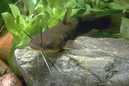
Yellow bullhead are ray-finned fish that lack scales. The dorsal part of the body can be yellow to olive, brown, mottled gray, or black. The belly is usually a yellow color. The caudal fin is rounded and unforked. Anal fin rays number 24 to 28; 25 to 26 is most common. Yellow bullhead may live to be 7 years old, and grow up to 45.7 to 48.3 centimeters long and weigh up to 3.2 kilograms.
Yellow bullhead are similar to black (Ameiurus melas) and brown (Ameiurus nebulosus) bullhead. They differ from these two species in that they have white or yellow chin barbels. Both black and brown bullhead have some dark pigmentation on the chin barbels. Fins and colorations are similar among the three species. ("Life History Notes: Bullhead", 2005; "Yellow Bullhead (Ameiurus natalis)", 2005; Eddy and Surber, 1943; Eddy and Underhill, 1974; Klossner, 2005; Trautman, 1981)
- Other Physical Features
- ectothermic
- heterothermic
- bilateral symmetry
- Sexual Dimorphism
- sexes alike
-
- Average mass
- 454 g
- 16.00 oz
-
- Average mass
- 1278 g
- 45.04 oz
- AnAge
-
- Range length
- 20.3 to 25.4 cm
- 7.99 to 10.00 in
Development
Yellow bullhead eggs hatch five to ten days after fertilization. The male yellow bullhead guards the nest during this period. Upon hatching, the young fry are herded into tight schools by the male and protected until they are approximately two inches long. Sexual maturity is reached between the ages of 2 and 3 years, when the fish are at least 140 mm in length. ("Life History Notes: Bullhead", 2005; "Yellow Bullhead (Ameiurus natalis)", 2005)
Reproduction
Yellow bullhead males dig nests, which may range from a shallow depression in muddy sediment to a deep burrow in the stream bank. Protected nest sites near rocks and stumps with dense vegetation are preferred. Nest sites attract females for mating. ("Ameiurus natalis (LeSueur)", 2005; Armstrong, 1962; Eddy and Surber, 1943; Etnier and Starnes, 1993; Hubbs and Lagler, 1958; Klossner, 2005)
- Mating System
- monogamous
Yellow bullhead spawn from April until June, beginning when water temperatures reach 23 to 28 degrees Celsius. The female produces 300 to 700 sticky yellowish eggs per spawning act, and the nest can contain 1700 to 4300 eggs in total. ("Ameiurus natalis (LeSueur)", 2005; Armstrong, 1962; Eddy and Surber, 1943; Etnier and Starnes, 1993; Hubbs and Lagler, 1958; Klossner, 2005)
- Key Reproductive Features
- iteroparous
- seasonal breeding
- gonochoric/gonochoristic/dioecious (sexes separate)
- sexual
- fertilization
- oviparous
-
- Breeding interval
- Yellow bullheads breed once yearly.
-
- Breeding season
- Yellow bullheads breed and spawn from April to July.
-
- Range number of offspring
- 1700 to 4300
-
- Average number of offspring
- 500
- AnAge
-
- Average time to hatching
- 5-7 days
-
- Average age at sexual or reproductive maturity (female)
- 2-3 years
-
- Average age at sexual or reproductive maturity (female)
Sex: female - 730 days
- AnAge
- Average age at sexual or reproductive maturity (female)
-
- Average age at sexual or reproductive maturity (male)
- 2-3 years
-
- Average age at sexual or reproductive maturity (male)
Sex: male - 730 days
- AnAge
- Average age at sexual or reproductive maturity (male)
Both the male and female help in the construction of the nest and while the young are in the nest one of the parents will guard them. After the fry hatch the male herds the young into a dense ball and will protect them until they grow to two inches long. ("Ameiurus natalis (LeSueur)", 2005)
- Parental Investment
-
pre-fertilization
- provisioning
-
protecting
- female
-
pre-hatching/birth
-
protecting
- male
-
protecting
-
pre-independence
-
protecting
- male
-
protecting
Lifespan/Longevity
Yellow bullheads have a 7 year life span in the wild. ("Ameiurus natalis (LeSueur)", 2005)
-
- Range lifespan
Status: wild - 7 (high) years
- Range lifespan
-
- Average lifespan
Status: wild - 4.0 years
- Max Planck Institute for Demographic Research
- Average lifespan
Behavior
Not much is known about the behavior of yellow bullheads. They are highly social and feed primarily at night. (Klossner, 2005)
- Key Behaviors
- natatorial
- nocturnal
- motile
- sedentary
- solitary
Home Range
At this time their is no information on home range in yellow bullheads.
Communication and Perception
Atema et al. (1969) and Todd (1971) have indicated that yellow bullheads are a very social fish and can recognize other individuals and their social status by their smell. The olfactory apparatus (i.e., nose) is responsible for this ability, while the barbels and other dermal taste buds are used for locating food (Etnier and Etnier, 2005).
Taste buds are found in the mouth and all over the body. Yellow bullheads have 5 taste buds every 5 mm² on their body surface. The barbels serve as both an external tongue and hands. Bullheads can feel with their body and their barbels. They also have 20,000 taste buds on the eight whiskers. The average adult has a total of over 200,000 taste buds on its body. (Atema, 1971; Etnier and Etnier, 2005)
Food Habits
Like all other catfish species, yellow bullheads are opportunistic feeders. Yellow bullheads feed at night. They have been known to eat minnows, crayfish, insects and insect larvae, aquatic invertebrates, and worms. Compared to the other two bullheads, the yellow bullheads consume more aquatic vegetation. The young will feed on aquatic invertebrates. (Eddy and Surber, 1943; Eddy and Underhill, 1974; Hubbs and Lagler, 1958; Trautman, 1981)
- Primary Diet
-
carnivore
- insectivore
- eats non-insect arthropods
- molluscivore
- Animal Foods
- fish
- carrion
- insects
- mollusks
- terrestrial worms
- aquatic crustaceans
- Plant Foods
- macroalgae
- Other Foods
- detritus
Predation
Yellow bullheads are preyed upon by larger fish such as largemouth bass (Micropterus salmoides), black crappie (Pomoxis nigromaculatus), bluegill (Lepomis macrochirus) and other catfish. Large wading birds and some turtles will also take the adults. The young will be taken by smaller predators, aquatic invertebrates, leeches, and crayfish. They can inflict venomous stings with their pectoral spines, helping them to avoid predation. ("Yellow Bullhead", 2005)
-
- Known Predators
-
- largemouth bass (Micropterus salmoides)
- black crappie (Pomoxis nigromaculatus)
- bluegill (Lepomis macrochirus)
- large wading birds (Aves)
- turtles (Testudines)
Ecosystem Roles
Yellow bullheads have been found to be a host species for creepers (Strophitus undulatus) and they are parasitized by leeches (Hirudinea). (Gray, et al., 2001)
- creepers (Strophitus undulatus)
- leeches (Hirudinea)
Economic Importance for Humans: Positive
Yellow bullheads are not considered to be a game fish, but they are widely sought after for food. Yellow bullheads also can be introduced into streams with high pollution because of their high tolerance to pollution. ("Life History Notes: Bullhead", 2005; Klossner, 2005)
- Positive Impacts
- food
Economic Importance for Humans: Negative
Bullheads are very well known for the ability to inflict a sting with their pectoral spines. The pain can last for a week or more. The sting is caused by small glands near their fins that produce a poison which causes the swelling. The pain can be dulled by dabbing ammonia on the wound. (Klossner, 2005)
- Negative Impacts
-
injures humans
- bites or stings
Conservation Status
Yellow bullheads are not known to have any specific conservation status.
-
- IUCN Red List
- Not Evaluated
-
- US Federal List
- No special status
-
- CITES
- No special status
-
- State of Michigan List
- No special status
Other Comments
(Ameiurus natalis) is translated in Latin meaning "primitive or curtailed" for Ameiurus, in reference to the notch in the distal end of the caudal fin, and natalis meaning "having large buttocks".
Other common names of yellow bullheads are polliwog, chucklehead cat, butter cat, yellow cat, creek cat, white-whiskered bullhead, and greaser. ("Yellow Bullhead (Ameiurus natalis)", 2005; "Yellow Bullhead", 2005)
Contributors
Tanya Dewey (editor), Animal Diversity Web.
Gabe Jenkins (author), Eastern Kentucky University, Sherry Harrel (editor, instructor), Eastern Kentucky University.
Glossary
- Nearctic
-
living in the Nearctic biogeographic province, the northern part of the New World. This includes Greenland, the Canadian Arctic islands, and all of the North American as far south as the highlands of central Mexico.

- benthic
-
Referring to an animal that lives on or near the bottom of a body of water. Also an aquatic biome consisting of the ocean bottom below the pelagic and coastal zones. Bottom habitats in the very deepest oceans (below 9000 m) are sometimes referred to as the abyssal zone. see also oceanic vent.
- bilateral symmetry
-
having body symmetry such that the animal can be divided in one plane into two mirror-image halves. Animals with bilateral symmetry have dorsal and ventral sides, as well as anterior and posterior ends. Synapomorphy of the Bilateria.
- carnivore
-
an animal that mainly eats meat
- carrion
-
flesh of dead animals.
- chemical
-
uses smells or other chemicals to communicate
- detritus
-
particles of organic material from dead and decomposing organisms. Detritus is the result of the activity of decomposers (organisms that decompose organic material).
- ectothermic
-
animals which must use heat acquired from the environment and behavioral adaptations to regulate body temperature
- external fertilization
-
fertilization takes place outside the female's body
- fertilization
-
union of egg and spermatozoan
- food
-
A substance that provides both nutrients and energy to a living thing.
- freshwater
-
mainly lives in water that is not salty.
- heterothermic
-
having a body temperature that fluctuates with that of the immediate environment; having no mechanism or a poorly developed mechanism for regulating internal body temperature.
- insectivore
-
An animal that eats mainly insects or spiders.
- iteroparous
-
offspring are produced in more than one group (litters, clutches, etc.) and across multiple seasons (or other periods hospitable to reproduction). Iteroparous animals must, by definition, survive over multiple seasons (or periodic condition changes).
- macroalgae
-
seaweed. Algae that are large and photosynthetic.
- molluscivore
-
eats mollusks, members of Phylum Mollusca
- monogamous
-
Having one mate at a time.
- motile
-
having the capacity to move from one place to another.
- natatorial
-
specialized for swimming
- native range
-
the area in which the animal is naturally found, the region in which it is endemic.
- nocturnal
-
active during the night
- oviparous
-
reproduction in which eggs are released by the female; development of offspring occurs outside the mother's body.
- seasonal breeding
-
breeding is confined to a particular season
- sedentary
-
remains in the same area
- sexual
-
reproduction that includes combining the genetic contribution of two individuals, a male and a female
- solitary
-
lives alone
- tactile
-
uses touch to communicate
- temperate
-
that region of the Earth between 23.5 degrees North and 60 degrees North (between the Tropic of Cancer and the Arctic Circle) and between 23.5 degrees South and 60 degrees South (between the Tropic of Capricorn and the Antarctic Circle).
- visual
-
uses sight to communicate
References
2005. "Ameiurus natalis (LeSueur)" (On-line). Kansas Fishes. Accessed October 15, 2005 at http://www.kansasfishes.com/Pages/yellowbullhead.htm.
2005. "Life History Notes: Bullhead" (On-line). Ohio Division of Wildlife. Accessed October 15, 2005 at http://www.dnr.state.oh.us/wildlife/Fishing/aquanotes-fishid/bullhead.htm.
2005. "Yellow Bullhead (Ameiurus natalis)" (On-line). Texas Parks and Wildlife Department. Accessed October 10, 2005 at http://www.tpwd.state.tx.us/huntwild/wild/species/ybh/.
"Yellow Bullhead" (On-line). Accessed October 31, 2005 at http://www.landbigfish.com/fish/fish.cfm?ID=21.
2005. "Yellow Bullhead" (On-line). Ohio Division of Natural Areas &Preserves. Accessed October 31, 2005 at http://www.fcps.k12.va.us/StratforkLandingES/Ecology.mpages.yellow_bullhead.htm.
Armstrong, P. 1962. Stages in the Development of Ictalurus nebulosus. Syracuse, New York: Syracuse Univeristy Press.
Atema, J. 1971. Structures and Functions of the Sense of Taste in the Catfish (Ictalurus natalis). Brain, Behavior and Evolution, 4: 273-294.
Atema, J., J. Todd, J. Bardach. 1969. Olfaction and taste: Proceedings of the third international symposium. New York, New York: Rockefeller Univ. Press.
Eddy, S., T. Surber. 1943. Northern Fishes. Minneapolis, Minnesota: University of Minnesota Press.
Eddy, S., J. Underhill. 1974. Northern Fishes, 3rd Ed.. Minneapolis, Minnesota: University of Minnesota Press.
Etnier, D., E. Etnier. 2005. "Yellow bullhead" (On-line). Discover Life in America. Accessed October 31, 2005 at http://www.dlia.org/atbi/species/animals/vertebrates/fish/Ictaluridae/A_natalis.shtml.
Etnier, D., W. Starnes. 1993. The Fishes of Tennesse. Knoxville, Tennesee: Univeristy of Tennesse Press.
Gray, E., W. Lellis, J. Cole, C. Johnson. 2001. Host Identification for Strophitus undulatus (Bivalvia: Unionidae), the Creeper, in the Upper Susquehanna River Basin, Pennsylvania. The American Midland Naturalist, Vol. 147, No. 1: 153-161. Accessed November 30, 2005 at http://www.bioone.org/bioone/?request=get-document&issn=0003-0031&volume=147&issue=01&page=0153.
Hubbs, C., K. Lagler. 1958. Fishes of the Great Lakes Region. Ann Arbor, Michigan: University of Michigan Press.
Klossner, M. 2005. "No Bull" (On-line). Wisconsin Department of Natural Resources. Accessed October 15, 2005 at http://www.wnrmag.com/stories/1998/oct98/bull.htm.
Trautman, M. 1981. The Fishes of Ohio. Columbus, Ohio: Ohio St. University Press.