Ambystoma texanumSmall-mouthed Salamander
Geographic Range
Small-mouthed salamanders occupy a range from northeastern Ohio west into Missouri and eastern Nebraska. The northern edge of the range is southeast Michigan and the southern range goes through western Kentucky and Tennessee to the Gulf of Mexico. They even inhabit several islands in southern Lake Erie. (Harding, 1997)
Habitat
Ambystoma texanum are most numerous in lowland floodplain woodlands. They can tolerate some human disturbances, such as habitat fragmentation and farming. They can even live in an open prairie as long as there are breeding ponds free of fish. Small-mouthed salamanders are more versatile in their breeding requirements than other Ambystoma. They can breed in woodland vernal ponds, runoff ponds, flooded areas, river backwaters, and roadside ditches. Ambystoma texanum does not travel far from breeding ponds, so good habitat near the pond is important. (Harding, 1997)
- Habitat Regions
- temperate
- terrestrial
- Terrestrial Biomes
- savanna or grassland
- forest
Physical Description
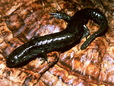
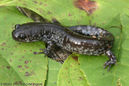
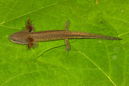
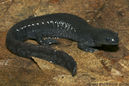
As its name suggests this species has a relatively small head with a blunt, short snout. The head tends to appear swollen behind the eyes and the lower jaw barely protrudes past the upper jaw. Coloration of the dorsum varies from pale gray to black. An irregular pattern of light blotches on the upper surface of specimen becoming darker on the sides and extending to the dark belly. During the breeding season small-mouthed salamanders may appear paler and have more conspicuous light markings. Adult length is normally between 11 and 17.8 cm (4.3 to 7 inches). Small-mouthed salamanders have 14 to 16 costal grooves. Males are smaller with longer and more compressed tails. Larvae usually have light bars or crossbands on an olive green or dark brown background. Near metamorphosis a dark pigment often obscures the light markings (Harding 1997). (Harding, 1997; Petranka, 1984)
- Other Physical Features
- ectothermic
- heterothermic
- bilateral symmetry
- Sexual Dimorphism
- sexes shaped differently
-
- Range length
- 11 to 17.8 cm
- 4.33 to 7.01 in
Development
Larvae metamorphose to terrestrial salamanders in two to three months. (Harding, 1997)
- Development - Life Cycle
- metamorphosis
Reproduction
Courtship consists of groups of males bumping and nudging the females and each other. Males will move away from the group and deposit spermatophores on the substrate or on a stick or leaf. Females then "collect" the spermatophores (Harding 1997). (Harding, 1997)
- Mating System
- polygynandrous (promiscuous)
Ambystoma texanum breeds very early in the year. The migration to breeding ponds seems to be stimulated by just a few days of rain in late winter, frequently while ice still covers portions of the ponds. They tend to stay closer to breeding ponds in summer and late winter than other salamander species. A sibling species, A. barbouri, has a different reproductive strategy. The two species were formerly considered two races of A. texanum but now are classified as different species. Ambystoma barbouri, the "stream form," breeds in ephemeral headwater regions in contrast to A. texanum, the "pond form," which breeds in ephemeral lenthic habitats, including road side ditches, flooded areas and small ponds (Maureer and Sih 1996). Breeding begins four to five weeks later for A. texanum, which is an explosive breeder (Petranka 1984). A single female can produce 300 to 700 eggs annually, which are deposited in small loose gelatinous masses of 3 to 30 eggs. The eggs hatch in 3 to 8 weeks. The young mature to breeding size usually in their second year (Harding 1997). Size at maturity is 60 to 70 mm length from their snout to their vent (Lanoo, 2006). (Harding, 1997; Lannoo, 2006; Petranka, 1984)
- Key Reproductive Features
- iteroparous
- seasonal breeding
- gonochoric/gonochoristic/dioecious (sexes separate)
- sexual
- fertilization
- oviparous
-
- Breeding interval
- Small-mouthed salamanders breed once each year.
-
- Breeding season
- Small-mouthed salamders breed in early spring.
-
- Range number of offspring
- 300 to 700
-
- Range time to hatching
- 3 to 8 weeks
-
- Average age at sexual or reproductive maturity (female)
- 2 years
-
- Average age at sexual or reproductive maturity (male)
- 2 years
Once a female deposits her eggs in the water, there is no further parental care.
- Parental Investment
- no parental involvement
-
pre-fertilization
- provisioning
-
protecting
- female
Lifespan/Longevity
The lifespan of small-mouthed salamanders is not known. (Lannoo, 2006)
-
- Average lifespan
Status: captivity - 5.3 years
- Max Planck Institute for Demographic Research
- Average lifespan
Behavior
Members of the family Ambystomatidae are commonly called the mole salamanders because of their secretive underground lifestyle (Indiviglio 1997). When not breeding, A. texanum individuals tend to be hidden under rotting logs, rocks or leaf litter. They also make use of burrows dug by other animals including crayfish and small mammal burrows. An evening rain occasionally provokes them to emerge above ground (Harding 1997).
- Key Behaviors
- motile
Food Habits
Adult small-mouth salamanders eat insects, other arthropods, slugs, worms, and sometimes aquatic crustaceans. Larvae are generalist predators (Maurer and Shi 1996). They eat small aquatic invertebrates including Daphnia, isopod hatchlings and even larvae of their own or another species of Ambystoma (Harding 1997). (Harding, 1997; Maurer and Sih, 1996)
- Primary Diet
-
carnivore
- insectivore
- molluscivore
- vermivore
- Animal Foods
- amphibians
- insects
- terrestrial non-insect arthropods
- mollusks
- terrestrial worms
- aquatic crustaceans
Predation
Small-mouthed salamanders have concentrations of granular glands on the top of the tail. Salamanders confronted by potential enemies raise and undulate the tail and curl the head underneath the tail. This behavior is most often used when attacked by a snake. Larvae are preyed on by dragonfly larvae and tiger salamander larvae. (Harding, 1997; Lannoo, 2006)
-
- Known Predators
-
- blue jays (Cyanocitta cristata)
- garter snakes (Thamnophis)
- water snakes (Nerodia)
- dragonfly larvae (Odonata)
- tiger salamander larvae (Ambystoma tigrinum)
Ecosystem Roles
Small-mouthed salamanders are predators of small invertebrates and are preyed on by small to medium-sized predators, such as snakes, birds, and other salamanders. They are important members of healthy woodland and grassland communities. Small-mouthed salamanders are parasitized by some protozoan and helminth species, and by a cyclophyllidean cestode (Cylindrotaenia americana). (Lannoo, 2006)
Economic Importance for Humans: Positive
Small-mouth salamanders eat slugs and worms and help keep pest species numbers down. In turn they are food for other animals.
- Positive Impacts
- controls pest population
Economic Importance for Humans: Negative
There are no negative impacts of small-mouthed salamanders on humans.
Conservation Status
Ambystoma texanum is common through much of its range. The success of small-mouthed salamanders is connected to their habitat tolerance. On the edges of their range, where numbers are low, management for this species would be beneficial--such as in Michigan, where it is listed as endangered. Management for A. texanum should be preservation of areas with known populations and maintenance of adjacent fish free ponds. (Harding, 1997)
-
- IUCN Red List
-
Least Concern
More information
-
- IUCN Red List
-
Least Concern
More information
-
- US Federal List
- No special status
-
- CITES
- No special status
-
- State of Michigan List
- Endangered
Other Comments
Ambystoma texanum hybridize with other Ambystoma species. Hybridization is most common in the areas south and west of Lake Erie. (Harding, 1997)
Contributors
Tanya Dewey (editor), Animal Diversity Web.
Kristi Roy (author), Michigan State University, James Harding (editor), Michigan State University.
Glossary
- Nearctic
-
living in the Nearctic biogeographic province, the northern part of the New World. This includes Greenland, the Canadian Arctic islands, and all of the North American as far south as the highlands of central Mexico.

- bilateral symmetry
-
having body symmetry such that the animal can be divided in one plane into two mirror-image halves. Animals with bilateral symmetry have dorsal and ventral sides, as well as anterior and posterior ends. Synapomorphy of the Bilateria.
- carnivore
-
an animal that mainly eats meat
- ectothermic
-
animals which must use heat acquired from the environment and behavioral adaptations to regulate body temperature
- fertilization
-
union of egg and spermatozoan
- forest
-
forest biomes are dominated by trees, otherwise forest biomes can vary widely in amount of precipitation and seasonality.
- heterothermic
-
having a body temperature that fluctuates with that of the immediate environment; having no mechanism or a poorly developed mechanism for regulating internal body temperature.
- insectivore
-
An animal that eats mainly insects or spiders.
- internal fertilization
-
fertilization takes place within the female's body
- iteroparous
-
offspring are produced in more than one group (litters, clutches, etc.) and across multiple seasons (or other periods hospitable to reproduction). Iteroparous animals must, by definition, survive over multiple seasons (or periodic condition changes).
- metamorphosis
-
A large change in the shape or structure of an animal that happens as the animal grows. In insects, "incomplete metamorphosis" is when young animals are similar to adults and change gradually into the adult form, and "complete metamorphosis" is when there is a profound change between larval and adult forms. Butterflies have complete metamorphosis, grasshoppers have incomplete metamorphosis.
- molluscivore
-
eats mollusks, members of Phylum Mollusca
- motile
-
having the capacity to move from one place to another.
- native range
-
the area in which the animal is naturally found, the region in which it is endemic.
- oviparous
-
reproduction in which eggs are released by the female; development of offspring occurs outside the mother's body.
- polygynandrous
-
the kind of polygamy in which a female pairs with several males, each of which also pairs with several different females.
- seasonal breeding
-
breeding is confined to a particular season
- sexual
-
reproduction that includes combining the genetic contribution of two individuals, a male and a female
- temperate
-
that region of the Earth between 23.5 degrees North and 60 degrees North (between the Tropic of Cancer and the Arctic Circle) and between 23.5 degrees South and 60 degrees South (between the Tropic of Capricorn and the Antarctic Circle).
- terrestrial
-
Living on the ground.
- tropical savanna and grassland
-
A terrestrial biome. Savannas are grasslands with scattered individual trees that do not form a closed canopy. Extensive savannas are found in parts of subtropical and tropical Africa and South America, and in Australia.
- savanna
-
A grassland with scattered trees or scattered clumps of trees, a type of community intermediate between grassland and forest. See also Tropical savanna and grassland biome.
- temperate grassland
-
A terrestrial biome found in temperate latitudes (>23.5° N or S latitude). Vegetation is made up mostly of grasses, the height and species diversity of which depend largely on the amount of moisture available. Fire and grazing are important in the long-term maintenance of grasslands.
References
Harding, J. 1997. Amphibians and Reptiles of the Great Lakes Region. Ann Arbor, MI: University of Michigan Press.
Lannoo, M. 2006. "Ambystoma texanum" (On-line). Amphibiaweb. Accessed November 02, 2006 at http://www.amphibiaweb.org/cgi-bin/amphib_query?query_src=aw_search_index&table=amphib&special=one_record&where-genus=Ambystoma&where-species=texanum.
Maurer, E., A. Sih. 1996. Ephemeral Habits and Variation in Behavior and Life History: Comparisons of Sibling Salamander Species. Oikos, 76: 337-349.
McWilliams, S., M. Bachmann. 1989. Predatory Behavior of Larval Small-Mouthed Salamanders. Herpetologica, 45(4): 459-467.
Petranka, J. 1984. Breeding Migrations, Breeding Season, Clutch Size, and Oviposition of Stream-Breeding Ambystoma texanum. Journal of Herpetology, 18(2): 106-112.