Alectoris chukarchukar(Also: Chukar partridge)


Geographic Range
Fourteen subspecies of Alectoris chukar are currently recognized. Populations in North America are thought to derive from an Indian subspecies, A. c. chukar, though several subspecies have probably intermixed. The native distribution ranges across mountainous areas of the Middle East and Asia from eastern Greece and southeastern Bulgaria through Asia Minor east to Manchuria China. The chukar has been successfully introduced to North America, Hawaii and New Zealand as a game species. In North America, successful populations have established themselves in mountainous, rocky, arid areas throughout the western states and the current distribution is centered around the Great Basin area, including Nevada, western Utah, southwestern Idaho, northeastern California, and southeastern Oregon. In the east, game farm birds are released for hunting, but successful populations have not established themselves (Christensen 1996; Del Hoyo 1994).
- Biogeographic Regions
- nearctic
- palearctic
- australian
- oceanic islands
Habitat
Alectoris chukar can be found in North America throughout the west in steep, mountainous, rocky locations in mixed habitat types. The Great Basin area of desert shrub is representative of their preferred habitat; climate is arid to semiarid, water is generally available from scattered sources, and temperature varies. The grazed and disturbed public lands provide plentiful grasses and seeds with scattered shrubs while the rocky terrain provides cover. In North America, such areas are generally inaccessible and not near cultivated land, though they will use such areas when available. Unsuccessful attempts to introduce the chukar into other areas of North America suggest that they are already established in most suitable habitat types (Christensen 1996).
Physical Description
Alectoris chukar is a medium-sized partridge. Males (510-800g) are slightly larger than females (450-680g) in length and mass. Plumage pattern is similar for both sexes and distinctive among game birds of North America. Chukars are gray-brown above with a buff belly. A dark black line across the forehead, eyes, and down the neck contrasts the white throat from the gray head and breast. Flanks are prominently barred black and white-chestnut and the outer tail feathers are chestnut. Bill, margins of eyelids, legs and feet are corral pink to deep red or crimson. Both sexes can have a small tarsal spur, but usually this is characteristic of males. Juveniles are smaller and are mottled brown and gray, with only slight brown barring on flanks. In its native habitat, coloring can vary geographically; birds in more arid areas tend to be grayer and paler (Christensen 1996; Del Hoyo 1994; National Geographic Society 1999).
- Other Physical Features
- endothermic
- bilateral symmetry
-
- Range mass
- 510 to 680 g
- 17.97 to 23.96 oz
Reproduction
Chukars are monogamous. Pairs form in mid-March after a male performs a courtship display involving a head-tilt and a showing of his barred flanks. Both begin to call and participate in a "tidbitting display" pecking at various objects. During drought seasons, when food is scarce, breeding may be restricted to a few birds. Males guard the female from access by other males(Christensen 1996; Del Hoyo 1994).
- Mating System
- monogamous
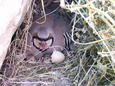
Nests are simple scrapes, sometimes lined with grass or feathers, in rocky or brushy areas. They are difficult to find and are not well studied. Clutch sizes vary with site and environmental condition between seven and twenty one. Incubation lasts approximately 24 days and is usually a female activity. Hatching can occur from May until August, depending on the success of the first clutch. Broods average around 10.5 chicks, but fluctuate. Young are precocial, or highly developed upon hatching, and are capable of flight within a few weeks. They reach adult size in 12 weeks. Males are thought to remain until chicks are reared, though some are reported to leave after clutch completion and regroup with other males. Much remains to be learned about the reproductive habits of the chukar. (Christensen, 1996; Del Hoyo, et al., 1994)
- Key Reproductive Features
- iteroparous
- seasonal breeding
- gonochoric/gonochoristic/dioecious (sexes separate)
- sexual
- fertilization
- oviparous
-
- Breeding interval
- Chukars breed once yearly depending on environmental conditions.
-
- Breeding season
- Breeding occurs from April to July in North America.
-
- Range eggs per season
- 7 to 21
-
- Average eggs per season
- 10.5
-
- Average time to hatching
- 24 days
Young are cared for by their mother and perhaps father until they reach independence. Young are precocial, they fly within a few weeks of hatching and reach adult size by 12 weeks old. (Christensen, 1996; Del Hoyo, et al., 1994)
- Parental Investment
- no parental involvement
- precocial
-
pre-fertilization
-
protecting
- female
-
protecting
-
pre-hatching/birth
-
provisioning
- female
-
protecting
- female
-
provisioning
-
pre-weaning/fledging
-
protecting
- female
-
protecting
-
pre-independence
-
provisioning
- female
-
provisioning
Behavior
Chukars are diurnal and forage on the ground throughout the morning and afternoon. They do not migrate and any seasonal movements are altitudinal. Flight is generally restricted to short distances downhill, usually when flushed. They hop when crossing rough terrain and prefer running to flight. The primary social group is a covey, consisting of varying numbers of adults and their offspring, and the largest groups are found at water sources. Larger unrelated groups form in the winter. Chukars roost on the ground under brush or outcrops. Males actively defend their nesting territories (Christensen 1996; Del Hoyo 1994). (Christensen, 1996; Del Hoyo, et al., 1994)
- Key Behaviors
- terricolous
- flies
- diurnal
- motile
- sedentary
- territorial
- social
Communication and Perception
Chukars use a number or vocalizations in interactions that are divided into three categories: alarm social contact, agonistic, and sexual. The most common call is a low chuck, chuck, chuck used by both sexes that changes gradually to a chukar chukar and can be heard from long distances, hence the name chukar. Communication presumably also occurs through visual cues. (Christensen, 1996; Del Hoyo, et al., 1994)
- Other Communication Modes
- duets
Food Habits
Chukars are generally opportunistic and forage on vegetation, including grass and forb seeds, green grass, forb leaves, and some shrub fruits, according to relative abundance and seasonal availability. On western rangelands, primary foods are seeds and foliage of introduced grasses and various forbs in the sagebrush community. Cultivated grains are used when available, but chukar habitat in North America is generally not near agricultural land. In Hawaii, different foods are available, but native shrub fruits and introduced herbaceous plants are still important. Young chicks primarily eat insects. Adults do not eat a significant number of insects, but are known to take locusts when available. All types of water sources are utilized by chukars and tend to dictate distribution during the hot summer months; they will stray farther from water in the winter when green vegetation is available (Christensen 1996; Del Hoyo 1994; Cole et al. 1995). (Christensen, 1996; Cole, et al., 1995; Del Hoyo, et al., 1994)
- Animal Foods
- insects
- Plant Foods
- leaves
- seeds, grains, and nuts
- fruit
Economic Importance for Humans: Positive
Alectoris chukar was first introduced to North America in 1893 as a game species and provides revenue to state wildlife agencies through hunting. The difficult, steep, often remote terrain they occupy provides a challenge and thrill to hunters and the meat is considered very tasty. In Hawaii, chukars have been found to occupy an important niche once occupied by now extinct native birds; they aid in the dispersal and germination of seeds from important native plants and thus may be beneficial in restoring degraded ecosystems (Christensen 1996; Cole et al. 1995).
Economic Importance for Humans: Negative
Chukars also aid in the dispersal and germination of invasive non-natives, such as cheat grass in North America. Also, they are susceptible to several avian diseases and might act as a vector for infections that can be passed from avian hosts to humans, such as Chlamydia, when raised in game-farming situations (Christensen 1996; Erbeck and Nunn 1999).
Conservation Status
Alectoris chukar are not globally threatened. In most areas, populations are stable or increasing, though habitat loss and intensive hunting may affect some local populations in their native distribution. There may be some concern for wild populations due to the possibility of disease transmission from domestic chickens and turkeys. In North America, they have been managed for hunting since their introduction. In most areas, states try to increase hunting through liberal bag-limits and long hunting seasons to overcome low yields due to the inaccessible and remote nature of their habitat. Habitat management includes developing and improving water sources. Monitoring populations through different methods of collaring and radio-transmitters has been explored (Christensen 1996; Del Hoyo 1994; Waters et al. 1994).
-
- IUCN Red List
-
Least Concern
More information
-
- IUCN Red List
-
Least Concern
More information
-
- US Federal List
- No special status
-
- CITES
- No special status
Other Comments
Much research still needs to be done to determine the habits and needs of Alectoris chukar. Information is somewhat limited in many areas of their natural history. In addition, research can be done to determine the current relatedness of North American chukars to the original old world subspecies (Christensen1996).
Contributors
Lara Peterson (author), University of Michigan-Ann Arbor, Terry Root (editor), University of Michigan-Ann Arbor.
Glossary
- Australian
-
Living in Australia, New Zealand, Tasmania, New Guinea and associated islands.

- Nearctic
-
living in the Nearctic biogeographic province, the northern part of the New World. This includes Greenland, the Canadian Arctic islands, and all of the North American as far south as the highlands of central Mexico.
- Palearctic
-
living in the northern part of the Old World. In otherwords, Europe and Asia and northern Africa.
- acoustic
-
uses sound to communicate
- bilateral symmetry
-
having body symmetry such that the animal can be divided in one plane into two mirror-image halves. Animals with bilateral symmetry have dorsal and ventral sides, as well as anterior and posterior ends. Synapomorphy of the Bilateria.
- chemical
-
uses smells or other chemicals to communicate
- diurnal
-
- active during the day, 2. lasting for one day.
- duets
-
to jointly display, usually with sounds in a highly coordinated fashion, at the same time as one other individual of the same species, often a mate
- endothermic
-
animals that use metabolically generated heat to regulate body temperature independently of ambient temperature. Endothermy is a synapomorphy of the Mammalia, although it may have arisen in a (now extinct) synapsid ancestor; the fossil record does not distinguish these possibilities. Convergent in birds.
- fertilization
-
union of egg and spermatozoan
- granivore
-
an animal that mainly eats seeds
- herbivore
-
An animal that eats mainly plants or parts of plants.
- internal fertilization
-
fertilization takes place within the female's body
- introduced
-
referring to animal species that have been transported to and established populations in regions outside of their natural range, usually through human action.
- iteroparous
-
offspring are produced in more than one group (litters, clutches, etc.) and across multiple seasons (or other periods hospitable to reproduction). Iteroparous animals must, by definition, survive over multiple seasons (or periodic condition changes).
- monogamous
-
Having one mate at a time.
- motile
-
having the capacity to move from one place to another.
- native range
-
the area in which the animal is naturally found, the region in which it is endemic.
- oceanic islands
-
islands that are not part of continental shelf areas, they are not, and have never been, connected to a continental land mass, most typically these are volcanic islands.
- oviparous
-
reproduction in which eggs are released by the female; development of offspring occurs outside the mother's body.
- seasonal breeding
-
breeding is confined to a particular season
- sedentary
-
remains in the same area
- sexual
-
reproduction that includes combining the genetic contribution of two individuals, a male and a female
- social
-
associates with others of its species; forms social groups.
- tactile
-
uses touch to communicate
- territorial
-
defends an area within the home range, occupied by a single animals or group of animals of the same species and held through overt defense, display, or advertisement
- visual
-
uses sight to communicate
- young precocial
-
young are relatively well-developed when born
References
Christensen, C. 1996. Chukar: Alectoris chukar.. Pp. 1-20 in A Poole, F Gill, eds. The Birds of Noth America (0):258. Philedelphia, PA: The Academy of Natural Sciences of Philedelphia.
Cole, F., L. Loope, A. Medeiros, J. Raikes, C. Wood. 1995. Conservation implications of introduced game birds in high elevation Hawaiian shrubland. Conservation Biology, 9: 306-313.
Del Hoyo, J., A. Elliot, J. Sargatal. 1994. Alectoris Chukar. Pp. 485-486 in Handbook of the birds of the world, vol. 2: New world vultures to guinea fowl. Barcelona: Lynx Edicons.
Erbeck, D., S. Nunn. 1999. Chlamydiosis in pen-raised bobwhite quail (Colinus virginianus) and chukar partridge (Alectoris chukar) with high mortality. Avian Diseases, 43: 798-803.
National Geographic Society, 1999. Field guide to North American birds, 3rd ed.. Washington, D.C.: National Geographic Society.