Alces americanusmoose(Also: American moose)



Geographic Range
Moose are found throughout northern North America. Their range coincides with that of circumpolar boreal forests. They occur throughout Alaska, Canada, the northeastern United States and as far south as the Rocky Mountains in Colorado. They are generally found near streams or ponds where there are willows. (Wilson and Ruff, 1999)
Habitat
Moose generally live in forested areas where there is snow cover in the winter, and prefer moist conditions where there are lakes, ponds, and swamps. They are found in areas with snow cover up to 60 to 70 cm in depth during the winter, although deep, crusted snow makes them vulnerable to predation by wolves. Moose are limited to cool regions because of their large bodies, inability to sweat, and the heat produced by fermentation in their gut. They cannot tolerate temperatures that exceed 27 degrees Celsius for long. In summer moose seek shade and cool themselves in ponds and streams. (Wilson and Ruff, 1999)
- Habitat Regions
- temperate
- terrestrial
Physical Description
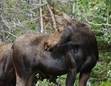
Moose are the largest members of the deer family and one of the largest land mammals in North America. Adults may stand as tall as 2.3 m high. Males are larger than females and possess elaborate, widened antlers that can measure up to 2 meters in total width, from tip to tip. These are the largest antlers carried by any mammal, worldwide. They are shed and re-grown annually. Males range from 2.5 to 3.2 meters in total length, females from 2.4 to 3.1 meters. Males weigh from 360 to 600 kg and females from 270 to 400 kg. Moose have thick, brown fur that ranges from light to almost black in color. Individual hairs are 15 to 25 cm long and hollow, resulting in excellent insulation. Moose are also distinguished by their long head with a long, flexible nose and upper lip. Moose have very long legs and a dewlap of skin on the throat. (Wilson and Ruff, 1999)
- Other Physical Features
- endothermic
- homoiothermic
- bilateral symmetry
- Sexual Dimorphism
- male larger
- ornamentation
-
- Range mass
- 270 to 600 kg
- 594.71 to 1321.59 lb
-
- Range length
- 2.4 to 3.2 m
- 7.87 to 10.50 ft
Reproduction
Females attract males with their long, moaning vocalizations, which can be heard up to 3.2 km away. They also emit a powerful scent. Rival males compete for access to females during the breeding season. Males may simply assess which is larger, and the smaller bull retreats, or they may engage in battles that can become violent. (Franzmann, 1981)
- Mating System
- polygynous
Mating takes place in September and October. There is an eight month gestation period. Females give birth synchronously during late May and early June. Females generally produce single young, although twins are common. Young lack the spots that are characteristic of most offspring in cervids. Males and females are sexually mature at two years of age but full growth potential isn't reached until 4 or 5 years of age. At that age females are at their reproductive peak and males have the largest antlers. (Franzmann, 1981; Wilson and Ruff, 1999)
- Key Reproductive Features
- iteroparous
- seasonal breeding
- gonochoric/gonochoristic/dioecious (sexes separate)
- sexual
- fertilization
- viviparous
-
- Breeding interval
- Moose breed once yearly.
-
- Breeding season
- Breeding occurs in September and October.
-
- Range number of offspring
- 1 to 2
-
- Average number of offspring
- 1
-
- Average gestation period
- 8 months
-
- Average time to independence
- 12 months
-
- Average age at sexual or reproductive maturity (female)
- 2 years
-
- Average age at sexual or reproductive maturity (male)
- 2 years
Young moose weigh 11 to 16 kg at birth and gain about 1 kg per day while they a re nursing. They can browse and follow their mother at 3 weeks of age and are completely weaned at five months. They stay with their mother for at least a year after birth, until the next young are born. (Franzmann, 1981; Wilson and Ruff, 1999)
- Parental Investment
- precocial
- female parental care
Lifespan/Longevity
Up to half of all moose die within their first year of life. Adult moose are in their prime from 5 to 12 years of age but begin to suffer from arthritis, dental diseases and wear, and other factors after about 8 years. Male moose also suffer as a result of male-male aggression associated with mating. Few bull moose survive longer than 15 years in the wild and the oldest recorded cow moose was 22 years old. (Wilson and Ruff, 1999)
-
- Range lifespan
Status: wild - 22 (high) years
- Range lifespan
-
- Average lifespan
Status: wild - 8 to 12 years
- Average lifespan
Behavior
Moose are active throughout the day with activity peaks during dawn and dusk. Moose are good swimmers, able to sustain a speed of 6 miles an hour. They move swiftly on land. Adults can run as fast as 56km/h (about 35 miles per hour). Moose mainly stay in the same general area, though some populations migrate between sites favorable at different times of the year. These migrations can exceed 300km in European populations.
Moose are solitary animals, although two individuals sometimes can be found feeding along the same stream. The strongest social bond is between the mother and the calf. Mothers are very protective of their calves, frequently charging people if they get too close and using their sharp hooves to strike at attackers. Moose gather in larger groups during the mating season in alpine and tundra habitats. (Wilson and Ruff, 1999)
- Key Behaviors
- terricolous
- natatorial
- diurnal
- crepuscular
- motile
- migratory
- sedentary
- solitary
Home Range
Moose home ranges average 5 to 10 square kilometers. (Wilson and Ruff, 1999)
Communication and Perception
Moose have poor sight but their hearing and sense of smell are excellent. Their large ears can be rotated 180 degrees and their keen noses find food below deep snow. Their vision seems to serve them best to detect moving objects.
Food Habits
Moose eat twigs, bark, roots and the shoots of woody plants, especially willows and aspens. In the warm months, moose feed on water plants, water lilies, pondweed, horsetails, bladderworts, and bur-reed. In winter, they browse on conifers, such as balsam fir, and eat their needle-like leaves. They require 20 kg of food per day. Their stomachs, when full, can weigh up to 65 kg. Most of a moose's time is spent eating.
- Plant Foods
- leaves
- roots and tubers
- wood, bark, or stems
Predation
Because of their large size moose are not highly susceptible to predation as healthy adults. Most moose are preyed on as calves or when they are ill or elderly. Up to half of all calves fall to predators during their first year. Average annual adult mortality is 10 to 15%. Primary predators are large carnivores such as humans, wolves, grizzly bears, and black bears. Moose are also able to aggressively defend themselves and their young with their robust antlers and sharp hooves. (Wilson and Ruff, 1999)
-
- Known Predators
-
- gray wolves (Canis lupus)
- brown bears (Ursus arctos)
- black bears (Ursus americanus)
- humans (Homo sapiens)
Ecosystem Roles
Moose have dramatic effects on the composition of plant communities through their browsing.
Moose are affected by several diseases and parasites. "Moose disease", fatal to moose, is caused by a brainworm which most commonly infects white-tailed deer. Moose can become severely infested with winter ticks and death can sometimes result in winter as a result of blood loss and nutritional stress. (Wilson and Ruff, 1999)
Economic Importance for Humans: Positive
Moose are hunted for meat and for sport and are the focus of some ecotourism activities.
- Positive Impacts
- food
- ecotourism
Economic Importance for Humans: Negative
Moose may inhibit reforestation efforts of pine and spruce forests, and therefore may have a negative impact on the timber industry. The cost in human injuries and property damage of moose impacts with cars is quite high in some areas.
Conservation Status
In some areas, moose populations have been greatly reduced by human hunting and habitat destruction. However, in the eastern United States moose populations have been expanding in recent years and moose populations introduced in Michigan and Colorado are doing well. Moose are commonly involved in car accidents and often wander into residential areas in their search for food. Moose are not listed as threatened or endangered on the national or global levels, but they are a species of special concern in Michigan. (Wilson and Ruff, 1999)
-
- IUCN Red List
- No special status
-
- US Federal List
- No special status
-
- CITES
- No special status
-
- State of Michigan List
- Special Concern
Contributors
Tanya Dewey (author, editor), Animal Diversity Web.
Anne Bartalucci (author), University of Michigan-Ann Arbor, Bret Weinstein (author), University of Michigan-Ann Arbor.
Glossary
- Nearctic
-
living in the Nearctic biogeographic province, the northern part of the New World. This includes Greenland, the Canadian Arctic islands, and all of the North American as far south as the highlands of central Mexico.

- acoustic
-
uses sound to communicate
- bilateral symmetry
-
having body symmetry such that the animal can be divided in one plane into two mirror-image halves. Animals with bilateral symmetry have dorsal and ventral sides, as well as anterior and posterior ends. Synapomorphy of the Bilateria.
- bog
-
a wetland area rich in accumulated plant material and with acidic soils surrounding a body of open water. Bogs have a flora dominated by sedges, heaths, and sphagnum.
- chemical
-
uses smells or other chemicals to communicate
- crepuscular
-
active at dawn and dusk
- diurnal
-
- active during the day, 2. lasting for one day.
- ecotourism
-
humans benefit economically by promoting tourism that focuses on the appreciation of natural areas or animals. Ecotourism implies that there are existing programs that profit from the appreciation of natural areas or animals.
- endothermic
-
animals that use metabolically generated heat to regulate body temperature independently of ambient temperature. Endothermy is a synapomorphy of the Mammalia, although it may have arisen in a (now extinct) synapsid ancestor; the fossil record does not distinguish these possibilities. Convergent in birds.
- female parental care
-
parental care is carried out by females
- fertilization
-
union of egg and spermatozoan
- folivore
-
an animal that mainly eats leaves.
- food
-
A substance that provides both nutrients and energy to a living thing.
- forest
-
forest biomes are dominated by trees, otherwise forest biomes can vary widely in amount of precipitation and seasonality.
- herbivore
-
An animal that eats mainly plants or parts of plants.
- internal fertilization
-
fertilization takes place within the female's body
- iteroparous
-
offspring are produced in more than one group (litters, clutches, etc.) and across multiple seasons (or other periods hospitable to reproduction). Iteroparous animals must, by definition, survive over multiple seasons (or periodic condition changes).
- marsh
-
marshes are wetland areas often dominated by grasses and reeds.
- migratory
-
makes seasonal movements between breeding and wintering grounds
- motile
-
having the capacity to move from one place to another.
- natatorial
-
specialized for swimming
- native range
-
the area in which the animal is naturally found, the region in which it is endemic.
- polygynous
-
having more than one female as a mate at one time
- seasonal breeding
-
breeding is confined to a particular season
- sedentary
-
remains in the same area
- sexual
-
reproduction that includes combining the genetic contribution of two individuals, a male and a female
- sexual ornamentation
-
one of the sexes (usually males) has special physical structures used in courting the other sex or fighting the same sex. For example: antlers, elongated tails, special spurs.
- solitary
-
lives alone
- swamp
-
a wetland area that may be permanently or intermittently covered in water, often dominated by woody vegetation.
- tactile
-
uses touch to communicate
- taiga
-
Coniferous or boreal forest, located in a band across northern North America, Europe, and Asia. This terrestrial biome also occurs at high elevations. Long, cold winters and short, wet summers. Few species of trees are present; these are primarily conifers that grow in dense stands with little undergrowth. Some deciduous trees also may be present.
- temperate
-
that region of the Earth between 23.5 degrees North and 60 degrees North (between the Tropic of Cancer and the Arctic Circle) and between 23.5 degrees South and 60 degrees South (between the Tropic of Capricorn and the Antarctic Circle).
- terrestrial
-
Living on the ground.
- visual
-
uses sight to communicate
- viviparous
-
reproduction in which fertilization and development take place within the female body and the developing embryo derives nourishment from the female.
- young precocial
-
young are relatively well-developed when born
References
Gelder, Richard. 1928. Mammals of the National Parks. Johns Hopkins University Press, Baltimore.
Stidworthy, John. 1988. The Large Plant-Eaters. Equinox Limited, Oxford.
Walker's Mammals of the World, fifth edition; Nowak, R. ed.; 1991; Johns Hopkins University Press.
Franzmann, A. 1981. Moose (Alces alces). Mammalian Species, 154: 1-7.
Wilson, D., S. Ruff. 1999. The Smithsonian Book of North American Mammals. Washington: Smithsonian Institution Press.