Alca tordarazorbill
Geographic Range
The Razorbills are found in boreal and sub-Arctic waters of the Atlantic. Razorbills are exclusively an Atlantic species, with no counterpart in the North Pacific. It breeds between 73 degree north and 43 degree north from Hudson Strait and west Greenland south to the Gulf of Maine, and from Iceland Jan Mayen, Bjornoya and northwest Russia (White Sea), south to Brittany and the Baltic Sea. During the winter they are mostly offshore in northern boreal water south to Long Island, Azores and western Mediterranean. Their breeding colonies can be found on sea cliffs of Canada, Maine, Greenland, Iceland, Jan Mayen, Faeroe Island, Britain, Ireland, Brittany, France, Helgland, Germany, Denmark, Sweden, Finland, Norway, Bjornoya, Kola Peninsula and White Sea. (Nettleship & Birkhead, 1985)
- Biogeographic Regions
- arctic ocean
- atlantic ocean
Habitat
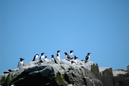
Razorbill colonies occur on cliffs and offshore islands. They breed colonially in rocky, coastal regions on mainland cliffs and on offshore islands. In most areas breeding locations are situated in boulder screens or on cliff-faces in rock crevices or on ledges. Because the chicks cannot fly when they leave the colony, the breeding site must give immediate access to the sea. They feed in continental shelf waters, and usually feed rather close to shore than Common Murres (Uria aalge). Sometimes, Razorbills scatter among the Murres. (Gaston & Jone, 1998)
- Habitat Regions
- saltwater or marine
- Aquatic Biomes
- coastal
Physical Description
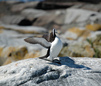
Razorbills are heavy-billed auks with an unusually long, rather graduated tail. During summer the head and the throat of adult Razorbills are black and dark chocolate brown. The under parts, including the under wing coverts, are white. There is a narrow white line extending forward from the eyes to the top of the bill. The gape is bright yellow and its iris is dark brown. Their legs and feet are black.
During winter the adult Razorbills are in their breeding plumage, but their throat, sides of neck, and face behind the eye are white. The vertical white line on the head and bill is less prominent.
The average weight for female Razorbills ranged from 505g to 730g. For males the weight ranged from 530g-720g. Average wing length for females ranged from 183mm-210mm. For males the wing length ranged from 182mm-206mm. (Wagner, 1999)
- Other Physical Features
- endothermic
- bilateral symmetry
-
- Range mass
- 505 to 730 g
- 17.80 to 25.73 oz
-
- Range wingspan
- 182 to 210 mm
- 7.17 to 8.27 in
Development
Razorbill chicks hatch at a weight of about 60g, and weight is directly correlated with egg size. They spend about 18 days at the breeding site. Chicks leave the colony around 18-23 days after hatching. By that time they are only partly grown and still flightless. They weigh between 140g and 180g when they leave the colony. (Wagner, 1999)
Reproduction
Egg-laying for Razorbills start in the first week of May and laying continues until the first week of June. At higher latitudes, or where water temperatures are lower, laying is later. A female Razorbill can produce only one egg each season. Most breeding sites are enclosed or partially enclosed to protect the egg from predators. The single egg is usually laid directly on bare rock, but some parents would collect small stones, dried dropping, lichen or other bits of vegetation from the immediate surrounding area and place them where the egg will be laid. (Nettleship & Birkhead, 1985)
Before laying their eggs, at least half of the females leave their mates and sneak off to another ledge to copulate with other males. Then they come back and copulate with their mates on an average of 80 times in the 30 days before the laying of the first egg. Later, while their mates are safely occupied incubating their eggs, the females slip away again to the neighboring ledge for more copulation. The couplings are like auditions to see who is better and are probably important in pair formation. (Carely, 1993)
- Key Reproductive Features
- iteroparous
- seasonal breeding
- gonochoric/gonochoristic/dioecious (sexes separate)
- sexual
- oviparous
-
- Range eggs per season
- 1 (high)
-
- Average eggs per season
- 1
-
- Average eggs per season
- 1
- AnAge
-
- Average time to hatching
- 36 days
- AnAge
Incubation for some happens immediately after laying. Parents exchange incubation duty several times a day. After the chick hatched the parents would feed the chick with fish up to 20 fish at a time, but they usually bring one to six fish at a meal. (Nettleship & Birkhead, 1985)
- Parental Investment
- male parental care
- female parental care
Lifespan/Longevity
-
- Range lifespan
Status: wild - 29.4 (high) years
- Range lifespan
-
- Average lifespan
Status: wild - 88 months
- Bird Banding Laboratory
- Average lifespan
Behavior
Razorbills are expert divers using their wings to swim underwater. The majority of dives consist of V-shaped dives in which Razorbills descend to a maximum depth and then start ascending. Most dives comprise of nonstop downward and upward movements to depths rarely greater than 35m, and never exceeding 43m. Average dive duration of birds feeding off the Isle of May, Scotland, was 35sec, implying, even at an underwater speed of 1.5m/sec, a mean maximum feeding depth of about 25m.
On the water and in flight Razorbills appears to be more agile than other auks. On land they usually squat on the tarsi and shuffle about, while maintaining a somewhat horizontal posture.
For Razorbill allopreening, mutual preening between pairs is common. It is a widespread ritualized form of agonistic behavior. It is usually directed at head, and neck and bout. Sometimes it may last for up to 6-7 minute. Several related behaviors involve signaling with the bill: bill clicking, in which mandible are clicked together while shaking head slowly from side to side; bill vibrating, where head is thrown back and lower mandible vibrates. (Gaston & Jones, 1998)
Communication and Perception
Food Habits
In general, adult Razorbills mainly feed on mid-water schooling fish: capelin, sandlance (Ammodytes), herrings (Clupea harengus), sprats (Sprattus sprattus), and juvenile cod. However, the species of the fish vary regionally. Adult Razorbills wintering off Newfoundland feed mainly on crustaceans. In Labrador the diet of adult Razorbills early in the season is largely capelin, but after the chicks hatch the adult take only some capelin but large numbers of small Myxocephalus sculpins and euphausiids. (Nettleship & Birkhead, 1985)
For the chicks, the parents usually bring one to six fish at a meal. Only occasionally do they bring up to 20 fish. Yet, the number of fish brought in a meal decreases as their size increases. The parents hold the fish crosswise in the bill to feed the chicks. Average length of fish brought to chicks varies in different regions. Sandlances that were brought to chicks in Irish Sea colonies were 53-79mm, yet, in Labrador they were 137mm. The diet of young Razorbills after they leave the colony is not known. (Nettleship & Birkhead, 1985)
Predation
Most auk chicks are vulnerable to predation from gulls during fledging. Razorbill chicks fledging asynchronously, either fairly early in the morning or late in the evening, are not protected. Therefore, they were more likely to be killed by gulls than those fledging synchronously. In other words, Razorbill chicks fledging not at the same time/rate are easier prey for gulls. (Nettleship & Birkhead, 1985)
Razorbills provide relatively large nutritious eggs, high in fat, having larger yolks than those of most terrestrial birds, as a result, they are easily targeted by red fox, raven and other predators. (Gaston & Jones, 1998)
Ecosystem Roles
Razorbills are carnivores (eating vertebrates) that are also eaten by other carnivores.
Economic Importance for Humans: Positive
Ornithologists are studying the sexual behaviors among razorbills. They are/very likely to use Razorbill as a model to study avian mating behavior. (Carey, 1993)
- Positive Impacts
- research and education
Conservation Status
After declining in the Gulf of St Lawrence during the 1970s, the species increased in the 1980s and is probably now as abundant as it has been in this century. The population of Britain and Ireland increased from 1970-1985, yet, the extent of increase is not known. (Gaston & Jones, 1998)
-
- IUCN Red List
-
Least Concern
More information
-
- IUCN Red List
-
Least Concern
More information
-
- US Migratory Bird Act
- No special status
-
- US Federal List
- No special status
-
- CITES
- No special status
Other Comments
In 1997 there were experiments about whether egg size has the same effect on wing-feather growth in the Razorbill as in other birds. During the experiment eggs were switched randomly among pairs. The experimental study reported that chicks that hatched from large eggs grew their wing feathers more quickly than did small-egg chicks. The wings of large-egg chicks began fast, linear growth sooner, indicating that early development of wing feathers was by far superior in large-egg chicks. Differences in wing length established in this manner persisted through the nestling period. (Hipfner, 2000)
Contributors
Joyce Lin (author), University of Michigan-Ann Arbor, Phil Myers (editor), Museum of Zoology, University of Michigan-Ann Arbor.
Glossary
- Arctic Ocean
-
the body of water between Europe, Asia, and North America which occurs mostly north of the Arctic circle.
- Atlantic Ocean
-
the body of water between Africa, Europe, the southern ocean (above 60 degrees south latitude), and the western hemisphere. It is the second largest ocean in the world after the Pacific Ocean.

- acoustic
-
uses sound to communicate
- bilateral symmetry
-
having body symmetry such that the animal can be divided in one plane into two mirror-image halves. Animals with bilateral symmetry have dorsal and ventral sides, as well as anterior and posterior ends. Synapomorphy of the Bilateria.
- carnivore
-
an animal that mainly eats meat
- chemical
-
uses smells or other chemicals to communicate
- coastal
-
the nearshore aquatic habitats near a coast, or shoreline.
- colonial
-
used loosely to describe any group of organisms living together or in close proximity to each other - for example nesting shorebirds that live in large colonies. More specifically refers to a group of organisms in which members act as specialized subunits (a continuous, modular society) - as in clonal organisms.
- endothermic
-
animals that use metabolically generated heat to regulate body temperature independently of ambient temperature. Endothermy is a synapomorphy of the Mammalia, although it may have arisen in a (now extinct) synapsid ancestor; the fossil record does not distinguish these possibilities. Convergent in birds.
- female parental care
-
parental care is carried out by females
- iteroparous
-
offspring are produced in more than one group (litters, clutches, etc.) and across multiple seasons (or other periods hospitable to reproduction). Iteroparous animals must, by definition, survive over multiple seasons (or periodic condition changes).
- male parental care
-
parental care is carried out by males
- motile
-
having the capacity to move from one place to another.
- native range
-
the area in which the animal is naturally found, the region in which it is endemic.
- oviparous
-
reproduction in which eggs are released by the female; development of offspring occurs outside the mother's body.
- piscivore
-
an animal that mainly eats fish
- saltwater or marine
-
mainly lives in oceans, seas, or other bodies of salt water.
- seasonal breeding
-
breeding is confined to a particular season
- sexual
-
reproduction that includes combining the genetic contribution of two individuals, a male and a female
- tactile
-
uses touch to communicate
- visual
-
uses sight to communicate
References
Benvenuti, S., L. Dall' Antonia, P. Lyngs. July, 2001. Foraging behavior and time allocation of chick-rearing Razorbill *Alca Torda* at Graesholmen, center Baltic Sea. Ibis, Print 143 (3): 402-412.
Birkhead, T., D. Nettleship. 1985. The Atlantic Alcidae. London: Academic Press Inc..
Carey, J. 1993. The Secret Lives of Birds. National Wildlife, June/July: 38-45.
Gaston, A., I. Jones. 1998. The Auks. New York: Oxford Univresity Press Inc..
Hipfner, M. June, 2000. The effect of egg size on post-hatching development in the Razorbill: An experience study. Journal of Avian Biology, Print 31 (2): 112-118.
Wagner, R. April 1999. Sexual size dimorphism and assortative mating in Razorbills. The Auk, Vol. 116 Issue. 2: 542-544.