Akodon montensismontane akodont
Geographic Range
Akodon montensis is found in the northeastern portion of Argentina, along the southeastern coast of Brazil, and throughout eastern Paraguay. (Pardinas, et al., 2008)
- Biogeographic Regions
- neotropical
Habitat
Akodon montensis is found in both temperate and tropical habitats. Within these habitats it occupies evergreen, semi-deciduous, and riparian gallery forests. It is also found in grassland and coastal biomes and in open areas. Furthermore, it occurs in agricultural fields, gardens, and young secondary growth. Generally, the species prefers areas with ground cover and leaf litter. Akodon montensis can be found at elevations of 800 m, but is more common at elevations of 900 m or higher. (Couto and Talamoni, 2005; Couto and Talamoni, 2005; Jordao, et al., 2010; Pardinas, et al., 2008)
- Habitat Regions
- temperate
- tropical
- terrestrial
- Terrestrial Biomes
- savanna or grassland
- forest
- Aquatic Biomes
- coastal
- Other Habitat Features
- agricultural
- riparian
-
- Range elevation
- 800 (low) m
- 2624.67 (low) ft
-
- Average elevation
- 900 m
- 2952.76 ft
Physical Description
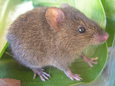
Akodon montensis is a small rodent with a heavy body that is often described as closely resembling a vole. Young differ from adults only in size, and males (45 g) are slightly larger than females (40 g). Adult mass ranges from 19 to 57 g, with a mean of 42 g. Total length of Akodon montensis ranges from 90 to 136 mm, with hind feet ranging from 17 to 28 mm long, ears ranging from 11 to 21 mm long, and tails ranging from 32 to 98 mm long. Although its basal metabolic rate is unknown, the basal metabolic rate for other members of Akodon is typically around 46 mL of oxygen per hour. Dorsal pelage of A. montensis is auburn and fades to lighter tan on the sides. The venter is either reddish grey or reddish tan with a slight orange hew. It has tan feet and a sparsely haired tail. Akodon montensis looks similar to Akodon cursor, however, A. montensis is smaller than A. cursor. (Bozinovic, 1992; Goncalves, et al., 2007; Redford and Eisenberg, 1989; Wienke and Yahnke, 2007)
- Other Physical Features
- endothermic
- homoiothermic
- bilateral symmetry
- Sexual Dimorphism
- male larger
-
- Range mass
- 19 to 57 g
- 0.67 to 2.01 oz
-
- Average mass
- 42 g
- 1.48 oz
-
- Range length
- 90 to 136 mm
- 3.54 to 5.35 in
Reproduction
Reproductive behavior of Akodon montensis has not been extensively studied, and the mating system that best characterizes this species is currently unknown.
Reproductive efforts of male Akodon montensis occurs via a four-stage process. First, recrudescence of spermatogenesis occurs, followed by the act of mating. These two stages take place between October and February (the wet season). The third stage, regression of activity and spermatogenesis, and the fourth stage, rest, take place from March to July (the dry season). If the immediate environment and weather are favorable, mating can take place year round. Typically, females have two litters but may have more if environmental conditions are favorable. Litter size ranges from 3 to 10 offspring, with an average litter size of 5. On average, gestation lasts 23 days, and offspring are typically weaned within 15 days. Males achieve sexual maturity in 32 to 37 days while females achieve sexual maturity between 35 and 91 days. Sexual maturity is most often reached between October and March. No information on birth mass is available, but average birth mass of other members of Akodon (e.g., Akodon lindberghi and Akodon azarae) ranges from 1.97 g to 3.10 g. No information is available concerning time to independence. Reproductively active and fertile females can be found in the wild with XY chromosomes. (Couto and Talamoni, 2005; De Conto and Cerqueira, 2007; Nowalk, 1991; Suarez, et al., 2004; Wienke and Yahnke, 2007)
- Key Reproductive Features
- iteroparous
- seasonal breeding
- year-round breeding
- gonochoric/gonochoristic/dioecious (sexes separate)
- sexual
- viviparous
-
- Breeding interval
- Twice yearly
-
- Breeding season
- October to February
-
- Range number of offspring
- 3 to 10
-
- Average number of offspring
- 5
-
- Average gestation period
- 23 days
-
- Range weaning age
- 15 (high) days
-
- Range age at sexual or reproductive maturity (female)
- 39 to 51 days
-
- Range age at sexual or reproductive maturity (male)
- 32 to 37 days
Information on parental investment specific to Akodon montensis is not available. However, in most mammals care of the young (e.g., provisioning and protecting) is performed by the mother from the time of fertilization until independence. (Dewey, 2011; Higdon, 2004)
- Parental Investment
- altricial
- female parental care
-
pre-fertilization
- provisioning
-
protecting
- female
-
pre-hatching/birth
-
provisioning
- female
-
protecting
- female
-
provisioning
-
pre-weaning/fledging
-
provisioning
- female
-
provisioning
Lifespan/Longevity
No specific information is available pertaining to the lifespan of Akodon montensis, aside from observations that they have a short life expectancy and quick population turnover . One member of Akodon, Akodon azarae, has a maximum lifespan of 18 months but typically lives one year or less. (Higdon, 2004; Kittlein, 2008; Wienke and Yahnke, 2007)
Behavior
Akodon montensis is solitary, with most intraspecific interactions occurring during mating season. It is nocturnal and spends much of its time in leaf litter, where it creates tunnels to travel through and nest in. (Jordao, et al., 2010; Puttker, et al., 2008; Wienke and Yahnke, 2007)
-
- Range territory size
- 100 (high) m^2
-
- Average territory size
- 36 m^2
Home Range
The home range of Akodon montensis is relatively small, with individuals occupying 36 m^2 on average. Home ranges never exceed 100 m^2 and do not vary in size between genders or seasons. (Jordao, et al., 2010; Wienke and Yahnke, 2007)
Communication and Perception
There is no information available on intraspecific communication in Akodon montensis. Its close relative, Akodon cursor uses olfactory cues to inform conspecifics about reproductive availability and territorial boundaries. (Higdon, 2004; Higdon, 2004)
- Communication Channels
- chemical
Food Habits
Akodon montensis is omnivorous. Its diet consists of fungi, plant matter, and invertebrates (e.g., insects and spiders) and does not vary in relation to season. Studies indicate that A. montensis prefers foraging on the seeds and mesocarp of Leandra panifilamentosa, Myrceugenia cucullata, Rubus sellowii and Berberis laurina. Similar to other small mammals, A. montensis caches food. (Talamoni, et al., 2008; Vieira, et al., 2006)
- Primary Diet
- omnivore
- Animal Foods
- insects
- terrestrial non-insect arthropods
- terrestrial worms
- Plant Foods
- leaves
- roots and tubers
- seeds, grains, and nuts
- fruit
- Other Foods
- fungus
- Foraging Behavior
- stores or caches food
Predation
Aside from barn owls, little information is available on the major predators of Akodon montensis. Although not documented, it is likely that mammalian carnivores, snakes, and large birds also prey on Akodon montensis. The brownish pelage of Akodon montensis helps it blend in with leaf litter and avoid predators. (Higdon, 2004; Jordao, et al., 2010; Pardinas, et al., 2004)
- Anti-predator Adaptations
- cryptic
-
- Known Predators
Ecosystem Roles
Akodon montensis preys on a variety of small insects including beetles, moths, flies, and other arthropods. Although limited information is available concerning is major predators, it is likely an important prey item for many large birds and carnivores. In addition, it is a host to numerous species of parasitic protists in the genus Besnoitia and a variety of nematodes. It is also a known carrier of hantavirus. Finally, Akodon montensis may play an important role in the seed dispersal of certain plant species as it is known to cache seeds throughout its home range. (Goodin, et al., 2009; Grisard, et al., 1997; Jordao, et al., 2010; Puttker, et al., 2008; Wienke and Yahnke, 2007)
- Ecosystem Impact
- disperses seeds
- nematodes, (Nematoda)
- hantaviruses, (Bunyaviridae)
- parasitic protists (Besnoitia)
Economic Importance for Humans: Positive
There are no known positive effects of Akodon montensis on humans. However, it may help control insect pest populations throughout its native range.
Economic Importance for Humans: Negative
Akodon montensis poses two main problems for humans. First, it is a known vector for hantaviruses. When transmitted to humans this virus can cause hantavirus pulmonary syndrome which can be fatal. Secondly, some members of the genus Akodon have a significant impact on agriculture by foraging on crops (e.g., rice, maize, peanuts, and cereal crops), resulting in a 10% to 90% decrease in crop yield. (Goodin, et al., 2009; Stenseth, et al., 2003)
- Negative Impacts
-
injures humans
- carries human disease
- crop pest
Conservation Status
Although Akodon montensis is thought to be decreasing in abundance, it is currently listed as a species of least concern by the IUCN Red List of Threatened Species. (Pardinas, et al., 2008)
-
- IUCN Red List
-
Least Concern
More information
-
- IUCN Red List
-
Least Concern
More information
-
- US Federal List
- No special status
-
- CITES
- No special status
Other Comments
Akodon montensis was formerly considered a subspecies of Akodon cursor. It has recently been promoted to species level based on several factors, including occupying a different elevational habitat then Akodon cursor and having a different karyotype (2n=24 for Akodon montensis, 2n=14/15 for Akodon cursor). Akodon montensis does not have a gall bladder but Akodon cursor does. Due to this recent change in classification, it is often difficult to determine if the study results apply to Akodon cursor or Akodon montensis. (Wienke and Yahnke, 2007)
Contributors
Meagan Crofoot (author), University of Michigan-Ann Arbor, Phil Myers (editor), University of Michigan-Ann Arbor, John Berini (editor), Animal Diversity Web Staff.
Glossary
- Neotropical
-
living in the southern part of the New World. In other words, Central and South America.

- acoustic
-
uses sound to communicate
- agricultural
-
living in landscapes dominated by human agriculture.
- altricial
-
young are born in a relatively underdeveloped state; they are unable to feed or care for themselves or locomote independently for a period of time after birth/hatching. In birds, naked and helpless after hatching.
- bilateral symmetry
-
having body symmetry such that the animal can be divided in one plane into two mirror-image halves. Animals with bilateral symmetry have dorsal and ventral sides, as well as anterior and posterior ends. Synapomorphy of the Bilateria.
- chemical
-
uses smells or other chemicals to communicate
- coastal
-
the nearshore aquatic habitats near a coast, or shoreline.
- cryptic
-
having markings, coloration, shapes, or other features that cause an animal to be camouflaged in its natural environment; being difficult to see or otherwise detect.
- endothermic
-
animals that use metabolically generated heat to regulate body temperature independently of ambient temperature. Endothermy is a synapomorphy of the Mammalia, although it may have arisen in a (now extinct) synapsid ancestor; the fossil record does not distinguish these possibilities. Convergent in birds.
- female parental care
-
parental care is carried out by females
- forest
-
forest biomes are dominated by trees, otherwise forest biomes can vary widely in amount of precipitation and seasonality.
- iteroparous
-
offspring are produced in more than one group (litters, clutches, etc.) and across multiple seasons (or other periods hospitable to reproduction). Iteroparous animals must, by definition, survive over multiple seasons (or periodic condition changes).
- motile
-
having the capacity to move from one place to another.
- native range
-
the area in which the animal is naturally found, the region in which it is endemic.
- nocturnal
-
active during the night
- omnivore
-
an animal that mainly eats all kinds of things, including plants and animals
- riparian
-
Referring to something living or located adjacent to a waterbody (usually, but not always, a river or stream).
- seasonal breeding
-
breeding is confined to a particular season
- sedentary
-
remains in the same area
- sexual
-
reproduction that includes combining the genetic contribution of two individuals, a male and a female
- solitary
-
lives alone
- stores or caches food
-
places a food item in a special place to be eaten later. Also called "hoarding"
- tactile
-
uses touch to communicate
- temperate
-
that region of the Earth between 23.5 degrees North and 60 degrees North (between the Tropic of Cancer and the Arctic Circle) and between 23.5 degrees South and 60 degrees South (between the Tropic of Capricorn and the Antarctic Circle).
- terrestrial
-
Living on the ground.
- tropical
-
the region of the earth that surrounds the equator, from 23.5 degrees north to 23.5 degrees south.
- tropical savanna and grassland
-
A terrestrial biome. Savannas are grasslands with scattered individual trees that do not form a closed canopy. Extensive savannas are found in parts of subtropical and tropical Africa and South America, and in Australia.
- savanna
-
A grassland with scattered trees or scattered clumps of trees, a type of community intermediate between grassland and forest. See also Tropical savanna and grassland biome.
- temperate grassland
-
A terrestrial biome found in temperate latitudes (>23.5° N or S latitude). Vegetation is made up mostly of grasses, the height and species diversity of which depend largely on the amount of moisture available. Fire and grazing are important in the long-term maintenance of grasslands.
- visual
-
uses sight to communicate
- viviparous
-
reproduction in which fertilization and development take place within the female body and the developing embryo derives nourishment from the female.
- year-round breeding
-
breeding takes place throughout the year
References
Bozinovic, F. 1992. Scaling of Basal and Maximum Metabolic Rate in Rodents and the Aerobic Capacity Model for the Evolution of Endothermy. Physiological Zoology, 65/5: 921-932. Accessed April 18, 2011 at http://www.jstor.org/stable/pdfplus/30158550.pdf?acceptTC=true.
Couto, D., T. Talamoni. 2005. Reproductive condition of Akodon montensis Thomas and Bolomys lasiurus (Lund) (Rodentia, Muridae) based on histological and histometric analyses of testes and external characteristics of gonads. Acta Zoologica, 86/2: "118-118". Accessed March 11, 2011 at http://onlinelibrary.wiley.com/doi/10.1111/j.1463-6395.2005.00191.x/abstract.
De Conto, V., R. Cerqueira. 2007. Reproduction, development and growth of Akodon lindberghi (Hershkovitz, 1990) (Rodentia, Muridae, Sidmondontinae) raised in captivity. Brazilian Journal of Biology, 67/4: 707-713. Accessed April 18, 2011 at http://www.scielo.br/scielo.php?pid=S1519-69842007000400017&script=sci_arttext&tlng=es.
Dewey, T. 2011. "Akodon philipmyersi" (On-line). Animal Diversity Web. Accessed April 18, 2011 at http://animaldiversity.ummz.umich.edu/site/accounts/information/Akodon_philipmyersi.html.
Goncalves, P., P. Myers, J. Vilela, J. De Oliveira. 2007. Systematics of Species of the Genus Akodon (Rodentia: Sigmondontinae) in Southeastern Brazil and implications for the Biogeography of the Campos De Altitude. Ann Arbor, MI: Museums of Zoology, University of Michigan.
Goodin, D., R. Paige, R. Owen, K. Ghimire, D. Koch, Y. Chu, C. Jonsson. 2009. Microhabitat Characteristics of Akodon montensis, a Reservoir for Hantavirus, and Hantaviral Seroprevalence in an Atlantic Forest Site in Eastern Paraguay. Journal of Vector Ecology, 34/1: "104-113". Accessed March 11, 2011 at http://www.bioone.org/doi/abs/10.3376/038.034.0113.
Grisard, E., M. Elsaid, W. Tafuri, J. Lima, C. Pinto, M. Steindel, R. Vitor. 1997. Besnoitia sp. (Protozoa:Toxoplasmatinae) from Akodon montensis (Rodentia:Cricetidae) in Santa Catarina State, Brazil. Journal f Parasitology, 83/2: 314-316. Accessed April 18, 2011 at http://www.ncbi.nlm.nih.gov/pubmed/9105318.
Higdon, L. 2004. "Akodon Cursor" (On-line). Animal Diversity Web. Accessed March 27, 2011 at http://animaldiversity.ummz.umich.edu/site/accounts/information/Akodon_cursor.html.
IABIN's Species and Specimen Thematic Network (SSTN), 2009. "Species: Akodon Montensis" (On-line). Accessed March 11, 2011 at http://ara.inbio.ac.cr/SSTN-IABIN/species/292228.
Jordao, J., F. Ramos, V. Silva. 2010. Demographic parameters of Akodon montensis (Mammalia: Rodentia) in an Atlantic Forest remnant of Southeastern Brazil. Mammalia, 74/4: ''395-400". Accessed March 11, 2011 at http://www.reference-global.com/doi/abs/10.1515/MAMM.2010.045.
Kittlein, M. 2008. Population dynamics of pamas mice (Akodon azarae): signatures of competition and predation exposed through time-series modeling. Population Ecology, 51/1: 143-151. Accessed April 18, 2011 at http://www.springerlink.com/content/y867864201931r6r/fulltext.pdf.
Nowalk, R. 1991. RODENTIA; MURIDAE; Genus AKODON. Pp. "676-677" in Mammals of the World, Vol. 2, 5th Edition. Baltimore and London: The Johns Hopkins University Press.
Pardinas, U., G. D'Elia, V. Fagundes, A. Christoff, L. Geise. 2008. "Akodon Montensis" (On-line). IUCN Red List of Threatened Species. Accessed March 11, 2011 at http://www.iucnredlist.org/apps/redlist/details/136197/0/biblio.
Pardinas, U., P. Teta, S. Fortabat. 2004. Vertebrate Prety of the Varn Owl (Tyto alba) in Subtropical Wetlands of Northeastern Argentina and Eastern Paraguay. Journal of Raptor Research, 39/1: 65-69. Accessed April 18, 2011 at http://elibrary.unm.edu/sora/jrr/v039n01/p00065-p00069.pdf.
Puttker, T., Y. Meyer-Lucht, S. Sommer. 2008. Effects of fragmentation on parasite burden (nematodes) of generalist and specialist small mammal species in secondary forest fragments of the coastal Atlantic Forest, Brazil. Ecological Research, 23/1: "207-215". Accessed March 11, 2011 at http://www.mendeley.com/research/effects-of-fragmentation-on-parasite-burden-nematodes-of-generalist-and-specialist-small-mammal-species-in-secondary-forest-fragments-of-the-coastal-atlantic-forest-brazil/#.
Redford, K., J. Eisenberg. 1989. TRIBE AKONDONTINI. Pp. "302" in Mammals of the Neotropics, Vol. 2, 1st Edition. Chicago and London: The University of Chicago Press.
Stenseth, N., H. Leirs, A. Skonhoft, S. Davis, R. Pech, H. Andreassen, G. Singleton, M. Lima, R. Machangu, R. Makundi, Z. Zhang, P. Brown, D. Shi, X. Wan. 2003. Mice and rats: the dynamics and bioeconomics of agricultural rodents pests. Frontiers in Ecology and the Environment, 1/7: 367-375. Accessed April 07, 2011 at http://www.bio.puc.cl/caseb/casebpdf/Stenseth&al.2003.FEcol.pdf.
Suarez, O., M. Busch, F. Kravetz. 2004. Reproductive strategies in Akodon azarae. Canadian Journal of Zoology, 82/10: 1572-1577. Accessed April 18, 2011 at http://www.nrcresearchpress.com/doi/abs/10.1139/z04-137.
Talamoni, S., D. Couto, D. Junior, F. Diniz. 2008. Diet of some species of Neotropical small mammals Nahrungsanalysen einiger kleiner neotropischer Säugetiere. Mammalian Biology, 73/5: "337-341 ". Accessed March 11, 2011 at http://www.sciencedirect.com/science?_ob=ArticleURL&_udi=B7GX2-4R70K4M-1&_user=99318&_coverDate=09%2F01%2F2008&_rdoc=1&_fmt=high&_orig=gateway&_origin=gateway&_sort=d&_docanchor=&view=c&_searchStrId=1674988377&_rerunOrigin=scholar.google&_acct=C000007678&_version=1&_urlVersion=0&_userid=99318&md5=2f6be0ea2b9e5c44a0bfa4313e0707c9&searchtype=a.
Vieira, E., G. Paise, P. Machado. 2006. Feeding of small rodents on seeds and fruits: a comparative analysis of three species of rodents of the Araucaria forest, southern Brazil. Acta Theriologica, 51/3: 311/318. Accessed April 18, 2011 at http://www.springerlink.com/content/d08551m1325qm503/fulltext.pdf.
Wienke, L., C. Yahnke. 2007. "Akodon cursor (montensis) Cursor Grass Mouse" (On-line). Accessed March 11, 2011 at http://www.uwsp.edu/biology/facilities/vertebrates/Mammals of Paraguay/Akodon cursor (montensis)Akodon cursor (montensis).htm.