Aimophila ruficepsrufous-crowned sparrow
Geographic Range
Rufous-crowned sparrows are found from mid to southern California through northern Baja California in the coastal areas to southern Mexico, as well as many other parts of the American Southwest, excluding northeastern Arizona and northwestern New Mexico. These birds range as far east as mid-eastern Texas and as far north as southern Utah and Colorado. (Collins, 1999; Peterson and Peterson, 1990; Robbins, et al., 1983)
Habitat
This species inhabits arid, rocky, open areas with varying elevation and heterogeneous vegetation, including low grasses and shrubbery. They are also found in open pine and oak forests. If a winter is particularly cold, these birds may move south or lower in elevation, but they do not move far from their breeding grounds. (Collins, 1999; Peterson and Peterson, 1990; Robbins, et al., 1983; Collins, 1999; Peterson and Peterson, 1990; Robbins, et al., 1983)
- Habitat Regions
- temperate
- terrestrial
- Terrestrial Biomes
- savanna or grassland
- forest
- scrub forest
-
- Range elevation
- 0 to 2195 m
- 0.00 to 7201.44 ft
Physical Description
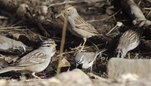
Rufous-crowned sparrows are medium-sized birds with red-capped heads and beige-gray breasts. They have black stripes on either side of their solid, gray-white throat. Males tend to have slightly larger wingspans and tail length than females. (Collins, 1999; Peterson and Peterson, 1990; Robbins, et al., 1983; Sibley, 2001; Sibley, 2003)
Similiar species include Aimophila rufescens, Aimophila notosticta, Spizella passerina, and Zonotrichia leucophrys. Rufous-crowned sparrows differ from these species in their red-brown cap and solid-colored breast. American tree sparrows (Spizella arborea) also have the red cap, but do not have a rounded tail. Sparrows in the genus Aimophila can also be distinguished from other sparrows in the range of rufous-crowned sparrows by their beaks and tails, which are longer in proportion to their body size than in other sparrows. Males and females ares similar in color, but males tend to be larger than females. (Collins, 1999; Peterson and Peterson, 1990; Robbins, et al., 1983; Sibley, 2001; Sibley, 2003)
- Other Physical Features
- endothermic
- homoiothermic
- bilateral symmetry
- Sexual Dimorphism
- male larger
-
- Range mass
- 15 to 23 g
- 0.53 to 0.81 oz
-
- Range length
- 13 to 15 cm
- 5.12 to 5.91 in
-
- Average wingspan
- 196.85 mm
- 7.75 in
Reproduction
These birds find a mate in the spring and stay with the same mate through the winter and often through following mating seasons. Males attract a mate by singing from a visible perch or while flying. The mates sing duets together and to each other when they reunite in their territory. These songs are used for recognition and to strengthen the bond between them. Males are territorial during mating season, are not exceptionally aggressive in protecting their territory. (Collins, 1999; Ehrlich, et al., 1988; Morrison, et al., 2004)
- Mating System
- monogamous
Reproduction varies by region and year-to-year with weather changes. For example, rainy weather seems to act as a cue for nesting, so nesting begins in early summer in Mexico, but much earlier in California, where rains begin earlier. The dates when eggs are laid also vary by region. Birds in California lay eggs earlier (Mar 11- Jul 10) than those in Texas (Apr 4- Sept 26). In some parts of their range, rufous-crowned sparrows nest twice per year based on rain patterns. It seems that these sparrows breed only when food is available (dependent on rainfall), which could result in increased survivorship of young.
Only female sparrows build nests. Nests are constructed of grass, bark, twigs, and hair, and are usually built in a shallow concavity in the ground. Once the eggs are laid, the female incubates until hatching. The young are altricial when hatched, and both parents help to find food and feed the hatchlings.
When the young birds leave the nest, they are as yet unable to fly and they continue to depend on their parents for food. The amount of time the fledglings are dependent on their parents is unknown, but they may not become independent until winter. The age of sexual reproductive maturity is also unknown, but it is assumed that the birds are over one year old before they reproduce.
Rufous-crowned sparrows tend to return to the same breeding ground year after year once a territory is chosen as an adult. (Collins, 1999; Ehrlich, et al., 1988; Morrison, et al., 2004)
- Key Reproductive Features
- iteroparous
- seasonal breeding
- gonochoric/gonochoristic/dioecious (sexes separate)
- sexual
- oviparous
-
- Breeding interval
- Rufous-crowned sparrows may breed once or twice yearly depending on rain cycles.
-
- Breeding season
- Breeding can occur from early spring to early fall.
-
- Range eggs per season
- 2 to 5
-
- Average eggs per season
- 3
- AnAge
-
- Range time to hatching
- 11 to 13 days
-
- Range fledging age
- 8 to 9 days
-
- Average age at sexual or reproductive maturity (female)
- 1 years
-
- Average age at sexual or reproductive maturity (male)
- 1 years
Females incubate eggs for 11 to 13 days. They stay with the eggs except when foraging, at which time the male sparrow sometimes joins her. Females will abandon the nest easily if it is disturbed, and will not attack intruders. However, females do attempt to ward off those who come too close to the nest by flapping her wings and making loud noises.
Once the eggs hatch, the female is the exclusive brooder. Both male and female sparrows find food for the young. They will feed the offspring for an unknown period of time, even after the young leave the nest. (Collins, 1999; Ehrlich, et al., 1988)
- Parental Investment
- altricial
-
pre-fertilization
- provisioning
-
protecting
- female
-
pre-hatching/birth
-
provisioning
- female
-
protecting
- female
-
provisioning
-
pre-weaning/fledging
-
provisioning
- male
- female
-
protecting
- female
-
provisioning
-
pre-independence
-
provisioning
- male
- female
-
provisioning
- post-independence association with parents
- extended period of juvenile learning
Lifespan/Longevity
The longest recorded lifespan for a rufous-crowned sparrow is 3 years and 2 months. (Collins, 1999)
-
- Range lifespan
Status: wild - 3.2 (high) years
- Range lifespan
-
- Average lifespan
Status: wild - 38 months
- Bird Banding Laboratory
- Average lifespan
Behavior
Rufous-crowned sparrows tend to use hopping and running as their primary mode of locomotion. Flight is rarely used; the sparrows are clumsy in their flight and generally don't fly long distances. These birds use their beaks to brush down their feathers, and will bathe when shallow water is present. They forage by pecking at the ground. Family units form for some time after breeding. These groups range in size from 4 to 6 individuals. During the breeding season, birds are observed in pairs within their territories. Otherwise, these sparrows are usually nonsocial, and do not form flocks. They are territorial during mating season, but not aggressive. (Collins, 1999)
- Key Behaviors
- terricolous
- flies
- diurnal
- motile
- sedentary
- territorial
-
- Range territory size
- 7700 to 8900 m^2
Home Range
The size of a rufous-crowned sparrow territory can range from 0.77 ha to 0.89 ha. The home range in this species includes the area protected as territory. These areas include the nest and surrounding area, the area where foraging occurs, and the area occupied by dependent fledglings. (Collins, 1999)
Communication and Perception
Rufous-crowned sparrows have voices that have been described as "hoarse" and their call is a descending succession of staccato notes. This call, described by Collins (1999) as the Primary Song, is probably used by males to announce their territory and to attract a female mate. Rufous-crowned sparrows sing at a lower pitch during the nonbreeding season. Visual signs such as posture and vocal calls are used by the birds at specified times for several purposes. For example, males use a certain call when chasing intruders from their territory. Both males and females use vocal calls to give predator warnings. Warning calls are often nasal noises described as sounding like "dear." Aggressive sounds and postures are used during competition over territory between two males. Mates also sing songs to one another in order to recognize each other or to strengthen the pair's relationship. (Collins, 1999; Sibley, 2001; Sibley, 2003)
Food Habits
Food habits depend on region and time of year. Grass, seeds and insects are primary foods. Rufous-crowned sparrows eat more plants such as knotweed (Polyugonum), chickweed (Stellaria media), filaree (Erodium), dock (Rumex), and wild oats (Avena) during the summer and spring. Grasshoppers (Acrididae), ground beetles (Carabidae), and ants (Formicidae) become a larger percentage of their diet during other parts of the year. (Collins, 1999)
- Primary Diet
- omnivore
- Animal Foods
- insects
- Plant Foods
- leaves
- seeds, grains, and nuts
Predation
Domestic cats (Felis silvestris) prey on rufous-crowned sparrows. Behaviors towards Mexican jays (Aphelocoma ultramarina) suggest a possible predator/prey relationship. Other possible predators include American kestrels (Falco sparverius), white-tailed kites (Elanus leucurus), sharp-shinned hawks (Accipiter striatus), and Cooper's hawks (Accipiter cooperii). Snakes are probably important predators of eggs and nestlings, as they are in other Aimophila species. (Collins, 1999; Morrison, et al., 2004)
- Anti-predator Adaptations
- cryptic
-
- Known Predators
-
- Domestic cats (Felis silvestris)
Ecosystem Roles
Rufous-crowned sparrows are primary consumers, as they eat vegetation. They are also secondary consumers, as they eat insects as well. These sparrows are preyed on by domestic cats (Felis silvestris) and probably predatory birds and snakes. Rufous-crowned sparrows can be hosts for the nest parasite, brown-headed cowbirds (Molothrus ater), though this is uncommon. They are also parasitized by two species of ticks (Amblyomma americanum and Ixodes pacificus). (Collins, 1999)
- Ecosystem Impact
- disperses seeds
- brown-headed cowbirds (Molothrus ater)
- ticks (Amblyomma americanum)
- ticks (Ixodes pacificus)
Economic Importance for Humans: Positive
These birds help to control insect populations through their feeding habits. (Collins, 1999)
- Positive Impacts
- controls pest population
Economic Importance for Humans: Negative
There are no known adverse effects of Aimophila ruficeps on humans.
Conservation Status
Although rufous-crowned sparrows are not considered endangered or threatened, loss of habitat through human expansion has limited their range and may affect populations. (Collins, 1999)
-
- IUCN Red List
-
Least Concern
More information
-
- IUCN Red List
-
Least Concern
More information
-
- US Migratory Bird Act
- Protected
-
- US Federal List
- No special status
-
- CITES
- No special status
-
- State of Michigan List
- No special status
Contributors
Tanya Dewey (editor), Animal Diversity Web.
Amel Omari (author), Kalamazoo College, Ann Fraser (editor, instructor), Kalamazoo College.
Glossary
- Nearctic
-
living in the Nearctic biogeographic province, the northern part of the New World. This includes Greenland, the Canadian Arctic islands, and all of the North American as far south as the highlands of central Mexico.

- acoustic
-
uses sound to communicate
- altricial
-
young are born in a relatively underdeveloped state; they are unable to feed or care for themselves or locomote independently for a period of time after birth/hatching. In birds, naked and helpless after hatching.
- bilateral symmetry
-
having body symmetry such that the animal can be divided in one plane into two mirror-image halves. Animals with bilateral symmetry have dorsal and ventral sides, as well as anterior and posterior ends. Synapomorphy of the Bilateria.
- chemical
-
uses smells or other chemicals to communicate
- choruses
-
to jointly display, usually with sounds, at the same time as two or more other individuals of the same or different species
- cryptic
-
having markings, coloration, shapes, or other features that cause an animal to be camouflaged in its natural environment; being difficult to see or otherwise detect.
- diurnal
-
- active during the day, 2. lasting for one day.
- duets
-
to jointly display, usually with sounds in a highly coordinated fashion, at the same time as one other individual of the same species, often a mate
- endothermic
-
animals that use metabolically generated heat to regulate body temperature independently of ambient temperature. Endothermy is a synapomorphy of the Mammalia, although it may have arisen in a (now extinct) synapsid ancestor; the fossil record does not distinguish these possibilities. Convergent in birds.
- forest
-
forest biomes are dominated by trees, otherwise forest biomes can vary widely in amount of precipitation and seasonality.
- iteroparous
-
offspring are produced in more than one group (litters, clutches, etc.) and across multiple seasons (or other periods hospitable to reproduction). Iteroparous animals must, by definition, survive over multiple seasons (or periodic condition changes).
- monogamous
-
Having one mate at a time.
- motile
-
having the capacity to move from one place to another.
- native range
-
the area in which the animal is naturally found, the region in which it is endemic.
- omnivore
-
an animal that mainly eats all kinds of things, including plants and animals
- oviparous
-
reproduction in which eggs are released by the female; development of offspring occurs outside the mother's body.
- scrub forest
-
scrub forests develop in areas that experience dry seasons.
- seasonal breeding
-
breeding is confined to a particular season
- sedentary
-
remains in the same area
- sexual
-
reproduction that includes combining the genetic contribution of two individuals, a male and a female
- tactile
-
uses touch to communicate
- temperate
-
that region of the Earth between 23.5 degrees North and 60 degrees North (between the Tropic of Cancer and the Arctic Circle) and between 23.5 degrees South and 60 degrees South (between the Tropic of Capricorn and the Antarctic Circle).
- terrestrial
-
Living on the ground.
- territorial
-
defends an area within the home range, occupied by a single animals or group of animals of the same species and held through overt defense, display, or advertisement
- tropical savanna and grassland
-
A terrestrial biome. Savannas are grasslands with scattered individual trees that do not form a closed canopy. Extensive savannas are found in parts of subtropical and tropical Africa and South America, and in Australia.
- savanna
-
A grassland with scattered trees or scattered clumps of trees, a type of community intermediate between grassland and forest. See also Tropical savanna and grassland biome.
- temperate grassland
-
A terrestrial biome found in temperate latitudes (>23.5° N or S latitude). Vegetation is made up mostly of grasses, the height and species diversity of which depend largely on the amount of moisture available. Fire and grazing are important in the long-term maintenance of grasslands.
- visual
-
uses sight to communicate
References
Collins, P. 1999. Rufous-crowned Sparrow. Pp. No.472, 1-28 in A Poole, P Stettenheim, K Kaufman, L Bevier, eds. The Birds of North America, Vol. 12, 1 Edition. Philadelphia, PA: The American Ornithologists' Union and The Academy of Natural Sciences of Philadelphia.
Ehrlich, P., D. Dobkin, D. Wheye. 1988. The Birder's Handbook. New York: Simon & Schuster, Inc..
Morrison, S., D. Bolger, T. Sillett. 2004. Annual Survivorship of the Sedentary Rufous-Crowned Sparrow (Aimophila ruficeps): No Detectable Effects of Edge or Rainfall in Southern California. The Auk, Vol.121: 904-916. Accessed November 11, 2006 at http://0-www.bioone.org.ariadne.kzoo.edu/perlserv/?request=get-document&doi=10.1642%2F0004-8038%282004%29121%5B0904%3AASOTSR%5D2.0.CO%3B2.
Peterson, R., V. Peterson. 1990. A Field Guide to Western Birds. Boston: Houghton Mifflin Company.
Robbins, C., B. Bruun, H. Zim. 1983. A Guide to Field Identification: Birds of North America. New York: Western Publishing Company.
Sibley, D. 2003. The Sibley Field Guide to Birds of Eastern North America. New York: Alfred A. Knopf.
Sibley, D. 2001. The Sibley Guide to Bird Life and Behavior. New York: Alfred A. Knopf, Inc..