Aimophila aestivalisBachman's sparrow
Geographic Range
Bachman's sparrows are found in the southeastern United States. Most of the populations live in Florida and along the Gulf Coast. They are also found as far north as the Indiana-Michigan border and as far west as the Arkansas-Oklahoma border. In the winter, Bachman's sparrows are especially secretive and little is known of their winter habits. Their winter range seems to be compressed into the coastal southeastern U.S., Florida, the Gulf states, and eastern Texas. (Dunning, 1993; USGS, 2010)
Habitat
Bachman's sparrows are mostly found in open oak and pine forests with abundant grasses. They are most often found in forests with wiregrass (Aristida) or broomsedge (Andropogon). Populations are highest in areas where forest fires are regular, eliminating hardwood understory shrubs. Bachman's sparrow populations disappear 4 to 5 years after a burn. Much of their original habitat, open pine forests, has been logged throughout their range, forcing them into marginal habitats, such as forest edges and utility rights-of-way, where hardwood understory shrubs are discouraged by poor soils, fires, or human management. (Dunning, 1993; Missouri Dept. of Conservation, 2009)
- Habitat Regions
- temperate
- terrestrial
- Terrestrial Biomes
- forest
- scrub forest
-
- Average elevation
- 50 m
- 164.04 ft
Physical Description
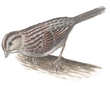
Bachman's sparrows are relatively small in size and plain brown in color with reddish streaks. They have cone shaped bills and pale brown faces. Bachman's sparrows have long brown tails with reddish brown backs. The breast is pale white in color. Bachman's sparrows also have a brownish-red crown. They are 12.2 to 15.2 cm long and about 21 grams in weight. They may be confused with a related species, Aimophila botterii in southeastern Texas, where their ranges overlap. However A. botterii is found in grasslands. They may also be confused with field sparrows (Spizella pusilla), which have smaller bills and tails, a white eye ring, less color on the face, and two white wing bars. ("Species Profile: Bachman's Sparrow (Aimophila aestivalis) on Military Installations in the Southeastern United States", 1998; Missouri Dept. of Conservation, 2009; The Georgia Museum of Natural History and Georgia Department of Natural Resources, 2006; "Species Profile: Bachman's Sparrow (Aimophila aestivalis) on Military Installations in the Southeastern United States", 1998; Dunning, 1993; Missouri Dept. of Conservation, 2009; The Georgia Museum of Natural History and Georgia Department of Natural Resources, 2006)
- Other Physical Features
- endothermic
- homoiothermic
- bilateral symmetry
- Sexual Dimorphism
- sexes alike
-
- Range mass
- 18.4 to 22.6 g
- 0.65 to 0.80 oz
-
- Average mass
- 21 g
- 0.74 oz
-
- Range length
- 12.2 to 15.2 cm
- 4.80 to 5.98 in
-
- Range wingspan
- 5.5 to 6.6 cm
- 2.17 to 2.60 in
Reproduction
Bachman's sparrow males begin singing to attract mates and defend mating territories in late February to early March. Mating behaviors are poorly documented. These sparrows seem to be primarily monogamous and males may follow females closely to guard them from other males. (Dunning, 1993)
- Mating System
- monogamous
After Bachman's sparrows have paired, females build a cup-shaped nest of grasses and other vegetation and lined with fine grass and fur on the ground, usually under overhanging vegetation or in a clump of grass. They lay two sets of eggs each mating season, the first usually in May and June, the second later in the season. Females incubate the eggs, from 2 to 5 in each brood. Males tend to females when they are off the nest. The eggs hatch in 12 to 14 days and the young depart from the nest 9 to 10 days after hatching and can fly soon after. They are at full adult size by 25 days post-hatching. (Dunning, 1993; Haggerty, 1992)
- Key Reproductive Features
- iteroparous
- seasonal breeding
- gonochoric/gonochoristic/dioecious (sexes separate)
- sexual
- oviparous
-
- Breeding interval
- Breeding occurs twice each summer season
-
- Breeding season
- Breeding occurs from May to September.
-
- Range eggs per season
- 2 to 5
-
- Average eggs per season
- 3.9
-
- Average eggs per season
- 4
- AnAge
-
- Range time to hatching
- 12 to 14 days
-
- Range fledging age
- 10 to 11 days
-
- Average time to independence
- 36 days
Young are altricial at hatching. Females brood the young and males provide food to the female while brooding. Males pass food to females who then pass it to the nestlings. After the brooding period, both males and females protect and provide food for the nestlings. Young are fed insects and parents remove their fecal sacs. (Dunning, 1993; Haggerty, 1992)
- Parental Investment
- altricial
-
pre-fertilization
- provisioning
-
protecting
- female
-
pre-hatching/birth
-
provisioning
- female
-
protecting
- female
-
provisioning
-
pre-weaning/fledging
-
provisioning
- male
- female
-
protecting
- male
- female
-
provisioning
-
pre-independence
-
provisioning
- male
- female
-
protecting
- male
- female
-
provisioning
Lifespan/Longevity
There is little available information on longevity in Bachmann's sparrows. Studies have shown survival into their third and fourth years. (Max Planck Institute, 2002)
-
- Range lifespan
Status: wild - 3 (high) years
- Range lifespan
-
- Average lifespan
Status: wild - 3.0 years
- Max Planck Institute for Demographic Research
- Average lifespan
Behavior
Bachman's sparrows have been observed hiding in the burrows of other animals. The suspected reason for this is for protection from predators. Bachman's sparrows are active during the day. Northern populations seem to be migratory, migrating to warmer areas in the coastal southeastern U.S.. Southern populations seem to be resident. Little is known about the migration of these birds. Bachman's sparrows are active during the day, during the breeding season they forage mostly during the first 5 hours of the day and 2 hours before sunset. Bachman's sparrows are mainly active on the ground. When disturbed they often drop from flight and run on the ground to escape. Their flight is described as weak and "floppy" as their tail pumps during flight. (Dean and Vickery, 2003; Dunning, 1993)
Home Range
Breeding territories range in size from 0.62 to 5.1 hectares. (Dunning, 1993; The Georgia Museum of Natural History and Georgia Department of Natural Resources, 2006)
Communication and Perception
Bachman's sparrows use songs and calls to communicate with conspecifics. Vocalizations are sometimes the most reliable way of distinguishing among sparrow species. Bachman's sparrows have 3 main songs, used by mails to attract females for breeding: primary songs, whisper songs, and excited songs. The primary song is described as one of the most beautiful sparrows songs. Both males and females use "calls", which include "chip", "pseet", "chitters", used in mate recognition and aggression, and others. (Dunning, 1993)
Food Habits
Bachman's sparrows are omnivorous, eating mainly insects and seeds. The feed on the ground. Insects consumed include beetles, bugs, grasshoppers, crickets, millipedes, and spiders. They also eat the seeds of grasses, especially Panicum species, sedges, and wood sorrel. ("Species Profile: Bachman's Sparrow (Aimophila aestivalis) on Military Installations in the Southeastern United States", 1998; USGS, 2010)
- Animal Foods
- insects
- terrestrial non-insect arthropods
- Plant Foods
- seeds, grains, and nuts
Predation
Predation on adult Bachman's sparrows is not documented. Known predators of Bachman's sparrow nestlings and eggs include crows and snakes, especially Coluber species and Elaphe species. In one study 12% of all Bachman's sparrows eggs were eaten by snakes. Brown-headed cowbird nestlings will often directly or indirectly kill Bachman's sparrow nestlings when they parasitize their nests. Adult Bachman's sparrows will feign an injury to distract predators near their nests. (Dunning, 1993)
-
- Known Predators
-
- brown-Headed cowbirds Molothrus ater
- snakes (Coluber or Elaphe species)
- crows (Corvus)
Ecosystem Roles
There is little known about the role of Bachman's sparrows in the ecosystem. One can speculate that they aid in seed dispersal through seed eating and that they help to control insect populations. They are parasitized by brown-headed cowbirds (Molothrus ater) who lay their eggs in Bachman's sparrow nests. Bachman's sparrows seem to rely on similar habitats to those required by red-cockaded woodpeckers (Picoides borealis). (Dunning, 1993)
Several ectoparasites are known from Bachman's sparrows: Analgopsis mites, the tick Haemaphysalis leporis-palustris, and lice in the genus Ricinus. Blowfly larvae (Protocalliphora deceptor) are known from nests. (Dunning, 1993)
- Ecosystem Impact
- disperses seeds
- brown-headed cowbirds (Molothrus ater)
Economic Importance for Humans: Positive
Bachman's sparrows have no direct effect on humans. One could argue that they play a key role in the food chain, in that they eat insects and other arthropods and keep their population down. (Missouri Dept. of Conservation, 2009)
Economic Importance for Humans: Negative
Bachman's sparrows are not harmful to humans. (Missouri Dept. of Conservation, 2009)
Conservation Status
The main threat to Bachman's sparrows is the elimination of the open pine forest habitat on which they rely. Since they nest on the ground, they are especially vulnerable. On the IUCN Red List they are listed as low risk. But they are protected under the Migratory Bird Act. They are given no special status on the US Federal List and CITES. In Tennessee Bachman's sparrows are listed as endangered, they are threatened in North Carolina, Oklahoma, and Kentucky. Bachman's sparrows are relatively rare, because of this there is not a lot known about this species. Bachman's sparrows rely on similar habitats to those required by red-cockaded woodpeckers (Picoides borealis). The protection of open pine forests throughout the southeastern United States has impacted populations of both rare bird species. (Dunning, 1993; Missouri Dept. of Conservation, 2009; The Georgia Museum of Natural History and Georgia Department of Natural Resources, 2006)
-
- IUCN Red List
-
Near Threatened
More information
-
- IUCN Red List
-
Near Threatened
More information
-
- US Migratory Bird Act
- Protected
-
- US Federal List
- No special status
-
- CITES
- No special status
-
- State of Michigan List
- No special status
Contributors
Tanya Dewey (author, editor), Animal Diversity Web, Nick Darin (author), Kalamazoo College, Ann Fraser (editor, instructor), Kalamazoo College.
Glossary
- Nearctic
-
living in the Nearctic biogeographic province, the northern part of the New World. This includes Greenland, the Canadian Arctic islands, and all of the North American as far south as the highlands of central Mexico.

- acoustic
-
uses sound to communicate
- altricial
-
young are born in a relatively underdeveloped state; they are unable to feed or care for themselves or locomote independently for a period of time after birth/hatching. In birds, naked and helpless after hatching.
- arboreal
-
Referring to an animal that lives in trees; tree-climbing.
- bilateral symmetry
-
having body symmetry such that the animal can be divided in one plane into two mirror-image halves. Animals with bilateral symmetry have dorsal and ventral sides, as well as anterior and posterior ends. Synapomorphy of the Bilateria.
- carnivore
-
an animal that mainly eats meat
- chemical
-
uses smells or other chemicals to communicate
- diurnal
-
- active during the day, 2. lasting for one day.
- endothermic
-
animals that use metabolically generated heat to regulate body temperature independently of ambient temperature. Endothermy is a synapomorphy of the Mammalia, although it may have arisen in a (now extinct) synapsid ancestor; the fossil record does not distinguish these possibilities. Convergent in birds.
- forest
-
forest biomes are dominated by trees, otherwise forest biomes can vary widely in amount of precipitation and seasonality.
- granivore
-
an animal that mainly eats seeds
- herbivore
-
An animal that eats mainly plants or parts of plants.
- insectivore
-
An animal that eats mainly insects or spiders.
- iteroparous
-
offspring are produced in more than one group (litters, clutches, etc.) and across multiple seasons (or other periods hospitable to reproduction). Iteroparous animals must, by definition, survive over multiple seasons (or periodic condition changes).
- migratory
-
makes seasonal movements between breeding and wintering grounds
- monogamous
-
Having one mate at a time.
- motile
-
having the capacity to move from one place to another.
- native range
-
the area in which the animal is naturally found, the region in which it is endemic.
- omnivore
-
an animal that mainly eats all kinds of things, including plants and animals
- oviparous
-
reproduction in which eggs are released by the female; development of offspring occurs outside the mother's body.
- scrub forest
-
scrub forests develop in areas that experience dry seasons.
- seasonal breeding
-
breeding is confined to a particular season
- sedentary
-
remains in the same area
- sexual
-
reproduction that includes combining the genetic contribution of two individuals, a male and a female
- tactile
-
uses touch to communicate
- temperate
-
that region of the Earth between 23.5 degrees North and 60 degrees North (between the Tropic of Cancer and the Arctic Circle) and between 23.5 degrees South and 60 degrees South (between the Tropic of Capricorn and the Antarctic Circle).
- terrestrial
-
Living on the ground.
- territorial
-
defends an area within the home range, occupied by a single animals or group of animals of the same species and held through overt defense, display, or advertisement
- visual
-
uses sight to communicate
References
US Army Corps of Engineers. Species Profile: Bachman's Sparrow (Aimophila aestivalis) on Military Installations in the Southeastern United States. SERDP-98-11. Vicksburg, MS: SERDP. 1998. Accessed October 07, 2006 at http://el.erdc.usace.army.mil/tes/pdfs/serdp98-11.pdf#search=%22Wilma%20A%20mitchell%20bachman's%20sparrow%22.
Dean, T., P. Vickery. 2003. Bachman's Sparrows use burrows and palmetto clumps as escape refugia from predators. BIOONE, 74/1: 26-30. Accessed October 15, 2006 at http://www.bioone.org/perlserv/?request=get-document&issn=0273-8570&volume=074&issue=01&page=0026.
Dunning, J. 1993. The Birds of North America. Philadelphia, PA: The American Ornithologists' Union and The Academy of Natural Sciences of Philadelphia.
Haggerty, T. 1992. Effects of Nestling Age and Brood Size on Nestling Care in the Bachman's Sparrow ( Aimophila aestivalis). JSTOR, 128: 115-125. Accessed October 07, 2006 at http://www.jstor.org/view/00030031/di003540/00p0254t/0.
Max Planck Institute, 2002. "Longevity Records" (On-line). Accessed October 11, 2006 at http://www.demogr.mpg.de/longevityrecords/0303.htm.
Meyer, R. 2006. "Aimophila aestivalis. In: Fire Effects Information System" (On-line). Accessed October 07, 2006 at http://www.fs.fed.us/database/feis/.
Missouri Dept. of Conservation, 2009. "Endangered Species Guidesheet" (On-line). Accessed October 07, 2006 at http://mdc.mo.gov/nathis/endangered/endanger/bachspar/index.htm.
The Georgia Museum of Natural History, , Georgia Department of Natural Resources. 2006. "Sparrows" (On-line). Accessed October 07, 2006 at http://museum.nhm.uga.edu/gawildlife/birds/passeriformes/aaestivalis.html.
USGS, 2010. "Bachman's sparrow Aimophila aestivalis" (On-line). Accessed October 07, 2006 at http://www.mbr-pwrc.usgs.gov/id/framlst/i5750id.html.