Ailuroedus crassirostrisgreen catbird
Geographic Range
Green catbirds are found from south-eastern Queensland to southern New South Wales on the east coast of Australia. (Mayr and Jennings, 1952)
- Biogeographic Regions
- australian
Habitat
Green catbirds are found primarily in the rainforests of the tropical and subtropical regions of Australia. Occasionally they are also found in paperbark and adjacent eucalypt forests. ("Green Catbird", 2008)
- Habitat Regions
- tropical
- Terrestrial Biomes
- forest
- rainforest
Physical Description
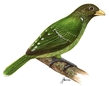
Green catbirds are rather large, stout birds weighing an average of 207 grams and having a length of approximately 28 cm. They have an overall color of emerald green with white spots and a dusky crown, nape and face with a red eye and a white bill. Juvenile green catbirds are a more dull green color. Spotted catbirds (Ailuroedus crassirostris melanotis) are a subspecies that differs in the faint black markings on the face and brighter green color. Green catbirds are sometimes confused with satin bowerbirds (Ptilonorhynchus violaceus), which are more olive green, have blue eyes, a darker bill, and more "scalloped patterning" on the underbody. ("Green Catbird", 2007)
- Other Physical Features
- endothermic
- homoiothermic
- bilateral symmetry
- Sexual Dimorphism
- male larger
-
- Average mass
- 207 g
- 7.30 oz
-
- Range length
- 24 to 33 cm
- 9.45 to 12.99 in
-
- Average length
- 28 cm
- 11.02 in
Reproduction
Like other bowerbirds (Ptilonorhynchidae), male green catbirds attempt to attract mates by displaying colorful leaves, fruits, or flowers in their beaks. When a female comes close, the male chases her from branch to branch and makes a raspy clicking sound. If the female leaves, the male preens, feeds, and calls before once again displaying the leaves, fruits, or flowers. Once the female accepts the male, they are mated for life (monogamous). Even though green catbirds are bowerbirds, they do not build a bower as do other bowerbirds. Instead they build a nest that looks like a cup composed of leaves, twigs and vines. This nest is noted for the unusual layer of soft, wet wood beneath the lining of twigs and leaves which gives the nest its thick, heavy design. The nest is set in a tree fork, tree fern, low branches of trees, or in prickly shrubs. ("Green Catbird", 2007; "Green Catbird", 2008; Becker, 2003; "Green Catbird", 2007; "Green Catbird", 2008; Becker, 2003; "Green Catbird", 2007; "Green Catbird", 2008; Becker, 2003; "Green Catbird", 2007; "Green Catbird", 2008; Becker, 2003; Hindwood and Cooper, 1968)
- Mating System
- monogamous
Green catbirds are seasonal breeders with the average breeding season starting in September and going through the end of January. The average clutch size is two or three cream or olive colored eggs, which hatch after about 24 days of incubation. Fledging occurs about 22 days after hatching. ("Green Catbird", 2007; "Green Catbird", 2008; Becker, 2003)
- Key Reproductive Features
- iteroparous
- seasonal breeding
- gonochoric/gonochoristic/dioecious (sexes separate)
- sexual
- oviparous
-
- Breeding season
- Breeding occurs from September to January.
-
- Average eggs per season
- 2.5
-
- Average time to hatching
- 24 days
-
- Average fledging age
- 22 days
Only female green catbirds build the nest and incubate the eggs. After hatching both the male and female look after and feed the young. They also both defend the territory throughout the year. This territory is used for nesting and feeding. ("Green Catbird", 2007; "Green Catbird", 2008; Becker, 2003)
- Parental Investment
- altricial
-
pre-fertilization
- provisioning
-
protecting
- female
-
pre-hatching/birth
-
provisioning
- female
-
protecting
- male
- female
-
provisioning
-
pre-weaning/fledging
-
provisioning
- male
- female
-
protecting
- male
- female
-
provisioning
Lifespan/Longevity
There is little available information for the lifespan and longevity of green catbirds in the wild and in captivity.
Behavior
Green catbirds are active during the day and are territorial. They live as mated pairs or small family groups and do not migrate. ("Green Catbird", 2007; "Green Catbird", 2008; Becker, 2003)
- Key Behaviors
- flies
- diurnal
- motile
- sedentary
- territorial
-
- Average territory size
- 20,000 m^2
Home Range
The average home range of the green catbirds is about five acres or around 20,000 m^2. This range is much reduced during the breeding season. (Innis and McEvoy, 1992; Mayr and Jennings, 1952)
Communication and Perception
The call of green catbirds has been said to sound like a cat meowing or a human baby crying. They are mostly solitary birds except for living with their mate, they use primarily vocalizations to communicate with mates, although visual displays are part of the initial courtship. ("Green Catbird", 2007)
- Other Communication Modes
- duets
Food Habits
Green catbirds primarily eat fruits, flowers, and other plant material. During breeding season they often prey on the hatchlings of other birds or small reptiles to feed their young. Foraging is usually done in pairs or small family groups by moving from one tree to the next in the mid and upper canopy of the forest. (Innis and McEvoy, 1992)
- Animal Foods
- birds
- reptiles
- insects
- Plant Foods
- leaves
- fruit
- flowers
Predation
There is little information on the predators of green catbirds, although it is likely that eggs and hatchlings are preyed on by nest predators. Green catbirds actively defend their territories and nests. They also use a broken wing display to distract potential predators from nests. ("Green Catbird", 2008)
Ecosystem Roles
Since green catbirds eat fruit, flowers, and other plant material, it is assumed that they aid in the dispersal of seeds and maybe even with the pollination of some plant species. (Innis and McEvoy, 1992)
- Ecosystem Impact
- disperses seeds
- pollinates
Economic Importance for Humans: Positive
Green catbirds eat some insects, which may be potential pests, and they aid in the dispersal and pollination of native plants.
- Positive Impacts
- controls pest population
Economic Importance for Humans: Negative
Green catbirds may occasionally take cultivated fruits, although their impact is negligible.
Conservation Status
Green catbird populations are considered relatively large and stable. They are described as "common" in most of their range and have an estimated global range size of 20,000 to 50,000 km^2." Humans are the biggest threat to these birds due to the destruction of their habitat. (Morcombe, 2000)
-
- IUCN Red List
-
Least Concern
More information
-
- IUCN Red List
-
Least Concern
More information
-
- US Migratory Bird Act
- No special status
-
- US Federal List
- No special status
-
- CITES
- No special status
-
- State of Michigan List
- No special status
Contributors
Tanya Dewey (editor), Animal Diversity Web.
Amanda Kaminski (author), Northern Michigan University, Alec R. Lindsay (editor, instructor), Northern Michigan University.
Glossary
- Australian
-
Living in Australia, New Zealand, Tasmania, New Guinea and associated islands.

- acoustic
-
uses sound to communicate
- altricial
-
young are born in a relatively underdeveloped state; they are unable to feed or care for themselves or locomote independently for a period of time after birth/hatching. In birds, naked and helpless after hatching.
- bilateral symmetry
-
having body symmetry such that the animal can be divided in one plane into two mirror-image halves. Animals with bilateral symmetry have dorsal and ventral sides, as well as anterior and posterior ends. Synapomorphy of the Bilateria.
- chemical
-
uses smells or other chemicals to communicate
- diurnal
-
- active during the day, 2. lasting for one day.
- duets
-
to jointly display, usually with sounds in a highly coordinated fashion, at the same time as one other individual of the same species, often a mate
- endothermic
-
animals that use metabolically generated heat to regulate body temperature independently of ambient temperature. Endothermy is a synapomorphy of the Mammalia, although it may have arisen in a (now extinct) synapsid ancestor; the fossil record does not distinguish these possibilities. Convergent in birds.
- folivore
-
an animal that mainly eats leaves.
- forest
-
forest biomes are dominated by trees, otherwise forest biomes can vary widely in amount of precipitation and seasonality.
- frugivore
-
an animal that mainly eats fruit
- herbivore
-
An animal that eats mainly plants or parts of plants.
- iteroparous
-
offspring are produced in more than one group (litters, clutches, etc.) and across multiple seasons (or other periods hospitable to reproduction). Iteroparous animals must, by definition, survive over multiple seasons (or periodic condition changes).
- monogamous
-
Having one mate at a time.
- motile
-
having the capacity to move from one place to another.
- native range
-
the area in which the animal is naturally found, the region in which it is endemic.
- oviparous
-
reproduction in which eggs are released by the female; development of offspring occurs outside the mother's body.
- rainforest
-
rainforests, both temperate and tropical, are dominated by trees often forming a closed canopy with little light reaching the ground. Epiphytes and climbing plants are also abundant. Precipitation is typically not limiting, but may be somewhat seasonal.
- seasonal breeding
-
breeding is confined to a particular season
- sedentary
-
remains in the same area
- sexual
-
reproduction that includes combining the genetic contribution of two individuals, a male and a female
- tactile
-
uses touch to communicate
- territorial
-
defends an area within the home range, occupied by a single animals or group of animals of the same species and held through overt defense, display, or advertisement
- tropical
-
the region of the earth that surrounds the equator, from 23.5 degrees north to 23.5 degrees south.
- visual
-
uses sight to communicate
References
2008. "Green Catbird" (On-line). Accessed April 02, 2008 at http://www.environment.nsw.gov.au/plantsanimals/GreenCatbirds.htm.
2007. "Green Catbird" (On-line). Birds In Backyards. Accessed April 12, 2008 at http://www.birdsinbackyards.net.
Becker, C. 2003. Modern Theory of Evolution. Indiana: Iuniverse Inc.. Accessed March 10, 2008 at http://books.google.com/books?id=dZgUg0QgrHIC.
Hindwood, K., W. Cooper. 1968. A Portfolio of Australian Birds. Rutland, Vermont and Tokyo, Japan: Charles E Tuttle Company Publishers.
Innis, G., J. McEvoy. 1992. Feeding Ecology of Green Catbirds (Airuroedus crassirostris) in Subtropical Rainforests of South-Eastern Queensland. Wildlife Research Management and Conservation, 19/3: 317-329. Accessed March 10, 2008 at www.publish.csiro.au/paper/wr9920317.htm.
Mayr, E., K. Jennings. 1952. Geographic Variation and Plumages in Australian Bowerbirds (Ptilonorhynchidae). American Museum of Natural History, 1602: 18. Accessed April 12, 2008 at http://hdl.handle.net/2246/2402.
Morcombe, M. 2000. Field Guide to Australian Birds. Australia: Steve parish Publishing.