Agraulis vanillae


Geographic Range
The Gulf Fritillary is a resident throughout the southern United States down into Mexico, Central America, the West Indies, and South America.
- Biogeographic Regions
- nearctic
- neotropical
Habitat
The Gulf Fritillary prefers subtropical second growth, woodland edges, brushy fields, and city gardens.
- Terrestrial Biomes
- savanna or grassland
- forest
- rainforest
- scrub forest
Physical Description
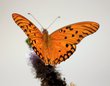
The Gulf Artillary has pointed forewings and a wing span of 2.0 to 2.5 inches. The upperside of the butterfly is bright orange with brown and black markings. The underside is a deeper color with distinct elongated silver spots. Females are darker with heavier markings.
- Other Physical Features
- ectothermic
- bilateral symmetry
Reproduction
Males search for freshly emerged females. The eggs are laid singly on passion-vines. The egg of the Gulf Fritillary is yellow, oblong, and ribbed. Mature larvae are a dark brown or black with red-orange stripes and rows of complex black spines.
Behavior
The Gulf Fritillary migrates northward to the Central U.S. It can be found in such areas as the Great Basin, the Rockies, the Midwestern United States, and the mid-Atlantic States.
Food Habits
The Gulf Fritillary feeds on Maypops and other passion-vine species. Passion Flower is the larval foodplant.
Economic Importance for Humans: Positive
No documented examples.
Economic Importance for Humans: Negative
No documented examples.
Other Comments
The Gulf Artillary belongs to the subfamily Heliconiinae. Members of this group are unique for collecting pollen in their proboscis. After the pollen is collected it is absorbed through the walls of the proboscis.
Contributors
Marie S. Harris (author), University of Michigan-Ann Arbor.
Glossary
- Nearctic
-
living in the Nearctic biogeographic province, the northern part of the New World. This includes Greenland, the Canadian Arctic islands, and all of the North American as far south as the highlands of central Mexico.

- Neotropical
-
living in the southern part of the New World. In other words, Central and South America.
- bilateral symmetry
-
having body symmetry such that the animal can be divided in one plane into two mirror-image halves. Animals with bilateral symmetry have dorsal and ventral sides, as well as anterior and posterior ends. Synapomorphy of the Bilateria.
- ectothermic
-
animals which must use heat acquired from the environment and behavioral adaptations to regulate body temperature
- forest
-
forest biomes are dominated by trees, otherwise forest biomes can vary widely in amount of precipitation and seasonality.
- native range
-
the area in which the animal is naturally found, the region in which it is endemic.
- rainforest
-
rainforests, both temperate and tropical, are dominated by trees often forming a closed canopy with little light reaching the ground. Epiphytes and climbing plants are also abundant. Precipitation is typically not limiting, but may be somewhat seasonal.
- scrub forest
-
scrub forests develop in areas that experience dry seasons.
- tropical savanna and grassland
-
A terrestrial biome. Savannas are grasslands with scattered individual trees that do not form a closed canopy. Extensive savannas are found in parts of subtropical and tropical Africa and South America, and in Australia.
- savanna
-
A grassland with scattered trees or scattered clumps of trees, a type of community intermediate between grassland and forest. See also Tropical savanna and grassland biome.
- temperate grassland
-
A terrestrial biome found in temperate latitudes (>23.5° N or S latitude). Vegetation is made up mostly of grasses, the height and species diversity of which depend largely on the amount of moisture available. Fire and grazing are important in the long-term maintenance of grasslands.
References
Opler, Paul A. A Field Guide to Eastern Butterflies. Houghton Mifflin Company, 1992.
Shull, Ernest M. The Butterflies of Indiana. Indiana Academy of Science, 1987.