Agkistrodon piscivorusconanti
Geographic Range
Cottonmouths, Agkistrodon piscivorus , are found in the United States ranging from as far north as the James River in Virginia to the western edge of Missouri, and as far south as the Florida Keys and the western part of Texas. They are found in parts of North Carolina, South Carolina, Georgia, Kentucky, Illinois, Indiana, Tennessee and all of Louisiana, Alabama, Mississippi and Arkansas. (Mitchell, 1994; Roth and Noble, 2005; Wilson, 1995; Zaidan III, et al., 2003)
Habitat
Cottonmouths prefer wetlands but are also found on land in vegetation and under logs and branches. Because cottonmouths are semiaquatic, they are most commonly found in moist habitats in close proximity to water. Cottonmouths can be found in bodies of water including bays, salt marshes, lakes, creeks, ditches, and even on river bottoms. (Mitchell, 1994; Wilson, 1995)
- Habitat Regions
- temperate
- terrestrial
- freshwater
- Terrestrial Biomes
- forest
- Aquatic Biomes
- lakes and ponds
- rivers and streams
- temporary pools
- coastal
- Other Habitat Features
- urban
- suburban
- agricultural
- riparian
- estuarine
Physical Description
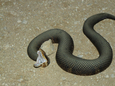
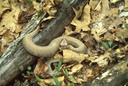
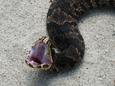
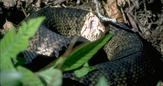
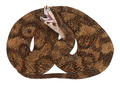
Cottonmouths have a maximum total length of 1.8 m and a maximum mass of 1700 grams. Males are typically longer, heavier, and have a greater number of subcaudal scales (enlarged scales on tail) than females. The heads of adults are large, spade-shaped, and brown, black, or olive on top or laterally. They also have brown patches on their chins. Adults are black, brown, and olive and have black crossbands down the length of their bodies. The crossbands are usually darker on the outside of the band with a lighter center and are dumbbell shaped. The closer to the tail, the darker the crossbands get until they are completely black at the end of the tail. Juvenile cottonmouths have a similar pattern, but have a yellow tip on the end of their tails, brighter overall color, and more distinct crossbands. The mouth is bright white inside, which gives them their common name. (Means, 2004; Mitchell, 1994)
- Other Physical Features
- heterothermic
- venomous
- Sexual Dimorphism
- male larger
-
- Range mass
- 435 to 1700 g
- 15.33 to 59.91 oz
-
- Range length
- 66 to 188 cm
- 25.98 to 74.02 in
Development
After copulation, female cottonmouths retain the eggs, which develop inside of her for 5 months, after which they give birth to live young. The sex of the young is determined through genetics, not the environment. These snakes exhibit determinate growth. (Ford, et al., 2004)
Reproduction
Male cottonmouths perform a combat dance in which they slither back and forth while waving their tails to lure a female away from competing males. Males also fight each other; the winner of those battles has the right to mate with the female they were competing over. Cottonmouths breed seasonally and are believed to be monogamous. (Hill III and Beaupre, 2008; Mitchell, 1994; Wilson, 1995)
- Mating System
- monogamous
Cottonmouths may breed year-round but most matings occur between April and May, followed by a gestation period of 5 months. Young cottonmouths are typically born in August or September. Females give birth to an average of 5 to 9 live young, but can have as many as 16. The age of sexual maturity for females is 1095 days, but is unknown for males. (de Magalhaes, et al., 2005; Ford, et al., 2004; Hill III and Beaupre, 2008; Mitchell, 1994; Wharton, 1960; Wilson, 1995; Zaidan III, et al., 2003)
- Key Reproductive Features
- iteroparous
- seasonal breeding
- sexual
- ovoviviparous
-
- Breeding interval
- Cottonmouths breed once yearly.
-
- Breeding season
- Breeding occurs most from April to May.
-
- Range number of offspring
- 1 to 16
-
- Average number of offspring
- 5-9
-
- Average number of offspring
- 8
- AnAge
-
- Average gestation period
- 5 months
-
- Average age at sexual or reproductive maturity (female)
- 1,095 days
-
- Average age at sexual or reproductive maturity (female)
Sex: female - 1095 days
- AnAge
- Average age at sexual or reproductive maturity (female)
Observations suggest the young stay with the mother for a few days until they are able to move around on their own. (Wharton, 1960)
- Parental Investment
-
pre-fertilization
- provisioning
-
protecting
- female
-
pre-hatching/birth
-
provisioning
- female
-
protecting
- female
-
provisioning
Lifespan/Longevity
In each clutch, on average, just 2 to 3 young make it to adulthood. Cottonmouth young suffer high predation rates. Little information has been documented on the lifespan of Agkistrodon piscivorous in captivity or in the wild, however, the oldest cottonmouth known lived to 24.5 years old. (de Magalhaes, et al., 2005; Mitchell, 1994)
-
- Range lifespan
Status: wild - 24.5 (high) years
- Range lifespan
-
- Range lifespan
Status: captivity - 24.5 (high) years
- Range lifespan
-
- Average lifespan
Status: captivity - 21.0 years
- Max Planck Institute for Demographic Research
- Average lifespan
-
- Average lifespan
Status: captivity - 18.9 years
- Max Planck Institute for Demographic Research
- Average lifespan
Behavior
Cottonmouths are solitary and do not wander far from their home range. Adults will not go far from sources of water (no more than 500 m) but juveniles will venture a little farther. Although cottonmouths are generally solitary, a temporary hierarchy among males is established during the mating season when they "dance" to attract a mate. Cottonmouths are aggressive snakes and bite when disturbed or provoked. They first give warning signs by shaking their tail back and forth, making a rustling noise, elevating their heads off the ground a few inches, and coiling up while exposing their open white mouth. As a defense mechanism or in a situation when they are threatened they will emit a foul-smelling musk as well. Cottonmouths are venomous and can bite while on land or in water. Cottonmouths are typically nocturnal. (Gibbons and Dorcas, 2002; Mitchell, 1994; Roth and Noble, 2005)
- Key Behaviors
- terricolous
- natatorial
- nocturnal
- sedentary
- hibernation
- solitary
-
- Range territory size
- 333 to 30,337 m^2
-
- Average territory size
- 10,685 m^2
Home Range
Cottonmouth home range size averages 1.06 ha, typically including a water source, such as a river or lake. The size of a cottonmouth's home range tends to increase with the size of the snake and varies with gender. Males typically have significantly larger home ranges than both gravid and non-gravid females. (Mitchell, 1994; Roth and Noble, 2005; Wilson, 1995)
Communication and Perception
Cottonmouths use vision, touch, smell, and sound. They use their eyes to locate prey and their senses of hearing and touch to better perceive their surroundings. Their strongest sense is the sense of smell, in which they use their tongue to "taste" the air. This is used to analyze what is in the air around them. Cottonmouths also use a gland to spray a foul-smelling musk up to 1.5 m away to warn potential predators. (Means, 2004; Mitchell, 1994)
- Other Communication Modes
- scent marks
- Perception Channels
- visual
- infrared/heat
- tactile
- acoustic
- vibrations
- chemical
Food Habits
Cottonmouths are carnivores, eating primarily mammals and fish. Cottonmouths catch their food by striking, biting, and releasing venom into the prey. They also hold the prey in their coils until it is no longer struggling. Cottonmouths then open their mouths wider than the normal size by detaching the jaw bones, making it easier to swallow the prey. Other prey taken includes frogs, turtles, snakes, eggs, insects, carrion, and birds. Common prey species include southern leopard frogs (Lithobates sphenocephalus sphenocephalus), catfish (Ictalurus), bass (Micropterus), juvenile black rat snakes (Pantherophis obsoletus), young snapping turtles (g.Chelydra serpentina), and least shrews (Cryptotis parva). (Lillywhite and McCleary, 2008; Mitchell, 1991; Mitchell, 1994; Wilson, 1995)
- Animal Foods
- birds
- mammals
- amphibians
- reptiles
- fish
- eggs
- carrion
- insects
- mollusks
Predation
The main predators of mature cottonmouths are humans Homo sapiens, mostly indirectly via habitat destruction. There are many predators of young cottonmouths. Known predators of juveniles are raccoons (Procyon lotor), longnose gar (Lepisosteus osseus), dogs (Canis lupus familiaris), cats (Felis catus), hawks (Buteo and Accipiter), eagles (Haliaeetus), egrets (Ardea and Egretta), largemouth bass (Micropterus salmoides), and snapping turtles (Chelydra serpentina). Their anti-predator adaptations include hiding, flattening themselves closer and using their cryptic coloration to blend in with the environment, coiling and rapidly shaking their tail in vegetation to make a rattlesnake-like sound, opening their mouth wide to present their very white mouths, swimming away, and using a gland that sprays a foul-smelling chemical to deter the predator. (Gibbons and Dorcas, 2002; Mitchell, 1994)
- Anti-predator Adaptations
- cryptic
-
- Known Predators
-
- humans (Homo sapiens)
- raccoons (Procyon lotor)
- longnose gar (Lepisosteus osseus)
- domestic dogs (Canis lupus familiaris)
- domestic cats (Felis catus)
- hawks (Buteo)
- hawks (Accipiter)
- eagles (Haliaeetus)
- herons (Ardea)
- egrets (Egretta)
- largemouth bass (Micropterus salmoides)
- snapping turtles (Chelydra serpentina)
Ecosystem Roles
Cottonmouths are important predators of shrews, other small mammals, snakes, fish, amphibians, and turtles. Young cottonmouths are also prey to larger predators. Cottonmouths are carriers of many types of parasites. Dasymetra is a digenetic trematode genus that occurs in cottonmouths and are usually located in the esophagus or mouth. Ochetosoma ancistrodontis and Ochetosoma aniarun are digenetic trematodes that are usually found in the mouth and esophagus, especially in the tissue folds. Another parasite found in cottonmouths is Pneumatophilus foliaformis, which is a digenetic trematode located in the lungs and trachea. Proteocephalus marenzelleri and Proteocephalus perspicua are cestodes found in the distal and proximal one-third of the small intestines of the cottonmouth. Kiricephalus coarctatus and Porocephalus crotali are pentastomids that can be found in the lungs of cottonmouths. These parasites can cause infections in the lungs of cottonmouths but cause no inflammation in the lungs. (Detterline, et al., 1984)
- Dasymetra conferta
- Ochetosoma ancistrodontis
- Ochetosoma aniarum
- Pneumatophilus foliaformis
- Pneumatophilus leidyi
- Proteocephalus marenzelleri
- Proteocephalus perspicua
- Ophidascaris labiatopapillosa
- Kiricephalus coarctatus
- Porocephalus crotali
Economic Importance for Humans: Positive
By keeping populations of small animals under control, cottonmouths may indirectly limit the effects of pest species. Humans benefit directly from cottonmouths because snake skin is sometimes used as a kind of leather. (Mitchell, 1991; Mitchell, 1994)
- Positive Impacts
- body parts are source of valuable material
- controls pest population
Economic Importance for Humans: Negative
As a venomous snake, cottonmouths have the ability to bite, poison, and potentially kill humans. Because cottonmouths are found in water and on land, and because they are common along the shores of ponds, lakes, and rivers, encounters between humans and cottonmouths are frequent. However, cottonmouths are generally secretive and are not aggressive, so bites are rare. Furthermore, cottonmouths, and other pitvipers, that bite defensively, typically inject less venom than they would if they were trying to kill a prey item. (Gibbons and Dorcas, 1998; Gibbons and Dorcas, 2002; Mitchell, 1994)
- Negative Impacts
-
injures humans
- bites or stings
- venomous
Conservation Status
Agkistrodon piscivorus is listed as a species of "least concern" by the IUCN Red List. Cottonmouths are not an endangered or threatened species and populations seems to be stable throughout their range.
-
- IUCN Red List
-
Least Concern
More information
-
- IUCN Red List
-
Least Concern
More information
-
- US Federal List
- No special status
-
- CITES
- No special status
-
- State of Michigan List
- No special status
Contributors
Tanya Dewey (editor), Animal Diversity Web.
Garrett Good (author), Radford University, Karen Powers (editor, instructor), Radford University.
Glossary
- Nearctic
-
living in the Nearctic biogeographic province, the northern part of the New World. This includes Greenland, the Canadian Arctic islands, and all of the North American as far south as the highlands of central Mexico.

- acoustic
-
uses sound to communicate
- agricultural
-
living in landscapes dominated by human agriculture.
- carnivore
-
an animal that mainly eats meat
- carrion
-
flesh of dead animals.
- chemical
-
uses smells or other chemicals to communicate
- coastal
-
the nearshore aquatic habitats near a coast, or shoreline.
- cryptic
-
having markings, coloration, shapes, or other features that cause an animal to be camouflaged in its natural environment; being difficult to see or otherwise detect.
- estuarine
-
an area where a freshwater river meets the ocean and tidal influences result in fluctuations in salinity.
- forest
-
forest biomes are dominated by trees, otherwise forest biomes can vary widely in amount of precipitation and seasonality.
- freshwater
-
mainly lives in water that is not salty.
- heterothermic
-
having a body temperature that fluctuates with that of the immediate environment; having no mechanism or a poorly developed mechanism for regulating internal body temperature.
- hibernation
-
the state that some animals enter during winter in which normal physiological processes are significantly reduced, thus lowering the animal's energy requirements. The act or condition of passing winter in a torpid or resting state, typically involving the abandonment of homoiothermy in mammals.
- infrared/heat
-
(as keyword in perception channel section) This animal has a special ability to detect heat from other organisms in its environment.
- iteroparous
-
offspring are produced in more than one group (litters, clutches, etc.) and across multiple seasons (or other periods hospitable to reproduction). Iteroparous animals must, by definition, survive over multiple seasons (or periodic condition changes).
- marsh
-
marshes are wetland areas often dominated by grasses and reeds.
- monogamous
-
Having one mate at a time.
- natatorial
-
specialized for swimming
- native range
-
the area in which the animal is naturally found, the region in which it is endemic.
- nocturnal
-
active during the night
- ovoviviparous
-
reproduction in which eggs develop within the maternal body without additional nourishment from the parent and hatch within the parent or immediately after laying.
- piscivore
-
an animal that mainly eats fish
- riparian
-
Referring to something living or located adjacent to a waterbody (usually, but not always, a river or stream).
- scent marks
-
communicates by producing scents from special gland(s) and placing them on a surface whether others can smell or taste them
- seasonal breeding
-
breeding is confined to a particular season
- sedentary
-
remains in the same area
- sexual
-
reproduction that includes combining the genetic contribution of two individuals, a male and a female
- solitary
-
lives alone
- suburban
-
living in residential areas on the outskirts of large cities or towns.
- swamp
-
a wetland area that may be permanently or intermittently covered in water, often dominated by woody vegetation.
- tactile
-
uses touch to communicate
- temperate
-
that region of the Earth between 23.5 degrees North and 60 degrees North (between the Tropic of Cancer and the Arctic Circle) and between 23.5 degrees South and 60 degrees South (between the Tropic of Capricorn and the Antarctic Circle).
- terrestrial
-
Living on the ground.
- urban
-
living in cities and large towns, landscapes dominated by human structures and activity.
- venomous
-
an animal which has an organ capable of injecting a poisonous substance into a wound (for example, scorpions, jellyfish, and rattlesnakes).
- vibrations
-
movements of a hard surface that are produced by animals as signals to others
- visual
-
uses sight to communicate
References
Blem, C. 1997. Lipid Reserves of the Eastern Cottonmouth (Agkistrodon piscivorus) at the Northern Edge of Its Range. Copeia, Volume 1: 53-59.
Detterline, J., J. Jacob, W. Wilhelm. 1984. A Comparison of Helminth Endoparasites in the Cottonmouth (Agkistrodon piscivorus) and Three Species of Water Snakes (Nerodia). Transactions of the American Microscopical Society, Volume 103 Issue 2: 137-143.
Ford, N., F. Brischoux, D. Lancaster. 2004. Reproduction In The Western Cottonmouth, Agkistrodon piscivorus, In A Floodplain Forest. The Southwestern Naturalist, Volume 49 Issue 4: 465-471.
Gibbons, J., M. Dorcas. 2002. Defensive Behavior of Cottonmouths (Agkistrodon piscivorus) Toward Humans. Copeia, Volume 2002 Issue 1: 195-198.
Gibbons, J., M. Dorcas. 1998. "Herps of the Southeast Virtual Walk" (On-line). University of Georgia, Savannah River Ecology Laboratory. Accessed January 22, 2009 at http://www.uga.edu/srelherp/SPARC/trip21.htm.
Hill III, J., S. Beaupre. 2008. Body Size, Growth, and Reproduction in a Population of Western Cottonmouths (Agkistrodon piscivorus) in the Ozark Mountains of Northwest Arkansas. Copeia, Issue 1: 105-114.
Lillywhite, H., R. McCleary. 2008. Tropical Ecology of Insular Cottonmouth Snakes: Review and Perspective. South American Journal of Herpetology, Volume 3 Issue 2: 175-185.
Martof, B., W. Palmer, J. Bailey, J. Harrison III. 1980. Amphibians and Reptiles of the Carolinas and Virginia. Chapel Hill: The University of North Carolina Press.
Means, D. 2004. The Loathed Cottonmouth Moccasin. Biology Digest, Volume 5 Issue 2: 14-22.
Mitchell, J. 1991. Snakes. Biology Digest, Volume 52 Issue 6: 17-22.
Mitchell, J. 1994. The Reptiles of Virginia. Washington and London: Smithsonian Institution Press.
Roth, E., S. Noble. 2005. Spatial Ecology of a Cottonmouth (Agkistrodon piscivorus) Population in East Texas. Journal of Herpetology, Volume 39 Issue 2: 308-312.
Vincent, S., A. Herrel, D. Irschick. 2004. Ontogeny of Intersexual Head Shape and Prey Selection in the Pitviper Agkistrodon piscivorus. Biological Journal of the Linnean Society, Volume 81 Issue 1: 151-159.
Wharton, C. 1960. Birth and Behavior of a Brood of Cottonmouths, Agkistrodon piscivorus With Notes on Tail-Luring. Herpetologica, Volume 16 Issue 2: 125-129.
Wilson, D. 1995. The Land Manager's Guide to the Amphibians and Reptiles of the South. Chapel Hill, North Carolina: The Nature Conservancy, Southeastern Region.
Zaidan III, F., D. Kreider, S. Beaupre. 2003. Testosterone Cycles and Reproductive Energetics: Implications for Northern Range Limits of the Cottonmouth (Agkistrodon piscivorus). Copeia, Volume 2003 Issue 2: 231-240.
de Magalhaes, J., J. Costa, O. Toussaint. 2005. "AnAge Database" (On-line). Accessed December 15, 2008 at http://genomics.senescence.info/species/entry.php?species=Agkistrodon_piscivorus.
de Magalhaes, J., J. Costa, O. Toussaint. 2005. HAGR: the Human Ageing Genomic Resources. Nucleic Acids Research, 33: D537-D543.