Agelaioides badiusbay-winged cowbird

Geographic Range
Bay-winged cowbirds are native to central and southern South America, making their homes primarily in the Andean highlands. This species generally is found throughout Argentina, with the westernmost portions of its range abutting the eastern slopes of the Andes. Bay-winged cowbirds may be found in Uruguay, Paraguay, Bolivia, and in the southwestern corner of Brazil. An isolated population of bay-winged cowbirds is found at the mouth of the Amazon River (Jaramillo and Burke 1999). (Jaramillo and Burke, 1999)
- Biogeographic Regions
- neotropical
Habitat
Like other members of the American blackbird family, Agelaioides badius is an edge species. They prefer to nest in open woodland, in scrub, and in grasslands with scattered trees. In particular, bay-winged cowbirds are readily seen in chaco, a type of scrub forest, and in Patagonia. Jaramillo and Burke (1999) note that bay-winged cowbirds use hackberry bushes as preferred nesting habitat. Individuals belonging to this species also frequent disturbed urban and agricultural areas, and have been spotted in urban parks in Buenos Aires (Jaramillo and Burke 1999). (Jaramillo and Burke, 1999)
- Habitat Regions
- tropical
- terrestrial
- Terrestrial Biomes
- savanna or grassland
- forest
- scrub forest
- Other Habitat Features
- urban
- suburban
- agricultural
Physical Description
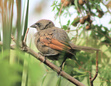
Bay-winged cowbirds are a medium-sized species of New World blackbird. They are largely sexually monomorphic, to the point of being indistinguishable in the field, though males tend to be slightly heavier (Fraga 1992; Jaramillo and Burke 1999). However, an old source (Hamilton and Orians 1965) seems to indicate a small but statistically significant difference in body mass between the sexes. This species is characterized by a light gray body and a charcoal gray tail. The wings are mostly rust-colored, though the retrices (flight feathers) are tipped brown. The legs and claws are black, as are the lores. The black lores and face combine to create what has been aptly described as a “mask”. The bill is short, conical, and black; Jaramillo and Burke (1999) note that the bill is “finch-like” in size and shape.
Juveniles are nearly identical to adults and are probably indistinguishable from adults to an observer in the field; however, they are usually slightly darker, with dark streaks on the body. The tail feathers in juveniles and in freshly molted adults may have reddish markings. In addition, the corner of the mouth in juveniles is whitish; this along with the juvenile’s pink mouth lining changes to black in adulthood. Finally, the bill tends to be slightly lighter in coloration in juvenile specimens (Jaramillo and Burke 1999).
Pale bay-winged cowbirds, Agelaioides badius fringillarius, have plumage that is substantially different from the nominate subspecies. Although patterns are largely conserved, the body is brownish-gray, with a blackish-brown mask and brown remiges (long tail feathers). It is currently debated whether the pale subspecies of bay-winged cowbird should actually be considered its own species (Jaramillo and Burke 1999).
Juvenile screaming cowbirds (Molothrus rufoaxillaris) are nest parasites of bay-winged cowbirds, which are used as their primary host. Although the two species are nearly impossible to tell apart more than a few days after hatching, Fraga (1979) states that there are four general differences between the young of screaming cowbirds and the young of bay-winged cowbirds. Fraga (1979) notes that in the first few days after hatching bay-winged cowbirds have orange skin, while the parasitic screaming cowbirds are pink. Second, while bay-winged cowbird hatchlings have a dark patch surrounding the egg tooth, screaming cowbird hatchlings have uniformly pink bills. Third, screaming cowbirds sometimes outgrow their bay-winged cowbird hosts; noting sexual dimorphism in screaming cowbirds, Fraga (1979) suggests that unusually large screaming cowbird juveniles are likely to be males. Finally, unlike bay-winged cowbird juveniles, screaming cowbirds do not solicit allopreening (interspecies preening) behavior (Fraga 1979). (Fraga, 1979; Fraga, 1992; Jaramillo and Burke, 1999)
- Other Physical Features
- endothermic
- homoiothermic
- bilateral symmetry
- Sexual Dimorphism
- sexes alike
-
- Average mass
- 45 g
- 1.59 oz
Reproduction
Bay-winged cowbirds were initially thought to always be monogamous (Hamilton 1965), although observations made by Fraga (1972) of banded birds indicate that some females mate with a different male each breeding season, which generally lasts from November through March. In keeping with their semi-colonial nesting habits, mated pairs of bay-winged cowbirds usually receive assistance in provisioning and nest defense from other adults (Fraga 1972; Fraga 1992). These individuals, invariably non-breeding ‘helper’ males, are found assisting virtually all bay-winged cowbird nests (Fraga 1972). (Fraga, 1972; Fraga, 1992)
- Mating System
- monogamous
- polyandrous
As with other New World blackbirds, females of this species typically lay one clutch of between two and five eggs (De Marisco and Reboreda 2010, but see Fraga 1972). Eggs are usually white or light blue with dark scrawling patterns (Jaramillo and Burke 1999); bay-winged cowbird eggs are similar to those of other blackbirds. Occasionally, more than one female will lay eggs in a single nest (De Marisco and Reboreda 2010).
Bay-winged cowbirds usually do not build their own nests. Instead, they lay eggs in a nest built and formerly occupied by another species. Usually, co-opted nests were previously abandoned but, when there is much competition for nests, bay-winged cowbirds have been known to forcibly evict the tenants of occupied nests. Bay-winged cowbirds prefer to occupy covered nests, which afford the eggs and young the greatest protection from predators and parasitic species (Jaramillo and Burke 1999).
Great Kiskadees (Pitangus sulphuratus) are a primary source for abandoned nests; bay-winged cowbirds have also been observed using the nests of ovenbirds (Furnariidae) and firewood gatherers (Anumbius annumbi), as well as woodpecker (Picidae) nest holes and artificial nest boxes (De Marisco and Reboreda 2010; Lowther 2010; Jaramillo and Burke 1999). De Marisco and Reboreda (2010) noted that in an isolated case, a pair of bay-winged cowbirds was observed occupying an abandoned paper wasp (Vespidae) nest.
If no nests are available, bay-winged cowbirds have been known to construct their own nests, made of fine grasses and other plant fiber. These nests are generally placed in the upper branches of trees, between 1.3 m to 10 m (~4 ft to 33 ft) from the ground (De Marisco and Reboreda 2010); populations residing in tropical scrub tend to prefer hackberry bushes (Jaramillo and Burke 1999). Nests are primarily constructed by females, though males do contribute to nest-building activities (Fraga 1972; Fraga 1992). (De Marisco and Reboreda, 2010; Fraga, 1972; Fraga, 1992; Hamilton and Orians, 1965; Jaramillo and Burke, 1999; Lowther, 2010)
- Key Reproductive Features
- iteroparous
- seasonal breeding
- gonochoric/gonochoristic/dioecious (sexes separate)
- sexual
- oviparous
-
- Breeding interval
- Bay-winged cowbirds breed once yearly
-
- Breeding season
- The breeding season generally lasts from November to March, but in some areas may begin in September
-
- Range eggs per season
- 2 to 5
-
- Average eggs per season
- 4
Males aggressively defend their nest from predators and parasites through the nesting season (Fraga 1972; Fraga 1992; Hamilton 1965). In many cases, nest defense by both breeding males and non-breeding ‘helper’ males takes the form of ‘mobbing’: an individual will charge its target while calling loudly (Fraga 1972). Both parents care for and protect their young through fledging and some may remain behind as helpers for additional seasons before becoming independent. (Fraga, 1972; Fraga, 1992)
- Parental Investment
- altricial
- male parental care
- female parental care
-
pre-fertilization
-
protecting
- male
- female
-
protecting
-
pre-hatching/birth
-
provisioning
- male
-
protecting
- male
- female
-
provisioning
-
pre-weaning/fledging
-
provisioning
- male
- female
-
protecting
- male
- female
-
provisioning
- post-independence association with parents
Lifespan/Longevity
Banding studies indicate that this species is capable of living to more than six years of age in the wild. The maximum longevity for members of this species has not been established (Jaramillo and Burke 1999). (Jaramillo and Burke, 1999)
-
- Range lifespan
Status: wild - 6 (high) years
- Range lifespan
Behavior
Bay-winged cowbirds are extremely social, having been observed congregating in flocks of more than 20 individuals. Flocks are generally larger in the winter (Jarmillo and Burke 1999).
Bay-winged cowbirds exhibit a behavior known as allopreening, where an individual will solicit a preening response from a member of a different species. Although this behavior present in young bay-winged cowbirds, it has not been observed in parasitic screaming cowbirds. Young screaming cowbirds are visually identical to young bay-winged cowbirds; thus, the aforementioned behavioral difference may be helpful in distinguishing the two species in the field (Selander 1964). (Jaramillo and Burke, 1999; Selander, 1964)
Home Range
This species is sedentary. There does not appear to be any significant, seasonally dependent movement among members of this species; however, local movements result in an increase in flock size in the winter. Banding studies indicate that a member of this species will rarely stray more than 1000 m from its nesting site (Jaramillo and Burke 1999). (Jaramillo and Burke, 1999)
Communication and Perception
The song is a continuous stream of notes, described by Jaramillo and Burke (1999) as dissonant, “hollow”, and with a quality that brings to mind “musicians that never really get in tune”. Groups of bay-winged cowbirds sing at once. Jaramillo and Burke (1999) describe calls as either a low or a high ‘chuck’; the high-pitched version of the call is used as an alarm, while the low-pitched call is used elsewhere. Jaramillo and Burke (1999) note that members of this species will infrequently give a cry described as ‘peeeooh’, though the purpose that this call serves is not explained. (Jaramillo and Burke, 1999)
- Communication Channels
- acoustic
- Other Communication Modes
- choruses
Food Habits
Adults are primarily granivores, feeding on the seeds of cultivated crops and wild plants; corn (Zea mays) and rice (Oryza sativa) are favored species. Both adults and nestlings will consume insects, especially grasshoppers and locusts (Orthoptera); butterflies, moths, and their larvae (Lepidoptera); and beetles (Coleoptera). Nestlings are fed primarily insects (Lowther 2010). (Lowther, 2010)
- Animal Foods
- insects
- Plant Foods
- seeds, grains, and nuts
Predation
Primary avian predators of bay-winged cowbirds are roadside hawks (Buteo magnirostris) and Chimango caracaras (Milvago chimango) (Fraga 1992). Nocturnal predation by the opossum, Didelphis albiventris tends to affect roosting females (Fraga 1992). As noted previously, shiny cowbirds and screaming cowbirds are brood parasites; members of both species occasionally puncture and remove an egg from a host’s nest before laying their own eggs (De Marisco and Reboreda 2010). (De Marisco and Reboreda, 2010; Fraga, 1992)
-
- Known Predators
-
- roadside hawks (Buteo magnirostris)
- Chimango caracaras (Milvago chimango)
- white-eared opossums (Didelphis albiventris)
Ecosystem Roles
Bay-winged cowbirds fall prey to a number of species, especially raptors and opossums. Bay-winged cowbirds may play a minor role in regulating the populations of prey insects.
Nearly all bay-winged cowbird nests are affected by brood parasites. In particular, bay-winged cowbirds are preferred hosts for screaming cowbird (Molothrus rufoaxillaris) eggs and young. Shiny cowbirds (Molothrus bonariensis), another species of brood parasite, affect about one fifth of bay-winged cowbird broods; parasitism by this species is often concurrent with screaming cowbird parasitism. Parasitized broods are often abandoned: the breeding pair will often either construct or co-opt a second or third nest. Likewise, brood parasites often affect secondary or tertiary nests (De Marisco and Reboreda 2010).
Brood parasitism is a significant factor contributing to a nest’s failure. The ancillary effects of nest parasitism—hatchling malnutrition due to increased competition for food, parental desertion of parasitized nests, and increased risk of predation—contribute to nest failure, and generally more severe in nests with larger numbers of parasitoids (De Marisco and Reboreda 2010). (De Marisco and Reboreda, 2010)
- screaming cowbird (Molothrus rufoaxillaris)
- shiny cowbirds (Molothrus bonariensis)
Economic Importance for Humans: Positive
In recent decades, this species attracted a great deal of attention in the ornithological community because of its unusual reproductive strategy and its presumed close genetic relation to South American cowbirds. As an unusual member of Icteridae, bay-winged cowbirds are likely to be of interest to visitors that wish to observe Argentine wildlife.
- Positive Impacts
- ecotourism
- research and education
Economic Importance for Humans: Negative
This species does not appear to have any negative effects on human economies.
Conservation Status
The IUCN lists this species as Least Concern (LC) because, although definitive data have not been gathered, it does not appear that this species’ population size and growth projections meet the conditions necessary to label bay-winged cowbirds as threatened or endangered (Butchart et al. 2010). (Butchart, et al., 2010)
-
- IUCN Red List
-
Least Concern
More information
-
- IUCN Red List
-
Least Concern
More information
-
- US Migratory Bird Act
- No special status
-
- US Federal List
- No special status
-
- CITES
- No special status
-
- State of Michigan List
- No special status
Other Comments
Phylogenetic analysis has revealed that Agelaioides badius does not share a most recent common ancestor with a member of the genus Molothrus, as was once assumed, but rather with Oreopsar bolivianus (Bolivian blackbird). Although this species was once named as a member of the genus Molothrus, new taxonomic information suggests that it is instead a member of the clade comprising the South American blackbirds and allies (Johnson and Lanyon 1999; Lanyon and Omland 1999) (Johnson and Lanyon, 1999; Lanyon and Omland, 1999)
Contributors
Matthew Murphy (author), University of Maryland, Baltimore County, Kevin Omland (editor), University of Maryland, Baltimore County, Tanya Dewey (editor), University of Michigan-Ann Arbor.
Glossary
- Neotropical
-
living in the southern part of the New World. In other words, Central and South America.

- acoustic
-
uses sound to communicate
- agricultural
-
living in landscapes dominated by human agriculture.
- altricial
-
young are born in a relatively underdeveloped state; they are unable to feed or care for themselves or locomote independently for a period of time after birth/hatching. In birds, naked and helpless after hatching.
- arboreal
-
Referring to an animal that lives in trees; tree-climbing.
- bilateral symmetry
-
having body symmetry such that the animal can be divided in one plane into two mirror-image halves. Animals with bilateral symmetry have dorsal and ventral sides, as well as anterior and posterior ends. Synapomorphy of the Bilateria.
- carnivore
-
an animal that mainly eats meat
- chemical
-
uses smells or other chemicals to communicate
- choruses
-
to jointly display, usually with sounds, at the same time as two or more other individuals of the same or different species
- colonial
-
used loosely to describe any group of organisms living together or in close proximity to each other - for example nesting shorebirds that live in large colonies. More specifically refers to a group of organisms in which members act as specialized subunits (a continuous, modular society) - as in clonal organisms.
- diurnal
-
- active during the day, 2. lasting for one day.
- ecotourism
-
humans benefit economically by promoting tourism that focuses on the appreciation of natural areas or animals. Ecotourism implies that there are existing programs that profit from the appreciation of natural areas or animals.
- endothermic
-
animals that use metabolically generated heat to regulate body temperature independently of ambient temperature. Endothermy is a synapomorphy of the Mammalia, although it may have arisen in a (now extinct) synapsid ancestor; the fossil record does not distinguish these possibilities. Convergent in birds.
- female parental care
-
parental care is carried out by females
- forest
-
forest biomes are dominated by trees, otherwise forest biomes can vary widely in amount of precipitation and seasonality.
- granivore
-
an animal that mainly eats seeds
- herbivore
-
An animal that eats mainly plants or parts of plants.
- insectivore
-
An animal that eats mainly insects or spiders.
- iteroparous
-
offspring are produced in more than one group (litters, clutches, etc.) and across multiple seasons (or other periods hospitable to reproduction). Iteroparous animals must, by definition, survive over multiple seasons (or periodic condition changes).
- male parental care
-
parental care is carried out by males
- monogamous
-
Having one mate at a time.
- motile
-
having the capacity to move from one place to another.
- native range
-
the area in which the animal is naturally found, the region in which it is endemic.
- oviparous
-
reproduction in which eggs are released by the female; development of offspring occurs outside the mother's body.
- polyandrous
-
Referring to a mating system in which a female mates with several males during one breeding season (compare polygynous).
- scrub forest
-
scrub forests develop in areas that experience dry seasons.
- seasonal breeding
-
breeding is confined to a particular season
- sedentary
-
remains in the same area
- sexual
-
reproduction that includes combining the genetic contribution of two individuals, a male and a female
- social
-
associates with others of its species; forms social groups.
- suburban
-
living in residential areas on the outskirts of large cities or towns.
- tactile
-
uses touch to communicate
- terrestrial
-
Living on the ground.
- tropical
-
the region of the earth that surrounds the equator, from 23.5 degrees north to 23.5 degrees south.
- tropical savanna and grassland
-
A terrestrial biome. Savannas are grasslands with scattered individual trees that do not form a closed canopy. Extensive savannas are found in parts of subtropical and tropical Africa and South America, and in Australia.
- savanna
-
A grassland with scattered trees or scattered clumps of trees, a type of community intermediate between grassland and forest. See also Tropical savanna and grassland biome.
- temperate grassland
-
A terrestrial biome found in temperate latitudes (>23.5° N or S latitude). Vegetation is made up mostly of grasses, the height and species diversity of which depend largely on the amount of moisture available. Fire and grazing are important in the long-term maintenance of grasslands.
- urban
-
living in cities and large towns, landscapes dominated by human structures and activity.
- visual
-
uses sight to communicate
References
Butchart, S., J. Bird, J. Ekstrom. 2010. "Species Factsheet: Agelaioides badius" (On-line). BirdLife International. Accessed August 11, 2010 at http://www.birdlife.org/datazone/species/index.html?action=SpcHTMDetails.asp&sid=9747&m=0..
De Marisco, M., J. Reboreda. 2010. Brood parasitism increases mortality of bay-winged cowbird nests. The Condor, 112(2): 407-417.
Fraga, R. 1992. Biparental care in bay-winged cowbirds (Molothrus badius). Ardea, 80: 389-393.
Fraga, R. 1972. Cooperative breeding and a case of successive polyandry in the Bay-winged Cowbird. The Auk, 89(2): 447-449.
Fraga, R. 1979. Differences between nestlings and fledglings of Screaming and Bay-winged cowbirds. The Wilson Bulletin, 91(1): 151-154.
Hamilton, W., G. Orians. 1965. Evolution of brood parasitism in altricial birds. The Condor, 67(4): 361-382.
Jaramillo, A., P. Burke. 1999. New World Blackbirds: the Icterids. Princeton, NJ: Princeton University Press.
Johnson, K., S. Lanyon. 1999. Molecular systematics of the grackles and allies, and the effect of additional sequence (cyt b and ND2). The Auk, 116(3): 759-768.
Lanyon, S., K. Omland. 1999. A molecular phylogeny of the blackbirds (Icteridae) : five lineages revealed by cytochrome-b sequence data. The Auk, 116(3): 629-639.
Lowther, P. 2010. "Bay-Winged Cowbird: Life History" (On-line). Neotropical Birds. Accessed August 11, 2010 at http://neotropical.birds.cornell.edu/portal/species/lifehistory?p_p_spp=34598.
Ney-Nifle, M., C. Bernstein, J. Reboreda, A. Kecelnik. 2005. Population dynamics and avian brood parasitism: persistence and invasions in a three-species system. Journal of Animal Ecology, 74: 274-284.
Selander, R. 1964. Behavior of captive South American cowbirds. The Auk, 81: 394-402.