Acridotheres tristiscommon myna

Geographic Range
Common mynas are native to south Asia. Their natural breeding range is from Afghanistan through India and Sri Lanka to Bangladesh. They have been introduced to many tropical areas of the world except for South America. Common mynas are a resident species in India, although occasional east-west movements have been reported. ("National Geographic Field Guide to the Birds of North America, 4th ed.", 2002; Invasive Species Specialist Group, 2006; Rousset and Thorns, 2007)
- Biogeographic Regions
- nearctic
- palearctic
- oriental
- ethiopian
- australian
- oceanic islands
Habitat
Common mynas occupy a wide range of habitats in warm areas with access to water. In their native range, common mynas inhabit open agricultural areas such as farmlands as well as cities. They are often found on the outskirts of towns and also outlying homesteads in desert or forest. They tend to avoid dense vegetation. They are most common in dry woodlands and partly open forests. On the Hawaiian islands, they have been reported from elevations of sea level to 3000 meters. Common mynas prefer to roost in isolated stands of tall trees with dense canopies. ("Factsheets: Common Myna", 2003; Invasive Species Specialist Group, 2006; Kannan and James, 2001)
- Habitat Regions
- temperate
- tropical
- terrestrial
- Terrestrial Biomes
- desert or dune
- savanna or grassland
- forest
- scrub forest
- Other Habitat Features
- urban
- suburban
- agricultural
- riparian
-
- Range elevation
- 0 to 3,000 m
- 0.00 to ft
-
- Average elevation
- 1,500 m
- ft
Physical Description
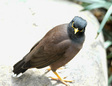
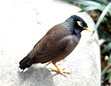
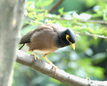
Common mynas range in body length from 23 to 26 cm, weigh anywhere from 82 to 143 grams, and have a wingspan of 120 to 142 mm. The female and the male are monomorphic for the most part – the male is only slightly larger, with a greater body mass and wingspan. Common mynas have yellow bills, legs, and eye skin. They are dark brown with a black head. They have white undertail coverts, tail tips, patches at the base of their primaries, and wing linings that are distinctive in flight. Juveniles have more brownish heads than adults. Common mynas are often confused with noisy miners (Manorina melanocephala). In contrast to common mynas, noisy miners are slightly larger and mostly grey. ("National Geographic Field Guide to the Birds of North America, 4th ed.", 2002; "Factsheets: Common Myna", 2003; Invasive Species Specialist Group, 2006)
- Other Physical Features
- endothermic
- homoiothermic
- bilateral symmetry
- Sexual Dimorphism
- sexes alike
- male larger
-
- Range mass
- 82 to 143 g
- 2.89 to 5.04 oz
-
- Range length
- 23 to 26 cm
- 9.06 to 10.24 in
-
- Range wingspan
- 120 to 142 mm
- 4.72 to 5.59 in
Reproduction
Common mynas are monogamous and territorial. In Hawaii pairs stay together year round. In other areas common mynas pair up during early spring and before establishment of territories. During the breeding season, normally from October to March, there is usually considerable competition for nesting sites. Occasionally, violent battles may occur between pairs over a single nesting site. The courtship display of the male is characterized by head bowing and bobbing, with fluffed plumage, accompanied by calls. ("Factsheets: Common Myna", 2003; Kannan and James, 2001)
- Mating System
- monogamous
Common mynas reach sexual maturity around 1 year of age. Females lay four to five eggs in a clutch. The incubation period is 13 to 18 days, during which both parents incubate the eggs. The nestlings may leave the nest at around twenty-two days or longer, but may still not be able to fly for another seven days or so. Depending on their geographic location, common mynas have been reported to breed anywhere from 1 to 3 times a season. In their native range, common mynas begin nesting in March and breeding lasts through September. Even after nestlings leave the nest parents may continue to feed and protect these juveniles until 1.5 months after they hatch. (Invasive Species Specialist Group, 2006; Kannan and James, 2001)
- Key Reproductive Features
- iteroparous
- seasonal breeding
- gonochoric/gonochoristic/dioecious (sexes separate)
- sexual
- oviparous
-
- Breeding interval
- Depending on geographical location, common mynas have been reported to breed anywhere from 1-3 times yearly.
-
- Breeding season
- In their native range, common mynas begin nesting in March and breeding lasts through September.
-
- Range eggs per season
- 4 to 5
-
- Range time to hatching
- 13 to 18 days
-
- Average time to hatching
- 13.9 days
-
- Range fledging age
- 22 to 24 days
-
- Average time to independence
- 1.5 months
-
- Average age at sexual or reproductive maturity (female)
- 1 years
-
- Average age at sexual or reproductive maturity (male)
- 1 years
Both parents play an equal part in building and defending nesting territory. Both parents incubate the eggs, with the female incubating the most. The female incubates alone at night, and the male incubates only a little during the day. When the young are hatched they are altricial and blind. Both parents feed the hatchlings for nearly 3 weeks, during the fledging period, and even continue to feed and protect them for up to 3 weeks after they leave the nest. Parents carry food to their chicks mostly in their beaks because they don’t have crops. The young are stimulated to beg when parents give a rich, honky trill while approaching the nest with food. After the young are independent, they sometimes continue to forage with their parents and the parents continue to protect them from predators. Juveniles form small flocks when they become independent. Some young begin to form pairs when they are nine months old, but rarely attempt to breed in their first year. (Invasive Species Specialist Group, 2006; Kannan and James, 2001)
- Parental Investment
- altricial
-
pre-fertilization
- provisioning
-
protecting
- female
-
pre-hatching/birth
-
provisioning
- female
-
protecting
- male
- female
-
provisioning
-
pre-weaning/fledging
-
provisioning
- male
- female
-
protecting
- male
- female
-
provisioning
-
pre-independence
-
provisioning
- male
- female
-
protecting
- male
- female
-
provisioning
- post-independence association with parents
Lifespan/Longevity
Little is known about the lifespan of common mynas. Reports suggest an average life expectancy for both sexes of 4 years. Lack of food or resources is the biggest limiting factor in the survival of common mynas. Other factors that contribute to mortality rates are poor selection of nest sites and unfavorable weather. (Kannan and James, 2001)
-
- Average lifespan
Status: wild - 4 years
- Average lifespan
Behavior
Common mynas are social, with juveniles forming small flocks after they leave their parents. Adults forage in loose flocks of 5 or 6, composed of single birds, pairs, and family groups. Outside of the breeding season they roost in large groups that can vary from tens to thousands. Communal roosting is helpful for defense against predators and also for food distribution. During the breeding season, common mynas can be aggressive and violent while competing with other pairs over nesting sites. Common mynas are described as tame, gregarious, and bold, and engage in allopreening within mated pairs. When foraging, these mynas hop sideways and saunter along the ground and on branches. Common mynas have also been observed participating in anting with fire ants. (Kannan and James, 2001; "Birds Scientific Reference: Vol. 5", 2007)
- Key Behaviors
- flies
- diurnal
- motile
- sedentary
- territorial
- social
-
- Average territory size
- 117.04 m^2
Home Range
The home range of common mynas consists of several regularly used day sites rather than a single contiguous area. Total home ranges average around 0.25 km2. The territory around nests is strongly defended, although sometimes nests are found in large colonies. Average territory size in India is 117.04 m2. (Kannan and James, 2001; "Birds Scientific Reference: Vol. 5", 2007)
Communication and Perception
Common mynas communicate vocally with other mynas and other bird species. They have a wide variety of alarm calls, that can warn other bird species as well. During the day, pairs resting in the shade also utter songs while half-bowing and bristling their feathers. When under duress, common mynas utter high-pitched screams. Parents sometimes utter a specific trill when approaching their nest with food, which signals the nestlings to begin begging. In captivity, common mynas are able to imitate human speech. Both females and males sing, but males sing more frequently. Common mynas also participate in loud dawn and dusk choruses. (Kannan and James, 2001)
- Other Communication Modes
- choruses
Food Habits
Common mynas are omnivorous and feed on almost anything. Their primary diet consists of fruit, grain, grubs, and insects. They prey on eggs and young of other birds, such as akepas (Loxops coccineus). They sometimes even wade in shallow waters to catch fish. Common mynas feed mostly on the ground. In residential areas they eat anything from garbage to kitchen scraps. Common mynas eat small mammals, such as mice, as well as lizards and small snakes. They also eat spiders, earthworms, and crabs. Common mynas eat mostly grains and fruit, but also feed on flower nectar and petals. ("Factsheets: Common Myna", 2003; Invasive Species Specialist Group, 2006; Kannan and James, 2001)
- Primary Diet
- omnivore
- Animal Foods
- birds
- mammals
- amphibians
- reptiles
- fish
- eggs
- carrion
- insects
- terrestrial non-insect arthropods
- terrestrial worms
- aquatic or marine worms
- aquatic crustaceans
- Plant Foods
- seeds, grains, and nuts
- fruit
- nectar
- flowers
Predation
Common nest predators of common mynas are house crows (Corvus splendens) and house cats (Felis silvestris). Javan mongooses (Herpestes javanicus) raid nests to take nestlings and eggs. Humans (Homo sapiens) in some of the Pacific Islands also eat common mynas. Common mynas roost together for predator defense and often mob predators in flocks. They warn each other through alarm calls. (Kannan and James, 2001)
-
- Known Predators
-
- domestic cats (Felis silvestris)
- humans (Homo sapiens)
- Javan mongooses (Herpestes javanicus)
- house crows (Corvus splendens)
Ecosystem Roles
Common mynas are important pollination or seed-dispersal agents for many plants and trees. On the Hawaiian Islands they disperse the seeds of Lantana camara. They also help control cutworms (Spodoptera mauritia) on the Hawaiian Islands. Common mynas also act as hosts for various parasites such as nematodes, tapeworms, trematode flukes, arthropods, and bird mites. In areas where they have been introduced they negatively impact native bird and seabird species by preying on eggs and nestlings. (Kannan and James, 2001)
- Ecosystem Impact
- disperses seeds
- pollinates
Economic Importance for Humans: Positive
Common mynas may be helpful in reducing insect populations in agricultural areas. On the Hawaiian Islands, they help control populations of cutworms (Spodoptera mauritia). Common mynas also pollinate and disperse the seeds of economically important trees. Common mynas are often sold as pets for their intelligence and ability to mimic human speech. In 1883, common mynas were introduced into the cane fields of Australia to combat insect pests such as plague locusts and cane beetles. ("Factsheets: Common Myna", 2003; Kannan and James, 2001)
- Positive Impacts
- pet trade
- pollinates crops
- controls pest population
Economic Importance for Humans: Negative
Common mynas are able to establish themselves in almost any habitat and, as a result, have become an invasive species in some areas outside of their native range. They are considered a pest because they eat grain or fruit from agricultural crops, such as fig trees. They are also seen as a nuisance for their noise and droppings in the vicinity of human habitation. (Invasive Species Specialist Group, 2006; "Birds Scientific Reference: Vol. 5", 2007)
- Negative Impacts
- crop pest
- household pest
Conservation Status
Common mynas remain common throughout much of their range.
-
- IUCN Red List
-
Least Concern
More information
-
- IUCN Red List
-
Least Concern
More information
-
- US Migratory Bird Act
- No special status
-
- US Federal List
- No special status
-
- CITES
- No special status
-
- State of Michigan List
- No special status
Contributors
Tanya Dewey (editor), Animal Diversity Web.
Tiffany Lin (author), Stanford University, Terry Root (editor, instructor), Stanford University.
Glossary
- Australian
-
Living in Australia, New Zealand, Tasmania, New Guinea and associated islands.

- Ethiopian
-
living in sub-Saharan Africa (south of 30 degrees north) and Madagascar.
- Nearctic
-
living in the Nearctic biogeographic province, the northern part of the New World. This includes Greenland, the Canadian Arctic islands, and all of the North American as far south as the highlands of central Mexico.
- Palearctic
-
living in the northern part of the Old World. In otherwords, Europe and Asia and northern Africa.
- acoustic
-
uses sound to communicate
- agricultural
-
living in landscapes dominated by human agriculture.
- altricial
-
young are born in a relatively underdeveloped state; they are unable to feed or care for themselves or locomote independently for a period of time after birth/hatching. In birds, naked and helpless after hatching.
- bilateral symmetry
-
having body symmetry such that the animal can be divided in one plane into two mirror-image halves. Animals with bilateral symmetry have dorsal and ventral sides, as well as anterior and posterior ends. Synapomorphy of the Bilateria.
- carrion
-
flesh of dead animals.
- chemical
-
uses smells or other chemicals to communicate
- choruses
-
to jointly display, usually with sounds, at the same time as two or more other individuals of the same or different species
- desert or dunes
-
in deserts low (less than 30 cm per year) and unpredictable rainfall results in landscapes dominated by plants and animals adapted to aridity. Vegetation is typically sparse, though spectacular blooms may occur following rain. Deserts can be cold or warm and daily temperates typically fluctuate. In dune areas vegetation is also sparse and conditions are dry. This is because sand does not hold water well so little is available to plants. In dunes near seas and oceans this is compounded by the influence of salt in the air and soil. Salt limits the ability of plants to take up water through their roots.
- diurnal
-
- active during the day, 2. lasting for one day.
- endothermic
-
animals that use metabolically generated heat to regulate body temperature independently of ambient temperature. Endothermy is a synapomorphy of the Mammalia, although it may have arisen in a (now extinct) synapsid ancestor; the fossil record does not distinguish these possibilities. Convergent in birds.
- forest
-
forest biomes are dominated by trees, otherwise forest biomes can vary widely in amount of precipitation and seasonality.
- introduced
-
referring to animal species that have been transported to and established populations in regions outside of their natural range, usually through human action.
- iteroparous
-
offspring are produced in more than one group (litters, clutches, etc.) and across multiple seasons (or other periods hospitable to reproduction). Iteroparous animals must, by definition, survive over multiple seasons (or periodic condition changes).
- monogamous
-
Having one mate at a time.
- motile
-
having the capacity to move from one place to another.
- native range
-
the area in which the animal is naturally found, the region in which it is endemic.
- oceanic islands
-
islands that are not part of continental shelf areas, they are not, and have never been, connected to a continental land mass, most typically these are volcanic islands.
- omnivore
-
an animal that mainly eats all kinds of things, including plants and animals
- oriental
-
found in the oriental region of the world. In other words, India and southeast Asia.
- oviparous
-
reproduction in which eggs are released by the female; development of offspring occurs outside the mother's body.
- pet trade
-
the business of buying and selling animals for people to keep in their homes as pets.
- riparian
-
Referring to something living or located adjacent to a waterbody (usually, but not always, a river or stream).
- scrub forest
-
scrub forests develop in areas that experience dry seasons.
- seasonal breeding
-
breeding is confined to a particular season
- sedentary
-
remains in the same area
- sexual
-
reproduction that includes combining the genetic contribution of two individuals, a male and a female
- social
-
associates with others of its species; forms social groups.
- suburban
-
living in residential areas on the outskirts of large cities or towns.
- tactile
-
uses touch to communicate
- temperate
-
that region of the Earth between 23.5 degrees North and 60 degrees North (between the Tropic of Cancer and the Arctic Circle) and between 23.5 degrees South and 60 degrees South (between the Tropic of Capricorn and the Antarctic Circle).
- terrestrial
-
Living on the ground.
- territorial
-
defends an area within the home range, occupied by a single animals or group of animals of the same species and held through overt defense, display, or advertisement
- tropical
-
the region of the earth that surrounds the equator, from 23.5 degrees north to 23.5 degrees south.
- tropical savanna and grassland
-
A terrestrial biome. Savannas are grasslands with scattered individual trees that do not form a closed canopy. Extensive savannas are found in parts of subtropical and tropical Africa and South America, and in Australia.
- savanna
-
A grassland with scattered trees or scattered clumps of trees, a type of community intermediate between grassland and forest. See also Tropical savanna and grassland biome.
- temperate grassland
-
A terrestrial biome found in temperate latitudes (>23.5° N or S latitude). Vegetation is made up mostly of grasses, the height and species diversity of which depend largely on the amount of moisture available. Fire and grazing are important in the long-term maintenance of grasslands.
- urban
-
living in cities and large towns, landscapes dominated by human structures and activity.
- visual
-
uses sight to communicate
References
2002. National Geographic Field Guide to the Birds of North America, 4th ed.. Des Moines, IA: National Geographic.
Net Industries. 2007. "Birds Scientific Reference: Vol. 5" (On-line). COMMON MYNA (Acridotheres tristis): SPECIES ACCOUNTS. Accessed May 22, 2007 at http://animals.jrank.org/pages/1392/Starlings-Mynas-Sturnidae-COMMON-MYNA-Acridotheres-tristis-SPECIES-ACCOUNTS.html.
Australian Museum. 2003. "Factsheets: Common Myna" (On-line). Factsheets: Common Myna. Accessed May 29, 2007 at http://www.amonline.net.au/factSheets/common_myna.htm.
Invasive Species Specialist Group, 2006. "Global Invasive Species Database" (On-line). Ecology of Acridotheres tristis. Accessed May 22, 2007 at http://www.issg.org/database/species/ecology.asp?si=108&fr=1&sts.
Kannan, R., D. James. 2001. "The Birds of North America Online: Common Myna" (On-line). Accessed May 29, 2007 at http://bna.birds.cornell.edu/BNA/account/Common_Myna/.
Rousset, P., D. Thorns. 2007. "Europe Solidaire Sans Frontieres" (On-line). The avifauna of the Parc des Beaumonts : list of species identified. Accessed May 22, 2007 at http://www.europe-solidaire.org/spip.php?article5884.