Aconaemys fuscusChilean rock rat
Geographic Range
Chilean rock rats (Aconaemys fuscus), are endemic to Argentina and central Chile. Their distribution ranges from 33 degrees to 41 degrees south latitude. These animals are generally confined to the high, southern Andes mountain range. Historically (ca. 1,000 years ago), the distribution of Chilean rock rats extended to areas near Santiago, more than 100 km north of the species' current range. (Saavedra and Simonetti, 2003; Wilson and Reeder, 1993)
- Biogeographic Regions
- neotropical
Habitat
Chilean rock rats inhabit rocky outcrops on the high border of alpine Andean grassland, above tree- and shrub-line at moderate altitudes of the Andes mountain range. This habitat is characterized as arid, with little or no woody plant cover, and has snow cover approximately 3 months per year. ("RODENTIA", 2004; Macdonald, 1984)
- Habitat Regions
- temperate
- terrestrial
-
- Range elevation
- 1000 to 3500 m
- 3280.84 to 11482.94 ft
Physical Description
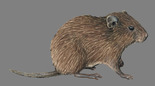
Chilean rock rats are similar in size and morphology to other members of the Octodontidae family. They are characterized as having large heads, pointed noses, moderately large and rounded ears, short tails, and long vibrissae on the face. Their legs are short; the forefeet have 4 digits, the hindfeet have 5 digits, and the toes end in sharp, curved claws. Their bodies are covered with long, dense, and silky fur with a well-developed underfur. Dense short hairs cover the tail, and a "comb" of stiff hairs extends slightly beyond the middle digits of the hind feet. Pelage is grayish over the back and a slightly paler gray on the belly.
The skull is relatively stout and angular in appearance. The angular process is highly deflected. The dentary has a prominant coronoid process. The zygomatic arch is simple, and the jugal does not contact the lacrimal. The bullae are fused to the short paroccipital processes. The dental formula is 1/1, 0/0, 1/1, 3/3. Incisors are well-developed, and molars are flat crowned, hypsodont, and distinctively "8"-shaped due to single labial and lingual folds. (Macdonald, 1984; Wilson and Reeder, 1993; Woods, 1984)
Aconaemys fuscus ranges in weight from 30 to 67 g, has lengths between 100 and 140 mm. Within the genus Aconaemys, males reportedly weigh less than non-pregnant females. (Macdonald, 1984; Nowak, 1999; Wilson and Reeder, 1993; Woods, 1984; Macdonald, 1984; Nowak, 1999; Wilson and Reeder, 1993; Woods, 1984)
- Other Physical Features
- endothermic
- homoiothermic
- bilateral symmetry
- Sexual Dimorphism
- female larger
-
- Range mass
- 0.030 to 0.067 kg
- 0.07 to 0.15 lb
-
- Range length
- 100 to 140 mm
- 3.94 to 5.51 in
Reproduction
Chilean rock rats are thought to be polygynous and cooperative breeders. (Ebensperger and Bozinovic, 2000; Ebensperger and Bozinovic, 2000)
- Mating System
- polygynous
- cooperative breeder
Chilean rock rat females have an average of 4 young per litter, yet retain 4 pairs of teats. The gestation period is around 75 days. Two litters may be produced over the breeding season which last from July to January. The eyes are closed at birth and the fur, although present, is thin. Eyes open at approximately 4 days of age, and young are weaned at approximately 60 days. Both females and males reach sexual maturity at 1 year. (Ebensperger and Bozinovic, 2000; Macdonald, 1984; Wilson and Reeder, 1993)
- Key Reproductive Features
- iteroparous
- seasonal breeding
- gonochoric/gonochoristic/dioecious (sexes separate)
- sexual
- fertilization
- viviparous
-
- Breeding interval
- Aconaemys fuscus breeds twice yearly.
-
- Breeding season
- Breeding takes place betweem July and January.
-
- Range number of offspring
- 2 to 5
-
- Average number of offspring
- 4
-
- Range gestation period
- 70 to 80 days
-
- Average weaning age
- 60 days
-
- Average time to independence
- 60 days
-
- Average age at sexual or reproductive maturity (female)
- 1 years
-
- Average age at sexual or reproductive maturity (male)
- 1 years
Newborn A. fuscus are precocial relative to many rodents, being fairly well developed at birth. Eyes open at a mere four days of age, and fur is present from birth. However, since the young cannot care for themselves, they are considered altricial. Chilean rock rat females living in the same burrow have been observed to nurse one another's young, and males have been observed to help raise the young. (Ebensperger and Bozinovic, 2000)
- Parental Investment
- altricial
-
pre-fertilization
- provisioning
-
protecting
- female
-
pre-hatching/birth
-
provisioning
- female
-
protecting
- male
- female
-
provisioning
-
pre-weaning/fledging
-
provisioning
- female
-
protecting
- male
- female
-
provisioning
-
pre-independence
-
provisioning
- female
-
protecting
- male
- female
-
provisioning
Lifespan/Longevity
No data were found on the lifespan of Chilean rock rats. However, other members of the Octodontidae family, such as Octodon degus, have a expected lifespan of approximately 5 years. Aconaemys fuscus may be similar. (Ebensperger and Bozinovic, 2000; Macdonald, 1984)
Behavior
Chilean rock rats are highly social, colonial, and fossorial. They dig communal burrows, and thus, construct larger and more elaborate burrows than they could on their own. Individuals digging together co-ordinate their activites, forming a digging chain. Burrow excavation is very rapid and efficient. Once a food supply is exhausted in an area, the colony will collectively relocate to an area of undisturbed food abundance. Thus, while occupying a particular burrow system, these animals are sedentary, but they are also nomadic, in that they move to new territories when their food supply is exhausted. (Ebensperger and Bozinovic, 2000)
The burrows of Aconaemys species are reported to be shallow. A burrow system has numerous entrances that are flush with the ground, and which are connected by surface runways. These runways are often partially obscured by vegetation. (Nowak, 1999)
-
- Range territory size
- 1,000 to 10,000 m^2
Home Range
The colony size and home range is strictly dictated by food abundance. Colonies average 15 members with a home range between 1000 and 10,000 square meters depending on concentration of food source. (Ebensperger and Bozinovic, 2000)
Communication and Perception
Chilean rock rats are fossorial and use their vibrissae to navigate within their extensive burrows. They sleep together in groups and have a system of vocal alarms if danger is present. Mothers vocally communicate with their young, and both sexes use the scent in their urine as chemical cues for colonial territoriality and individual recognition. "Outsiders" to colonies use intense vocalization and tail movements to discern territoriality. (Ebensperger and Bozinovic, 2000; Woods, 1984)
- Other Communication Modes
- scent marks
- Perception Channels
- visual
- tactile
- acoustic
- vibrations
- chemical
Food Habits
Chilean rock rats feed nocturnally, primarily on grasses, grains, and foliage. Interestingly, they store tubers and grains in their burrows, but do not become dormant during the winter. They also re-ingest their own feces to maximize nutrient extraction from their food. (Ebensperger and Bozinovic, 2000; Macdonald, 1984; Ebensperger and Bozinovic, 2000; Macdonald, 1984)
- Plant Foods
- leaves
- roots and tubers
- wood, bark, or stems
- seeds, grains, and nuts
- Other Foods
- dung
- Foraging Behavior
- stores or caches food
Predation
Details on predation of A. fuscus are not readily available. The pelage of these rodents is camoflaged with the rocky outcrops they inhabit. They are colonial and have a system of vocal alarms if danger is present, indicating that predation has been a factor in their evolutionary history. Despite the lack of information for this species we are able to infer something about predation based on related animals. Octodon degus, a member of same family (Octodontidae), which has a similar geographic range and is found in the same habitat as Chilean rock rats, is known to be preyed upon by both raptors and snakes. It is likely that these animals also eat A. fuscus. (Ebensperger and Bozinovic, 2000; Saavedra and Simonetti, 2003)
- Anti-predator Adaptations
- cryptic
Ecosystem Roles
Soil is disturbed and aerated through A. fuscus burrowing activities, which may promote seed germination. To a further extent, these animals also ingest a large number of seeds, which may aid in the dispersal of seeds via feeding activities and fecal droppings.
- Ecosystem Impact
- disperses seeds
- soil aeration
- None
- None reported
- None reported, but lice, mites, and fleas are likely.
Economic Importance for Humans: Positive
No economic importance determined to date.
Economic Importance for Humans: Negative
This species is not considered to have any negative effects on humans. It is not considered an agricultural pest or household pest, and is not known to transmit disease to other economically important species or humans.
Conservation Status
Multiple internet sources claim Chilean rock rats are a critically endangered species. In fact, most claim the species is to be extinct within 6 years. However, Aconaemys fuscus was not found on the IUCN Red List, U.S. Federal List, or the CITES list. All internet sources researched were not produced by a governmental or research agencies and could not be deemed credible.
-
- IUCN Red List
-
Least Concern
More information
-
- IUCN Red List
-
Least Concern
More information
-
- US Federal List
- No special status
-
- CITES
- No special status
Contributors
Jackson Fox (author), University of Alaska Fairbanks, Link E. Olson (editor, instructor), University of Alaska Fairbanks, Nancy Shefferly (editor), Animal Diversity Web.
Glossary
- Neotropical
-
living in the southern part of the New World. In other words, Central and South America.

- acoustic
-
uses sound to communicate
- altricial
-
young are born in a relatively underdeveloped state; they are unable to feed or care for themselves or locomote independently for a period of time after birth/hatching. In birds, naked and helpless after hatching.
- bilateral symmetry
-
having body symmetry such that the animal can be divided in one plane into two mirror-image halves. Animals with bilateral symmetry have dorsal and ventral sides, as well as anterior and posterior ends. Synapomorphy of the Bilateria.
- chaparral
-
Found in coastal areas between 30 and 40 degrees latitude, in areas with a Mediterranean climate. Vegetation is dominated by stands of dense, spiny shrubs with tough (hard or waxy) evergreen leaves. May be maintained by periodic fire. In South America it includes the scrub ecotone between forest and paramo.
- chemical
-
uses smells or other chemicals to communicate
- colonial
-
used loosely to describe any group of organisms living together or in close proximity to each other - for example nesting shorebirds that live in large colonies. More specifically refers to a group of organisms in which members act as specialized subunits (a continuous, modular society) - as in clonal organisms.
- cooperative breeder
-
helpers provide assistance in raising young that are not their own
- cryptic
-
having markings, coloration, shapes, or other features that cause an animal to be camouflaged in its natural environment; being difficult to see or otherwise detect.
- endothermic
-
animals that use metabolically generated heat to regulate body temperature independently of ambient temperature. Endothermy is a synapomorphy of the Mammalia, although it may have arisen in a (now extinct) synapsid ancestor; the fossil record does not distinguish these possibilities. Convergent in birds.
- fertilization
-
union of egg and spermatozoan
- folivore
-
an animal that mainly eats leaves.
- fossorial
-
Referring to a burrowing life-style or behavior, specialized for digging or burrowing.
- granivore
-
an animal that mainly eats seeds
- herbivore
-
An animal that eats mainly plants or parts of plants.
- iteroparous
-
offspring are produced in more than one group (litters, clutches, etc.) and across multiple seasons (or other periods hospitable to reproduction). Iteroparous animals must, by definition, survive over multiple seasons (or periodic condition changes).
- motile
-
having the capacity to move from one place to another.
- mountains
-
This terrestrial biome includes summits of high mountains, either without vegetation or covered by low, tundra-like vegetation.
- native range
-
the area in which the animal is naturally found, the region in which it is endemic.
- nocturnal
-
active during the night
- nomadic
-
generally wanders from place to place, usually within a well-defined range.
- polygynous
-
having more than one female as a mate at one time
- scent marks
-
communicates by producing scents from special gland(s) and placing them on a surface whether others can smell or taste them
- seasonal breeding
-
breeding is confined to a particular season
- sedentary
-
remains in the same area
- sexual
-
reproduction that includes combining the genetic contribution of two individuals, a male and a female
- social
-
associates with others of its species; forms social groups.
- soil aeration
-
digs and breaks up soil so air and water can get in
- stores or caches food
-
places a food item in a special place to be eaten later. Also called "hoarding"
- tactile
-
uses touch to communicate
- temperate
-
that region of the Earth between 23.5 degrees North and 60 degrees North (between the Tropic of Cancer and the Arctic Circle) and between 23.5 degrees South and 60 degrees South (between the Tropic of Capricorn and the Antarctic Circle).
- terrestrial
-
Living on the ground.
- vibrations
-
movements of a hard surface that are produced by animals as signals to others
- visual
-
uses sight to communicate
- viviparous
-
reproduction in which fertilization and development take place within the female body and the developing embryo derives nourishment from the female.
References
LoveToKnow. 2004. "RODENTIA" (On-line). LoveToKnow 1911 Online Encyclopedia. Accessed November 12, 2004 at http://40.1911encyclopedia.org/R/RO/RODENTIA.htm.
Ebensperger, L., F. Bozinovic. 2000. Communal burrowing in the hystricognath rodent, Octodon degus: a benefit of sociality?. Behavioral Ecology and Sociobiology, 47: 365-369.
Macdonald, D. 1984. The Encyclopedia of Mammals. New York: Facts on File Publications.
Nowak, R. 1999. Walker's Mammals of the World, Sixth Edition. Baltimore and London: The Johns Hopkins University Press.
Saavedra, B., J. Simonetti. 2003. Holocene distribution of Octodontid rodents in central Chile. Revista Chilena de Historia Natural, Vol. 76: 383-389.
Wilson, D., D. Reeder. 1993. Mammal Species of the World. Smithsonian Institution Press.
Woods, C. 1984. Orders and Familes of Mammals of the World: Hystricognath Rodents. New York: John Wiley and Sons.